
Thanks to your beautiful support, my blog is changing. Do you like the new logo? While I pull together a new post and my new direction, I wanted to share something different with you…
I have a tumultuous and intense relationship with reading, picky and obsessive. If I try to read something and it doesn’t start to thrum for me within a few pages, I would rather eat my own arm than continue and nothing will make me persevere, whatever its merit. I often feel guilty about that, but I’m just not very good at faking authentic connection, with its deeply personal, unpredictable yeses and nos. Find me something that catches me up in its dance and I will give all of myself to its unfolding, but only then. When I can’t find the right thing, I am morose and restless. It has to be just right, you see.
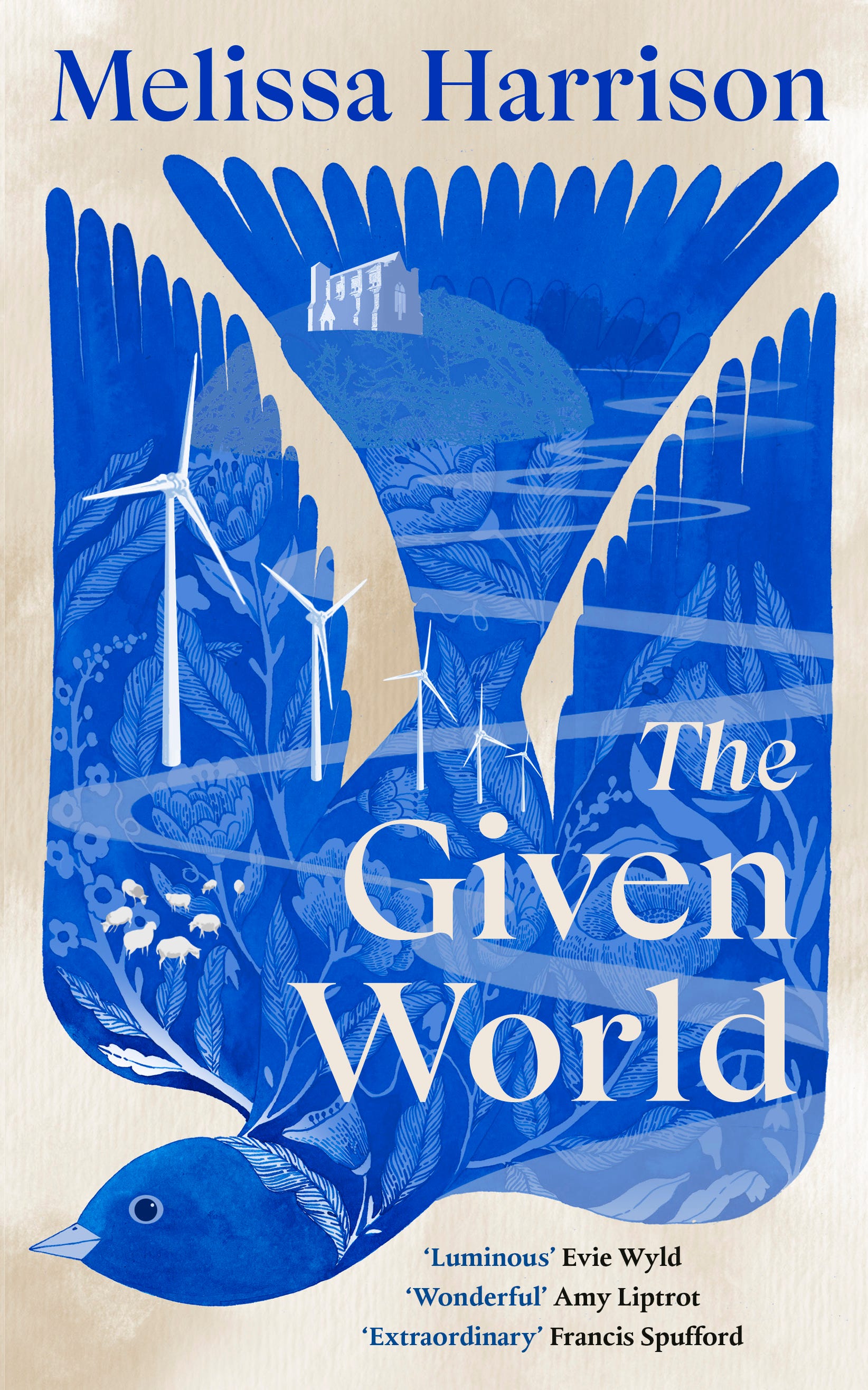
You can imagine my delight, then, when a perfect right book landed in my lap late last year, written by someone I knew, no less. The book was The Given World and it was written by my friend Melissa Harrison.
The Given World did something to me. It made me want to write again — something I had been struggling to do for months — and it made me fall in love again with people, in all their mess and glory, the way that words can capture and describe them. The Given World is a book about people and the small village they inhabit, but more than that, it’s about our deep, aching humanity. Starting with one woman — Clare — each chapter moves on to share the headspace of one of Clare’s neighbours, weaving a bright web of connection between them. The complexity of our modern lives reveals itself through each person’s thoughts, longings and confusions. The great challenges of our times, too: shifting economies, imbalances of power, the anxiety of our fragile mortality, and the quiet, devastating threat of climate change.
It’s a masterpiece, truly. It’s out this week on the 14th May. I wanted to do something to mark its release and so I asked Mel some questions so she could share her answers here.
Mel’s work, her tenacity and her skill, has taught me so much about what it means to be a writer. She never glosses over how hard it is to create something, and in that companionship she emboldens all of us to keep trying, too.
Here then are my questions and Mel’s answers.
Me: Most stories start from a tiny seed. Did yours? Was there an image or experience or observation that sparked its beginning?
Melissa: Yes, although it wasn’t an ‘idea for a book’, because I don’t have those. The Given World is a group portrait which gives readers a glimpse into lots of very different people’s lives. I suppose it’s a way of playing to my weaknesses, because the truth is, I’m terrible at plot! For a long time I didn’t think I could be a writer because I’m just not a natural storyteller, and I thought that you had to be. Even now, plot is the last thing that arrives when I’m writing a book, which often surprises people. Instead, I usually begin with the place I want to write about, and often an idea of the book’s form: with The Given World I knew it would be set in an English village in the present day, and I knew that each chapter would focus on a different character. That was about it.
You used the word ‘seed’ and that’s often where I start from, rather than a story. I’d had a glimpse of a middle-aged woman walking home, up a hill, in autumn. That’s the time of year when the countryside empties out: growth slows, plants die back, the trees are stripped bare and all the summer birds leave. That felt like an echo of the wider emptying-out that’s happening to the natural world at the moment. I wondered which of those things she was witnessing, and whether it might be both. I started writing, making her up as I went (her name, where she had been that day, the things in her cotton tote bag) and then there she was: Clare Grey. Before long I had her neighbour, Alan Jope, and one by one the rest of the villagers arrived.
Me: A very solid sense of observation runs throughout your books — you must spend a huge amount of time noticing and collecting details about nature, people, places. How do you weave this into your day and routine?
Melissa: Thank you, Josie! I am, like you, a very committed noticer, particularly of nature. It’s a habit I acquired in childhood, partly because I was quite lonely for much of it, which puts you on the outside of things, looking in, but also because that’s what kids do, isn’t it? They’re close to the ground where everything is potentially interesting: stones, snails, worms. Everything might have selfhood, everything has a kind of luminosity that can be so easily lost as we grow up. And it was lost, for a while: like most teenagers I started noticing different things, like pixie boots and eyeshadow, and the natural world receded for a long while. I didn’t really tune back into it until my mid-twenties, when I taught myself to use a ‘proper’ camera and all that richness began to reveal itself to me again.
Now I write about nature as a career, in books, in the newspapers and in the nature journaling app I’ve made, Encounter, so noticing is part of my job and I get outside most days to make sure I’m tuned in to what’s going on around me. But there’s another layer to it, which is harder to articulate. Turning myself into a writer meant making a profound shift in the way I moved through the world, so that at almost every moment, no matter what’s happening, I’m not fully subsumed in the moment but am asking myself: what is this like? And what can I do with it? That kind of detachment is, if I’m honest, a double-edged sword. It’s made me more tuned in to the world and to other people, but at times it can make me less tuned in to myself, which is something I need to work on.
Me: I really get this! I’ve changed the name of this blog to ‘what is here?’ because I’m obsessed with this too, but you’re right — the challenge is to stay close to things, close to our bodies and other people and the shifting flow of our experience as we observe, not to be a passive, automaton waiting with a clipboard at the banks, but to be right there in the river with everything, without losing ourselves to the drama of it. It’s a difficult balance.
Lastly, I want to ask you about writing itself. Persevering to write a whole story from start to finish is a gruelling and emotional undertaking, and I say that as someone who is struggling to finish one right now! Was there a particular emotion, thought or block that you battled with while trying to see it through? What helped you to keep going?
Melissa: Oh, it’s awful, isn’t it? Gruelling is absolutely the right word. I don’t think people have any idea what it can ask of you — I certainly had no idea of the cost of writing until I tried. One of the things I struggle with is the lack of control. If I plan a book out, it dies: the only way I can do it is to write blind, which means starting each scene with very little idea of what’s going to happen, and then, as characters speak (and reveal themselves), and events accumulate, looking at what’s there and trying to make some kind of sense of it. But that is a terrifying way to proceed, because who’s in charge? How can I tell how well or badly it’s going, or whether I’m wasting my time? There’s a constant desire to take control of the book, battling with the knowledge that if I do that, it’s game over. It’s a real test of nerve, one that I have to sustain for two or three years each time.
I think what kept me going, particularly with The Given World, was the knowledge that however messy and sprawling and muddy and flawed it seemed to me when I was pressed right up against the rock face of it, it would look different once I had some perspective — just as my other books have. I have been wrong before — every time! —and so when it felt like a load of rubbish I just had to remind myself that I was not the best judge. I also had to trust in the ability of my subconscious to make patterns and connections and meanings that I wasn’t consciously aware of, but which would reveal themselves to me after the book was published.
I have also found it to be true that the finished work never resembles the original ‘seed’ or idea, however successful it may be in another way. There is a great paradox here, because to create the work you need to treasure the original seed and use it to drive forward and keep faith, while knowing that at some point it must be given up — it must fail — in order for the actual thing you’re making to come to exist. Janet Malcolm, in a piece about Sylvia Plath, described “the ghost of the impossible ideal that gave [a work] its life, and does not survive its development and completion”, which had me shouting ‘Yes!’ when I read it.
I won’t say I’ve made peace with this fundamentally destabilising aspect of creativity, but I have come to accept that is it true for me, and must be tolerated somehow. In his brilliant book about fiction and the Russian short story, A Swim in a Pond in the Rain, George Saunders writes:
Having an intention and then executing it does not make good art. Artists know this. According to Donald Barthelme, “The writer is one who, embarking upon a task, does not know what to do.” Gerald Stern put it this way: “If you start out to write a poem about two dogs fucking, and you write a poem about two dogs fucking — then you wrote a poem about two dogs fucking.”
My goal is to never write a novel about two dogs fucking. If I can manage that a few more times I think I’ll be pleased with myself!
Isn’t that reassuring? So often, as I write or make art, I’m haunted by the disappointment that it doesn’t look/read how I thought it should. But maybe the shift between what we imagine and what emerges is the whole point? If we make space for something new to arise, something that isn’t constrained by our constant desire to control everything, perhaps that’s when something important gets to speak for itself. Something surprising, perspective-shifting. Something bigger than our small selves.
Thank you Mel, for The Given World and your example.
I hope you will all be encouraged to go and grab a copy. It really is something special.
Comments
Nothing yet. Say the first thing.
Sign in to join the conversation.