
The standoff between President Trump and Iran’s leadership in the Persian Gulf remains a tense stalemate.
Trump is caught between his desire to end the war and his need to have something to show for it. Having survived the war’s first round — as a regime if not individually — Iran’s leadership sees no reason to give in.
So shipping traffic from the critical Strait of Hormuz remains virtually frozen, blocked from the inside by Iranian drones and mines and on the outside by the U.S. navy.
But shockwaves from the standoff continue to reverberate around the world.
Fuel shortages have hammered Asia and could spread to Europe in the coming weeks. An even more serious food crisis is brewing, as well, as the ingredients of much of the world’s fertilizer production remain bottled up inside the Gulf with planting seasons already underway. What once looked to many like a short and ultimately manageable conflict — an “excursion” Trump called it — has turned into an epic economic crisis for most of the world.
Especially Asia.
I explained in my last post how this combined with the 2022 Russian invasion of Ukraine have become for the rapidly developing economies of Asia what the historic 1970s oil shocks were for the rapidly developing economies of that era, the United States, Europe and Japan.
In this post and two more to follow, I want to dig deeper into the various parts of Asia to better understand the profound geopolitical and economic shifts the crisis is accelerating. These tectonic changes are reshaping the international energy landscape. They’ll undermine America’s dominant role if the U.S. doesn’t find a way to push beyond the global fossil fuel order it has built over the past century.

While all the tensions are focused on the Gulf, the critical country in this country is China. A decade ago, the Chinese economy would have been immediately crushed if its main source of oil had been throttled as it is now. Today, although the Chinese are the world’s largest importer of crude oil both overall and from the Gulf, the ongoing closure of the Strait of Hormuz presents a manageable challenge.
That’s partly because China purchased and stockpiled vast amounts of oil over the past few years. This was mostly to protect themselves against America imposing sanctions or cutting off their oil supplies, as the U.S. has repeatedly done to Russia, Iran, Venezuela, North Korea and, most recently, Cuba. Those reserves — enough to last close to a year — have provided a critical cushion during the Gulf war.
China remains heavily dependent on oil. But the auto industry shows how the government’s multi-decade effort to nurture an innovative, home-grown and globally competitive electric vehicle industry has significantly mitigated that dependence.
For two decades, the government subsidized dozens of electric carmakers and then set them against each other in competition. The share of EVs sold each year the rocketed upward, from 6% in 2020 to almost 55% last year, when 13 million electric vehicles were sold.

The pace plateaued toward the end of last year and early this year after the government removed some of most powerful incentives for switching from gasoline-powered cars. But the share grew again in April, cracking 60%.
That’s because after all the subsidies and competition they’re less expensive, better products than conventional cars. Last year, 70% of the small electric vehicles sold cost less than comparable conventional cars in China. The IEA projects that nine of ten vehicles sold in China in 2035 will be electric.
As the number of EVs skyrockets — growing over 75% annually between 2020-2024 — the overall share of EVs on the road edges higher. From virtually none in 2020, in one in ten cars on the road in 2024 was electric. Last year it edged up to 13%.
That meant China consumed around 1 million fewer barrels of oil in 2025, about 15% less than if there had only been conventional vehicles on the roads.
That’s a huge chunk of avoided oil demand for a country that imported a record 11.5 million barrels per day. Those savings, roughly $110 million a day at current prices, grow with each EV sold. By 2035, EVs will displace 2.7 million barrels a day of oil consumption, the IEA predicts.
None of these trends stop at China’s shores.
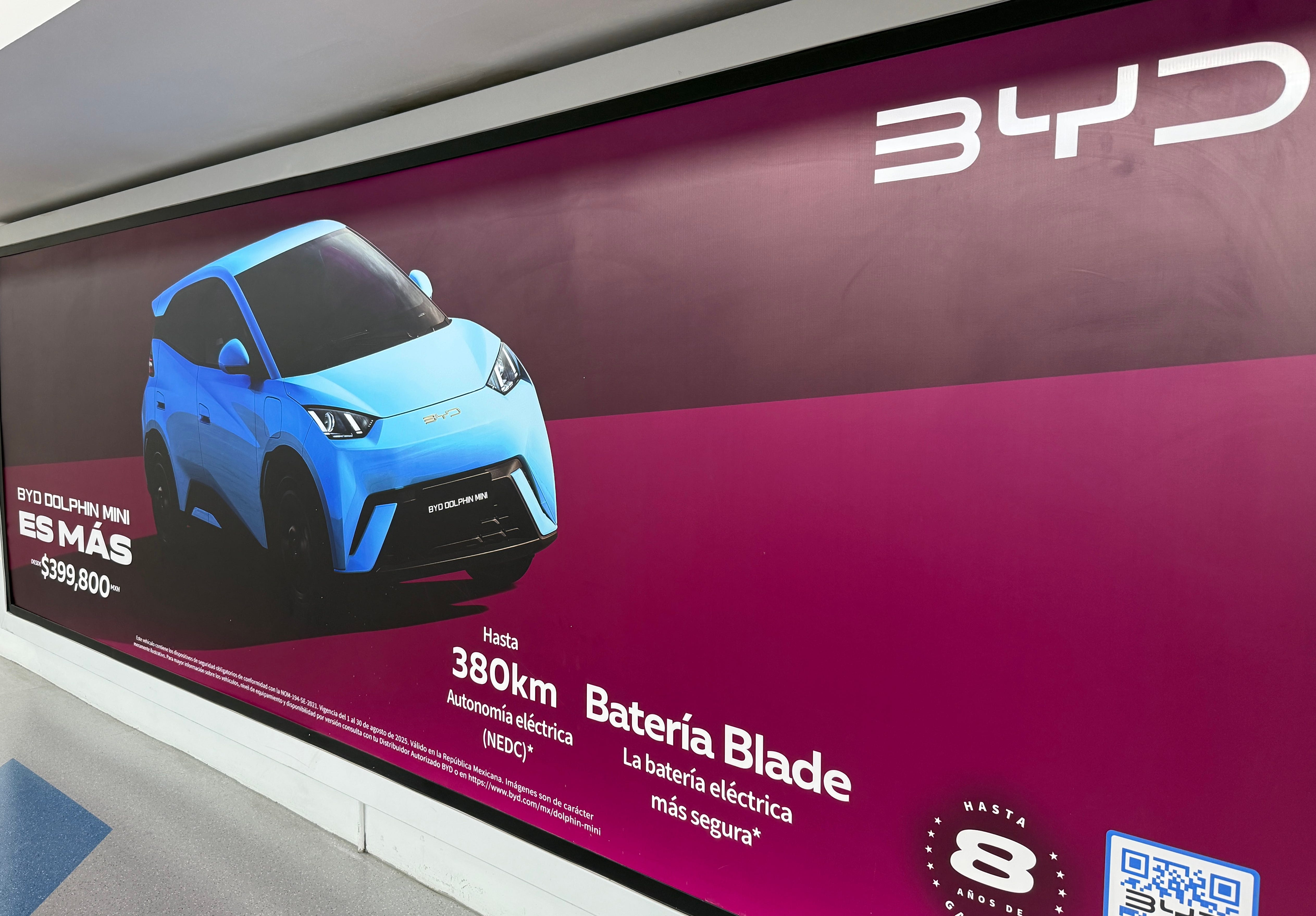
Even before this year’s Persian Gulf energy crisis, Chinese EV makers were beginning to send their vehicles overseas, taking markets from Southeast Asia to Europe to Latin America by storm.
Sales last year jumped 30% in Europe, where more than one out of every four cars sold had a plug. Sales in Southeast Asia doubled with one in five vehicles sold being electric. Latin America saw sales grow 75%, led by Brazil and Mexico.
Overall, EV sales grew 20% globally last year, surpassing 20 million sold. More than 100 countries saw sales of electric cars grow, one third of them with EVs representing 10% or more of sales. About 60% of all the EVs sold globally last year were made by Chinese companies.
The charts below tell the story. On the left, the rising number of EV sales globally. On the right, the growing share of EVs compared to traditional vehicles.
With Chinese EV makers determined to grow exports and expand overseas production, the IEA projects that the global fleet of EVs will expand six-fold by 2035, reaching 510 million vehicles. And that’s not even counting the tens of million more electric motorcycles and three-wheeled rickshaws across the developing world.
All this was before the Persian Gulf crisis, which has rocked global energy markets like none before.
Almost half the oil used today is for road transport. The gains to be had from switching to EVs are glaringly obvious to both consumers — the savings from driving an EV ballooned by more than third in Europe — and import-dependent countries rapidly depleting their foreign currency reserves.
With few EV offerings, traditional U.S., European and Japanese carmakers are poorly positioned to compete, to say the least.
Even in the U.S., where Biden-administration EV incentives died with the arrival of the Trump administration and Chinese vehicles are blocked by tariffs, EVs still account for one in ten car sales. Fast expanding fleets of autonomous cars operated by Google’s Waymo and other companies in an increasing number of U.S. cities are entirely electric and always will be. Tesla just launched a highly competitive new battery powered electric heavy duty truck.
The ability of U.S., European and Japanese carmakers to offer competitive electric cars in global markets will be the single biggest factor defining their health in the coming decades. Increasingly, they’re finding that the only way to do that is produce those cars in China, or team up with Chinese companies to produce them in their increasingly underutilized factories at home.
I recently listened to Jim Farley, head of Ford Motors, deliver a message to a conference room full of oil industry executives in Houston, the seat of America’s oil and gas industry.
Farley, an American car guy to his bones, gushed over the design, features and performance of Chinese electric vehicles, which he has gone out of his way to drive and study extensively.
Ford, like other traditional automakers in the U.S., has backed off many of its most ambitious EV plans with the rollback of Biden administration incentives.
Yet he essentially told the oil executives that this must be tactical retreat. The company will have to remake itself around EVs over the long run. Because competing with Chinese EV makers — overseas but also inevitably at home — is, as he put it, “existential” for Ford.

Comments
Nothing yet. Say the first thing.
Sign in to join the conversation.