
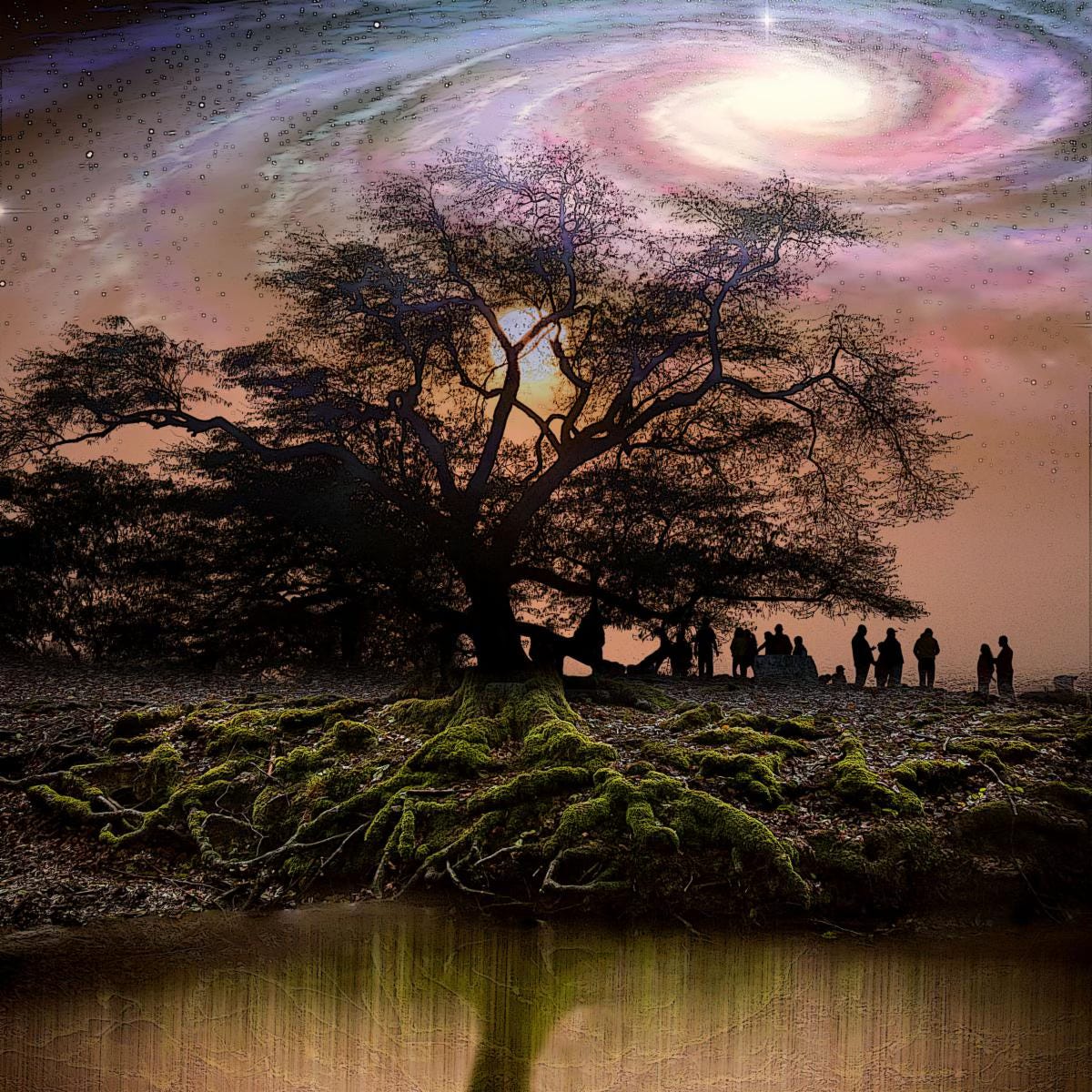
The Long Becoming [Collage]. Doug Van Houten
This is Part Fifteen of a 20-plus-part essay on making and following a map that might get us to the Next World, and on what it means to leave one world and eventually reach another, and on what it’s like for a community or a society to be between worlds, perhaps walking that long road for several generations. Think of this as a draft of an essay I’ll be working on for a while — or eventually a short book. Let me know what resonates with you. To fully understand or contextualize today’s part, you might want to read, reread, or at least scan the first fourteen parts. If so, click here.
My Substack postings will appear more or less at the same time on our Animas Valley Institute weekly “Soulcraft Musings,” which you can access here. I encourage you to join this free Animas list because our Musings include the voices of other Animas guides as well as soul-and-nature-oriented verse from familiar poets and others who may be new to you. Also, joining our list will provide you free access to several previous years of Soulcraft Musings, to upcoming Animas program information, and links to The Animas Commons, our online community with frequent events you can drop in on.
Last week, I suggested that soul-initiated adults and elders could be thought of as the imaginal cells of human societies during their transformation from life-destroying to life-enhancing communities. But unlike the week-or-two-long metamorphosis from caterpillar to butterfly, cultural metamorphosis of this sort could be expected to take several generations. We might think of such a cultural renaissance or zeitgeist change as a soul revolution.
What does this possibility of a soul revolution suggest about the specific ways the human Ego might transform on our way to the Next World? How would such an evolutionary unfolding differ from what humanity has experienced in the past? And what might this suggest about how the contemporary journey of soul initiation, including the Descent to Soul, is different from its precursors?
Here’s another way to ask this: What would have to be true about a human Ego capable of imagining futures that are utterly unlike any previous human experience — futures that are so wildly divergent that the word future itself would have to be re-visioned?
I believe the answer has to do, at least in part, with how we experience time.
One of the many things I’ve learned from Thomas Berry and Brian Swimme is that modern science and cosmology require us to think about the world as not only unfolding in ever-repeating cycles — as in the traditional, classic, and indigenous views — but also as a one-way, progressive, nonrepeating trajectory of evolution and transformation. Everything in the universe is steadily moving into entirely new terrain, entirely new sequences of development. The cosmos is less a noun, more a verb — a cosmogenesis.[1] There is a panoramic arc to our own existence as well as a replicating pattern. This is a new idea for humans, and a revolutionary one. We didn’t begin to think in an evolutionary way until Darwin’s time, a mere 150 years ago. The older, ever-renewing-cycle model supports our experience of time in terms of the repeating rhythms of nature — the rhythms of the day, the Moon, the stars and planets, the seasons, and the stages of plant, animal, and human growth. This perspective is essential to any healthy, ecocentric worldview. In contrast, the irreversible trajectory model — for example, that the universe originated in a big bang about fourteen billion years ago and is still expanding, and birds evolved from dinosaurs, humans from apes, and all life ultimately from primordial single-celled organisms — is the perspective we find in modern cosmology and biology. This view has become indispensable to our modern understanding of the universe and our human place in it. Thomas refers to this latter perspective as “the time-developmental model.”[2] His larger point is that our approach to the development of anything must now embrace both models — both circle and arc (in a sense, both feminine and masculine), which together describe a spiral progression through space and time.
When enough of us fully embrace this evolutionary arc to the unfolding of the world, not only will the world change, but we may very well be transformed as a species. We will individually and collectively live and experience, in every moment, from the perspective that (a) the Earth is continuing to evolve, as is the entire universe, (b) we humans are both a part of this evolution and, especially as it concerns Earth, an essential mode of it, and (c) we humans now have a determining role in this evolution. Humanity as a whole has never before confronted such a psyche-shifting idea or such an Earth-shaping and cosmos-participating responsibility: our species as a conscious evolutionary partner with Mystery.
An Ego that can imagine a future using an integration of both kinds of time is a very different Ego than has existed in the past. The future it must be able to imagine is radically different because it is not a variation on the patterns or rhythms of ever-repeating circular time. It’s not a new version of anything we’ve done or experienced in our human story up till now. And yet such an Ego must at the same time hold as sacred the repeating natural rhythms of the wild world. This is an Ego capable of a conscious, forward-seeing, wildly imaginative partnership with evolution, with Earth. This, I believe, is an Ego we will have to consciously grow into if we are to reach the Next World.
Will we ever achieve such a partnership with Earth? At the time of this writing — in mid 2026, in a world spawning viral pandemics and in the face of the even more dire crises of surging fascism, endless wars, the proliferation of nuclear arms, social and racial injustice, ecosystem pollution and degradation, climate disruption, and anthropogenic mass extinction — I will confess to some doubts. But if enough of us contribute all we can to the fashioning of life-sustaining and eventually life-enhancing societies, we might just get there. This project will require the efforts of several generations — and even this may only lay the foundation. Cultural change this deep and radical takes time. But let’s place this in context: Earth needed 4.3 billion years of evolution to get to this point. And modern humans (Homo sapiens) have been around for only two, maybe three hundred thousand years. What’s another five hundred or a thousand years? The main uncertainty is whether we’ll be so fortunate as to have that much time — which will require, in this century, a global shift in consciousness that will enable human life to thrive, or at least to survive.
Or maybe this kind of partnership with evolution won’t be realized on Earth until some far distant future and by some future species endowed and cursed, like us, with conscious self-awareness. Although it’s possible the Next World will have to wait for a time far beyond our capacity to imagine, we humans of the twenty-first century must proceed as if we can get there. After all, this is what Earth evolved us to do. There never was nor could be a guarantee we would succeed but that’s no reason to give up — not only because it’s our species’ destiny to try but what else could be more fulfilling or joyous to attempt?
Thanks for reading! This post is public so feel free to share it.
[1] See Brian Thomas Swimme’s immensely engaging and inspiring “auto-cosmology,” Cosmogenesis: An Unveiling of the Expanding Universe (Counterpoint, 2023).
[2] See, for example, Thomas Berry, The Great Work: Our Way into the Future (New York: Bell Tower, 1999), 162–63, 198–99.
This post is Part Fifteen of a 20-plus-part essay on a journey to the Next World and on a map that might help get us there. We’ll continue with Part Sixteen next week. Thanks for tuning in. If you found this article helpful, please restack it to share it with your followers.
No posts
Comments
Nothing yet. Say the first thing.
Sign in to join the conversation.