
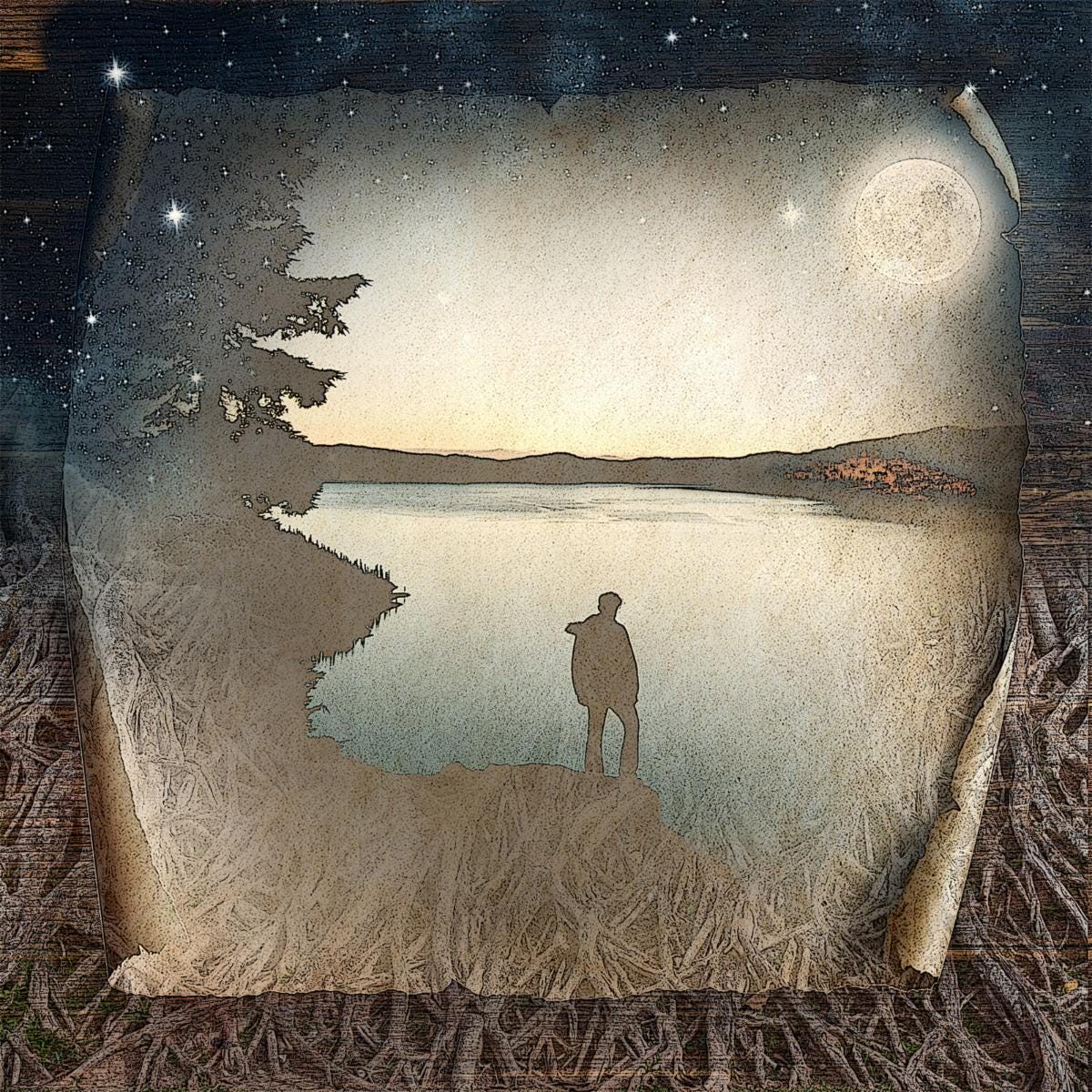
Rooted in Questions, Guided by Stars [Collage]. Doug Van Houten
This is Part Nine of a 20-plus-part essay on making and following a map that might get us to the Next World, and on what it means to leave one world and eventually reach another, and on what it’s like for a community or a society to be between worlds, perhaps walking that long road for several generations. Think of this as a draft of an essay I’ll be working on for a while — or eventually a short book. Let me know what resonates with you. To fully understand or contextualize today’s part, you might want to read, reread, or at least scan the first eight parts. If so, click here.
My Substack postings will appear more or less at the same time on our Animas Valley Institute weekly “Soulcraft Musings,” which you can access here. I encourage you to join this free Animas list because our Musings include the voices of other Animas guides as well as soul-and-nature-oriented verse from familiar poets and others who may be new to you. Also, joining our list will provide you free access to several previous years of Soulcraft Musings, to upcoming Animas program information, and links to The Animas Commons, our online community with frequent events you can drop in on.
Last week, we explored the distinction between the journey of soul initiation, which is a transformation of an individual human, and the journey to the Next World, which is a transformation of a human community. If we arrive in the Next World, it will only be as a community. For any given individual, soul initiation is neither necessary nor sufficient to be a member of a community that arrives in the Next World. No community, however, will reach the Next World unless, among its members, are enough soul-initiated adults and true elders.
In other words, individual human development is the key to community health and wellbeing. (And a psychospiritually healthy community is the single most potent support for personal development.)
For each of us, the next steps with our nature-based full-spectrum human development depend on our current life stage, the developmental tasks of that stage, and our most incomplete tasks from previous stages. (See Parts V and VI of this essay.) Where we “enter” the map to the Next World depends on what life stage we’re in.
While exploring our Animas map to the Next World, you’ll eventually find yourself faced with a number of challenging questions — questions you might choose to live, as the poet Rainer Maria Rilke advised. Living these questions can prepare you to find, join, or co-form a community capable of moving toward the Next World. Living these kinds of questions, in other words, can shapeshift you into someone more likely to find others with whom you might form or further evolve a community able to locate the threshold between worlds. Here are some examples of these questions:
· What does it mean to be human?
· What are humans for?
· What does it mean to belong to a place?
· What is it to participate in and contribute to the evolving life of the greater Earth community?
· What are human children for? (What is the goal of parenting or educating a child?)
· What makes mortality, your mortality or your child’s mortality, praiseworthy?
· What is a world?
· What is this world?
It’s not like there are “correct” answers to these questions. The point of living them is not for you to do your work on these questions by answering them. The intent is to let these questions do their work on you. By living them. By filling your space with them, as if they’re the air you’re breathing. By letting them trouble you. By going for a walk with one of them — at dawn or noon or dusk, or even for a whole day. By inviting your Muse to respond with images, memories, emotions, song, dance, or wonder, or shifts in somatic experience or consciousness. In the process of living these questions, you might “hear” answers to them, which is fine so long as the answers serve to keep the questions alive and working you. An answer is not the goal of these questions. As Ken Kesey put it:
The answer is never the answer. What’s really interesting is the mystery. If you seek the mystery instead of the answer, you’ll always be seeking. I’ve never seen anybody really find the answer — they think they have, so they stop thinking. But the job is to seek mystery, evoke mystery, plant a garden in which strange plants grow and mysteries bloom. The need for mystery is greater than the need for an answer.[1]
Or John Fowles:
[A human being] needs the existence of mysteries. Not their solution.[2]
Here are some additional questions-to-live that I borrowed from Joy Harjo’s poem, “A Map to the Next World”:
· What is “the language of the land”?
· What for you is the gift that we are in and of?
· What is it to “travel through the membrane of death”?
· What is “the language of suns”?
· What mistakes did we humans make that are the same that Earth once made and that we humans might make again? What does it say about Earth that she would have made those kinds of mistakes? What does it say about us?
For each day this next week or two, I encourage you to select one of these thirteen questions and live it. Not to arrive at an answer but to notice what happens to you, to your awareness, to your experience of self, Other, and world. Take notes.
* * *
To summarize this multi-part essay so far, a map to the Next World must provide foundational instructions on how to generate healthy human communities by supporting every person’s nature-based, full-lifespan, full-spectrum human development. An individual’s next steps with their personal development depends on their current life stage and their most incomplete developmental tasks from previous stages. Each eco-soulcentric life stage has two unique developmental tasks, one culture-oriented and the other nature-oriented. The primary way to grow whole is to engage the tasks of your current stage. Supplementally, living certain questions can affect you in ways that support you to address the tasks of your stage and that can also prepare you to find, join, co-form, or further cultivate a community capable of reaching the Next World. Living these questions together with others can also help deepen and form such a community.
Thanks for reading! This post is public so feel free to share it.
[1] From The Paris Review (Issue No. 130, Spring 1994).
[2] From The Magus.
This post is Part Nine of a 20-plus-part essay on a journey to the Next World and on a map that might help get us there. We’ll continue with Part Ten next week. Thanks for tuning in. If you found this article helpful, please restack it to share it with your followers.
No posts
Comments
Nothing yet. Say the first thing.
Sign in to join the conversation.