
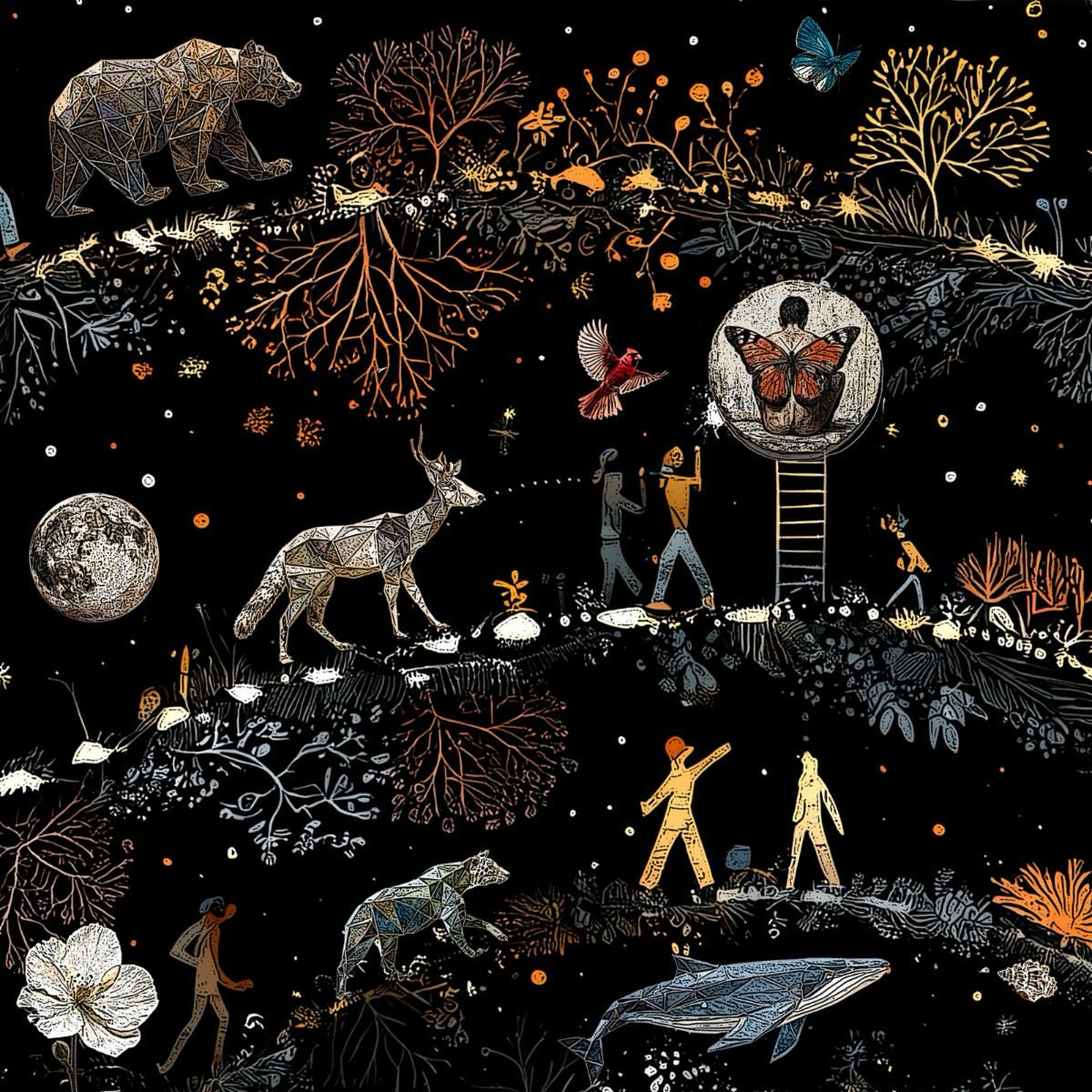
Spiraling Home [Collage]. Doug Van Houten
This is Part Three of a 20-plus-part essay on making and following a map that might get us to the Next World, and on what it means to leave one world and eventually reach another, and on what it’s like for a community or a society to be between worlds, perhaps walking that long road for several generations. Think of this as a draft of an essay I’ll be working on for a while — or eventually a short book. Let me know what resonates with you. To fully understand or contextualize today’s part, you might want to read, reread, or at least scan Parts One and Two. If so, click here.
My Substack postings will appear more or less at the same time on our Animas Valley Institute weekly “Soulcraft Musings,” which you can access here. I encourage you to join this free Animas list because our Musings include the voices of other Animas guides as well as soul-and-nature-oriented verse from familiar poets and others who may be new to you. Also, joining our list will provide you free access to several previous years of Soulcraft Musings, to upcoming Animas program information, and links to The Animas Commons, our online community with frequent events you can drop in on.
At Animas Valley Institute, we have come to understand — or to remember — soul as, first and foremost, an ecological concept (in contrast to the more common psychological, spiritual, or theological frames), namely as an individual’s innate place or niche in the gift that is the animate world — our unique way, in other words, to participate in and love the more-than-human world (the world that includes us humans but so much more). Occupying that niche is the path to our greatest service to life, and offering that service is the source of our greatest fulfillment and of the deepest meaning of our lives. And isn’t depth of meaning and the joy of fulfillment what the word “soul” has always implied? Perhaps the fundamental reason so many modern people rarely experience depth, meaning, joy, or fulfillment is because modernity has forgotten that our Souls are rooted in nature, the land, in the greater Earth community. We’ve forgotten where to look for Soul and how to go about finding it — or even what we’re really seeking. (From this paragraph on, I’ll spell Soul with a capital “S” simply as a reminder that I’m referring to a unique ecological niche.)
To elaborate, I’m going to shamelessly quote my own words from The Journey of Soul Initiation:
By this definition — Soul as eco-niche — all creatures have Souls, not just humans. And not just creatures, but every naturally occurring thing: every flower and stone; every river, mountain, forest; every cloud, storm, rainbow; every season; every species. Even every human language, community, and culture — which is to say, all human creations that evolve organically, those that we do not fabricate solely with our strategic minds. Each natural thing, in other words, has its own unique position or role in the larger web of Earthly life. A niche, in essence, consists of a thing’s unique set of relationships with every other thing in its ecosystem. A thing’s eco-niche — its Soul — is what makes it what it is on the deepest, widest, and most natural level of identity.
This foundational relationship between our eco-niche and our deepest identity is why I believe “unique eco-niche” is the best definition for soul.
When it comes to our own species, the individual human Soul is, by this definition, the particular ecological niche a person is born to occupy whether or not that niche is ever consciously discovered or embodied. This caveat must be added because we humans might be the only creature capable of never discovering the individual niche we were born for — or refusing it if we do. This has consequences.
To reduce the chance of being misunderstood, I’ll be even more explicit because the following point is the hardest for most people to grasp: By human Soul, I mean a person’s unique place, not in human culture, but in the greater Earth community, the more-than-human world. The human Soul, when understood as unique eco-niche, is an identity much deeper than our personality, social-vocational role, or political or religious affiliations. Although we express ourselves through human culture by way of our social roles, our Soul is of and belongs to the larger, natural, not-only-human world. Each human Soul is first and foremost an element of the Soul of the world, the anima mundi. We, like individuals of all species, are creatures that emerge from and are shaped by Earth and by our relationships with all her other inhabitants and environments.
This concept of eco-niche returns the idea of soul, at long last, to its original home and context — the greater web of life. This is the only definition of soul I know that can support culturally exiled humans to return to Earth. With this definition, Soul becomes the missing link between ecology and psychology: Soul — the ecological niche we were born to occupy — is precisely what connects our human psyche to ecology (where psyche refers to our capacity to experience, both consciously and unconsciously — including dreams, thoughts, perceptions, imaginings, memories, and feelings). The way we experience both the world and ourselves has everything to do with our innate eco-niche.[1]
Although we’re born to fill a particular ecological niche, we aren’t capable of comprehending such a niche (nor should we attempt to) during childhood and adolescence. To discover our eco-niche, we must go through an initiatory process — the journey of soul initiation — if and when we’re developmentally prepared for it.
From the perspective of Soul as eco-niche, no one is born to have a particular job or role in a human community. Rather, like members of all other species, we’re each born to take a specific place within the Earth community, to fill an individual ecological niche in the greater web of life, to provide a suite of unique ecological functions.That place is what I mean by Soul, and occupying that psycho-ecological niche and providing those functions is what I mean by soul purpose. This most essential realm of purpose is nearly absent from contemporary discussions and from most contemporary practices and methods for uncovering and embodying purpose.[2]
This post is Part Three of a 20-plus-part essay on a journey to the Next World and on a map that might help get us there. We’ll continue with Part Four next week. Thanks for tuning in. If you found this article helpful, please restack it to share it with your followers.
Thanks for reading! This post is public so feel free to share it.
[1] This way of understanding Soul could transform the new field of ecopsychology, and psychology more generally. It makes possible a complete ecopsychology — an eco-depth psychology.
[2] “Unique eco-niche” is, to me, such an obviously fitting definition for soul that I’ve wondered why Western people hadn’t seen it earlier. I suspect psychologists were generating psychological definitions and theologians theological ones; neither discipline was thinking ecologically. Now, with the emergence of ecopsychology and ecospirituality, both groups can and ought to be thinking this way. We all must now learn to think, feel, imagine, and act ecologically in everything we do. The survival of the Earth community depends on it.
No posts
Comments
Nothing yet. Say the first thing.
Sign in to join the conversation.