
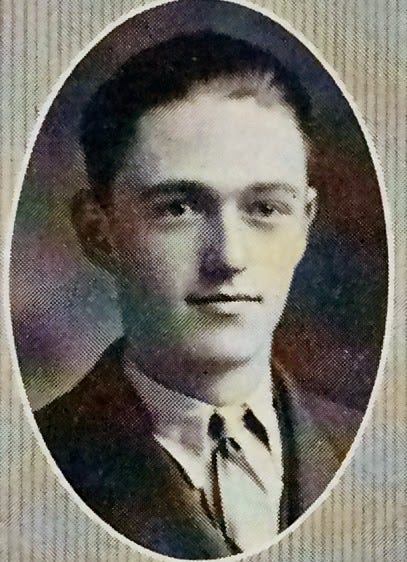
A picture in the 1926 Marion High School yearbook - Walter Grant, a fresh-faced senior in his graduation suit and tie, with neatly combed hair and a confident look. “Ready to face the world,” as almost every commencement speaker would say. Young Walter’s life took a course that led to his death by artillery fire in a dusty valley near Zaragoza, Spain, on February 17th, 1937.
Walter Fairbanks Grant was the son of Martin and Margaret Grant. The Grant family arrived in Marion in 1920. The elder Grant was called to the pulpit of Temple Congregational Church, a position that he held until 1937, the year of his son’s death.
According to his biographer, Robert Steck, Walter was an excellent student, musically talented, and a budding journalist. He was also a committed evangelical Christian who actively participated in Sunday evening discussion groups at Temple Congregational Church.
The Marion lynching forever altered the young man’s life. His sisters report that Walter was there during the worst of the communal race murders. He begged those he recognized to stop the killing. He dropped to his knees before the mob, all to no avail.
The event so traumatized him that he could not speak for two days. When he did speak, his sisters recount that he demanded to know why Marion’s pastors did not speak out, why law enforcement abandoned the black young men to the mob? Where were his teachers? Why did his father not speak out?
After this event, Grant’s search for answers to these questions led him to join the Communist Party USA, a membership he would maintain for the rest of his life.
He pursued a Bachelor’s and Master’s degree in English at Indiana University. While there, Grant wrote for and edited several campus publications. He taught for a time at IU but lost his job due to Depression cutbacks. He returned to Marion and hired on at Anaconda. He was fired from that job for participating in union organization.
Like many talented young Hoosiers, Walter set out for New York City. Working for the Federal Writers Project, he lived on a subsistence wage. He was encouraged in his writing by the famous columnist Heywood Broun.
Grant needed to act on his belief in social justice, and one of the burning issues of the day was the civil war in Spain between the elected republican government and fascist military forces led by Francisco Franco. Along with 2000 young American men and women, he joined the Abraham Lincoln Brigade. Earnest Hemingway fictionalized this group of students, workers, and poets in For Whom the Bells Tolls.
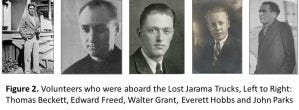
Grant was traveling in a convoy near Zaragoza, Spain, when a unit of Franco’s troops confronted them. He was killed in action.
Walter Grant, a young man from Marion, like many young men and women from Marion, moved by idealism to fight injustice, gave his life in the service of his ideals.
Thanks to Peggy Siegel, author and historian, for pointing out this story to me. She is currently researching Hoosiers in the Spanish Civil War.
By William F. Munn, Grant County Historian
Peggy Seigel. (2016). A Minister’s Son, A Haunted Town, and the Spanish Civil War. Indiana Magazine of History, 112(2), 81–107. https://doi.org/10.5378/indimagahist.112.2.0081
No posts
Comments
Nothing yet. Say the first thing.
Sign in to join the conversation.