
We’re a little less than a month out from RootsTech. Have you planned out your sessions yet?
I choose my sessions with a couple of criteria. This year I’m trying to devote the majority of my time to learning more about how professional genealogists do their jobs. Fortunately, there many sessions that will fill that need. If I don’t see a session that fills that need during a particular time slot, I look at the speakers and try to choose one I believe to be particularly interesting.
With that said, here’s what I will be watching:
Thursday, March 5 10:00 AM EST
Learn to determine when research is thorough by evaluating real-world examples. This session demonstrates how to apply the Genealogical Proof Standard (GPS) to address research challenges, including identifying parents, distinguishing between multiple individuals with the same name, resolving conflicting evidence, and writing biographical sketches.
Participants will learn advanced techniques for integrating thorough research, source analysis, and evidence correlation.
11:30 AM EST
As artificial intelligence rapidly reshapes genealogical workflows, understanding how to use these tools responsibly has never been more important. This pioneering panel highlights the latest best practices for integrating AI into your research while upholding genealogical standards. Join us to learn how thought leaders in the field approach accuracy, disclosure, privacy, education, and ethical compliance in 2026—and how you can confidently apply these principles in your own work.
1:00 PM EST
Join us for General Session 1 at RootsTech 2026 with an inspiring keynote address from award winning actress Marlee Matlin, FamilySearch CEO Steve Rockwood and news and updates from our platinum sponsor Ancestry.
2:15 PM EST
In every community, there were dozens of social and civic clubs to be a part of and volunteer for. Garden Clubs, Home Demonstration Clubs, Historical Societies, Rotary Clubs, Lions Clubs, and so many more. Were your ancestors part of these clubs? Learn from a professional genealogist and archivist about the records that could be available in archives in the United States and other countries for genealogists to learn about their ancestors who volunteered for and made a difference in their communities.
This presentation will cover:
Our Ancestors were not Hermits
What is a Social Club?
What is a Civic Club?
Before there were Government Programs
Volunteerism and Your Ancestor
Church Social and Civic Clubs
Men, Women, and Children, They All Volunteered
Finding Social and Civic Club Records in the United States and Other Countries
Finding Your Ancestor Volunteering in Unexpected Groups and Organizations
3:30 PM EST
Are you interested in learning about the genealogy community on youtube? Are you already active on youtube and have some channels you absolutely love watching? Are you thinking about creating your own genealogy youtube channel? Come meet some of the influential genealogists on youtube, learn about the community that has grown on youtube, and hear how they built their own channels! The panel will then open up to questions from the audience. The panel will include Connie Knox of Genealogy TV, Jarrett Ross of GeneaVlogger and Professional Genealogist Reacts, Amy Johnson Crow of Genealogy with Amy Johnson Crow, and Aimee Cross of Genealogy Hints.
5:00 PM EST
This case study of an African American woman born in the late 19th century, who left no original birth record, uses analysis and correlation to resolve conflicting birth dates from later records.
Attendees would benefit from an understanding of the Genealogical Proof Standard (GPS)
This advanced-level session is sponsored by BCG and ICAPGen.
6:30 PM EST
Manuscripts are more than historical artifacts; they are silent witnesses that can transform your genealogical research. This session will explore how to locate and analyze valuable manuscripts, including minister journals, lawyer notebooks, personal papers, and unpublished family histories, found in both major repositories and local collections. We will dive into the complexities of working with manuscripts, including evaluating provenance, identifying authors and transcribers, comparing manuscript versions, and extracting reliable data from uncited or edited materials. Attendees will learn how to incorporate scripted evidence into genealogical proof arguments, how to overcome challenges with unsourced content, and discover underutilized resources that can break through research barriers. This session is designed for professional genealogists looking to expand their research toolkit and tackle the complexities of manuscript-based evidence.
Attendees would benefit from having a strong foundation in genealogical research methods, understanding how to work with primary sources, and a basic knowledge of archival research.
This advanced-level session is sponsored by BCG and ICAPGen.
11:00 PM EST (Yes, I know it’s late, but I want to see Andrew’s session.)
Struggling to keep your family history research organised? Not sure where to put things or how to find them later? This session is for everyday family historians who want to simplify their digital research using easy and effective strategies. We will cover how to set up consistent folder structures, use file naming conventions that actually work, and create simple research logs to track your progress. You will also learn about best practices for recording names, dates, and places, which are essential for consistency, sorting, and searching. Additional tips will include how to manage downloads, reduce digital clutter, and back up your work safely. Whether you are just starting out or trying to bring order to years of research, this session will provide practical and realistic tools to help you feel more in control of your research and better prepared to preserve and share your findings. No technical expertise is required. Just bring your curiosity and a willingness to tidy things up.
Friday, March 6
10:00 AM EST
In this session, we show how FamilySearch applies generative AI to read historical handwriting and produce complete transcripts of billions of pages of historical manuscripts in a variety languages and scripts. We describe how FamilySearch identifies names, dates, and places in the text distilled from these documents. We then demonstrate techniques for searching the resulting full text by keyword, name, date, and place. We show how to leverage filter and search features in tandem so that you can readily find the records that reveal your ancestors and tell their stories.
Sponsored by FamilySearch
11:30 AM EST
Doing genealogical research can be tricky. We are working with very few pieces of information that cover the whole life of a person. Even advanced researchers can find themselves off track if they do not stay vigilant. Using case studies, we will illustrate common research pitfalls that happen with names, locations, and timing. We will show you ways to resolve conflicting information, the importance of original documents, and researching the entire family, adding in friends, neighbors, and associates when necessary. We will discuss the importance of staying organized and staying open-minded about the evidence until you have done exhaustive research.
This advanced-level session is sponsored by BCG and ICAPGen.
1:00 PM EST
Renowned explorer and author Tara Roberts and RootsTech platinum sponsors MyHeritage and Life Weaver share powerful messages.
2:15 PM EST
Cornelia Ingersoll was born about 1788 in Carmel, Dutchess (later Westchester) County, New York. Cornelia’s life after her marriage to Henry Stogdill was well documented. However, extensive documentary research in the Carmel area failed to reveal her parents’ names. Autosomal DNA analysis left little doubt that Cornelia was the granddaughter of Josiah Ingersoll, Sr. However, Josiah fathered multiple children with two different wives. This session will illustrate how multiple test takers, DNA networks, half relationships, and maternal surnames were combined with documentary evidence to pinpoint the most likely parents for Cornelia.
Attendees would benefit from a basic understanding of the principles of using autosomal DNA evidence in their research.
This advanced-level session is sponsored by BCG and ICAPGen.
5:00 PM EST
Learn how to plan and organize your research findings when encountering challenging problems or projects. In addition to a discussion on research questions, plans, and logs, an organizational strategy derived from the investigative world will be showcased to teach you how to have all of your findings in one location for optimal efficiency.
This advanced-level session is sponsored by BCG and ICAPGen.
6:30 PM EST
Genealogists must transform complex research into clear and convincing conclusions. This session will focus on writing proof arguments that meet the Genealogical Proof Standard (GPS), highlighting how to select and organize the strongest evidence. Additionally, we will also review ways to address conflicting and indirect evidence using correlation tools such as timelines and tables. The importance of incorporating social and historical context will also be discussed. Whether you are writing for yourself or your clients, this session will provide you with the tools to write with clarity, confidence, and credibility.
Attendees should have a working knowledge of the GPS.
Thanks for reading Family History with Bill Moore! This post is public so feel free to share it.
Saturday, March 7
10:00 AM EST
Learn the tried-and-true methodology to defeat the Genealogy Gremlin and achieve accurate results using DNA for genealogy. This lecture discusses the evaluation of match pedigrees to identify potential snafus and demonstrates mitigation strategies to address the problem. Don’t let researcher confirmation bias pollute your family trees!
Participants should have an understanding of atDNA before participating in this session.
This advanced-level session is sponsored by BCG and ICAPGen.
11:30 AM EST
Are you struggling to find your ancestors’ parents? Learn how to bust those brick walls and find your family by using a variety of sources. This lecture is geared for more advanced researchers and examines two kinship case studies for an Ohio couple who moved west.
This advanced-level session is sponsored by BCG and ICAPGen.
1:00 PM EST
RootsTech 2026 concludes with a session, featuring former pro quarterback and author Steve Young, as well as our platinum sponsors Storied and FamilyTreeDNA.
3:30 PM EST
No matter how long you’ve been a genealogist, asking yourself the right questions can transform your research and your writing. In this session, we’ll look at how questioning yourself can guide you from the beginning of your process through testing hypotheses, assumptions, deepening analysis, and refining writing. Whether you’re working through conflicting evidence, or polishing your proof arguments, these straightforward strategies will help you sharpen your work.
Attendees will benefit from a thorough understanding of the Genealogical Proof Standards and BCG Genealogy Standards.
This advanced-level session is sponsored by BCG and ICAPGen.
5:00 PM EST
Immigrant laborers flocked to New York in the early 1900s, often changing their names to assimilate. Families moved from one town to another, chasing work.
Italian immigrant Gennaro Cesta died at work in the Bronx, leaving behind eight children. An autopsy report named his father ‘Furtunato,’ but Italian records identified him as the son of Stanislao, a foundling, and an unnamed mother. Who were Gennaro’s parents?
Through this case study, you will learn how to trace your immigrant ancestors and use cluster research to prove identity. You will also learn how to research foundlings and how circumstances of birth influence records across generations.
This advanced-level session is sponsored by BCG and ICAPGen.
So, that’s my plan for the three days of RootsTech. Of course, I’ll be doing other things, too.
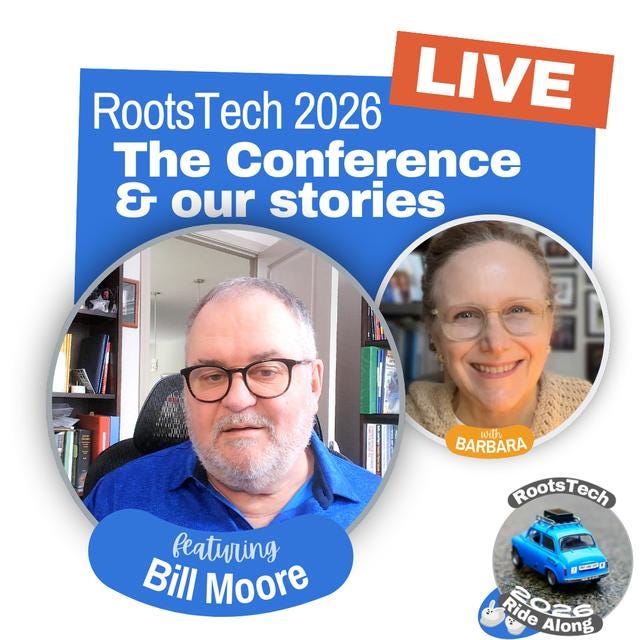
On Wednesday, March 4, at 1:00 PM, I will be joining the amazing Barbara Tien of Projectkin for a RootsTech Ride Along to discuss my plans for the coming few days. I’ll be one of the leaders of the “Bunny Slipper Brigade” participating from home. (If you don’t know, tune in!)
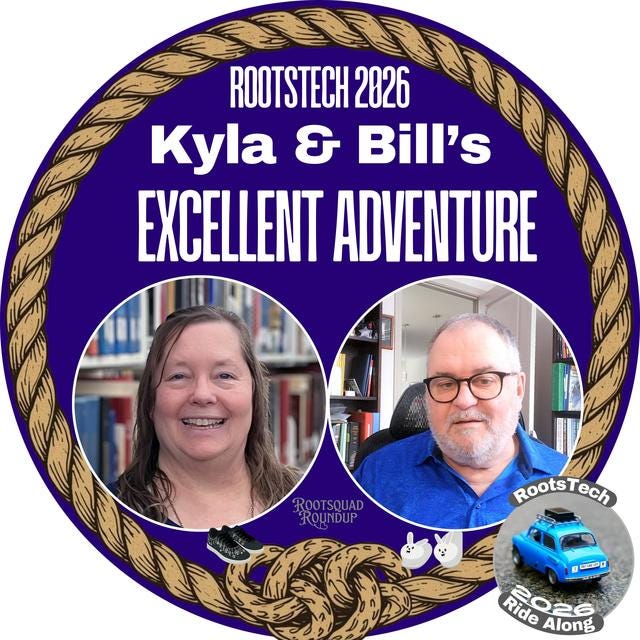
Also, Thursday, Friday, and Saturday evenings, I will be joining with my good friend, Kyla Bayang, for “Kyla and Bill’s Great Adventure.” We will do a quick recap of what we have each seen and heard that day and what we believe will be important in the next day’s programming. The link will be available soon at http://projectkin.org/events .
And don’t forget to participate in Relatives at RootsTech! It’s a fun way to find out who at RootsTech is related to you. You may be amazed at what you find. The link to it should be available in the next week or so.
I’m looking forward to a good time during RootsTech. And I’m always available for questions or advice about the sessions.
Comments
Nothing yet. Say the first thing.
Sign in to join the conversation.