
Like many Americans, I had ancestors on both sides in the Civil War. In hindsight, it’s easy to make moral judgements. But in truth, the reasons behind the war were complex. Each soldier had reasons to fight. As family historians, our job is not to assess blame, but to record history accurately and without bias. I will attempt to do that here.
You met William Roby Moore briefly in the previous episode in this series. He was the young man working as a blacksmith alongside his father, William Jackson Moore. He was my 2nd great-granduncle. To distinguish him from all the other Williams in the family, we will refer to him here as Roby.
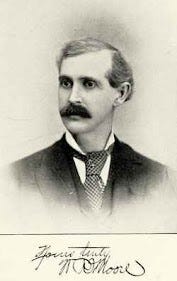
Roby joined the company of Captain Samuel J. Williams, a neighbor of the Moore family. Roby was only 16 years old at the time, although his military records listed him as 18. So, he had to convince his father, William Jackson Moore, to permit him to serve. William J. had also tried to enlist, but he was denied due to his age.1
Captain Williams’ company proceeded to the state capital at Indianapolis, where they were officially organized on 29 August 1861. This was very early in the war; The attack on Fort Sumter had only happened in April of that year. The company was initially ordered to travel by rail to Washington, D.C. Upon arrival, they were attached to the Third Brigade in McDowell’s Division, Army of the Potomac.
Thanks for reading Family History with Bill Moore! This post is public so feel free to share it.
The 19th Indiana was one of the more active units in the Civil War. They were involved in battles in Lewisville, Virginia, Falls Church, Falmouth, and Fredericksburg, Virginia. As the war progressed, Roby and the 19th Indiana took part in some well-known battles, including the Second Battle of Bull Run.
After Bull Run, the company was attached to the 4th Brigade, 1st Division, 1st Corps, Army of the Potomac, also known as the “Iron Brigade.” They immediately joined the Maryland Campaign, taking part in the Battle of South Mountain where the 19th Indiana suffered 53 casualties.
Just a few days later, the Iron Brigade was the spearhead of General Hooker’s early morning attack in the Battle of Antietam. The major Union victory was hard-fought and suffered many casualties. Other battles involving the 19th Indiana included Chancellorsville, and General Burnsides’ famous “Mud March.”
In July 1863, the soldiers of the 19th Indiana joined the fight at Gettysburg.
The 19th Indiana was commanded at the Battle of Gettysburg by Colonel Samuel J. Williams, a farmer from Selma, Indiana who was originally from Virginia. Williams was wounded on July 1st. He returned to command of the regiment and would be killed at the Battle of the Wilderness on May 6, 1864.
The regiment brought 339 men to the field and lost 27 killed, 133 wounded and 50 missing. This 62% casualty rate shows the vicious fighting along Willoughby Run and during the retreat to Seminary Ridge on July 1st, where the 19th Indiana served on the exposed left flank of the brigade. Five regimental color bearers were killed or wounded on July 1st.2
Roby was one of the injured. He was shot on the first day of the battle, severing the index finger of his left hand as the 18-year-old soldier held the battalion banner high. After being injured, he was captured by the Confederate soldiers and held as a prisoner of war in Gettysburg until the Union forces won the battle on July 4th.3
After his wound healed, Roby was transferred to Philadelphia, where he worked as a clerk. He completed the last six months of his military service in Indianapolis, working as the head clerk at the soldiers’ home. He mustered out of the Army in August 1865, after serving for nearly the entire duration of the Civil War.4
On September 16, 1866, Roby married Susanna Miller, the daughter of William Miller, a former County Commissioner in Delaware County. They had two daughters who died as infants. They never had other children.5
After leaving the military, Roby accepted a position working for the Big 4 Railroad in Indiana. Later, he studied business at Briggs, Stratton, and DeHans’ Commercial College in Cincinnati.6 The additional education was beneficial in later years as Roby became part of the business community in the Muncie, Indiana area. His business sense and willingness to be involved in civic affairs served Roby well. He became a well-respected member of the community.7
In their later years, Roby and Susanna moved to San Diego, California, where he worked as a notary public for some time.8
They returned home to Muncie on at least two occasions. The first was to celebrate their 50th wedding anniversary.9 The second was on their 57th anniversary, shortly before Roby’s death.10
Roby died in San Diego, on 5 July 1926. His funeral was held in Muncie at the home of his sister, Cynthia Ella Moore Clark.11
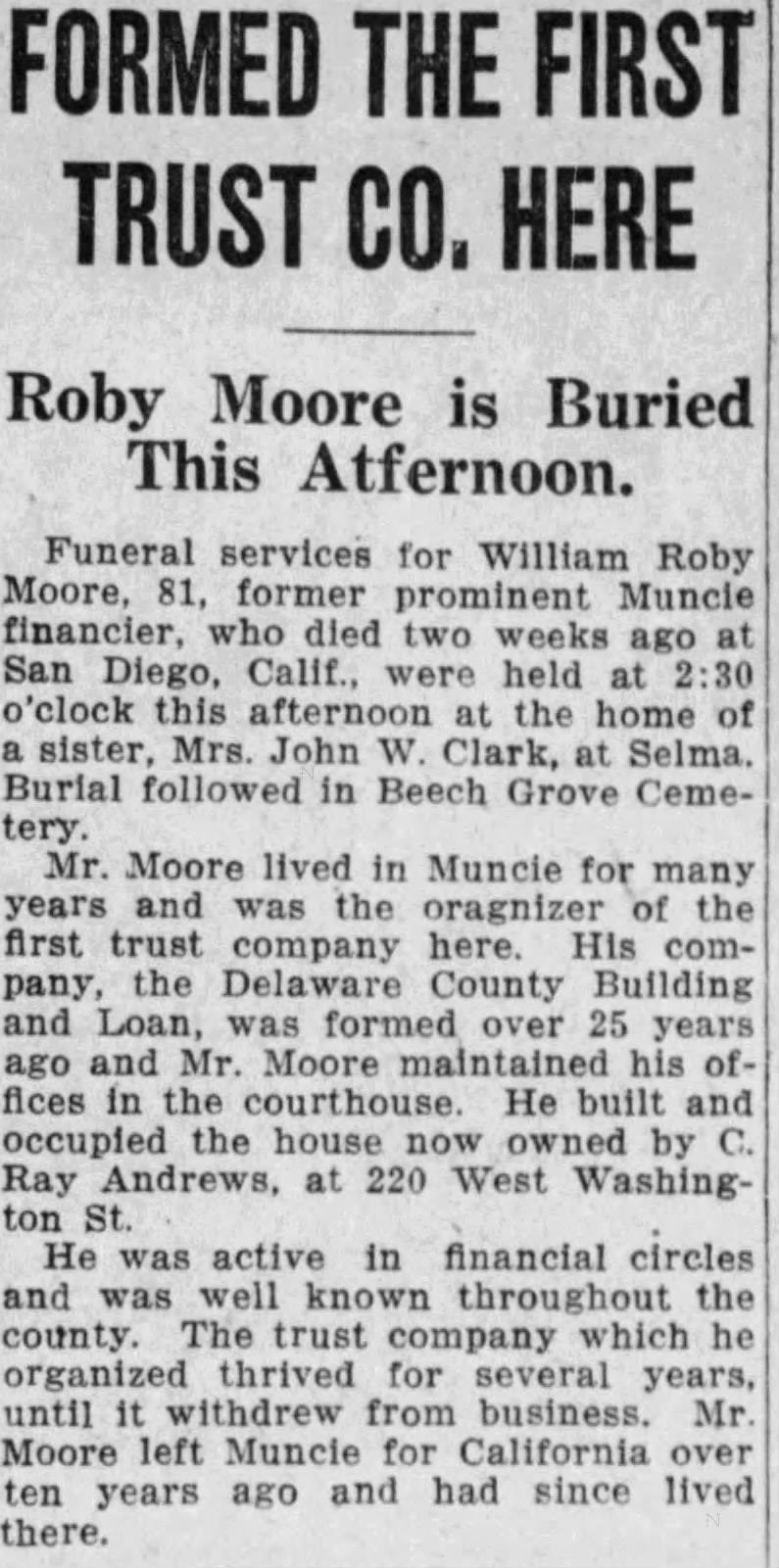
San Diego Directory Company’s 1918 San Diego City Directory (San Diego, California, 1918), 328, entry for “Moore, William R”, imaged in, U.S. City Directories, 1822-1995,” Ancestry, (https://www.ancestry.com/imageviewer/collections/2469/images/3671139?pId=266724434: accessed 5 July 2025).
“Biography of William Roby Moore,” 19th Indiana The Volunteer Infantry, website.
Comments
Nothing yet. Say the first thing.
Sign in to join the conversation.