
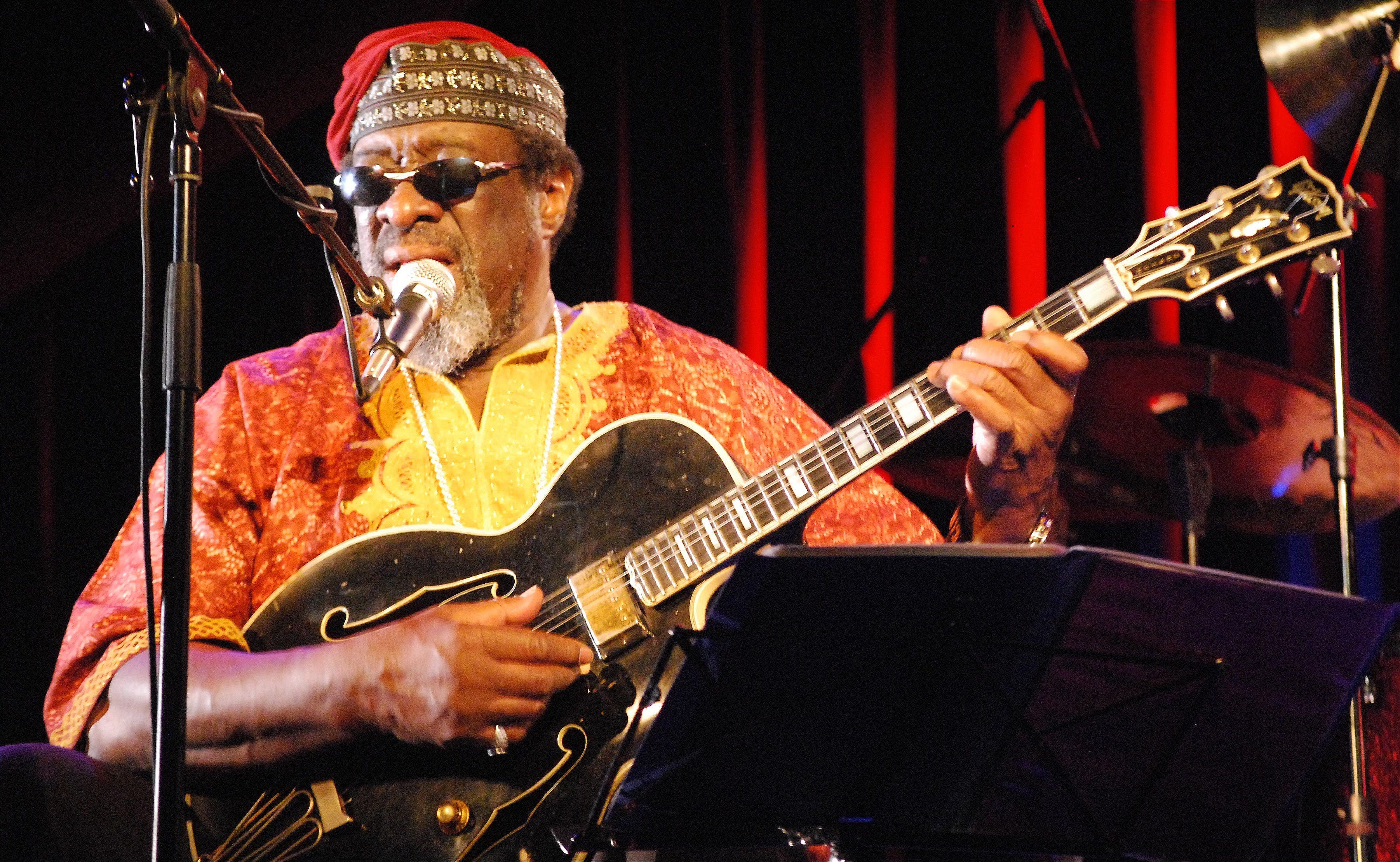
Hearing about the passing of the enigmatic guitarist James “Blood” Ulmer, who died peacefully in his sleep on June 3, triggered a flood of memories for me. Blood was a proponent of an edgy new musical movement that captured the New York avant garde scene when I arrived in the Big Apple back in 1980. Characterized by a compelling free-funk undercurrent with lots of dissonance overlayed on top, this new ‘harmolodics’ sound had its origins in Ornette Coleman’s Prime Time band, initially on 1976’s Dancing in Your Head (A&M/Horizon), then more pointedly on 1978’s Body Meta (Artists House) and 1982’s Of Human Feelings (Antilles). That trailblazing band featured the two-guitar attack of Bern Nix and Charles Ellerbee and was fueled by the throbbing, funky undercurrent of electric bass phenom Jamaaladeen Tacuma and super drummer Ronald Shannon Jackson, who was replaced by the two-drum tandem of Calvin Weston and Ornette’s son Denardo for Of Human Feelings.
Being an Ornette disciple, having already featured the cutting edge alto saxophonist along with bassist Tacuma and drummer Denardo Coleman on his 1978 album Tales from Captain Black (Artists House), Ulmer was deeply into harmolodics by the time he released his followup album on the U.K.-based Rough Trade label, 1980’s Are You Glad To Be In America?, with saxophonists Oliver Lake and David Murray, drummers Calvin Weston and Ronald Shannon Jackson and electric bassist Amin Ali (son of avant garde drummer Rashied Ali). By the time I came to NYC, Ulmer was part of Dr. George Butler’s hip new roster at Columbia Records, providing him and labelmate Arthur Blythe with more visibility than they ever had in their careers. Ulmer’s premier on the prestigious label was 1981’s exhilarating Free Lancing while Blythe made some waves with 1979’s Lenox Avenue Breakdown and 1980’s Illusions (both featuring Ulmer on guitar).
Ulmer would follow up his major label deal with other ‘avant gutbucket’ offerings like 1982’s Black Rock and 1983’s Odyssey (a superb trio date with violinist Charles Burnham and drummer Warren Benbow) before releasing Live at the Caravan of Dreams in 1985 and America — Do You Remember the Love? (his lone Blue Note date) in 1987).
Ulmer was also a key player on a succession of recordings through the ‘80s and ‘90s by the group Phalanx (with tenor saxophonist George Adams, bassist Sirone and drummer Rashied Ali) and the Music Revelation Ensemble (featuring saxophone powerhouse David Murray, bassist Jamaaladeen Tacuma and drummer Ronald Shannon Jackson). Ulmer’s own album as a leader in 1996, Music Speaks Louder Than Words, was a quintet outing showcasing the compositions of Ornette Coleman. He was also a part of the supergroup Third Rail (with bassist Bill Laswell, organists Bernie Worrell and Amina Claudine Meyers and The Meters drummer Zigaboo Modelist) that same year, releasing South Delta Space Age.
Following a Reunion of his Odyssey band in 1998, Ulmer would focus on getting back to his South Carolina blues roots on a series of recordings produced by and featuring Living Colour guitarist Vernon Reid, including 2001’s Memphis Blood: The Sun Sessions (recorded at Memphis’ Sun Studios), 2003’s No Escape from the Blues: The Electric Lady Sessions (recorded Jimi Hendrix’ Electric Lady Studio in the heart of Greenwich Village), 2005’s Birthright and 2007’s Bad Blood in the City: The Piety Street Sessions (recorded in New Orleans. His last album as a leader was 2009’s In and Out for the German In+Out label.
It was in the mid ‘90s that I became aware of Ulmer’s 1970 recordings as a sideman with organist Big John Patton — Memphis to New York Spirit and Accent on the Blues. He was playing ‘out’ even then, long before recording his own first album as a leader.
I also did very much enjoy Ulmer’s 1977 recording Revealing, a real swinging effort featuring George Adams on tenor sax, Cecil McBee on bass and Doug Hammond on drums that I discovered some time in the ‘90s.
I also was particularly fond of the New Art Jazz Quartet, Ulmer’s quartet with pianist John Hicks, bassist Reggie Workman and drummer Rashied Ali, which I got to see in some rare gigs at Sweet Basil and Birdland (including this 2001 performance, which I attended):
I did get to interview Blood once in 1994 at his loft on Greene Street in SoHo, just a few doors down from his neighbor, drummer Rashied Ali. Here is that brief piece from that interview that I wrote for the April 1994 issue of Guitar Player:
Fifteen years ago, New Yorkers were buzzing about this freaky cat who was touted as a harmolodic Taj Mahal. A disciple of Ornette Cole-man, James Blood Ulmer was decidedly “out there,” yet he retained an earthy Delta feel characterized by jangling open-string drones. Critics called his style “avant gutbucket” and heralded Ulmer as “the next new thing.”
“Back then, the loft scene was happening in jazz and new wave was happening in rock,” Ul-mer remembers. “It was a good period for enterprising musicians who wanted to do alternative, experimental music. There was a lot of excitement in the air.”
During this period, he used a Gibson Byrd-land with what he calls a ‘diatonic harmolodic’ tuning. “It’s a unison tuning where every string is tune to the same note, like a one-string guitar,” he explains. “You’re not thinking chords and scales. It’s total freedom.” After recording three critically acclaimed, cutting-edge albums for Columbia in the early ‘80s — Free Lancing, Black Rock and Odyssey — Ulmer was unceremoniously dumped by the label. In 1987, producer Bill Laswell tried to resurrect Blood’s career with America — Do You Remember The Love? on Blue Note.
Now Ulmer is back with a new ax, new album and new attitude. For Blues Preacher (DIW), his most accessible record to date, Blood swapped his usual Gibson Byrdland hollow body jazz box for a solid body Steinberger guitar tuned to E A B G D, leaving the sixth string tuning to last-minute impulse. “I give the guitar five strings and I take one for me,” he says.
Though Ulmer is currently pursuing a vocal-oriented blues-rock direction, he still delves deeply into harmolod-ics with the Music Revelation Ensemble (Sam Rivers, Hamiet Bluiett, Arthur Blythe, Cornell Rochester, and Amin Ali). He also plans to record an ambitious album for string quartet and guitar. “I think of my music as blues,” says Blood. “Other people might not, but I do. I can get up and play the blues all night. I’d like to eventually play with guys like Magic Slim and Lucky Pe-terson, but my real dream is to hook up a gig with Taj Mahal. That’d really be something.” BILL MILKOWSKI
No posts
Comments
Nothing yet. Say the first thing.
Sign in to join the conversation.