
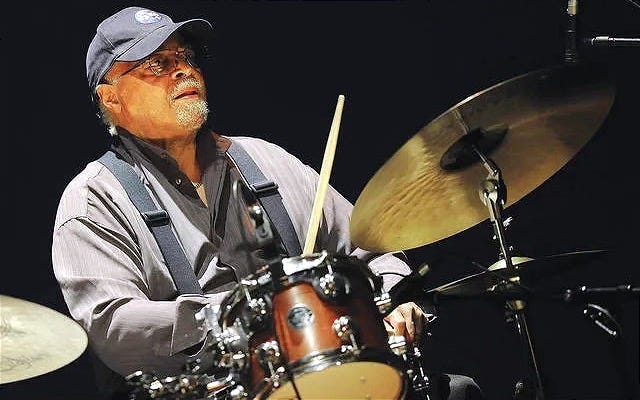
I was lucky enough to have seen the great drummer Jimmy Cobb in action multiple times over my career, beginning with a couple of gigs he made in Milwaukee during the ‘70s as a member of Sarah Vaughan’s trio — the first a 1977 outdoor concert at the historic art deco bandshell in Washington Park as part of the Milwaukee County Jazz Galaxies Festival (in which Sarah split the bill with Mel Torme); the second at the 1978 Kool Jazz Festival, a massive touring multi-city concert series sponsored by Brown & Williamson Tobacco Corporation’s Kool cigarette brand, at the Performing Arts Center (again sharing the bill with Torme, who was backed by the 13-piece Gerry Mulligan big band).
After moving to New York City in 1980, I would see Cobb numerous times in different situations, whether it was him leading his Cobb’s Mob (with guitarist Peter Berstein, bassist John Webber and pianist Richard Wyands), playing with the 4 Generations of Miles band (with tenor saxophonist George Coleman or Sonny Fortune, guitarist Mike Stern, and either bassist Ron Carter or Buster Williams) or backing the likes of Cedar Walton and Freddie Hubbard at the Village Vanguard, Nat Adderley at Sweet Basil, Charlie Rouse at Fat Tuesday’s, Eddie Gomez at Visiones or playing alongside bassist Walter Booker, saxophonists Sonny Stitt and Ricky Ford, trumpeter Roy Hargrove…on and on.
There was one memorable night in the late ‘90s when I walked into The Savoy (not the famous 10,000 sq. ft. Savoy Ballroom in Harlem that was a key scene for dancers during the Swing era, but a funky former biker bar on 40th Street and 9th Avenue near the Port Authority that had converted into a jazz club and had a short run there). Adam Scone was the house organist at the Savoy and this night he was playing with Cobb, among others who were sitting it. I’ll never forget the timing of me walking into the club and some overserved patron at the bar literally falling off his stool and hitting the floor perfectly in synch with Cobb’s cymbal crash. The choreography of that was beautiful.
Apart from seeing Cobb perform numerous times, I also got to interview him on several occasions, including for this Before & After session for the November 1999 issue of Jazz Times magazine.
Jimmy Cobb Before & After
The lone surviving member from 1959’s landmark Kind of Blue sessions, drummer Jimmy Cobb is still swinging forcefully and creatively at age 80 while leading a couple of different working bands. A recent recipient of the NEA Jazz Master Award, Cobb spent a great deal of 2009 touring with his So What Band (trumpeter Wallace Roney, alto saxophonist Vincent Herring, tenor saxophonist Javon Jackson, pianist Larry Willis and either Buster Williams or John Webber on bass) to commemorate the 50th anniversary of that Miles Davis masterpiece.
Cobb also plans to commemorate the 50th anniversary of Davis’ Sketches of Spain (which he also played on) with several performances next year, beginning with a weeklong engagement at New York’s Iridium nightclub in January 2010.
Meanwhile, he has just released a new ballads project, Jazz in the Key of Blue (Chesky), which finds the revered elder joining forces with trumpeter Roy Hargrove, guitarist Russell Malone and bassist Webber. His rhythmically assured pulse and signature cymbal beat can be heard on countless sessions over the past six decades, including some of the all-time classics by jazz giants like Davis, Wes Montgomery, Cannonball Adderley, Sarah Vaughan, Dinah Washington and Wynton Kelly. This Before & After session was conducted at the midtown Manhattan office of Chesky Records.
Miles Davis
“Morpheus” (from Miles Davis & Sonny Rollins: The Classic Prestige Sessions, 1951-1956, Prestige). Davis, trumpet; Rollins, tenor saxophone; Bennie Green, trombone; John Lewis, piano, composition; Percy Heath, bass; Roy Haynes, drums. Recorded in 1951.
BEFORE: I seem to recognize that one a little bit. That’s Miles with Sonny Rollins, with one of my favorite Sonny Rollins solos on it. And that sounds like Snap, Crackle & Pop [Roy Haynes] on the drums. I remember hearing this record when I was a teenager still in Washington, D.C. I used to have this. It’s one of the records I went out and bought. In fact, I listened to it so much I kind of memorized Sonny’s solo a little bit back then.
AFTER: Well, Roy is easy to identify. All that cross sticking he was doing here gave it away. He still does that, but he used to do it a lot back then. In fact, he was one of the first ones that I heard play like that. I met him around that time, too, in ’51. He came to D.C. with Luis Russell’s band and we got to be friends, because he was the kind of guy that you could talk to. Then another time he came back with Pres. I used to see him come down there a lot.
That cymbal intro by Roy is pretty unusual for him.
Well, he was trying to be inventive there. That’s what he’s always been doing, coming up with little things that are really connected to Roy Haynes. Like the way he plays on the snare drum, which is why they used to call him Snap, Crackle & Pop.
2. The Great Jazz Trio
“Someday My Prince Will Come” (from Someday My Prince Will Come, Eighty-Eights/Columbia). Hank Jones, piano; Richard Davis, bass; Elvin Jones, drums. Recorded in 2002.
BEFORE: [laughs out loud during the drum solo ] Well, I’m kind of thrown by the piano player. It sounds like Bill [Evans], but it sounds like Bill scuffling. … I don’t know why he would be scuffling. So it sounds like Bill, but it doesn’t. And that’s Elvin. The bass player is probably the guy who used to play with Bill, Scott LaFaro.
AFTER: I thought about Richard Davis. I remember these dates. They did two or three of them together. But to me, it sounded like Hank trying to have a feeling like Bill. Elvin … you can’t hide Elvin anywhere, even on a waltz like this. See, even on ballads, Elvin plays the whole cymbal beat on snare drum. That’s how come I can get him out of the closet like that real quick. And then, of course, when he went into his solo … there ain’t nobody else like that. Yeah, he’s an octopus after that. I remember doing a gig with Hank in Japan and we were playing a ballad. And he got finished playing the solo and he looked at me and says, “You got it.” I got what? [laughs] He wanted me to play a solo on the ballad like Elvin just did here. I don’t know, I probably got away with something, but that was surprising just to do that on the bandstand like that.
I thought it was clever to open this piece with the riff from Bird’s “Scrapple From the Apple” before segueing right into “Someday My Prince Will Come.”
Yeah, the Joneses are like that. That whole family was tricky. Elvin was tricky like that on the drums, Thad was tricky like that on the trumpet and Hankenstein, as I call him, was tricky like that on piano. Hank tells me that he had a sister who played piano and if she had lived she would’ve bumped them all off because she was that bad. That’s some good genes in that Jones family.
3. Ed Thigpen Trio
“Sometime Ago” (from Mr. Taste, Justin Time). Thigpen, drums; Tony Purrone, guitar; Mads Vinding, bass. Recorded in 1991.
BEFORE: I got a blank for that. I don’t know who the guitar player is. It sounds like John Scofield or somebody like that. The bass player might be Eddie Gomez. And the brushes sound real good here. Is it Lewis Nash?
AFTER: No kidding! Ed and I started out about the same time on the road. He was with Cootie Williams’ band and I was with Earl Bostic. Then he had all those years with Oscar Peterson and I always knew he played good brushes. That’s one of his signatures. Another great brush player is the guy who plays with Diana Krall now, Jeff Hamilton. I thought it might’ve been him on this tune. Thigpen was noted for his brush playing because he probably had to do a lot of it with Oscar. And we each had our own different approaches to playing brushes. It’s whatever works for you.
You’re noted for your brush playing on “Flamenco Sketches” from Kind of Blue and all the stuff you played on Porgy & Bess and Sketches of Spain.
For me, it was just a question of giving Miles what he wanted. Miles would ask for different things at critical times. Like one time we were working with Gil Evans and the big band and Miles came over and said, “Make it sound like it’s floating.” So I came up with something that felt like that. Then Gil came over and said, “Floating is cool but you have to keep the band together.” So some kind of way we got it together.
It’s a tricky balancing act between keeping time and eliminating the notion of time.
Yeah, but with that particular pattern you just keep hearing One all the time. So long as you’re gonna hear One, that’s all they have to have. And if you just keep doing that, it’ll work itself out. A guy was asking me one time, “How do you play with the brushes?” And I told him, “Well, there’s only a certain number of things you can do. There’s one pattern that you play that’s like a cymbal beat on the snare drum. Then there’s the thing where you make a slow kind of a circle thing from right to left with the left hand while the right hand is going from left to right. And anything you come up with after that that keeps the band together, it works. So there aren’t a whole lot of things. Basically, it’s what you can get away with while still keeping the band together. Make it mellow for the band. I had to play brushes a lot when I was with Dinah Washington when I first came to New York [in late 1951]. Before I even left home I played a couple weeks with Billie Holiday. She’s got some really slow stuff, like “God Bless the Child” and “Don’t Explain,” where you gotta play brushes. So I had to get into that. So I had a lot of experience playing brushes behind singers before I ever got with Miles. And then after I left Miles I worked with Sarah Vaughan for nine years, and you know she does really beautiful slow ballads. So I got to play a lot of brushes with her during that period. There’s definitely an art to playing brushes and everybody’s got their own way to do it.
4. Art Blakey & the Jazz Messengers “Hammer Head” (from Free for All, Blue Note). Blakey, drums; Freddie Hubbard, trumpet; Curtis Fuller, trombone; Wayne Shorter, tenor saxophone, composition; Cedar Walton, piano; Reggie Workman, bass. Recorded in 1964.
BEFORE: Well, that’s Art, Curtis, Wayne and Freddie. The piano player I couldn’t get. It sounds like either Cedar or John Hicks. I’m trying to think, who else was playing in the band at that time? I don’t know who the bass player was at the time either. It could’ve been Reggie Workman.
AFTER: Art is the only one who could beat out like that, single or double stroke. And he’s strong with that shuffle beat. He’s really kicking that band here. He was a guy who could put things where they were supposed to be. Some guys might say, “Aw, man, I don’t wanna play no shuffe.” But if it was supposed to be a shuffle, Art put it there. If it’s supposed to be there, you’re supposed to give it up. And he came from a time where that was the daily thing. People were playing shuffles all the time back in the ‘30s and ‘40s, and that’s what they expected from a drummer, to be able to play the backbeat and shuffle. Just like tenor players. When they went to a gig they were expected to hold B flat and walk the bar. That was the only way to get a gig back then. As good as they could probably play, that’s what the proprietors at that time figured was needed to get customers in their joints—honking tenor players and backbeat shuffles. That’s all they knew. And believe me, I played a whole lot of shuffles in Earl Bostic’s band.
McCoy Tyner remembers when he was a teenager seeing Trane playing a gig in Philly where he was walking the bar and honking.
Right, that’s what was expected.
And you can hear that earthy quality in Art’s playing here.
Yeah, that’s some stuff that he had to do daily coming up.
But then he’s also so powerful in terms of how he orchestrates the band from the kit, coming off of those press rolls here.
Well, he got that from Billy Eckstine’s band. Art got a real education in that band. Billy Eckstine had all the real killer players in that band. Anybody that you could name that was prominent later on came out of that band-Bird, Dizzy, Dexter Gordon, Gene Ammons, Leo Parker, Sassy [Sarah Vaughan]. Art Blakey was the drummer in that band and I used to see them when they came to D.C. at the Music Hall. I got to know Art later on after I got to New York. I left Washington with Earl Bostic’s band and we were traveling with Dinah Washington, whom I got socially involved with. We were living together on 7th Avenue and 122nd Street and in the same building was Dizzy and [his wife] Lorraine, Erroll Garner ... it was like an artists’ kind of a building. So through Dinah I got to meet a lot of people during that period, including Art. He wasn’t as good then as he got to be later on, but you could always tell he was a powerful drummer.
5. Tony Williams “Obsession” (from Angel Street, Blue Note). Williams, drums, composi-tion; Wallace Roney, trumpet; Billy Pierce, tenor saxophone; Mulgrew Miller, piano; Charnett Moffett, bass. Recorded in 1988.
BEFORE: Sounds like Tony and Wallace, and I’m trying to think who the tenor player was. Who was the piano player?
AFTER: I never knew Charnett Moffett was in that band. That was a powerful group he had at that time. Tony was a very talented young man. When I first met him he was still up in Boston. In fact, I met Howard Johnson with him, met them both on the same day. He used to come by when I was up there with Miles at Storyville and wed hang out, fool around on my drums and stuff. Tony studied with Alan Dawson for a while, but Alan said he couldn’t teach Tony nothing because Tony was into his own place, so I don’t think that lasted too long. But he used to come down from Boston and stay with Max Roach sometimes. We got to be good friends. He had something really different from everybody else. It’s like over the years things change with the drums, different styles come along. A long time ago it was Klook [Kenny Clarke] and Max, then Art Blakey and Buddy Rich. Then Elvin came along and changed the way the whole thing was going. And Tony did the same thing. So you get those kinds of guys that changed the way that drums were played over the years.
And Tony was one of those pioneers that changed the way that people played the drums. The way he could play things off the meter—all those really quick fills—and still be in the meter, he could really do that well. Quick hands and quick feet, and his mind was quick too. He could change from thing to thing and be right on it still. And he could play anybody’s style. Wallace told me that he used to play my stuff, Max’s stuff, Buddy Rich’s stuff, Art’s stuff. He could probably play anybody’s thing. He probably thought, Why not play all that stuff? And he had his own little thing there, too, which was great. It’s a shame the way that ended up with him. That’s really a travesty the way that happened. I wouldn’t have ever thought that I’d be here and he’s not.
6. Jeff “Tain” Watts “Dingle-Dangle” (from Watts, Dark Key). Watts, drums, composition; Terence Blanchard, trumpet; Branford Marsalis, tenor saxophone; Christian McBride, bass. Recorded in 2008.
BEFORE: That one tricked me altogether. I don’t have no idea who it is unless it’s Monk Jr. because of that Monk reference in there. I think it’s “Trinkle, Tinkle.” I don’t know, but the drummer sounds overpowering here.
AFTER: Jeff “Tain” and I were born on the same day. Yeah, he’s a powerful drummer, alright, and he’s got a great sense of humor, which you can hear in this piece. I don’t know why I didn’t recognize both him and Christian McBride. I just played at the Hollywood Bowl with Christian a couple weeks ago, doing a Miles tribute with some Porgy & Bess music and Sketches of Spain.
I love Christian. We also made a couple records together [New York Time with Cedar Walton and Javon Jackson, West of 5th with Hank Jones; both recorded in 2006 for Cheskyl, so I should’ve known it was him. And Jeff, I hadn’t heard him play recently, so that’s probably what threw me about that. But hearing this, you can tell it’s a drummer’s band because the sound of drums is overpowering. I made a record for Branford’s label [2006’s Marsalis Music Honors Jimmy Cobb] where he wanted a bunch of drum solos and things on it, so I did that. Some drummers figure if they’re the bandleader they need to play drum solos on every song, but I don’t like to play drum solos on every tune. I like for it to be music most of the time. On my new album we made it no drum solos because we were going for a mellower vibe and drum solos weren’t compatible with that.
7. Newport All-Stars “Old Man River/Caravan” (from 1964 Newport Jazz Festival, wolfgangsvault.com). Jo Jones, drums; Billy Taylor, piano; Slam Stewart, bass; Ed Hall, clarinet.
BEFORE: Well, that’s Papa Jo.
You got that one quick.
Well, there’s only one of him. Nobody was as slick with brushes as Papa Jo. It’s hard to play brushes that fast. He’s amazing, man. Of course, he’s the one that started that hi-hat beat with the Count Basie band that everybody started to do later on. I saw Max do it, I saw Roy do it. So he invented a lot of stuff for drummers to work on. And they’re still trying to get it together.
AFTER: I got to see him doing this solo drum routine. That’s the beauty of it, to actually watch him doing it. He was a real showman. Hed do stuff with his hands and his fingers on the snare drum. Hed play the rims; hed do flashy stuff with the sticks; he’d do stuff around the drums; he’d play four on the floor like they used to do in the big-band days. And he’d be up there on the bandstand smiling the whole time he was doing all of that stuff. I imagine that was sort of the way that Chick Webb played too. Papa Jo told he used to play for a lot of tap dancers, so he’s got all that intricate little stuff that he used to have to play for those guys. We got to be good friends, too. In fact, he used to come to where I was playing and bring me an apple. Every time that he’d come he’d hand me an apple. I never knew what that was about, but I always accepted it and was flattered that he would do that.
Musings on Music by The Milkman is a reader-supported publication. To receive new posts and support my work, consider becoming a free or paid subscriber.
Comments
Nothing yet. Say the first thing.
Sign in to join the conversation.