
This mind has little time for nonsense unless it comes carrying good humour. I woke up to a sharp Dave Chappelle bit, and that was enough to launch the day. There are worse ways to enter the morning than laughing before you’ve had time to remember what the world has been up to.
YouTube remains an endless warehouse of the unpredictable and overlooked. Most days, you have to step around the usual clutter: conspiracy quackery, synthetic voices, AI-generated sludge and people explaining—with enormous confidence—things they learned twelve minutes earlier. But every so often, something comes at you sideways. That is what I’m looking for. Not another algorithmic serving of what I already know I like, but something capable of stopping the thumb.
Recently, I came across The Diary of a CEO and fell into the trap. One I had apparently set for myself.
Neil deGrasse Tyson clocked me again. The man does time maintenance for me. An hour with him rarely feels stolen. It feels properly spent. I don’t know whether that is an age thing or simply the consequence of becoming a little more philosophical at this particular bend in the road. Perhaps the appetite changes. You become less interested in collecting facts merely to possess them and more interested in what they do once they get inside your head.
When I watch shows like this, I find myself concentrating on the questions and, even more, on the follow-ups. Anyone can arrive with a clipboard of prepared inquiries. The real test comes after the guest answers. Did the interviewer hear what was said? Did something slip through the language? Is there a contradiction worth pursuing, or are we all expected to nod politely and continue down the promotional highway?
I remain leery of being dragged along like some helpless sheep. There is enough shepherding going on already.
With The Diary of a CEO, it was a slow burn. Who is this guy, and why am I still watching? Why haven’t I wandered off to look at a dog stealing a rotisserie chicken or a Russian mechanic rebuilding a tractor with two wrenches and a cigarette?
I suspect some of the appeal stems from my affection for the late Christopher Hitchens. I miss that willingness to speak with full honesty—or at least with the conviction that honesty was the objective. Hitchens could land a solid right or get smacked down in public, but there was always the sense that he had entered the ring knowingly. No padded corners. No soft-focus agreement. No host hovering nearby to protect everyone from the dangerous possibility of an actual thought.
I’m only beginning to learn about Steven Bartlett, and, like the most enterprising YouTube creators, he is clearly pushing for bigger numbers. Nineteen million subscribers ought to put a person somewhere in the box-office range of The Odyssey and Spider-Man. At that level, you are no longer merely hosting a podcast. You are operating a country with ring lights.
Bartlett launched The Diary of a CEO in 2017 while running the social media company Social Chain. In the beginning, it was a more intimate account of entrepreneurship—the uncertainty, failures, psychological bruises and private fears behind the title of CEO. It wasn’t the usual parade of polished business advice delivered by someone standing in front of a rented Lamborghini. It was intended to explore what happened behind the performance.
Over time, the guest list widened. Founders and executives were joined by scientists, psychologists, physicians, athletes and celebrities. The conversations moved beyond business and into ambition, trauma, relationships, health and personal development. In other words, the show discovered that the chief executive also has a childhood, a nervous system and, occasionally, unresolved business with his father.
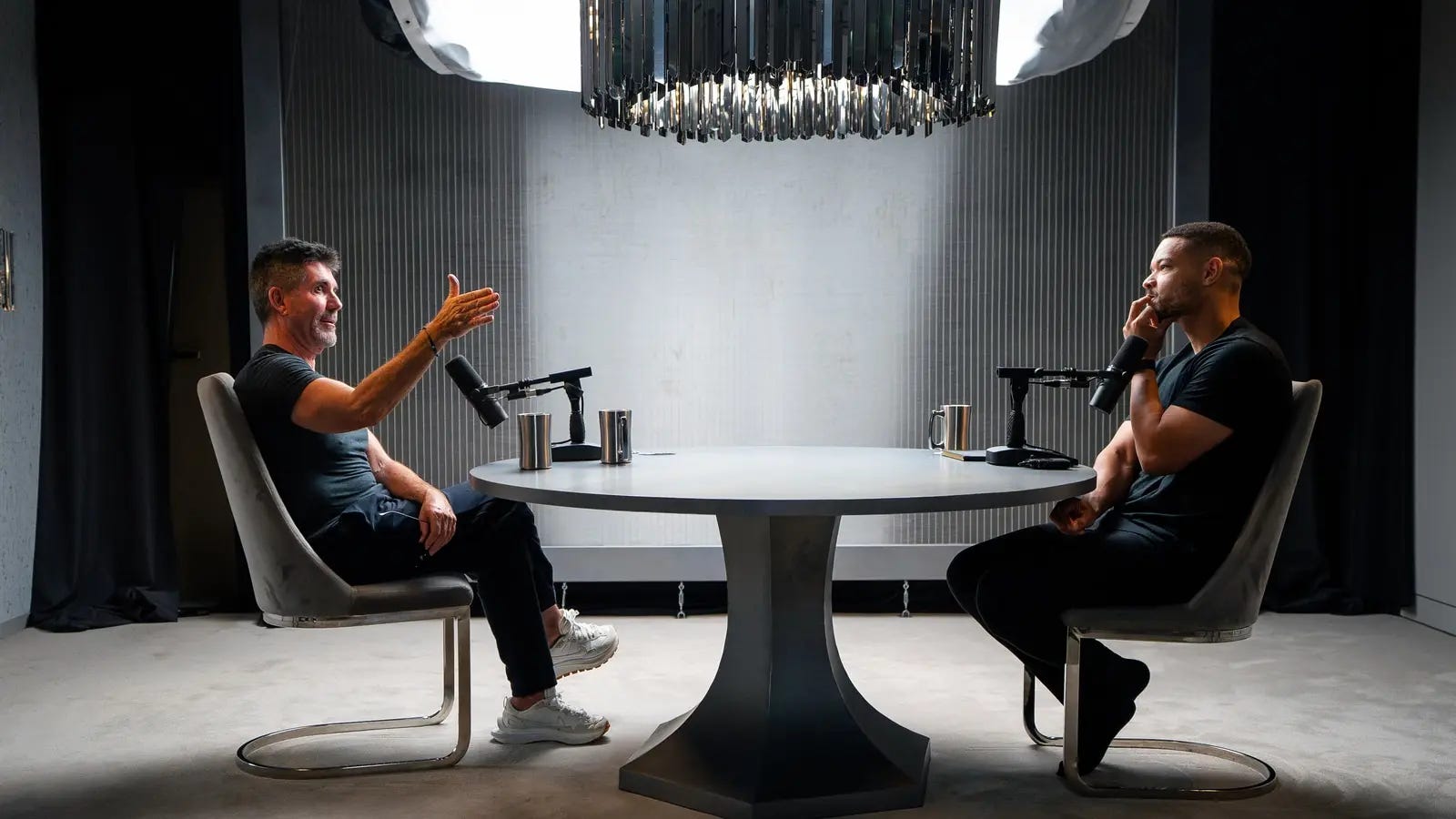
The interviews are long, personal and handsomely staged in a dark, minimalist studio. Bartlett tends to work his way toward the guest’s formative experiences and vulnerabilities. The atmosphere is part confessional, part executive lounge and part expensive therapy session where nobody has to glance at the clock.
As a podcaster, the set is marvellous. It understands the assignment. The lighting is controlled, the silences are given room, and everybody appears to have been inspected before entering the frame.
Poor James Carville could use a groomer up against talent like this. Carville often looks as though he has been laid out like a patient in a walk-in clinic who failed to consult a mirror and remove the chunk of horse meat resting just below the Marine insignia on one of those well-worn military-surplus T-shirts. Visually, he is a long way from The Diary of a CEO. I’m not going to argue content. James knows his shit. He simply arrives looking as though the camera crew surprised him behind a bus station.
Bartlett, by comparison, understands that video has become part of the conversation. The show is produced by his media company, FlightStory, and its growth has been driven by polished video, prominent clips and relentless social-media distribution. FlightStory says the podcast has passed one billion listens and views. That is no longer an audience gathered around a microphone. That is weather.
Bartlett was born in Botswana and raised in Plymouth, England. He left university, co-founded Social Chain, became an investor on the BBC’s Dragons’ Den and built a collection of businesses around media and investment. In 2023, he published The Diary of a CEO: The 33 Laws for Business & Life. Despite the shared branding, the book is not a transcript or a history of the program. It is a collection of principles, lessons and working rules drawn from Bartlett’s experience.
There is, of course, a catch. There is always a catch when intimacy becomes an industry.
The show has been criticized for giving insufficiently challenged airtime to questionable medical claims. A 2024 investigation examined misleading statements made by some of its health-focused guests. FlightStory defended the program’s commitment to open discussion, which is fair as far as it goes. Open discussion is valuable. It is, however, not a substitute for evidence. A microphone does not turn an opinion into medicine, and expensive lighting does not make a claim clinically sound.
That distinction matters because a gifted interviewer can make almost anything feel plausible. Long-form conversation creates trust. The pauses feel honest. The personal disclosures lower the drawbridge. Before long, the viewer is not simply listening but participating emotionally, and that is precisely when the critical faculties need to remain awake.
What Bartlett proves is that we can still hang in for the long conversation when it isn’t pulling our chain. We will give someone two hours if the exchange produces results. Not necessarily solutions. Not necessarily truth descending from the ceiling in a shaft of heavenly light. Sometimes the result is simply a better question than the one we started with.
I’m not going to say lives are changed. That phrase has been worn down to the stitching. But perhaps a mind opens another inch. Perhaps an assumption gets moved off the good chair. Perhaps we reconsider something we’ve been carrying around for years because nobody has asked us to set it on the table and look at it properly.
I never mind being proved wrong. There is something cleansing about it, provided the proof is good and the person delivering it isn’t dancing on the table. Being wrong means there was still something left to learn. That, in itself, is a positive.
I’ve supplied a little background on the show and three episodes of interest. I could have covered Farticus’s presser from a couple of days back, where he soiled the air while RFK stood nearby, clutching papers and shaking like a cartoon wino from the sixties. There was certainly material there. More than enough. But some mornings you must decide what kind of garbage you are willing to carry before breakfast.
It’s Wednesday, and the geese are still honking around the campsite. You’re trolling the iPad, looking for something of interest, and I’m being generous. Or perhaps, like me, you’re downstairs and fully engaged before your companion appears and changes the channel to the weather update.
Either way, here is something that might come at you sideways.
Comments
Nothing yet. Say the first thing.
Sign in to join the conversation.