
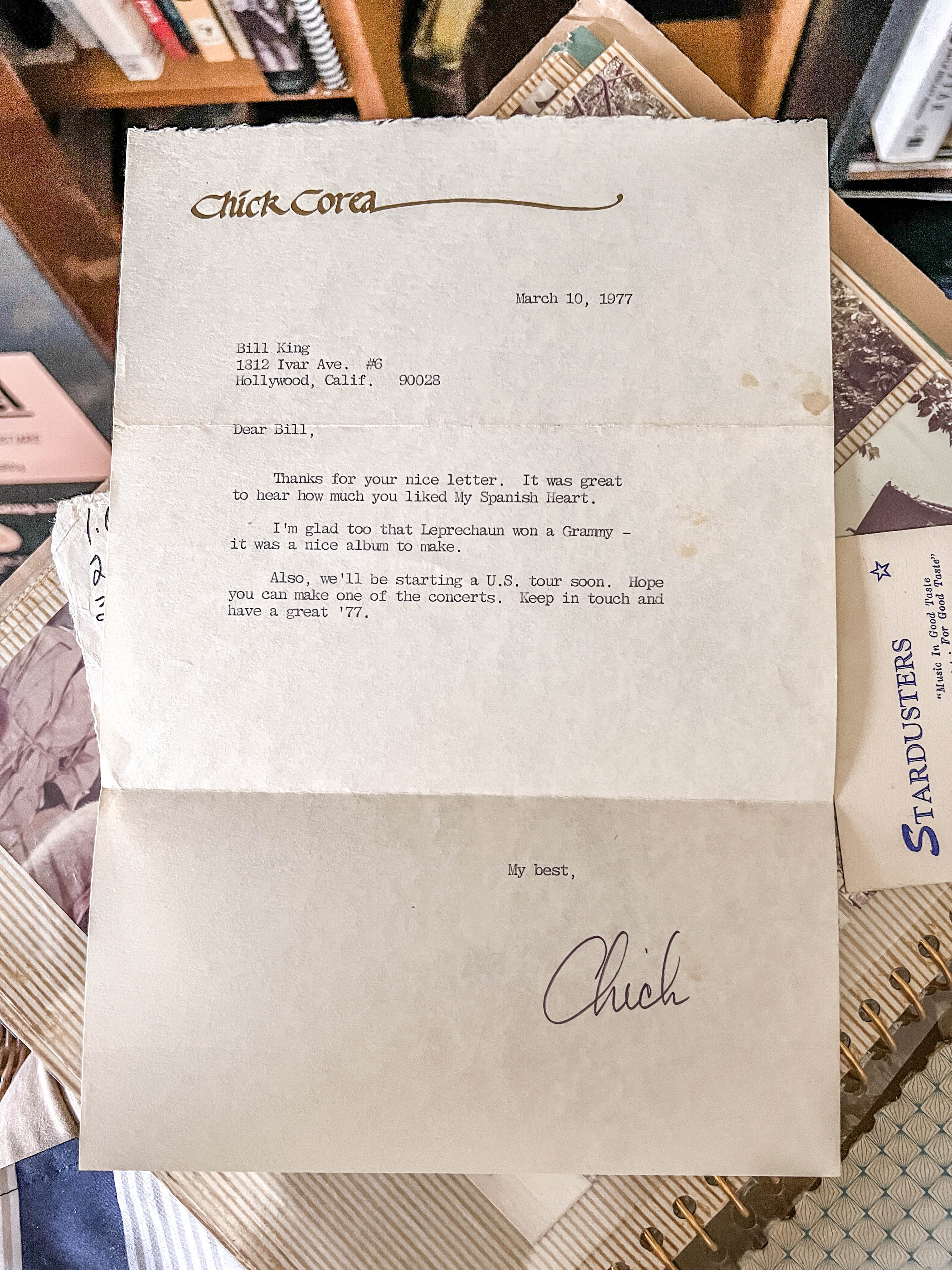
I’m browsing old hard drives, thinking about my October 18 show at the Redwood Theatre. Old photographs appear. Memorabilia. Sounds and essays from another time. Then I come across a letter dated March 1977—a return letter from Chick Corea—and the room begins to move backward.
I can honestly say, from my ears and my heart, that Chick Corea was the greatest jazz pianist of my generation.
Much of that declaration comes from taste. Preference. Something in me has gathered the history of jazz during my years on this earth and spun it through my own mental cycle of hard truths. I love Herbie, Keith, McCoy, Bill and Oscar, along with the innovators who accompanied those greats. But when I consider the reach of them all, then measure it against the depth and breadth of Corea’s output, the man stands alone on my playing field.
Much of it has to do with the transformational projects, the astounding technique, the songwriting and the ever-present need to innovate. Corea’s improvisational skills were unmatched.
I know I’m going to take a Bud Powell hit to the skull over this. That’s all right. Just keep this in mind: I’m not trying to convert anyone or persuade you to think less of the musicians you may hold in higher regard. We all arrive at music through different doors. This is simply the room I landed in.
I wrote to Chick Corea because I was so taken by My Spanish Heart. Written by the man, shaped by his imagination and filled with music that seemed to come from several corners of the world at once. I would have done the same for Herbie Hancock after hearing “Speak Like a Child,” but I was never given the opportunity.
I’m a composer at heart. I lived inside those recordings. There were complex, heartfelt melodies that made the hair on your arms stand up. Songs we quickly carried to the bandstand, eager to see what they might reveal beneath our own fingers. Chick’s songs were worldly. They were never trapped inside a strictly American essence. There was a travel guide hidden in every melody, something to assist you on the journey and remind you that music had crossed borders long before we gave those borders names.
Composing more than a head designed merely to get the players to the chord changes is a difficult undertaking. Each note and its placement must have purpose. It must also carry a quirky little side shuffle. You can’t simply ride the predictable. There must be bumps in the road, an unexpected turn, a place where the listener leans forward because the scenery has suddenly changed.
Chick always put the bounce in the predictable.
Reading that letter again, I thought about the moment it first arrived. The turntable. The Marantz receiver. The not-so-finely-tuned speakers. And the pleasure I found with every play. You lowered the needle, sat back and waited for the room to open. It always did.
I never tried to emulate Corea. There are musicians you borrow from, musicians you study and musicians whose depth tells you to stand back and listen. He belonged to that last class. His harmonic language was deep, and the demands he placed on improvisation were relentless. The ear was always catching up.
Twenty-two years after receiving that letter, I was preparing to leave for nine weeks of work aboard a cruise ship. I always handled the cover interviews for the Jazz Report Magazine. Before departing, I notified my partner that we had Corea for the cover. I also left one firm instruction: don’t let him get involved in a conversation about Scientology.
I returned home. The magazine was out. And there it was—the dreaded conversation, venturing directly into Scientology.
The letters began pouring in. Readers were pissed. We published a couple of them in response, and then the floodgates sprang open. The harassment began. A fourteen-page letter of rebuttal arrived. There were demands for a retraction and constant phone calls. I had never faced an onslaught of vengeance like it. Then the caller went after one of the letter writers.
Ugly stuff.
I’m fine with anyone’s faith. People have a right to believe, to search, to find whatever spiritual structure helps them make sense of their time here. But this was operating on another level. It was no longer a quiet matter of personal belief. It had become pressure, intimidation and pursuit.
Still, that episode does not erase the musician or diminish what he gave. To the end of his life, Chick Corea was teaching, sharing and giving freely of himself. He kept reaching toward younger musicians and inviting them into the conversation. He remained curious. He continued working. He continued opening doors.
I will never question that generosity, just as I will never question his place at the top of my list of piano minds.
The old letter remains in front of me. March 1977. A turntable turning, a Marantz receiver glowing in the room, and Chick Corea’s music finding its way through those not-so-finely-tuned speakers.
The ear was catching up then.
It still is.
Comments
Nothing yet. Say the first thing.
Sign in to join the conversation.