
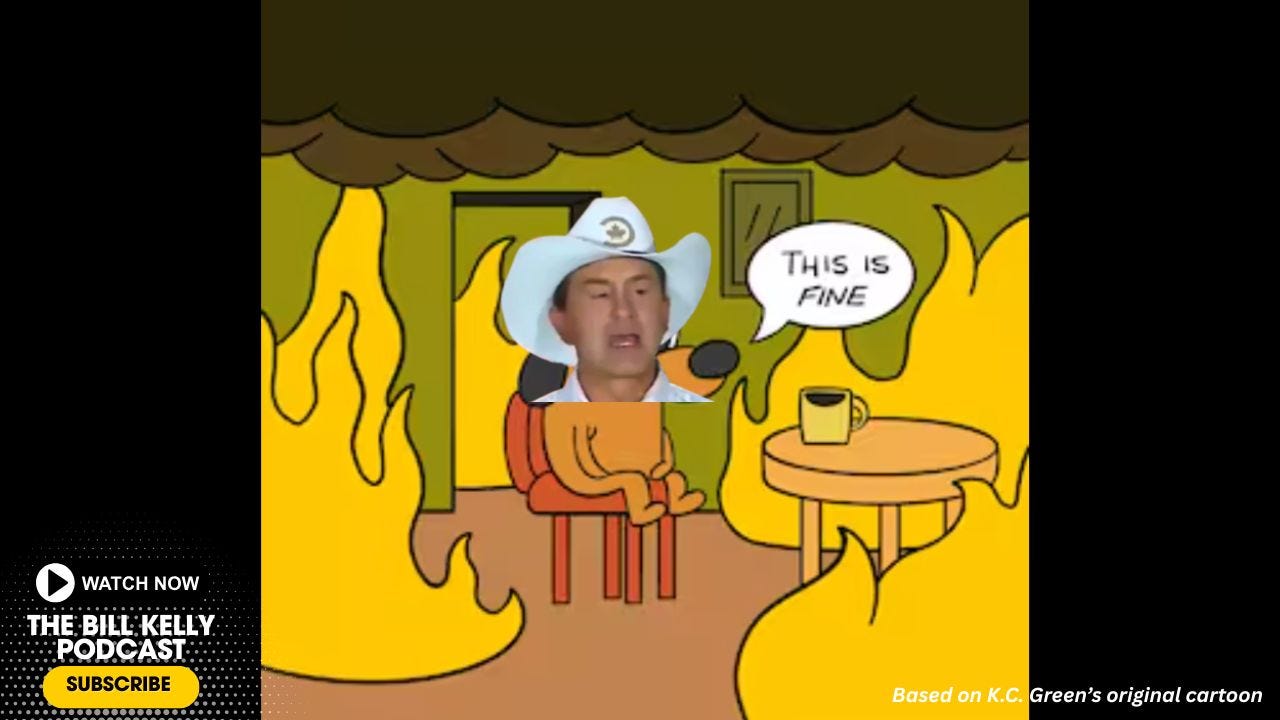
Every political party loses elections.
The real test comes afterward.
Bill Kelly’s Substack is a reader-supported publication. To receive new posts and support my work, consider becoming a free or paid subscriber.
Do you honestly examine what went wrong? Do you learn from your mistakes? Or do you double down, blame everyone else, and pretend nothing needs to change?
According to a fascinating report published this week in The Hill Times, the federal Conservatives appear to be choosing the third option—and it’s creating exactly the kind of internal turmoil many of us predicted after the 2025 election.
The article quotes Conservative MPs, longtime party members, staff, and volunteers describing morale inside the party as being, in one MP’s words, “in the absolute shitter.”
Those aren’t my words.
They’re coming from inside the Conservative movement itself.
And while party leadership continues presenting the image of a united front, the reality behind the scenes appears very different.
We Were Told the Summer Would Fix Everything
When Parliament rose for the summer, the expectation was that Pierre Poilievre and his team would use the break to regroup after losing the federal election.
Many Conservatives insisted the election was behind them.
The party would reset.
Everyone would get back on the same page.
According to The Hill Times, that’s simply not what’s happening.
Instead, senior Conservatives continue fighting among themselves over why they lost, who bears responsibility, and—perhaps most importantly—whether Pierre Poilievre is still the right person to lead the party.
That conversation isn’t being driven by Liberals.
It’s happening inside Conservative circles.
The Turning Point Was the Election Campaign
If you’ve been following this podcast, none of this should come as a surprise.
We’ve talked repeatedly about what happened during the 2025 campaign, and The Hill Times report confirms much of what political observers suspected at the time.
Veteran Conservative strategist Corey Tanaike reportedly urged Poilievre to pivot his campaign as Donald Trump became an increasingly dominant issue in Canadian politics.
Trump’s tariff threats.
His repeated comments about Canada becoming the “51st state.”
The growing uncertainty surrounding Canada’s economic relationship with the United States.
Those were the issues Canadians were talking about.
Tanaike believed the campaign had to respond.
Poilievre refused.
Instead, he stayed focused on affordability slogans and familiar campaign messaging that, while important, had been overtaken by events.
Politics moves quickly.
Campaigns have to move with it.
According to those close to the campaign, that never happened.
Refusing to Adapt Comes at a Cost
The election results speak for themselves.
Despite spending more than $100 million, the Conservatives failed to win government.
Reports indicate the party exhausted its campaign resources in the process.
That’s a remarkable amount of money to spend without achieving the result you were seeking.
Normally, a defeat like that prompts serious reflection.
Instead, critics inside the party argue that Poilievre blamed many of the very people who warned him the strategy wasn’t working.
Rather than asking whether the campaign should have changed course, those advocating a different approach were accused of distracting from the message.
But as we’ve said many times on the podcast, disagreement wasn’t creating the problem.
It was revealing one that already existed.
The Maple MAGA Divide
One of the themes we’ve discussed repeatedly is what I describe as the “Maple MAGA” movement inside today’s Conservative Party.
Whether people agree with that label or not, there is little question that a significant portion of the party has embraced a style of politics that closely mirrors Donald Trump’s movement in the United States.
Pierre Poilievre has increasingly positioned himself alongside that wing of the party.
For many Conservatives, that’s exactly what they want.
For many others, it’s becoming a growing concern.
The debate is no longer happening between Conservatives and Liberals.
It’s happening among Conservatives themselves.
That’s an important distinction.
Calgary Didn’t Help
The divisions resurfaced again during the Calgary Stampede.
Fresh off the British Columbia Conservative leadership race, Poilievre introduced Kerry-Lynne Findlay as the province’s “future premier.”
On the surface, that might seem like ordinary political enthusiasm.
But many longtime Conservatives had supported her opponent, believing a more pragmatic, centre-right approach would better position the party for future elections.
Veteran organizers—including Corey Tanaike—had worked on that campaign.
To many of them, Poilievre’s remarks weren’t simply congratulatory.
They were another signal that anyone outside his ideological camp would be marginalized.
Conservatives Are Speaking Out
Some of the sharpest criticism is now coming from people who spent decades helping Conservatives win elections.
Anthony Koch, who worked on Poilievre’s leadership campaign, recently wrote that if you believe messaging matters, you’re labelled weak.
If you question strategy, you’re called a fake Conservative.
If you suggest screaming louder isn’t a political strategy, you’re dismissed as “Liberal-lite.”
That’s not healthy debate.
That’s political tribalism.
Corey Tanaike has also become increasingly outspoken.
His criticism goes beyond campaign tactics.
He argues that leaders who have spent virtually their entire adult lives in politics, without significant experience outside Parliament, are at a disadvantage when facing opponents who have led businesses, managed organizations, or built careers beyond political life.
Whether one agrees with that assessment or not, it’s a conversation many Conservatives are now openly having.
Then came another striking rebuke from longtime Progressive Conservative strategist Nick Kouvalis, who publicly declared he had gone from being one of Poilievre’s strongest supporters to one of his harshest critics.
Again, these aren’t Liberal commentators.
They’re Conservative veterans.
The Defections Matter
The internal frustration isn’t limited to opinion columns.
Members continue leaving the Conservative caucus.
Some have resigned.
Others have accepted appointments elsewhere.
Others simply appear unwilling to defend the current direction of the party.
That matters.
When people believe they’re part of a winning team, they usually stay.
When experienced people begin walking away, it’s often because they no longer believe the current leadership can take them where they want to go.
That’s exactly the concern many Conservatives are quietly expressing today.
Why Isn’t This Getting More Attention?
One of the questions I keep asking is why stories like this receive so little attention from much of Canada’s mainstream media.
The internal divisions are real.
The criticism is real.
The concerns are coming from respected figures within Conservative politics.
Yet much of the national conversation continues to treat Pierre Poilievre as though nothing significant has changed since the election.
That disconnect deserves scrutiny.
Canadians deserve to know what’s happening inside a party that still hopes to form government.
The Conservatives Created This Problem
Some Conservatives point to Stephen Harper as proof that leaders can recover after losing an election.
History certainly shows that’s possible.
But history also shows every political situation is different.
Harper inherited a very different political landscape.
Today’s Conservatives face a different challenge altogether.
The debate isn’t simply about campaign tactics anymore.
It’s about identity.
It’s about leadership.
It’s about whether the party wants to broaden its appeal or continue appealing primarily to its most ideological supporters.
That’s a choice only Conservatives can make.
But one thing seems increasingly clear.
The growing divisions inside the party didn’t come from outside attacks.
They came from within.
As the old saying goes, “We have seen the enemy, and they are us.”
For many longtime Conservatives, that may be the hardest truth of all.
Watch the full episode on the Bill Kelly Podcast YouTube channel, and if you value independent political commentary that goes beyond the headlines, consider subscribing and sharing the podcast with others who want to stay informed.
WATCH NOW: Canada's Conservative Party is 'IN THE SH1TTER' After WASTING $100M on Pierre Poilievre
REFERENCE
Infighting among senior Conservatives leaves caucus, staff, and volunteer morale ‘in the absolute shitter,’ say MPs, veteran party members (The Hill Times)
Bill Kelly’s Substack is a reader-supported publication. To receive new posts and support my work, consider becoming a free or paid subscriber.
Comments
Nothing yet. Say the first thing.
Sign in to join the conversation.