
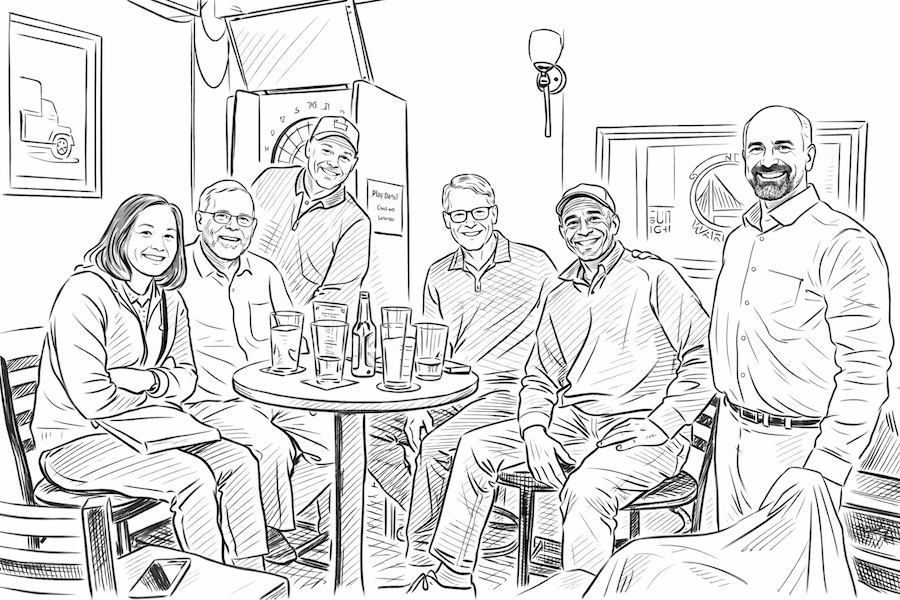
In the past three weeks, I’ve held two more dinners with a total of fourteen people in Los Gatos and San Francisco. As these conversations accumulate, it’s becoming clearer what it will take to build a more competitive center-right presence in the Bay Area. What follows are five working hypotheses drawn from these conversations.
In left-leaning places like the Bay Area, the rap on Republicans is that they “don’t care.” They oppose taxes to fund more social services because they don’t care about poor people. They oppose abortion because they don’t care about the well-being of women. They oppose tax increases to fund public transit because they don’t care about systems they don’t use themselves.
Of course, some Republicans may fit that description, but overall it’s a bad rap. Most want government to help those in need through targeted, effective programs. To overcome this perception, we should frame our ideas around expanding opportunity — better schools, safer neighborhoods, and stronger pathways to upward mobility. “Caring” is performative unless the programs that express it actually work. When voters see that our policies aim both to help people and hold systems accountable for results, the caricature of indifference becomes harder to sustain.
Bay Area Republicans are not going to convert large numbers of No Party Preference (NPP) voters through messaging alone. Rather, we need to create environments where people can think clearly, speak honestly, and hear one another without the usual tribal pressures. Many NPPs and moderate Democrats are not looking for a new ideology so much as a place where thoughtful people can have honest conversations without being quickly sorted into moral categories.
Done well, small gatherings — over dinner or at local bars — can begin to dissolve the reflexive distrust that defines much of American politics. When NPPs encounter Republicans who are serious, grounded, and pragmatic, it becomes easier to appreciate their ideas and imagine ways to collaborate. The goal is not to “convert,” but to expand how people think and foster collaboration where possible. Over time, these relationships become the foundation for a new brand and coalition.
No effort to build a center-right presence in the Bay Area can avoid the question of Donald Trump. The problem is that Trump’s gravitational pull quickly makes him the only topic people can think about, overwhelming any attempt to articulate a forward-looking agenda. For that reason, it is counterproductive to talk about him in public messaging, even when the underlying concerns are legitimate. The practical effect is to collapse a local project into a referendum on a single national figure — which gets us nowhere fast.
At the same time, avoiding the topic entirely is neither credible nor wise. In private, high-trust conversations, it is both possible and desirable to engage honestly with how Trump has reshaped the country and the party. Foundational questions about strategy and ethics — how a party builds trust, how leaders should conduct themselves, and what standards followers should uphold — are not resolved through messaging, but through candid discussion among those doing the work. By keeping the focus externally on what we are building, and internally on these questions, we preserve both clarity of purpose and the honest dialogue needed to develop alignment over time.
In a region where Republicans are widely assumed to be noncompetitive, the most persuasive argument is not rhetorical but empirical. What people need to see is a credible path to winning. That path begins with local elections that may lack visibility but offer something more valuable: the opportunity to demonstrate competence, build trust, and show that a center-right approach can deliver tangible results in communities skeptical of the Republican brand.
Success in the local arena does more than add a few seats; it begins to change expectations. When voters see capable, grounded Republicans governing effectively, it becomes easier to imagine Republicans in higher office. Local victories also create a bench of leaders who understand governance and coalition-building in a place like the Bay Area. The path to statewide relevance does not run around local politics — it runs through it.
Typically, Republican leaders decide to target a race and then look for a candidate to fill it. Given the registration and trust deficit Republicans face in the Bay Area, a more promising approach is to reverse that logic: identify individuals already demonstrating leadership, judgment, and commitment to their communities, and then determine where they have the best chance to succeed. This requires patience and discipline, but it increases the likelihood that candidates run from a position of strength.
In the Bay Area, where the margin for error is small, candidate quality matters enormously. Voters are not simply evaluating policy positions; they are assessing whether someone seems capable, reasonable, and trustworthy. By focusing first on people — their character, credibility, and ability to engage across differences — Frontier Republicans can put forward candidates well-positioned to earn the trust of voters and advance the Frontier mission. Over time, this approach compounds — building a bench of credible leaders who gradually reshape expectations about what a Republican candidate can be in the Bay Area.
These hypotheses are starting points, not final answers. Each will need to be tested, refined, and in some cases discarded as the work continues. Taken together, they point toward a different way of building a center-right presence in the Bay Area — one grounded in relationships, credibility, and demonstrated results.
No posts
Comments
Nothing yet. Say the first thing.
Sign in to join the conversation.