
Recently, I read Steve Martin’s autobiography, Born Standing Up: A Comic’s Life. It’s a quick, enjoyable read. And though I had never come across it, it’s not new. He published it nearly twenty years ago now (2007), and it chronicles primarily his early life through his successful stand-up career.
I’m definitely a sucker for an autobiography, in particular when the subject is a noted comedian and actor. Among many fun stories and lessons in the book, one stood out to me that I’ve been sharing with friends and colleagues frequently since.
Martin shares the best advice he ever received, from his contemporary the late, great Johnny Carson: “You’ll use everything you’ve ever learned.” The arrow-through-the-head gag, for instance, that Martin used in his legendary stand-up routine came from an original magic kit he received as a child. Prior to performing comedy, he was a magician, working in a magic shop and taking his routine on the road.
Years later, as one of the biggest comics in the world, it was that nod to his magic act that became his visual on-stage identity.
You’ll use everything you’ve ever learned.
As the world has gotten faster…almost overwhelmingly so… it has become increasingly difficult for many of us to recognize the beauty of a meandering existence. Millennials have been dubbed the “burnout generation” as we reach our 40s and navigate enormous pressures to adapt and succeed. The generation behind us is now growing as a percentage of the workforce and faces even greater pressure, with cost of living higher than ever and the existential threat of artificial intelligence taking away entry-level work.
I see it in the university students that I teach. They feel a visceral need to “know” - who they are, what they will do, and how they will succeed. How sad, because very few people truly know the path they are on by the time they are in their early 20s. Comfort with being young and making mistakes has eroded over the years. “We simply don’t have time to waste,” I hear, though they may not express the sentiment in those exact terms.
When I was younger, I envied the people who had it all figured out. They went to school for something, with a plan, and then executed it to perfection. I didn’t have that clarity. I liked a lot, and so I explored a lot. Yet as I’ve matured, I’ve realized that Carson’s advice is dead on, though only part of the story.
You’ll use everything you’ve ever learned…and you’ll need it.
Stagnation is truly the only mistake we can make. If we are moving, in any direction, accumulating skills, experiences, or stories, we’re filling a tool box that might come in handy when we least expect it.
Finding new stages at every stage of life.
Over the past year, my job has required significant more travel, to speak at conferences, host panel discussions, or emcee industry events. I really enjoy it, and I seem to be decent at it. When colleagues ask me how I’m so comfortable in front of audiences, I joke that I’m a “failed comedian,” which makes conference halls far less intimidating.
Perhaps that’s overly self-deprecating, but it’s also true. I spent 15 years actively trying to pursue a career in comedy. I performed many times a week, spent thousands of dollars on classes, and even had an agent and auditioned a fair amount in Los Angeles. During those years, I felt like I was leading a double life. During the day, I worked a corporate marketing job, and at night I would perform or take classes. I did this for years and years. Of course, I recognized that performing comedy improved some aspects of my corporate skills. I was comfortable networking, thinking quickly in brainstorming sessions, and working with people from many backgrounds. But I still considered the roles separate. Marketer and comedian.
Then something funny happened. Slowly, and maybe deliberately, my day job started to draw more on the skills I was refining with my “hobby.” And comedy has continued to play a surprising role in my career as it has developed.
I’ve gone to meet with design teams at Fortune 100 corporations, only to realize that the “client” is someone I performed shows with in Brooklyn, New York, in 2014. I’ve been asked as to host events and industry gatherings with little planning time and without scripts. That’s ok, “I’m an improviser” I think, I’ll figure it out. And usually I do.
You’ll use everything you’ve ever learned…and you’ll need it.
Which brings me back to the beginning. Up until recently, I think the last time I had done stand-up comedy myself was just before COVID in early 2020, so more than six years ago. I found myself in New York in July, with a free night and the task of preparing to host meetings at another event for marketing leaders in Times Square the next day. For some reason, I felt compelled to find a stage.
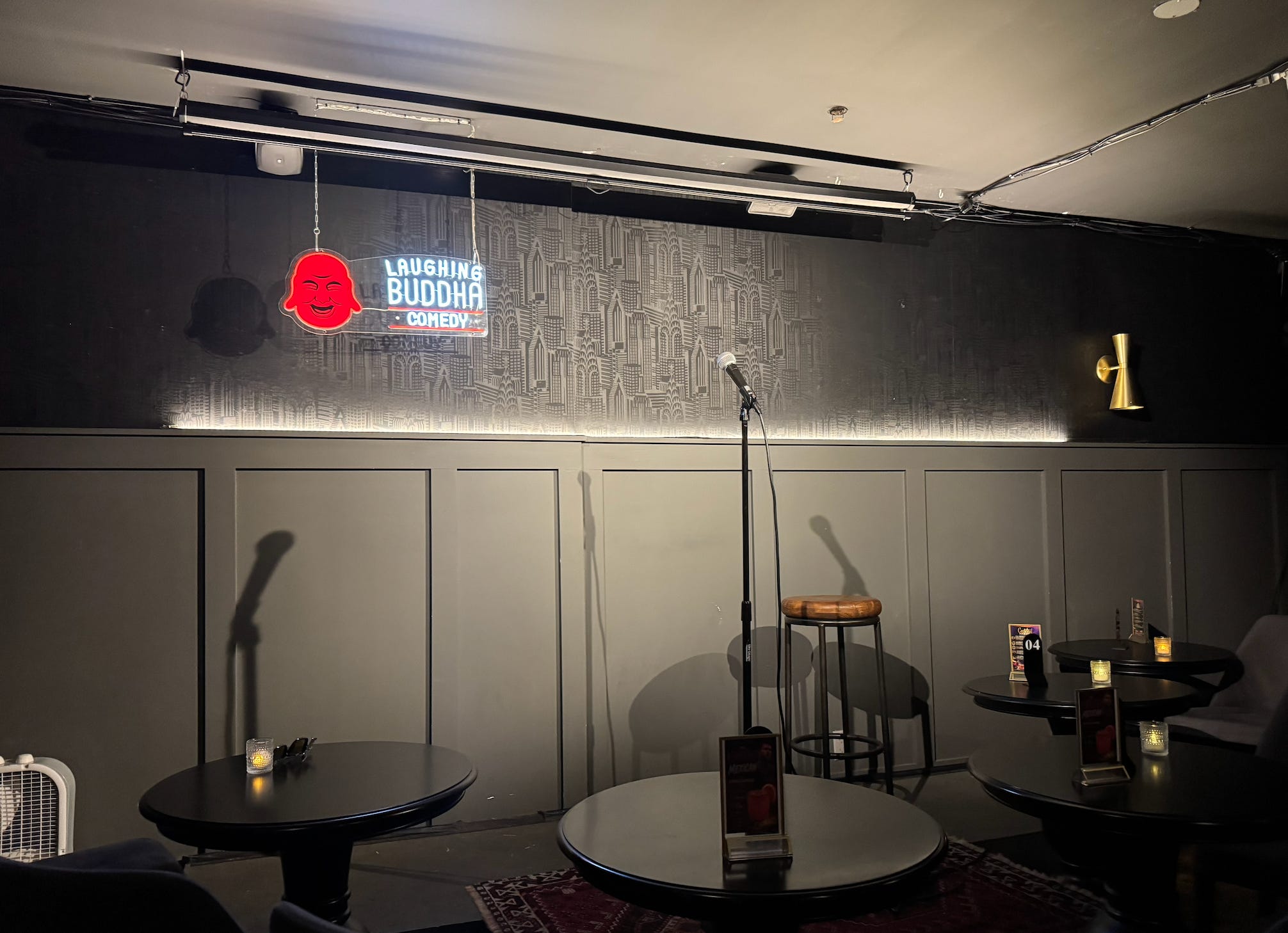
So I looked up an open mic, there was one in my neighborhood (only in New York). It started in 15 minutes. I walked over quickly and put my name on the sheet, next to a young woman named Jazz who was also waiting in the bar before they opened the doors. She was from LA, and was in New York for the week to do a bunch of shows and try to expand her network. We chatted a bit about both cities and then entered the show.
I’m sure my set was forgettable, especially since I didn’t have any material before going on stage - I just riffed on what others had said. That’s not really the point of an open mic anyway. It felt good to do bits, to meet some hungry young creatives, and to share space with people trying to find their own purpose.
Comedy stages aren’t likely to get bigger for my any time soon, and that’s ok. Finding my way back to them has been a blessing and a reminder of how far I’ve come. One of the reasons I got into comedy in the first place was that I loved the idea that even successful comedians would go back to small rooms to work out new material. There is almost no other art form where that happens. Comedy is inherently experimental, and vulnerable. Which is why it translates so well to other disciplines.
I may be performing comedy less than before, but I’m using comedy more than ever in my work. What about you?
What is something from your past life that you find has been unexpectedly helpful in your current work? I bet there is more than you’d realize.
Comments
Nothing yet. Say the first thing.
Sign in to join the conversation.