
At a time when artificial intelligence seems to be reshaping every corner of every industry, we’ve lost focus on the reality: organizations that win are *still* the ones that get the people part right.
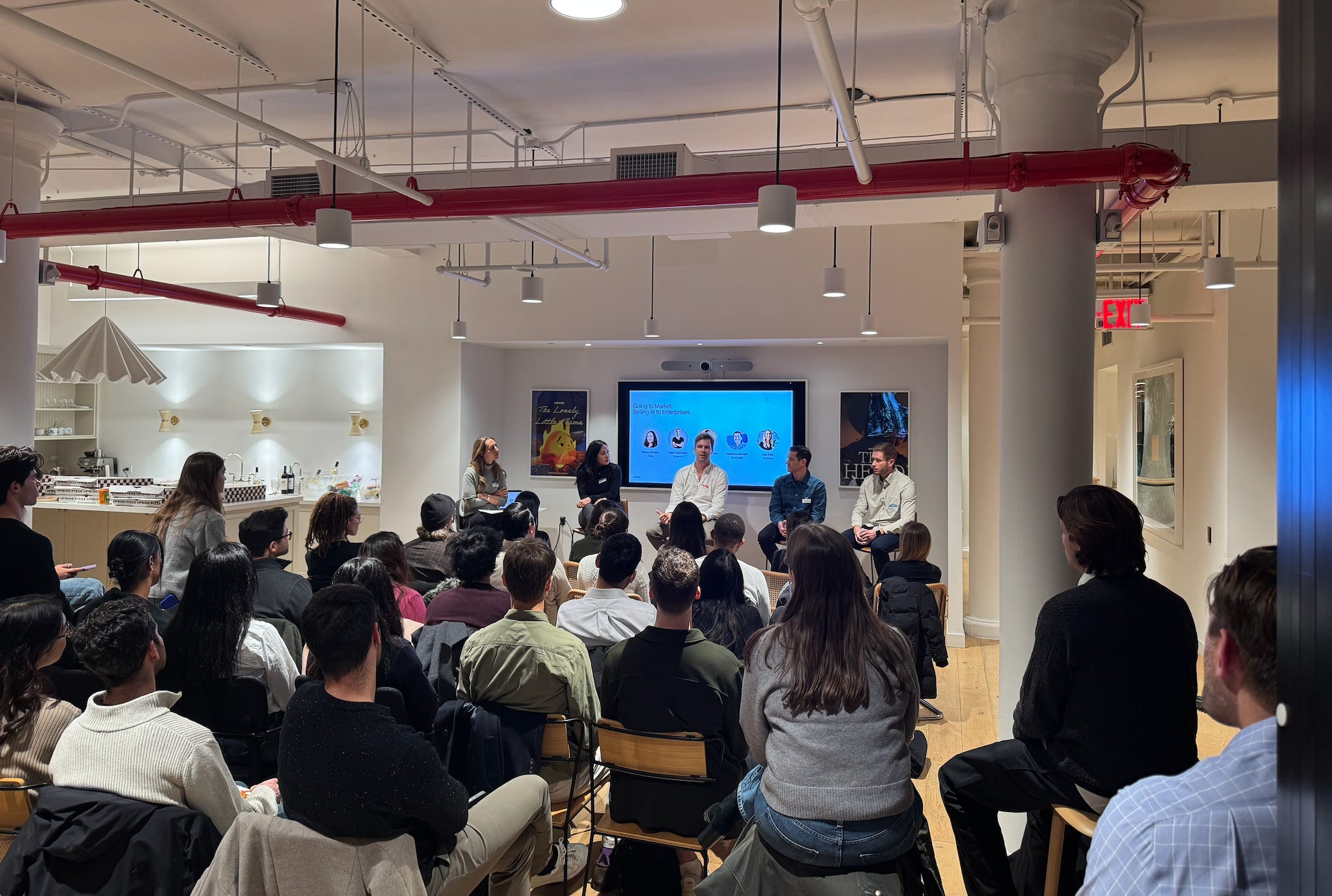
This was a key theme at an event I attended last night in New York City. Hosted by Runway, a professional AI video production company, a panel of market leaders from notable AI-led organizations shared strategies and challenges in building modern businesses - often at breakneck speeds.
The panel was capably hosted by Runway’s Liza Katz in the company’s beautiful office space, and featured:
Hans Husmann, Enterprise at Scale AI
Matthew Kempin, Head of Enterprise Sales at Synthesia
Nancy Mottice, Partnerships at Clay
Robert Lendensky, Enterprise Sales Leader at Glean
The audience was filled with young, engaging, excited builders, and I’d imagine all of them are smarter than me (even just a few of the conversations I had blew me away). In a room of technologists and strategists, there was predictable agreement that innovation is accelerating, tools are changing monthly (or weekly), and competitive advantages are increasingly short-lived.
But relationships, trust, and a genuine understanding of customers? Those are much harder to replicate—and as such, more valuable than ever.
Among several, below were my three biggest takeaways from the panel discussion.
AI may be revolutionizing workflows, but technology alone doesn’t build loyalty, affinity, or belief. Panelists emphasized that as automation increases, what becomes scarce—and therefore most valuable—is emotional connection.
Leaders talked about how “getting the people relationships right” isn’t a soft skill; it’s the strategic lever. The companies that stand out are the ones investing in community-building and relationship-centered experiences: curated dinners, intimate IRL gatherings, and thoughtful post-sale touch points that reinforce trust long after the contract is signed.
When answering a question on the top skill these leaders look for when hiring talent, Husmann responded with “EQ (emotional intelligence).” Noting that the technology is learned, but understanding people, responding to their needs and adapting to various environments and working groups is much, much harder to achieve if it is not an innate skill. Glean’s Lendensky added another traditional ‘soft skill” to the mix, sharing that he looks for people who are curious - “if you aren’t curious, this is not the industry for you.”
The last year-plus has been rife with hype - and inbound investment - and untested growth. But that initial enthusiasm seems to be waning, and what’s left are customers looking for AI businesses that can support them - for real, and for a long time.
This talk-track resonated deeply with me. In my role, I lead customer engagement for a team within the creative industry. Ultimately, that boils down to understanding our customer needs, the success / product management, marketing, strategy, etc., that we deploy is a result of deep listening and trust-building. Not simply a focus on selling, but a focus on partnership.
For its part, Katz highlighted how Runway has doubled down on its post-sale approach, building programs that drive engagement of customers so that they see continued and sustained value from doing business with the brand. Mottice articulated her approach as moving beyond account planning. “I shouldn’t say it this way, but I don’t plan very much. Instead, I believe in increasing the surface level for luck.”
In a market where technology becomes ubiquitous quickly, the relational layer becomes the moat.
Another theme was the idea that the most effective product teams are the ones who immerse themselves fully in their own tools. “Use your product everywhere,” was a unanimous consensus. It’s not just dogfooding (a term they collectively agreed we need to replace), it’s a discipline. To step outside of the industry, I would argue this is good advice for anyone in any business.
Consider the “Ptolemy complex.” Ptolemy helped shape many solid philosophical perspectives, yet it was based on a flawed assumption, that the universe revolved around the Earth. Too many businesses operate with this same flawed assumption, that customers will want whatever you build simply because you want them to.
Truly living the product experience reveals what user research alone cannot: subtle friction points, workflow gaps, and emotional moments that shape product love (or frustration). This approach doesn’t just improve quality—it forces teams to stay close to reality, not assumptions.
Equally important: we must resist the urge to become a caricature of ourselves. Put differently, technology teams should reflect the diversity of the users they build for. Not just slick tech peeps in vests and fitted slacks playing ping pong in the office.
Several leaders stressed the importance of hiring beyond traditional tech backgrounds, bringing in people who speak the language of the customer and who understand markets from the inside. The future of AI-powered products depends on perspective diversity as much as engineering excellence.
While the pace of development has never been faster, the panel agreed that the fundamentals of good product and buisness building haven’t changed—they’ve simply become more essential:
Lead with value
Do the research
Listen deeply to pain points
Build trust early and often
It sounds simple, but in a landscape dominated by hype cycles and feature races, returning to these basics is its own form of competitive strategy. I liken it to the return of tactile content in marketing, or, why direct mail has had its own form of Renaissance in an overly-digital era.
Rapid iteration only matters if the direction is right. And the right direction comes from grounding in customer needs, not assumptions or internal excitement.
Mottice from Clay captured this well when she spoke about the importance of designing experiences that bring people together and strengthen connection—because even the best technology still relies on human networks to grow, spread, and find meaning. At Monotype, some of the most rewarding work I’ve been able to do over the past few years has aligned with this approach. Picking great partners, building great environments for connection, and then letting luck find your business.
—
AI will continue to reshape industries, roles, and workflows. But the companies that thrive won’t be the ones chasing every emerging capability—they’ll be the ones building technology around people, not instead of them.
Trust. Community. Perspective diversity. Deep understanding of real human pain points.
Those fundamentals have never mattered more.
What do you think?
Photo by Philippe Bout on Unsplash.
Comments
Nothing yet. Say the first thing.
Sign in to join the conversation.