
Several weeks ago, Nvidia announced a suite of new services and developments on their platform. While it’s still early days and information is still coming out, the media seemed to miss the implications of Nvidia announced.
The announcements seem to mark a shift in strategy by Nvidia. They’re changing the kinds of workloads they’re trying to target, the services they’re trying to provide users, and the products they build. I wanted to take a stab at breaking down what Nvidia is trying to accomplish, the challenges associated with doing so, and what it means for the ML & AI space.
What did Nvidia announce? ➡ Nvidia Announced the Omniverse
As they put it, the Omniverse is a collection of tools for building applications in the metaverse. In their view, the metaverse connects the real world and virtual worlds. The Nvidia Omniverse is a platform for building and operating metaverse applications.
From the keynote, Jensen Huang mentioned the following1:
The metaverse—the 3D internet—is delivering enormous opportunities for everyone. From artists building content across multiple 3D tools, developers building AIs trained in virtual worlds, or enterprises building digital twin simulations of their industrial processes, metaverse applications are here, and everywhere.
Now, this is a lot of buzzwords, so let’s breakdown what they’re actually trying to do.
Nvidia wants to be a strong part of the future of gaming (ok, this is obvious)
Nvidia wants to enable AI developers to create real world applications via simulations - virtual worlds for things like self-driving cars and digital twins to model factory processes.
What’s more important to note is how they intend to deliver this product to customers - Nvidia making a massive bet on cloud services for the first time. Nvidia isn’t just trying to “stay within their lane” of hardware, they’re trying to own the end to end use case from hardware to software to managed service.
This is a big move for a couple of different reasons:
🤝 coopetition with cloud providers and other hardware vendors
🚚 Changing the delivery model
👩🏻💻 Betting on software, not just hardware
Let’s explore each of these…
🤝 Coopetition with cloud providers & other hardware vendors
Earlier this year Nvidia’s attempt to buy ARM (to keep their pricing power) failed due to regulatory scrutiny.2 Nvidia dominates the existing accelerator market for the most part. However, this market is beginning to diversify and get more and more competitive. Competition means worse margins for Nvidia.
It’s not just general competition, it’s also who is competing. Nvidia is also going to have to compete and cooperate with the cloud vendors both providing Nvidia GPUs as well as their own products like AWS Graviton and Google Cloud TPUs.
Nvidia wants to keep selling large amounts of GPUs to these cloud vendors to maintain their business, but they have to compete with them at the same time.
This represents a pretty stark change to Nvidia’s future, they can’t just rely on selling hardware. They want to get into services as well and in doing so will compete with the cloud vendors at their own games.
🚚 Changing the delivery model
Nvidia sells hardware. They sell it to consumers for gaming (won't talk about this), crypto (won't talk about this)3, and businesses as racks they can integrate into data centers.
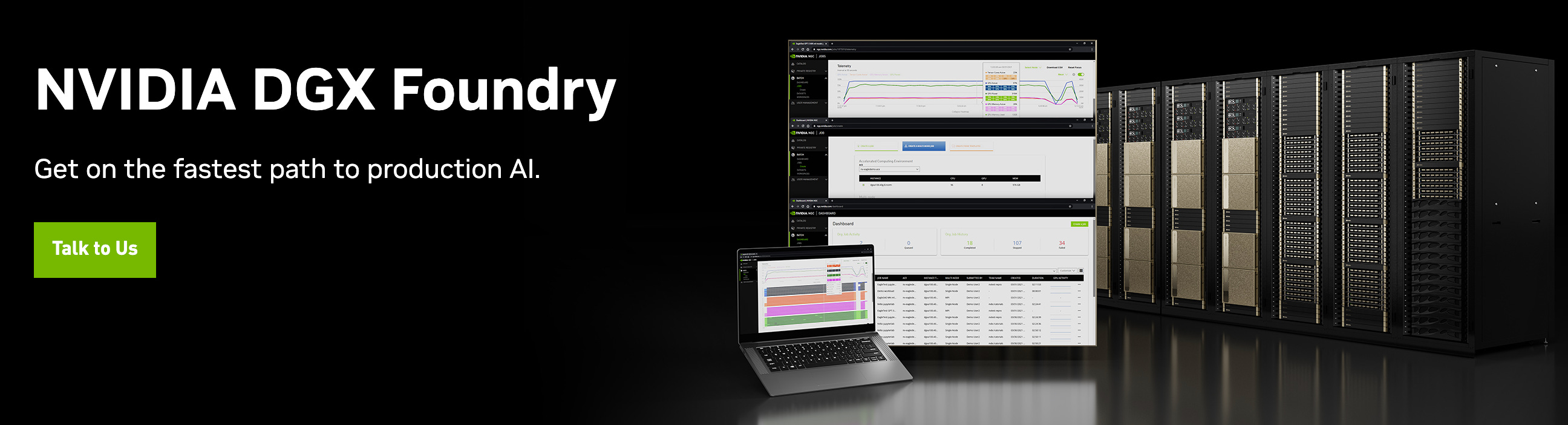
What does this look like for a customer? You talk to them, they install a bunch of servers in a data center then you’re off to the races. The problem is, this business has its limits. The delivery model is terrible (compared to software) and involves all kinds of challenges.
Now what the Omniverse Cloud represents is a move to a new delivery model, one foreshadowed by Ben Thompson of Stratechery. He caught this in an interview with Jensen Huang (CEO of Nvidia) earlier this year4:
if we ever do services, we will run it all over the world on the GPUs that are in everybody’s clouds, in addition to building something ourselves.
This is a pivot for Nvidia. It represents the coopetition with the cloud vendors but also the pivot towards a new delivery model. It seems like they’re targeting two approaches:
A licensed version of Omniverse with container images or an Nvidia AMI.
Buy an Nvidia managed service in the cloud (currently in early access)
A managed service is a new adventure for Nvidia and involves a lot more than shipping licensed software.
👩🏻💻 betting on software, not just hardware
This new delivery model represents a change for Nvidia. It represents a bet on software, not just hardware. Here are several examples of what Nvidia is taking steps towards:
Now all of these remain built around Nvidia GPUs but these are all software products. They’re all products that seem like something AWS or an independent software vendor would build. Let’s take a deeper look at each of these products.
The product positioning (seen below) is spot on - people want this capability. This is an obvious workload - people want to scale batch workloads across the cloud.
The catch is, can Nvidia build a good product for this? They’ve got the GPUs, they’ve got that hardware to software knowledge but the challenge is do they have the culture to build a self-service SaaS product? Do they have the right people in place to lead the charge?
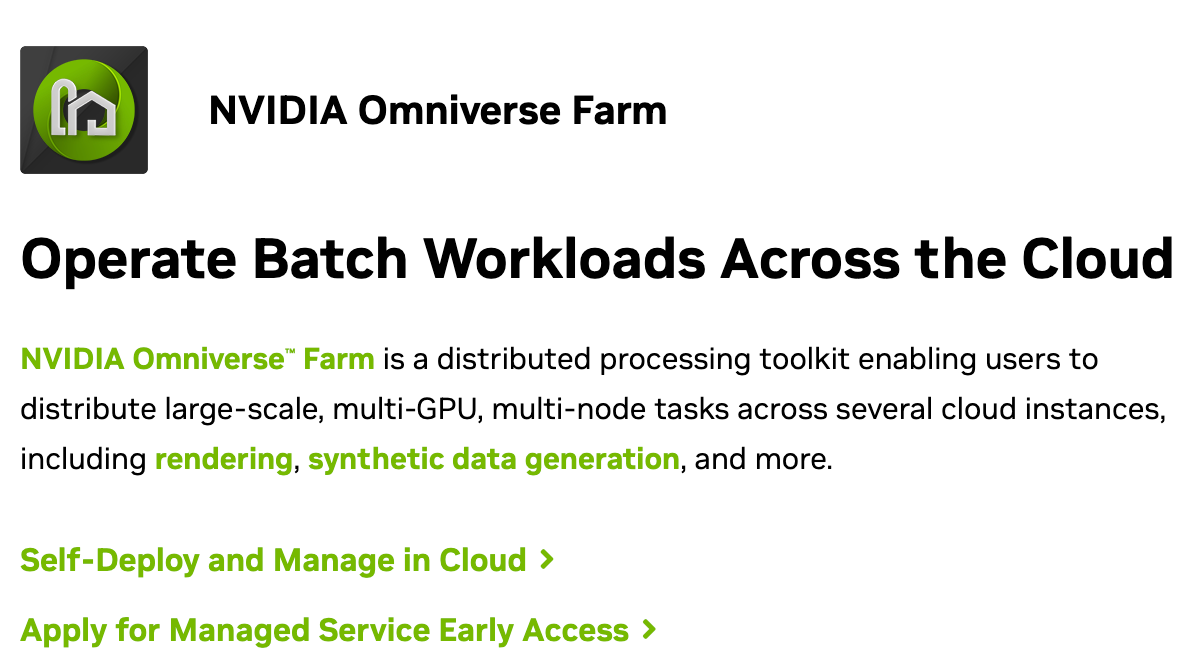
It’s crazy to think of a world where Nvidia is competing with Databricks or Snowflake for cloud workloads, but this product seems to suggest just that.
Nvidia is betting self driving cars are going to be huge. Now there’s been a lot of spiking on self-driving cars recently, but $100B is no amount of trivial spend and Nvidia wants to capture as much of it as possible. Nvidia wants to control the simulation software or provide simulations as a service for companies building self-driving cars.
Doing simulations well is critical in the space and it’s a massively intensive compute workload. What’s interesting about Drive Sim is that it’s not just (necessarily) licensed software but I’d wager that it’s a whole compute platform as well.
This is a different bet, rather than betting on a particular workload as in the case of Drive Sim, they’re betting on an entire pipeline / general use case: computer vision. The interesting bet here is that this is open source and targets being an end-to-end computer vision pipeline tool.
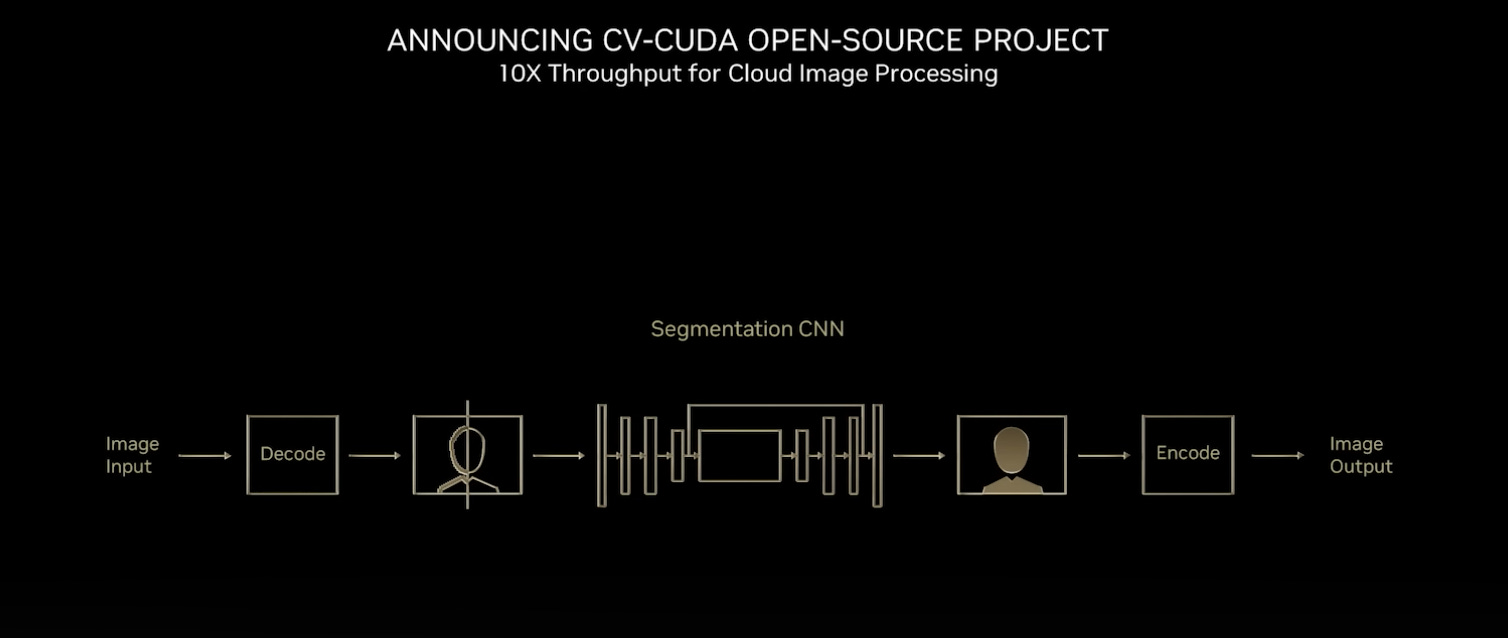
CV-CUDA is an open source project that enables developers to build highly efficient, graphics processing unit (GPU)-accelerated pre- and post-processing pipelines in cloud-scale Artificial Intelligence (AI) imaging and computer vision (CV) workloads.
This directly states Nvidia’s ambitions - they want to target end user software development. It also dabbles into open source as well as cloud data processing.
Nvidia Triton Inference Server
Available as a Docker container, Triton integrates with Kubernetes for orchestration, metrics, and autoscaling. Triton also integrates with Kubeflow and KServe for an end-to-end AI workflow and exports Prometheus metrics for monitoring GPU utilization, latency, memory usage, and inference throughput.
Now Triton is more typical software delivery for Nvidia. It’s also open source.
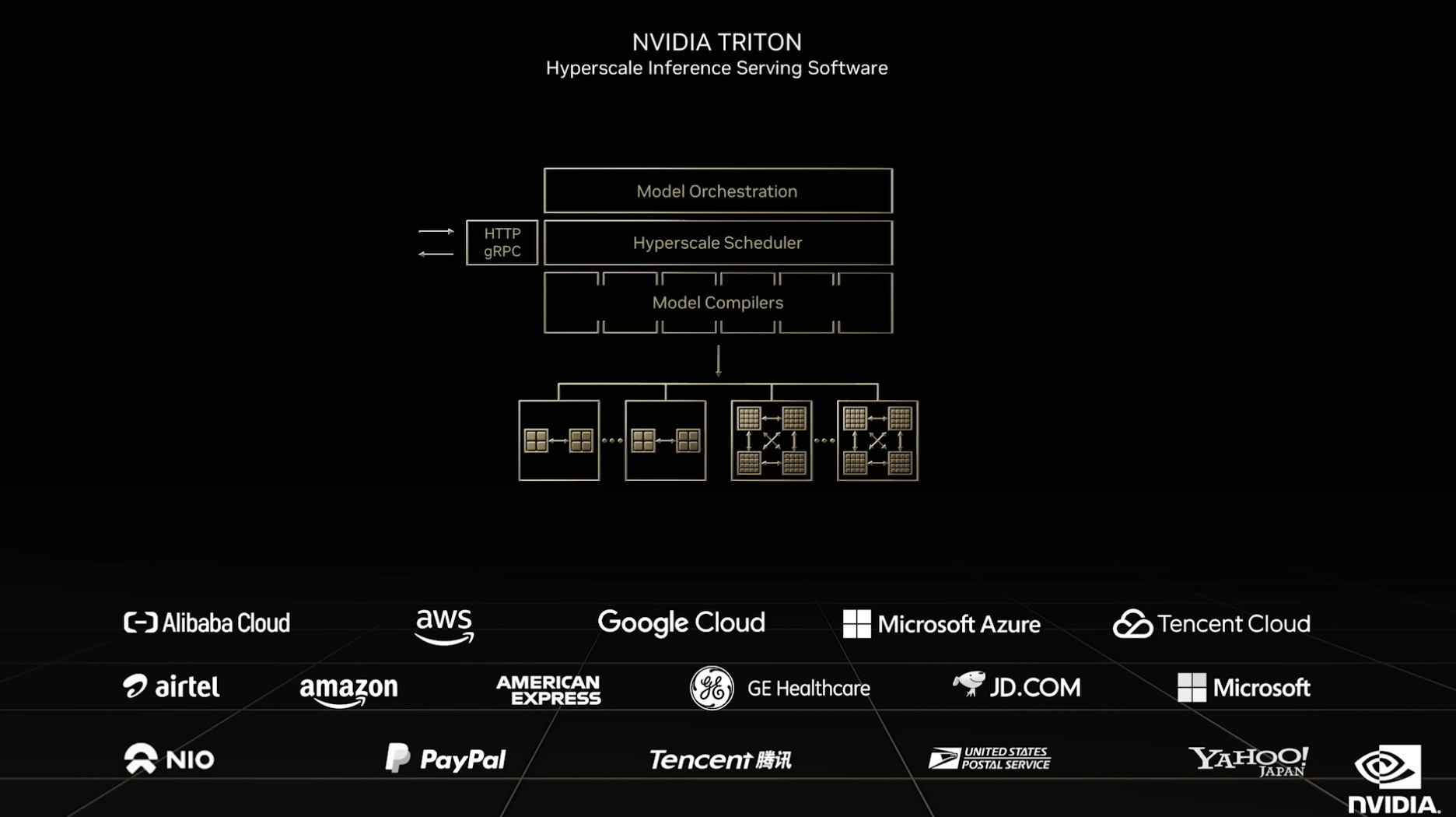
In the future, do they plan on providing this as a serverless product? Something that is fully managed in the cloud? There’s a ton of potential things to evolve this product into, especially if you consider cloud.
The Road Ahead for Nvidia
If I have to put myself in Nvidia’s shoes and estimate what they’re trying to do is that they’re trying to build a product portfolio that provides high margins and a more diversified income stream than just hardware. Now there isn’t a ton of data on all of these projects at this point, they’re basically all in early access, but over the coming year we should get a much better picture of how Nvidia aims to shift their business.
“Today, we announced new chips, new advances to our platforms, and, for the very first time, new cloud services,” Huang said as he wrapped up. “These platforms propel new breakthroughs in AI, new applications of AI, and the next wave of AI for science and industry.”
Could Nvidia become a dominant player with software running on all the clouds? Crazy to imagine but they’re moving in that direction. If you’ve got thoughts to share, drop a comment below - would love to hear them!
https://blogs.nvidia.com/blog/2022/09/20/keynote-gtc-nvidia-ceo/
https://www.nytimes.com/2022/02/07/technology/nvidia-arm-softbank-deal.html#
https://stratechery.com/2022/an-interview-with-nvidia-ceo-jensen-huang-about-building-the-omniverse-cloud/
Comments
Nothing yet. Say the first thing.
Sign in to join the conversation.