
A Note on Nomenclature
Curiosity is a funny thing. When my wife Alex and I moved our family from central Michigan to western Pennsylvania in the fall of 2022, I was of course keen to get familiar with the local birding scene. Birding paints a portrait of a region in a way few hobbies can. An avid pursuer of the local avian life quickly becomes acquainted with the surrounding roads, woods, fields, and… runs?
As I drove around Allegheny County in those early days, particularly to birding locations near our home in the suburban North Hills of Pittsburgh, I couldn’t help but notice the area was lousy with runs. Everywhere the road signage announced their presence—Fall Run, Hart’s Run, Willow Run, Thompson Run, the wonderfully named Gourdhead Run.
There was no escaping it—Pittsburgh had the runs. But what the hell were they?
A run, as far as I was able to deduce, is a stream, nothing more, nothing less. In our corner of the North Hills, all the runs form part of the Pine Creek Watershed. The runs feed Pine Creek, which in turn feeds the Allegheny River.
And that’s where my curiosity about runs petered out, even though I didn’t quite have the full picture.
Not until I started exploring the fascinating history of our nearby run, Crouse Run, did my curiosity rekindle. Why the heck were all these streams called runs? Were there clear features warranting one body be labeled “creek” and another “run”? As far as my research can tell, not really! The terms are pretty ambiguous and often region-dependent. Creeks are not necessarily bigger. Runs are not necessarily faster. Brooks don’t necessarily babble any louder. Run is simply a regional term, used predominantly in Appalachia and the mid-Atlantic to describe a stream, and there seem to be no defining physical characteristics that distinguish a run from a brook, creek, rivulet, rill, runnel, or any other term attached to a flowing body of water deemed too puny to be called a river, though I invite you, dear reader, to bring your intel to the party and correct me if I’m wrong!
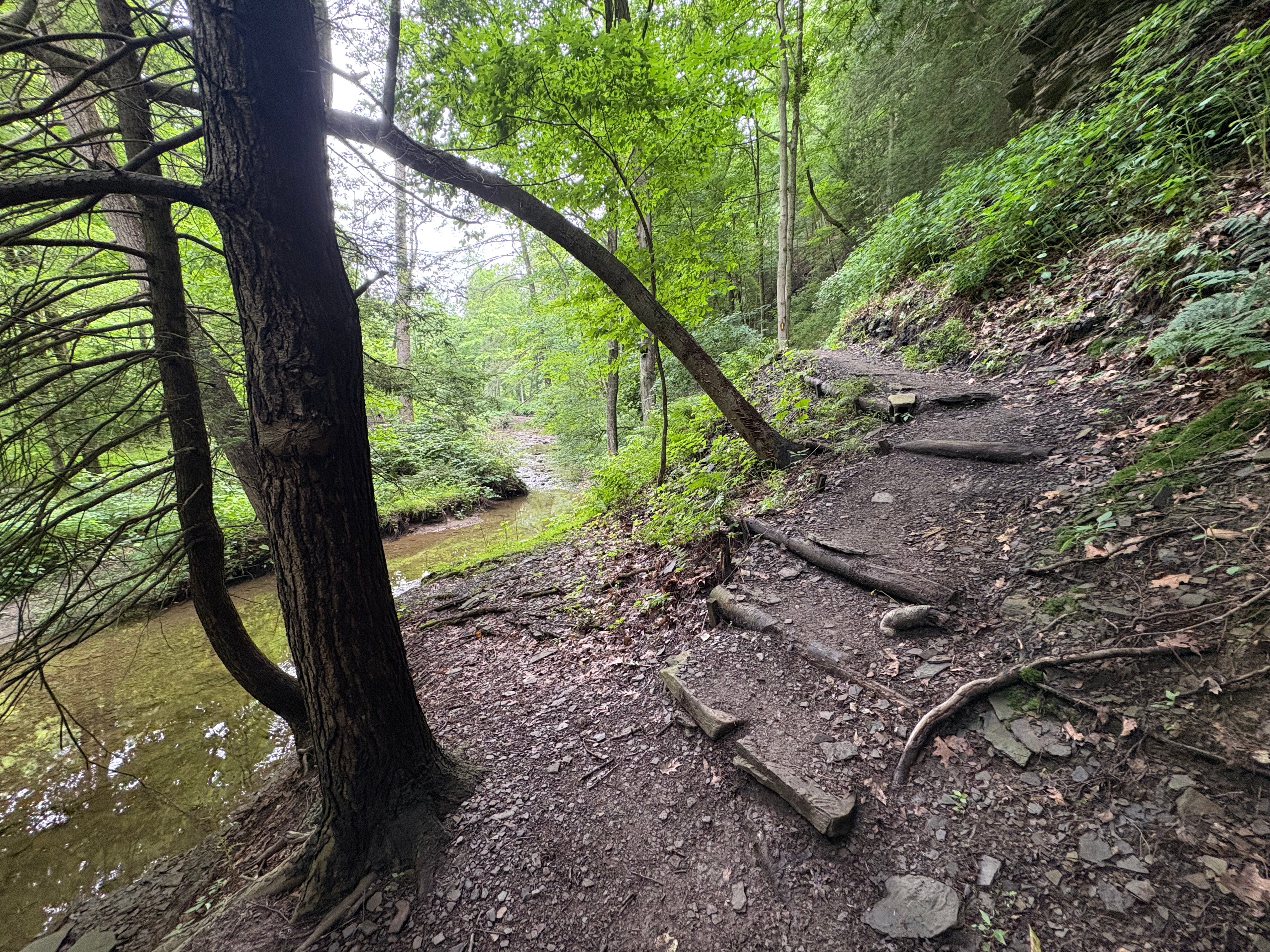
Now that I’ve sort of been able to clear that mystery up, let’s get back to the run in question—our family’s favorite run, and with good reason, because for all their loveliness, I’m not sure any of the local runs can top the combined beauty and biological and historical interest of Crouse Run.
In the first of this three-part series, I told the story of Italian opera singer-turned-entrepreneur Francesco “Frank” Bongiovanni, who in 1920 opened the largest dance hall in the eastern United States along the banks of Crouse Run.
The Bootlegger and the Birds
·
May 13
Local lore. My birding patch is full of it. The valley directly behind our house features a section of Pine Creek, an active railroad line, and one of the oldest roads in the Pittsburgh suburb of Hampton Township. I began exploring the area when we moved here in the fall of 2022. Birds were the main draw, of course. A healthy water corridor flanked by w…
Today that dance hall is a ruin that sits 1.7 miles from our home. A century ago, Bongiovanni’s Gardens was a retreat where Prohibition-era Pittsburghers went to dine, dance, and drink bootleg liquor. Those with automobiles could drive north from the city. Others got there via the Butler Short Line, the electric trolley that deposited passengers mere steps from Bongiovanni’s doorstep.
But not everyone hopping on the BSL was seeking the kind of entertainment offered at Bongiovanni’s roadhouse. The proprietor may have chosen the location primarily to dodge the long arm of Pittsburgh’s municipal law enforcement, but he also had good taste. Crouse Run is a beautiful creek valley with wonderful biological diversity. The local populace noticed, and the area became a popular destination for picnickers and nature enthusiasts, including one science-minded college student with literary ambitions.
The Biologist
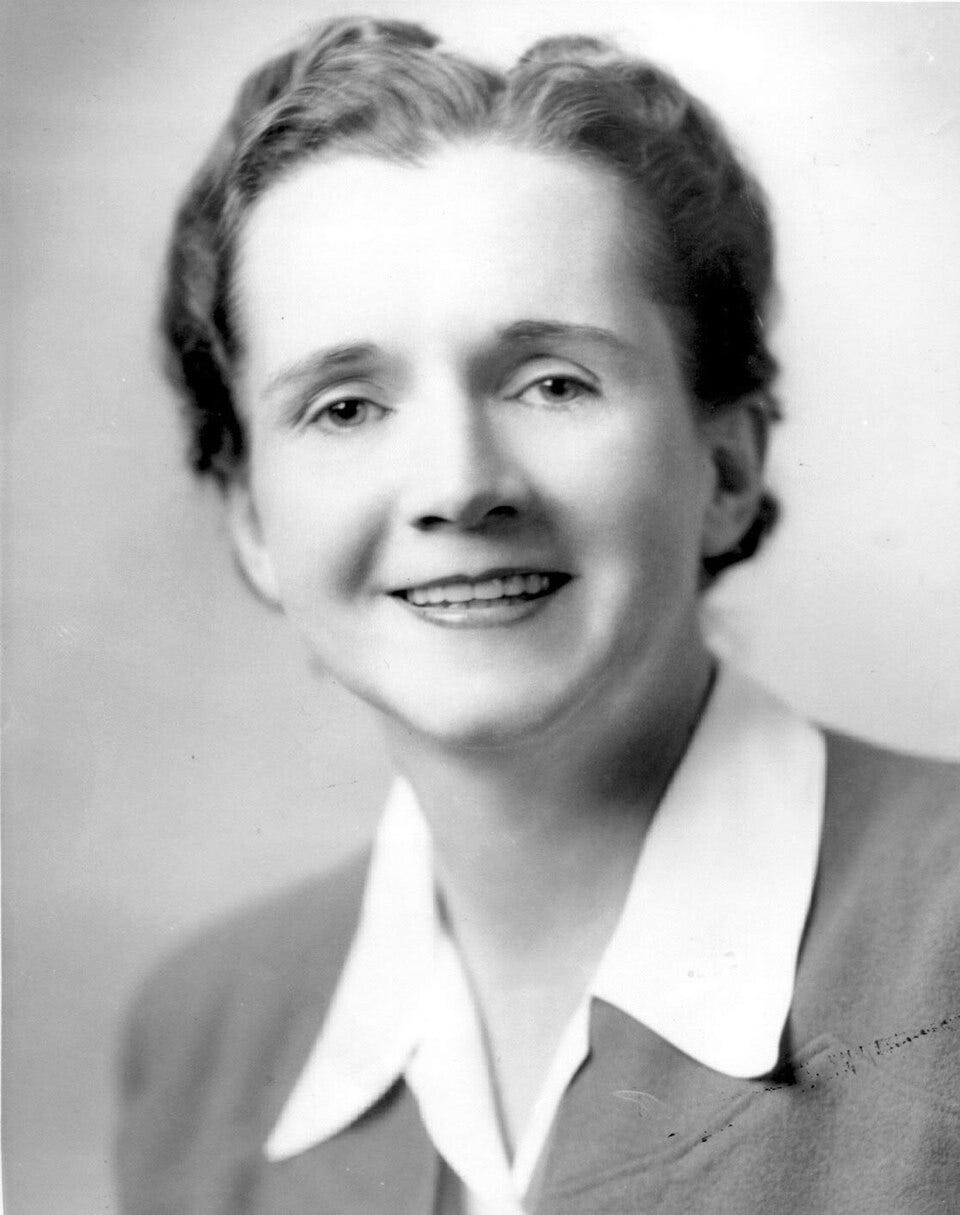
Today we know Rachel Carson as one of the most important conservationists of the 20th century and a driving force behind the modern environmental movement. Birders enjoy the widespread distribution of Bald Eagles, Peregrine Falcons, and Osprey instead of mourning their disappearance largely due to Carson’s efforts in exposing the deleterious impacts of DDT and other chemical pesticides on birds’ reproductive abilities. Her best-known book, Silent Spring, not only led to a national ban of DDT, it also helped mainstream the concept of environmental conservation.
But before she got busy changing the world, Rachel Carson was a curious young girl growing up in rural Western Pennsylvania.
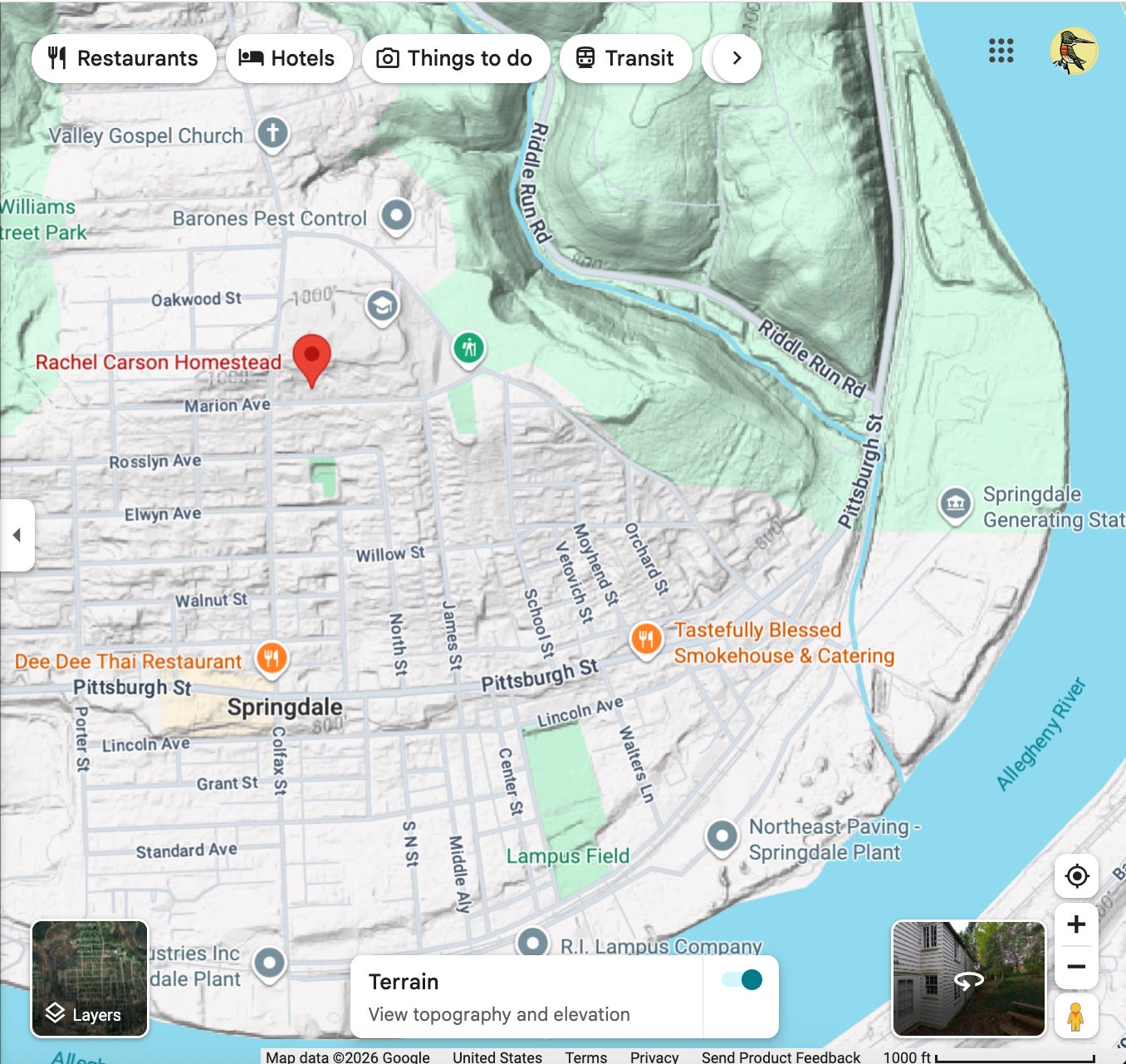
The borough of Springdale, Pennsylvania sits on the Allegheny River, some 18 miles northeast of Pittsburgh. The Carson family owned a 65-acre farm in Springdale when Rachel, their third child, was born in 1907. There, under the guidance of her nature-loving mother, she explored the surrounding fields and woods (and no doubt the nearby Riddle Run!).
A passion for nature sparked early, as did a knack for the written word. Always an avid reader, young Rachel began publishing her own stories in the St. Nicholas League magazine at age 10. At age 14, her first story about nature appeared in the magazine. “My Favorite Recreation” describes a day of “birds’-nesting” and the birds she and her dog encountered during their wanders in the Pennsylvania hills.
But her explorations weren’t limited to the Carson property. Like many families living in the greater Pittsburgh area at the time, the Carsons would ride the Butler Short Line to Crouse Run for picnics, a journey Rachel continued to make after enrolling at the then-Pennsylvania College for Women (now Chatham University), where she studied English before switching her major to biology in 1928.
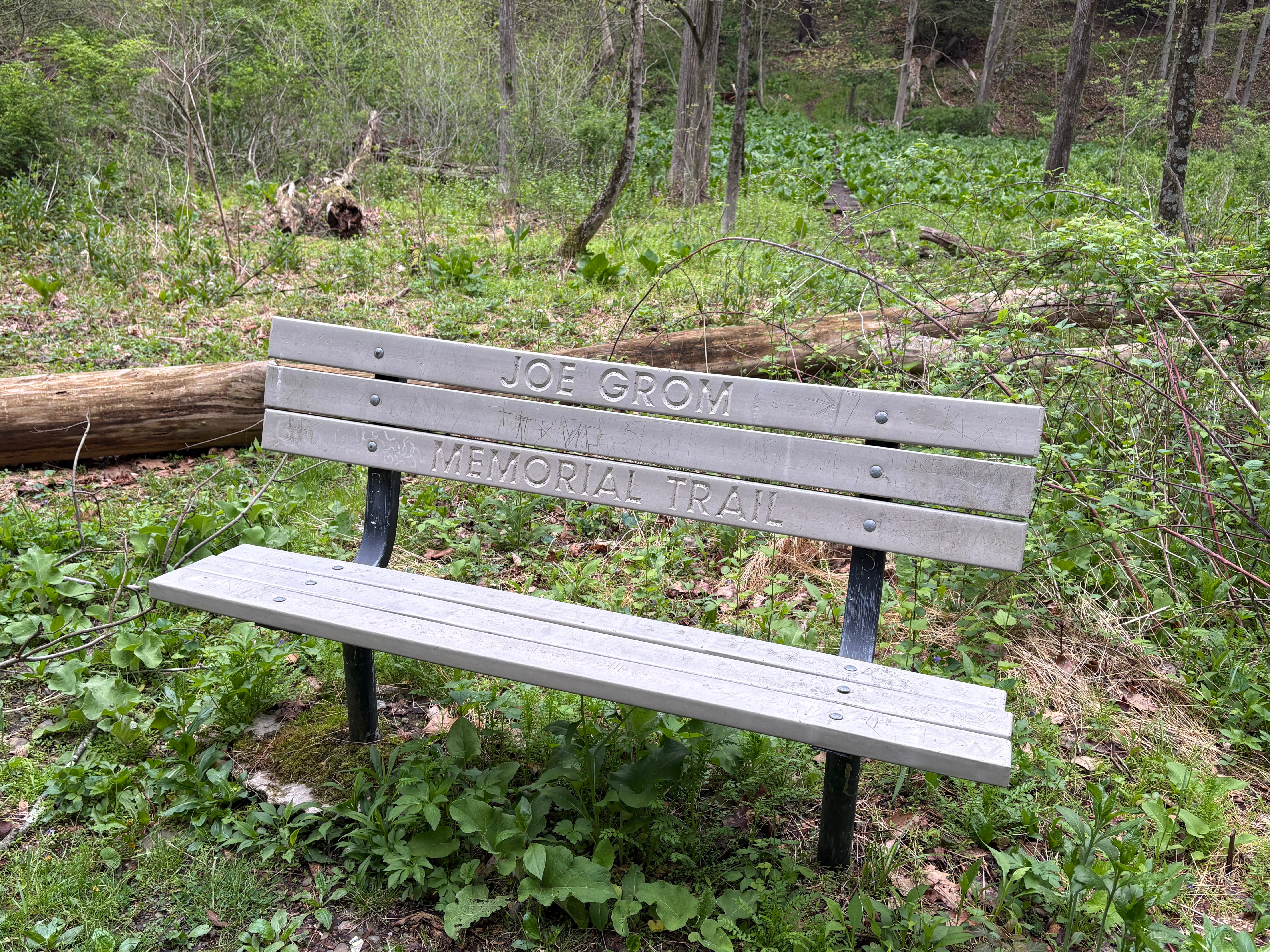
What was the appeal of Crouse Run? The answer begins with its very formation. The valley is narrow and its walls are steep, geologic characteristics that combine to trap cool air year round, making the ravine hospitable to a range of plant species, including some that typically occur in more northerly locations. The Allegheny County Natural Heritage Inventory (ACNHI) has identified Crouse Run as a site of state significance, and its biological diversity has long attracted nature enthusiasts like the legendary Allegheny County naturalist Joe Grom, whose legacy lives on at Crouse Run and whose good works certainly did not warrant the name of our pestilential president being etched into his memorial bench.
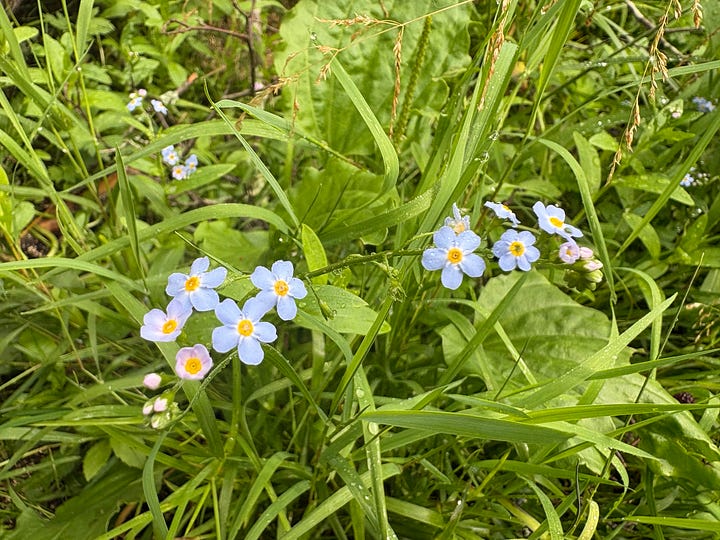
Springtime is particularly magical at Crouse Run, when the flora springs to life and the valley floor is carpeted in native wildflowers, many of them doubtless the same that Carson and Grom observed in decades past.

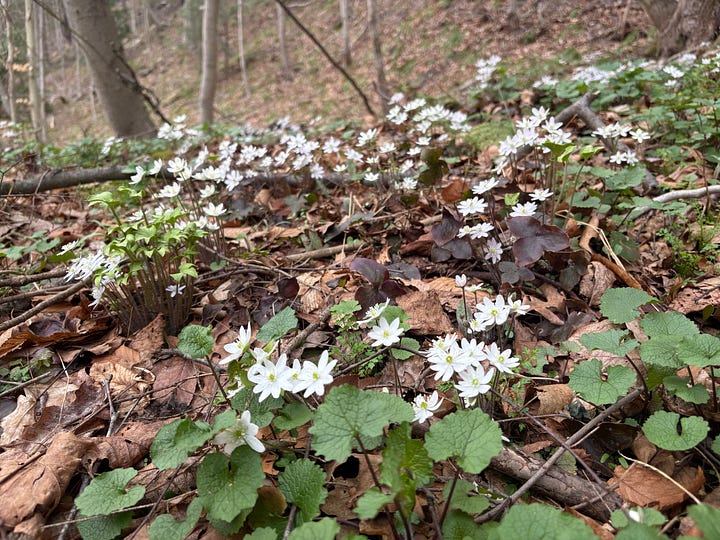
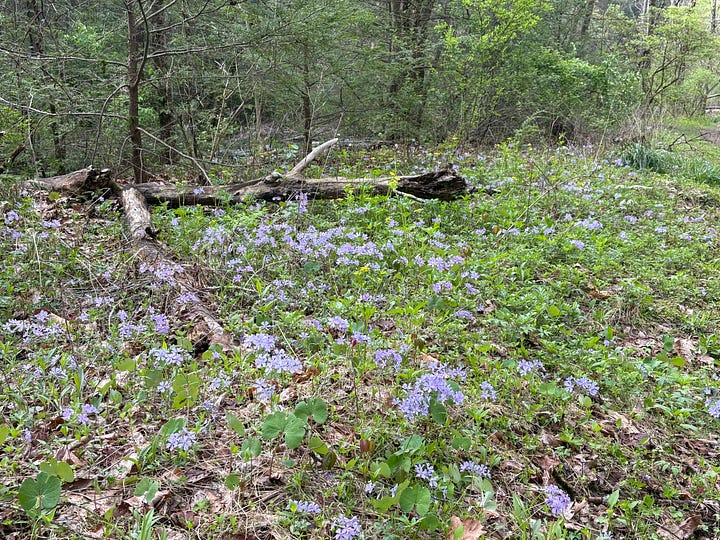
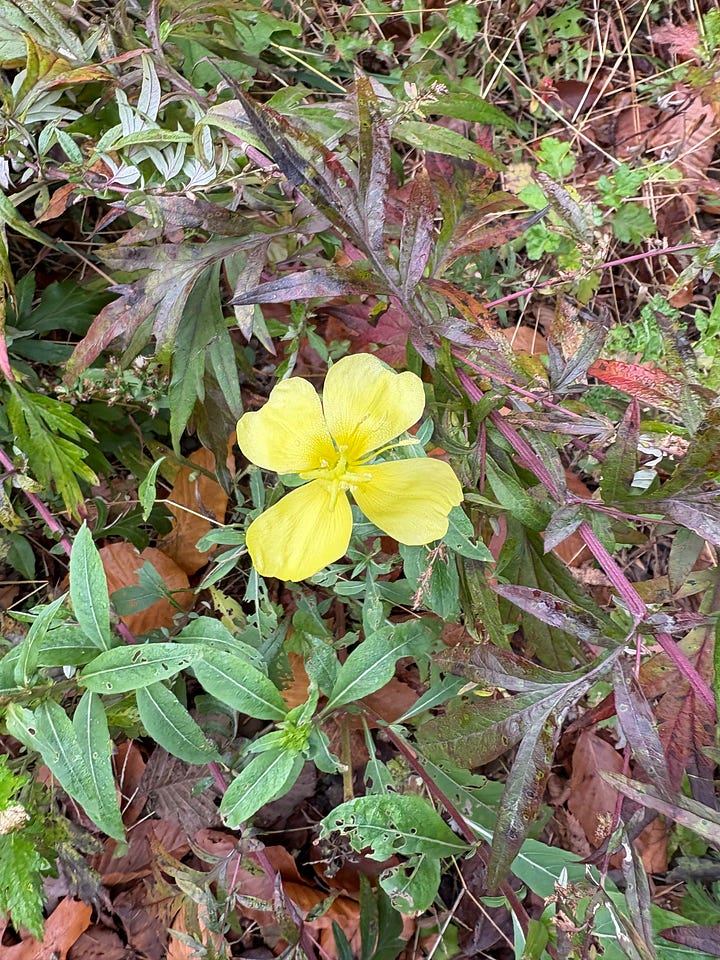
Some aren’t the same. The ACNHI has also identified numerous threats to native Crouse Run’s native flora, including invasive plants. Oh, to travel back in time, a hundred years or so, when Rachel Carson was observing Crouse Run in a more natural state, before garlic mustard and Japanese stiltgrass and any number of other invasive/non-native (though lovely) plants found their way via human intervention into the valley.


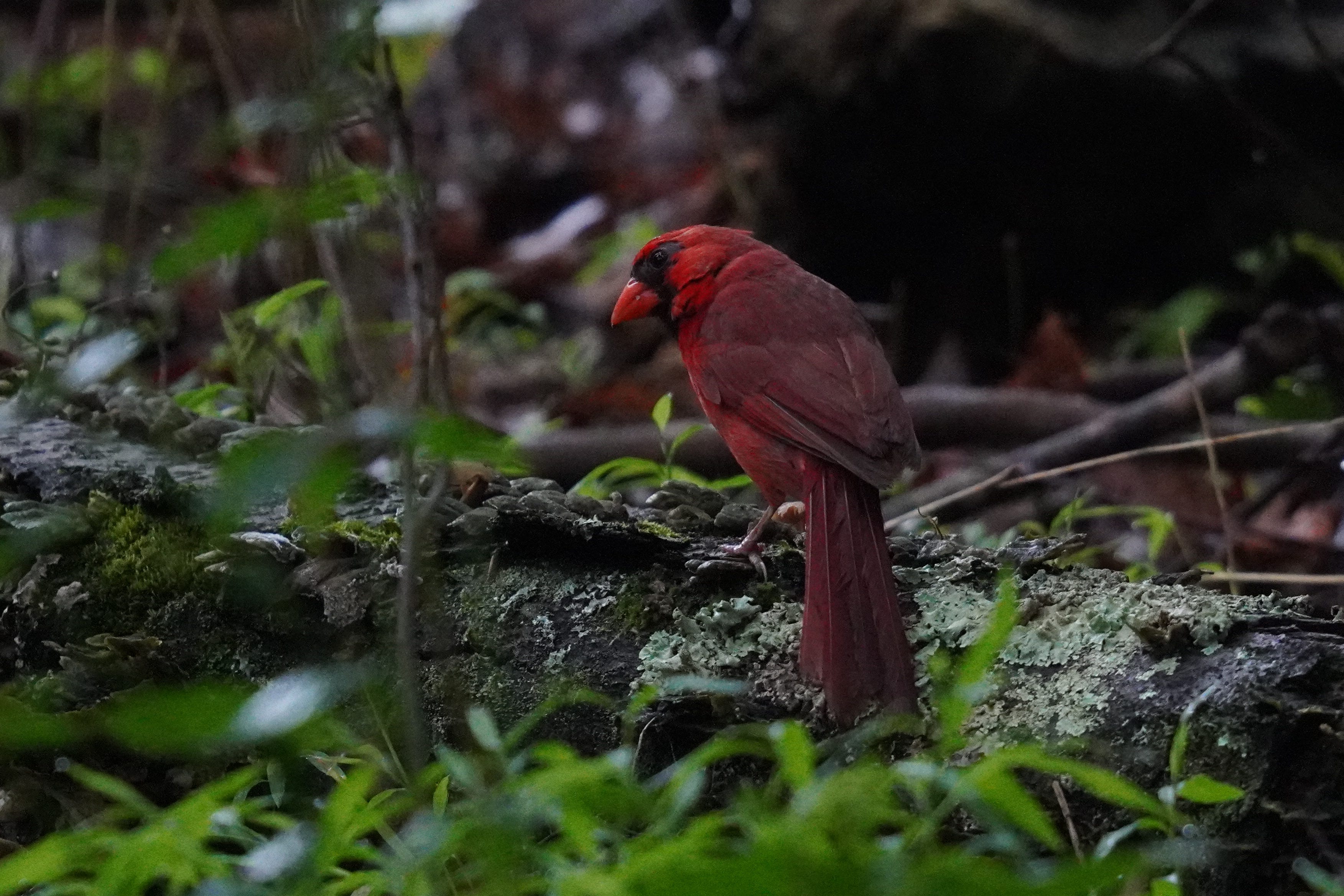
Bird life abounds in Crouse Run too. Did Rachel Carson observe the same birds in 1926 that are typical for my birdwalks a hundred years later? Certainly Carolina Wrens and Red-bellied Woodpeckers, ubiquitous here now, were uncommon or even rare in her day. Even though Northern Cardinals have expanded their range north, I suspect they were well established in western PA a century ago, and hearing a Cardinal’s song in Crouse Run would not have been unusual.
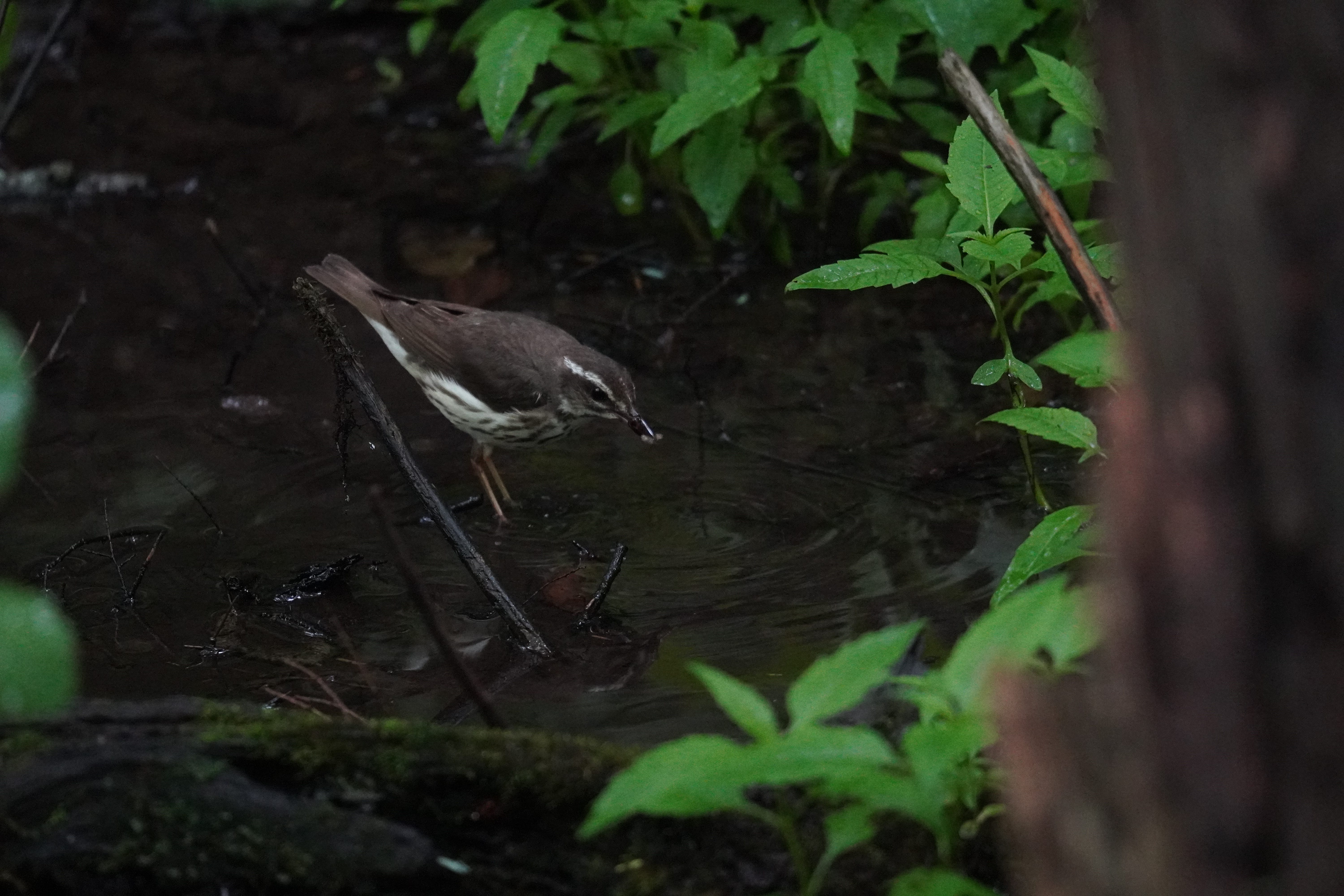
Did Louisiana Waterthrushes breed in Crouse Run in the 1920s like they do every spring today? Did their signature ass waggle amuse Rachel Carson the way it does me in the 2020s?
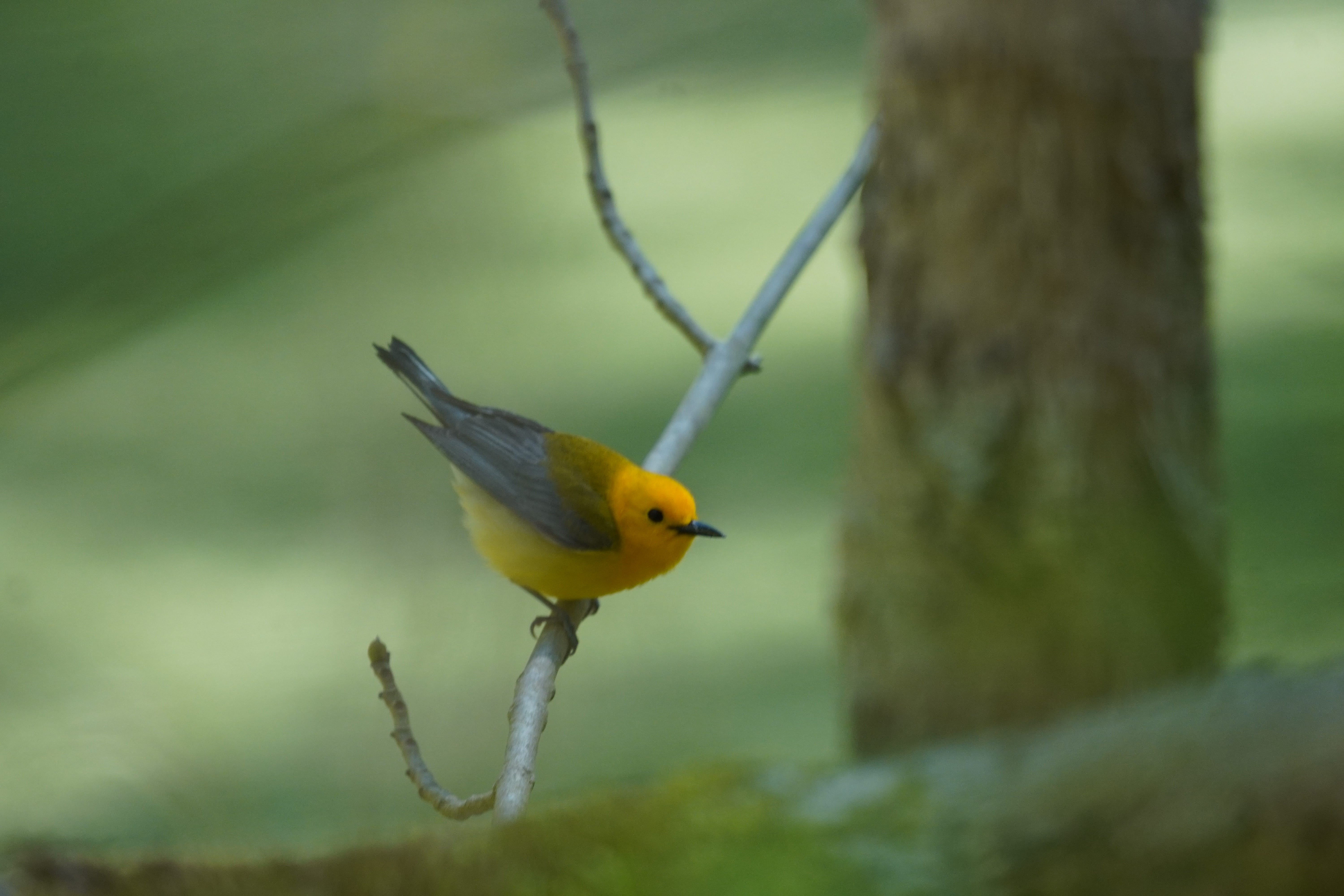
Did Rachel ever encounter a Prothonotary Warbler like the one I found foraging around the pond at Crouse Run? Was it a rarity in western PA in her time too?
I suspect there were at least as many Song Sparrows to be found in Crouse Run in 1926 as there are now. In 2026 you can count on finding at least a dozen foraging along the stream at any time of year.
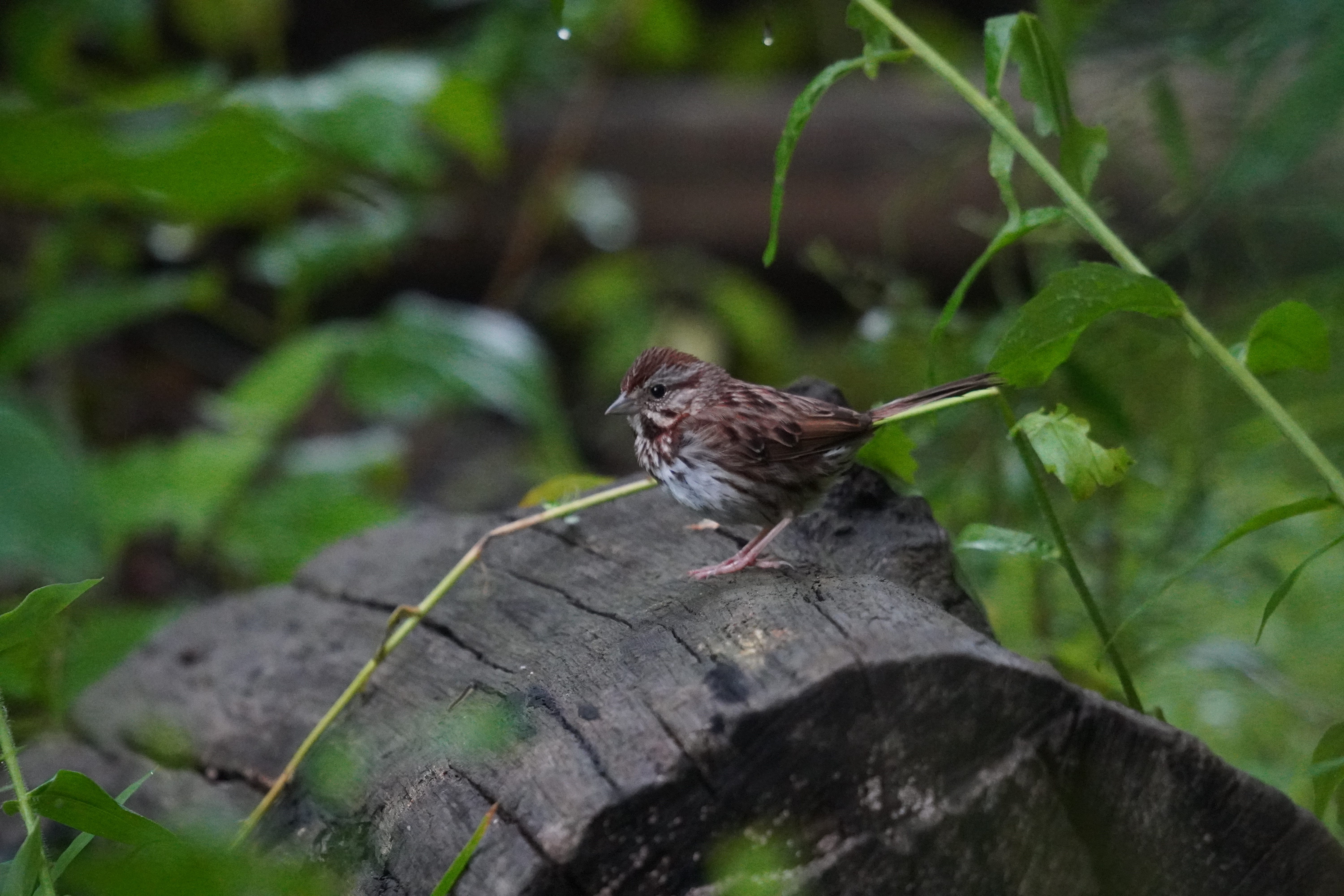
One bird I imagine was not hard to find in Crouse (formerly Grouse) Run in Carson’s time was the bird for which the run is named, but by now the forests of Allegheny County have been altered too drastically for the taste of the Ruffed Grouse, who prefers mixed woods with plenty of the kind of understory that White-tailed Deer have decimated in western Pennsylvania.
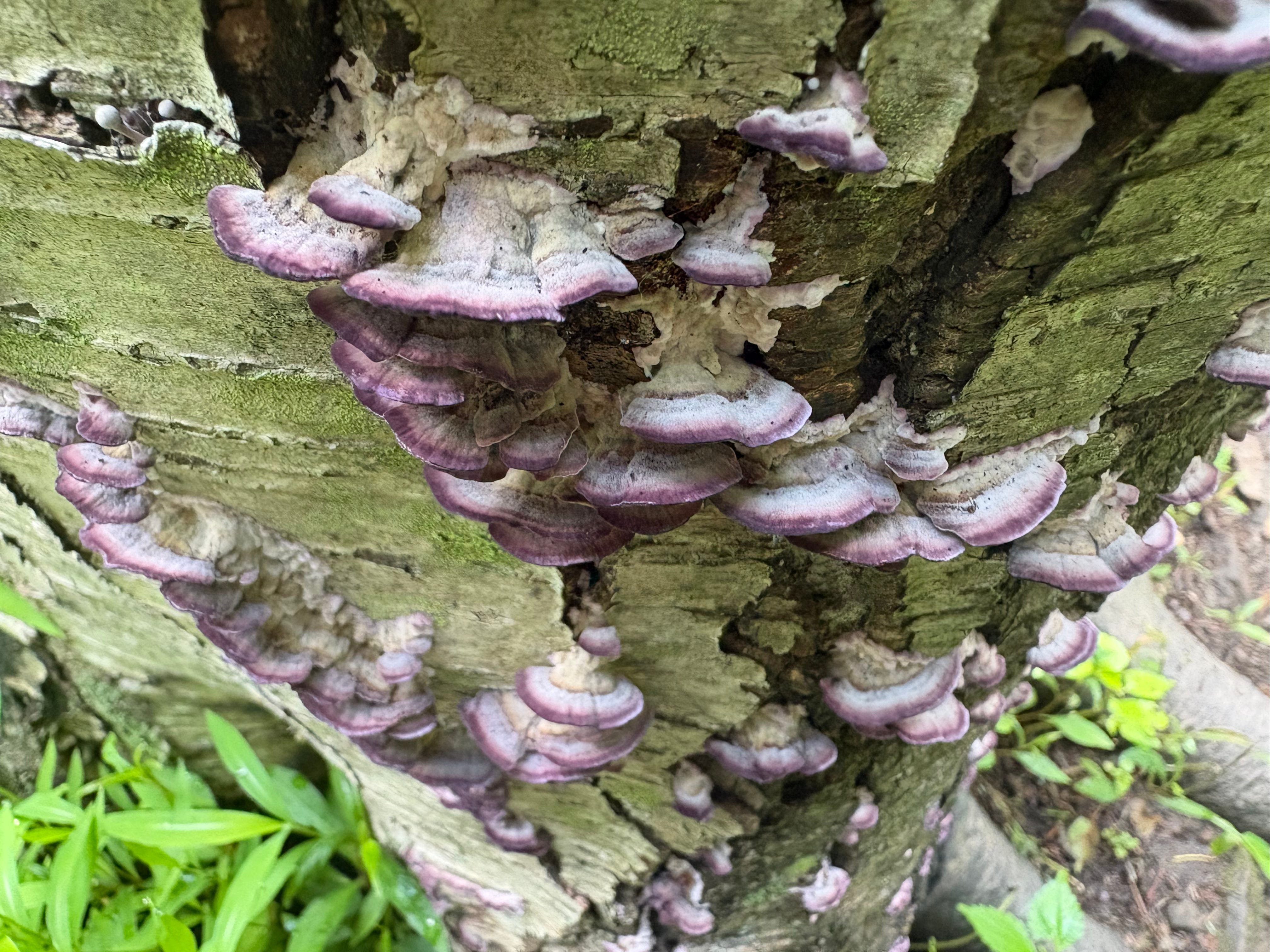
What about the fungi of Crouse Run? Did Rachel Carson take an interest in stunning violet-toothed polypores like these?
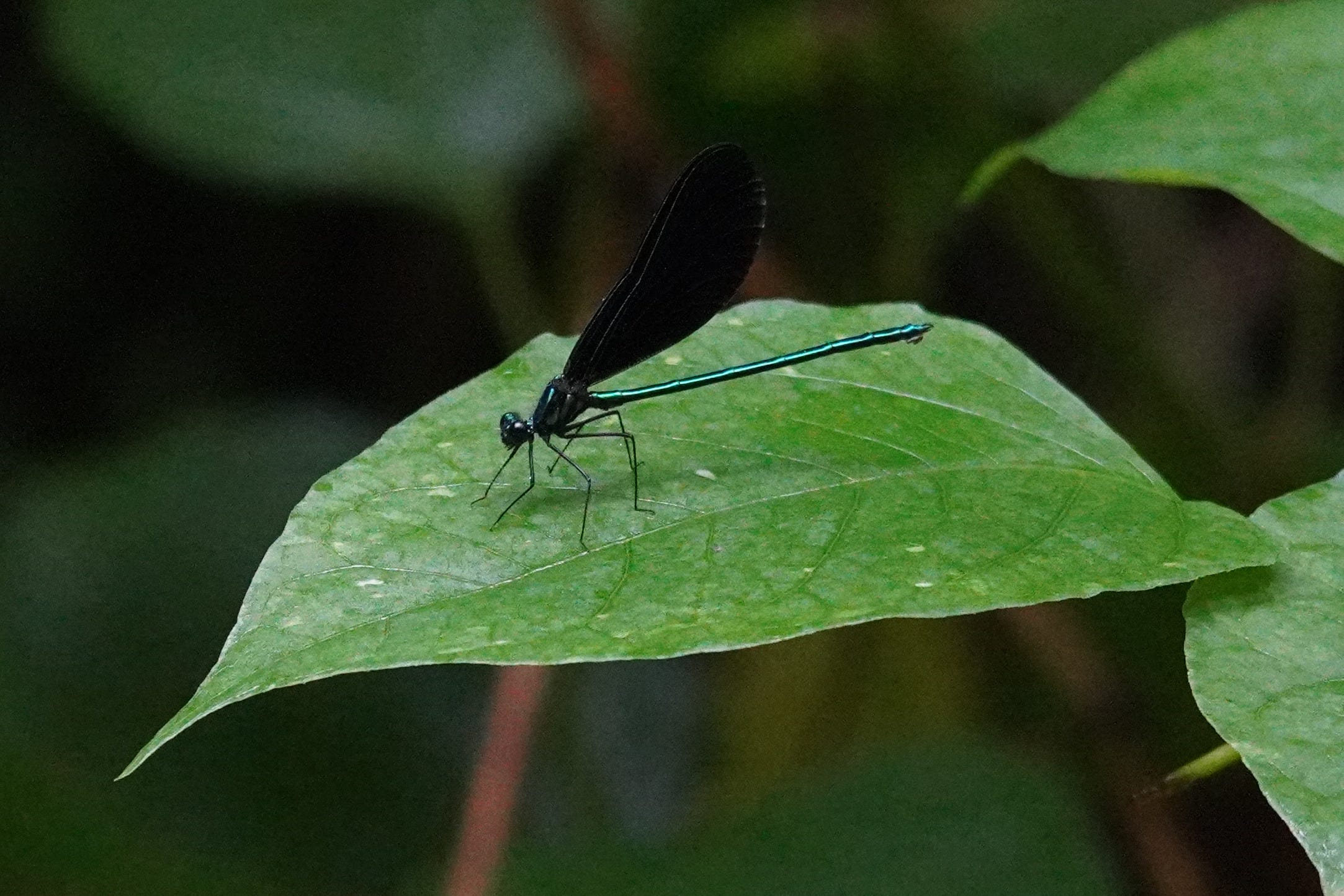
Did Rachel Carson get as much joy observing Ebony Jewelwings as my wife and I do during our strolls?
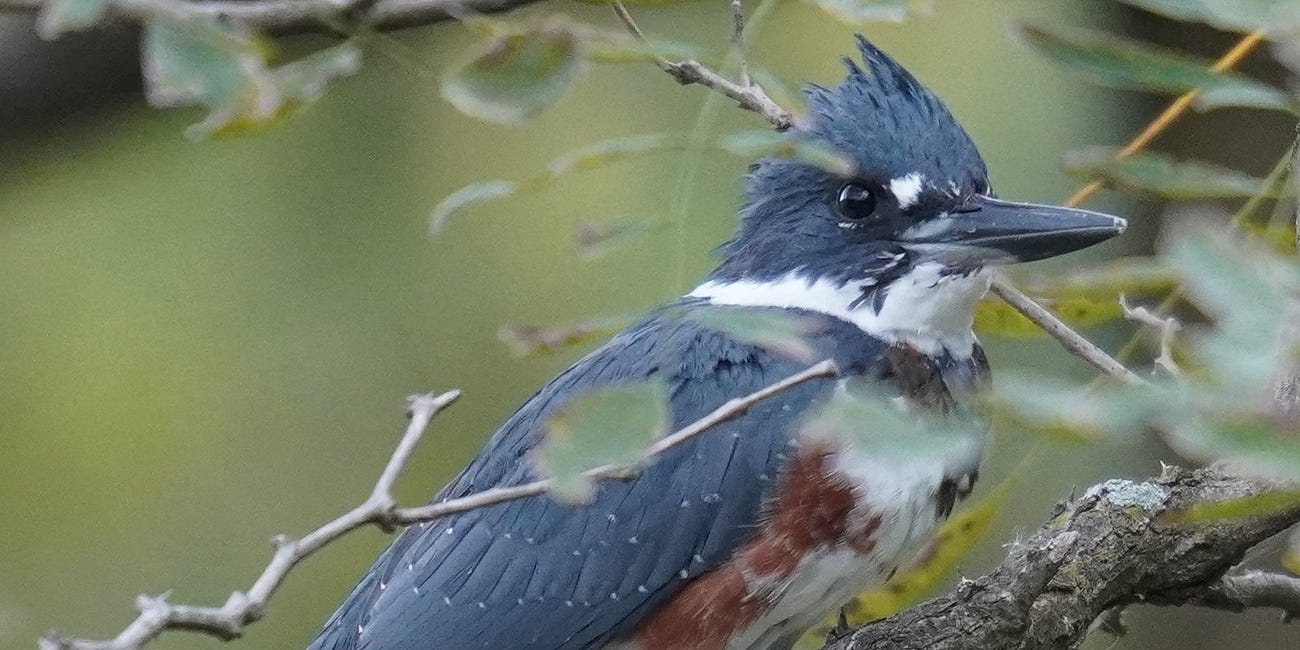
Though she is perhaps best known for saving birds, Rachel Carson was a marine biologist by training, and she burst upon the literary scene with her bestselling trilogy of books about the ocean and marine life. There’s no lack of marine life at Crouse Run, and thus no lack of Belted Kingfishers and Great Blue Herons. Just don’t ask me to identify the fish swimming in this video.
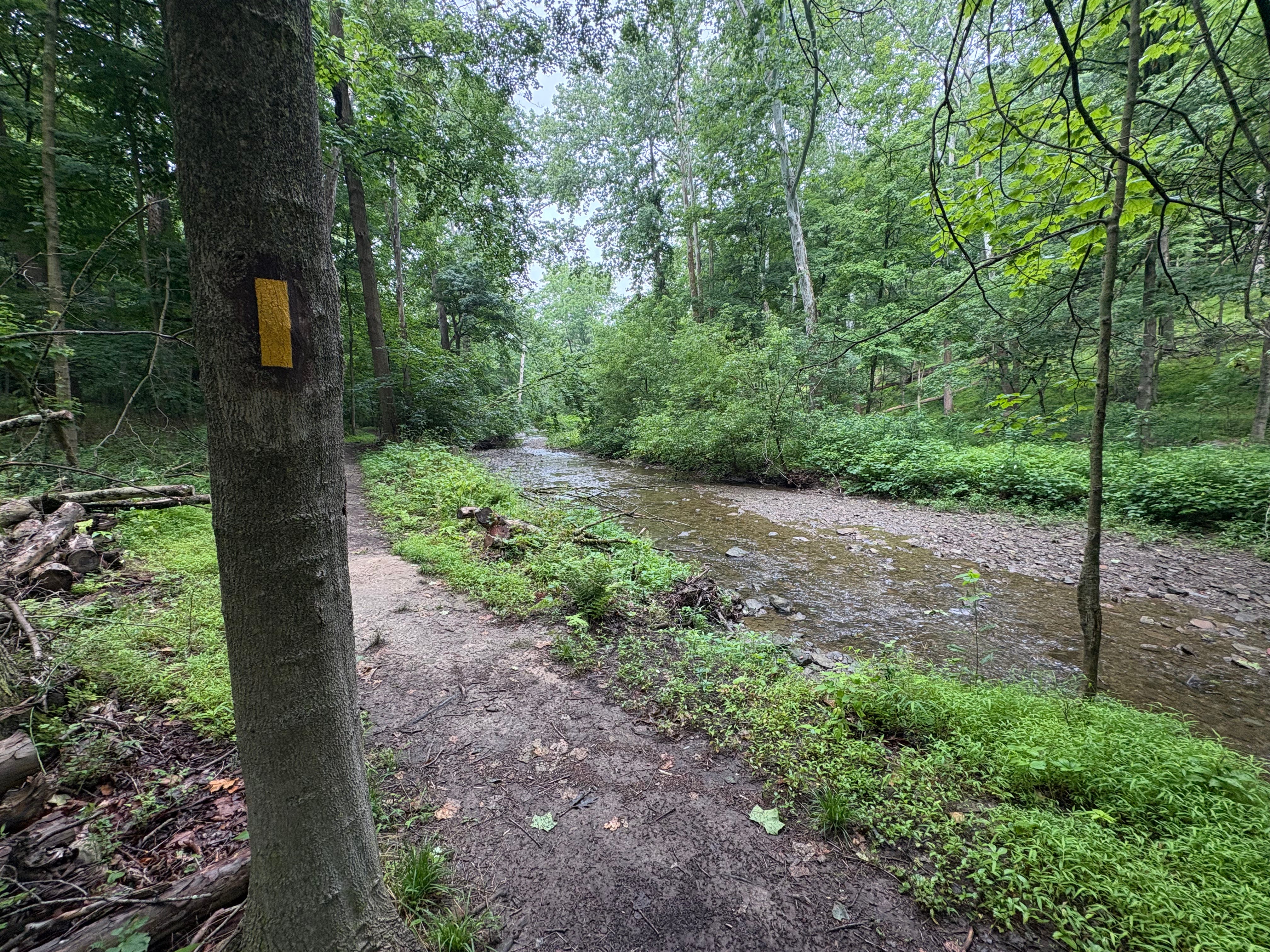
Too bad we haven’t solved time travel. What I wouldn’t give to take a stroll along Crouse Run with Rachel Carson today. I’d show her Bongiovanni’s speakeasy, now a crumbling, graffitied foundation. Gone too is the trolley line, its rails replaced by the trail that is marked by a series of rectangular yellow blazes. No doubt her curiosity would have her questioning the significance of the markers, and I wonder how she’d feel to learn that they indicate to a hiker that they are walking a section of a larger 46-mile path known as the Rachel Carson Trail.
Embarrassment is what I suppose she would feel. Rachel Carson doesn’t strike me as the type to festoon everything in sight with her name. But that didn’t stop admirers around her home county from doing it for her. You’ll find the Rachel Carson Bridge spanning the Allegheny River in downtown Pittsburgh. The home where she first fell in love with the outdoors is now a museum known as the Rachel Carson Homestead. I like to think she’d be tickled that my friend Elizabeth Pagel-Hogan has devoted a whole newsletter to birding the entirety of the Rachel Carson Trail every season, and that she writes exuberantly about wanting to see a Veery, among Rachel’s favorite birds, one whose rich, descending song can be heard ringing through Crouse Run every breeding season.
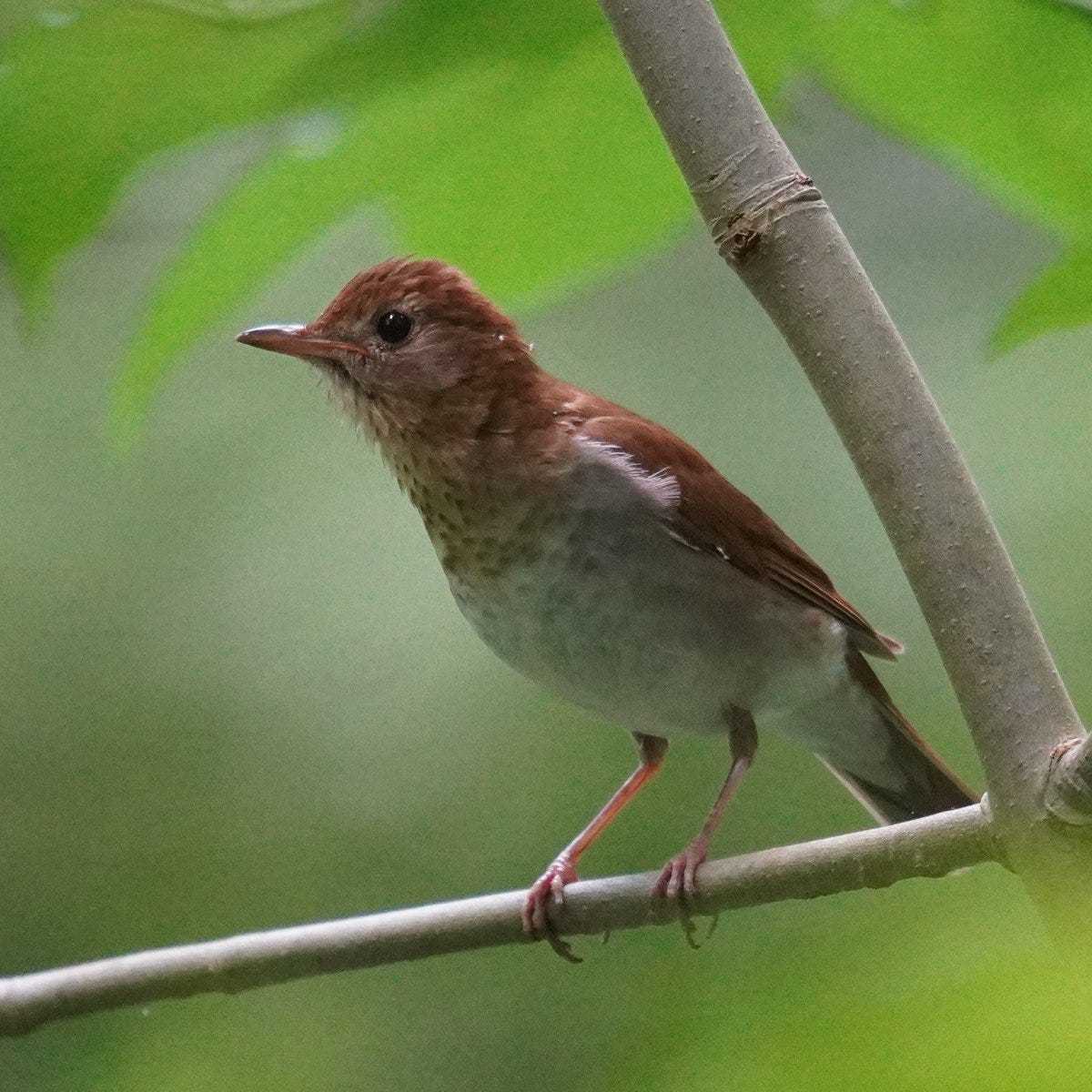
Of course I can’t think of anyone more deserving of a run than one of Allegheny County’s most important native daughters, the one who devoted her life to conservation, whose superpower was combining sound science with beautiful prose to demystify nature for the rest of us. You’ll find the 1.4-mile Rachel Carson Run near the western terminus of the Rachel Carson Trail, where it flows southeast through Harrison Hills Park toward the Allegheny River.
Carson wasn’t universally beloved in her time, nor is she today. Her warnings about the heavy use of DDT and other pesticides collided with big business interests and the still-prevalent attitude that nature was something to be conquered and tamed rather than protected and revered. Knowing she rose to the height of her fame in the early 60s, I had a hunch there was speculation that she was a communist. Sure enough, in a letter to President Dwight Eisenhower, former Secretary of Agriculture Ezra Benson concluded that because she was “a spinster with no children” in spite of being physically attractive, Carson was “probably a Communist.”
Perhaps a biology lesson would have come in useful for Benson, who was apparently unaware that communists are mammals and thus reproduce in the way all mammals do. As to Carson’s love life, she may never have married, but she certainly loved, and profoundly so, as revealed in a series of correspondences between herself and friend Dorothy Freeman. In one, Carson writes:
First–in answer to your answer to my veery letter–I thought the whole episode pretty starry, beginning with the fact that, as I learned the other day, while I was in the Rock Creek Park listening to veeries and wishing for you, you were walking along your road listening to wood thrushes and wishing for me!
What a lovely, bird-filled sentiment. As to Carson’s political beliefs and what economic system she espoused, I don’t know. I do know she never called for an outright ban of chemical pesticides. I also know she was right about DDT and the harm it was causing, and nowhere more evident than our national symbol, the Bald Eagle, which was in rapid decline before Carson sounded the alarm. Thanks to her words and the research of others who were committed to reversing the awful trend, the hypothetical scenario Carson paints in the opening of Silent Spring has not come true:
It was a spring without voices. On the mornings that had once throbbed with the dawn chorus of robins, catbirds, doves, jays, wrens, and scores of other bird voices, there was now no sound. Only silence lay over the fields and woods and marsh… No witchcraft, no enemy action had silenced the rebirth of new life in this stricken world. The people had done it themselves.
Crouse Run is anything but silent. As I sit here typing, the sun is rising. I know less than two miles away, Veerys and Wood Thrushes are singing. So are American Robins, Gray Catbirds, Mourning Doves, Blue Jays, Carolina Wrens. Scores of other bird voices will fill the valley on this summer day.
And thanks to Rachel Carson, the summer nights are alive with another species that was impacted by DDT and will play an outsized part in the third part of this series.
Silent Spring
Duh. What a masterpiece. Peregrine Falcons nest around Pittsburgh thanks to this book. Thanks to this book, Osprey patrol the confluence of Crouse Run and Pine Creek. Each year, hundreds flock to North Park to photograph the celebrity Bald Eagles. There’s a biologist and her book to thank for that.
Toy Story 5
Speaking of sounding alarms, loneliness is a real problem in this era of supposed connectedness, and Toy Story 5 shines brightest not in denouncing technology and screentime, but in valuing genuine friendship. Though the most recent two installments of the beloved franchise don’t quite measure up to the first three, the creators at Pixar clearly care about the quality of the storytelling of Toy Story. At no point did the fifth iteration feel like a cash grab, though our family was somewhat divided about how well or accurately the studio portrays technology.
That’s all for this week. Have you read Silent Spring or any of Rachel Carson’s books? Do you have any important biological areas where you bird? Do you see evidence of Carson’s legacy in your favorite natural areas? What are streams called where you live? Drop your thoughts in the comments!👇
Until next time, thanks for reading, and don’t forget to conserve your ass off!
nwb
At Birding with BillBow, I strive to entertain you with tales of birding adventures and podcast interviews with fascinating birders. If that sounds like your type of content, consider supporting my work with a paid subscription. Your financial contribution helps me dedicate more time to BWB as I endeavor to deliver passionate, (hopefully) funny, high-quality writing. As always, 5% of earnings donated to the American Birding Association.
Like what you read but aren’t ready for a subscription? Consider tossing a few coins into the virtual tip jar!
Paid or not, every bit of engagement, every like and comment, is truly appreciated. Please consider sharing this post, a wonderfully free way to help spread the bird joy.
This post was human-generated. All media by Nathaniel Bowler, except where noted.
Developmental edit by Alexandra Hidalgo.
No posts
Comments
Nothing yet. Say the first thing.
Sign in to join the conversation.