
I remember the chill I felt when I encountered this entry in Birds of North America, the first field guide I owned, sometime in 1993.
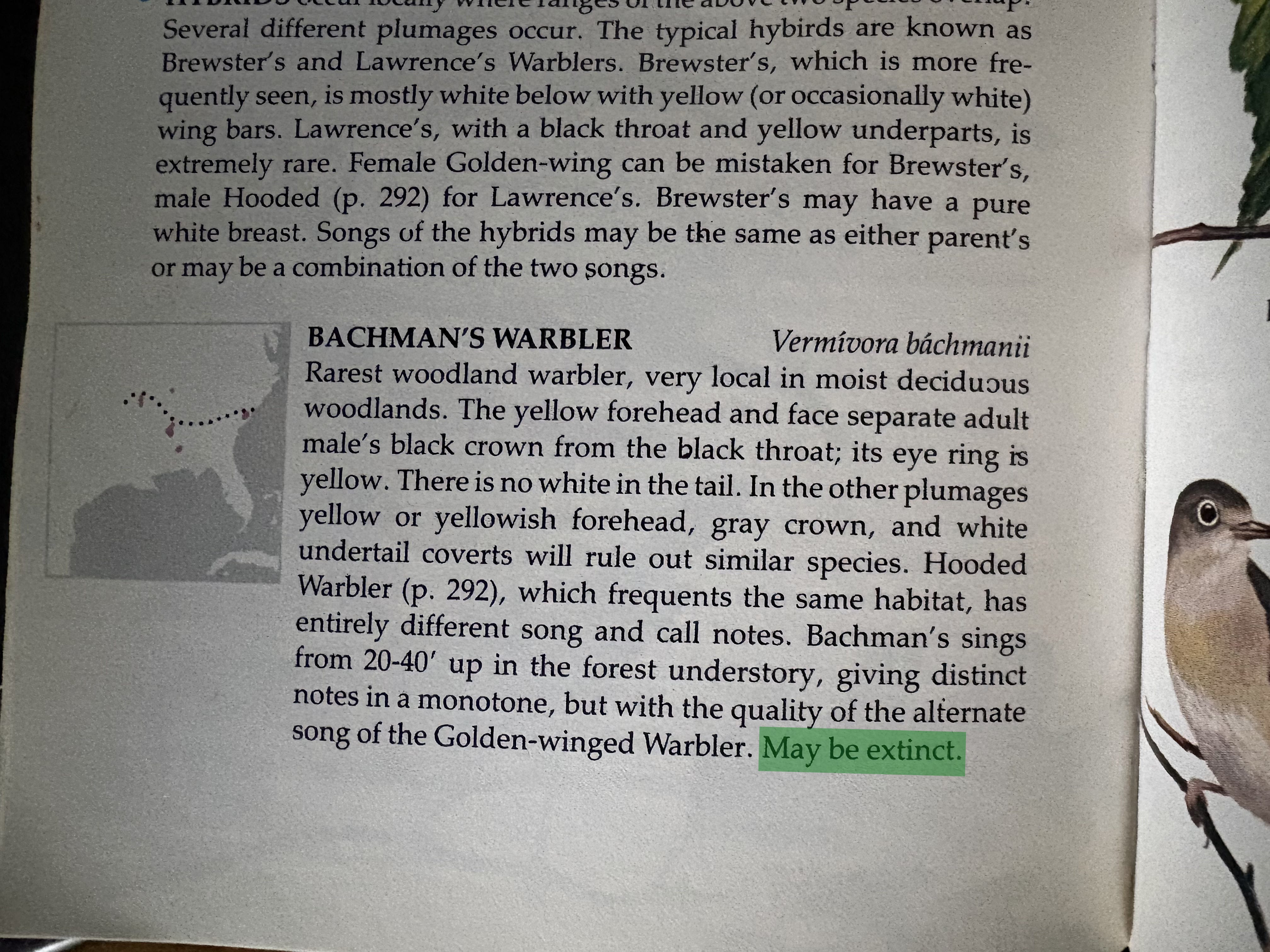
May be extinct sounded grim, but not final. Was there a chance Bachman’s Warblers could still be out there, eluding human detection in remote corners of the American Southeast? What a tantalizing idea, but the more-up-to-date Peterson Field Guide didn’t share my optimism.
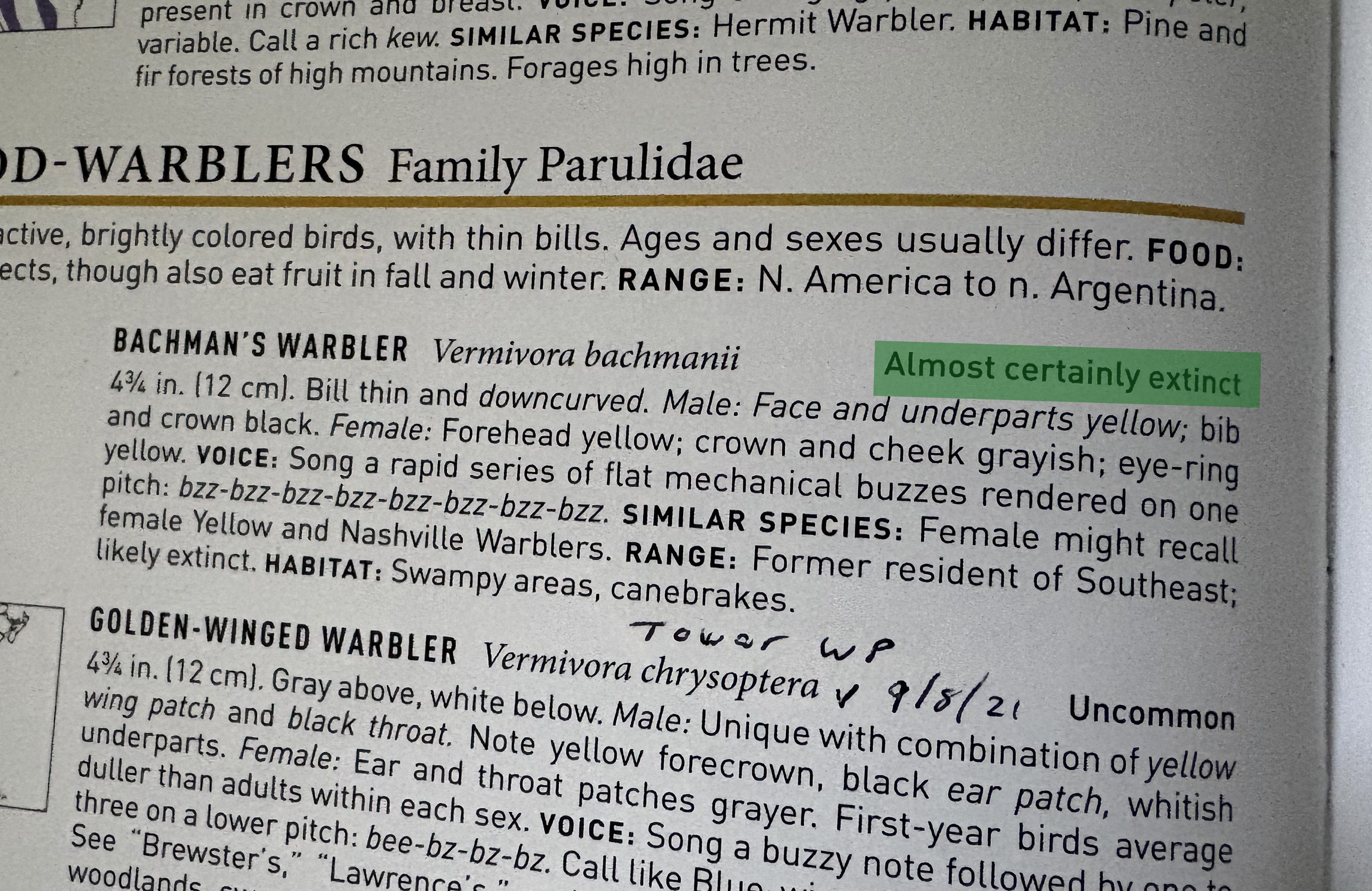
As for the Sibley Guide? Forget it. You won’t find an entry for Bachman’s Warbler, except for the page it shares with Ivory-billed Woodpecker, Great Auk, and several other species of birds that have disappeared forever.
I’ll never see a Bachman’s Warbler. No one will. No one has seen one for sure since the 1960s. Subsequent sightings of the then-critically endangered bird in the late 1980s and early '00s were compelling but not confirmed, and extensive surveys of its habitat since then have turned up no visual or auditory evidence suggesting the warbler may somehow still be hanging on.
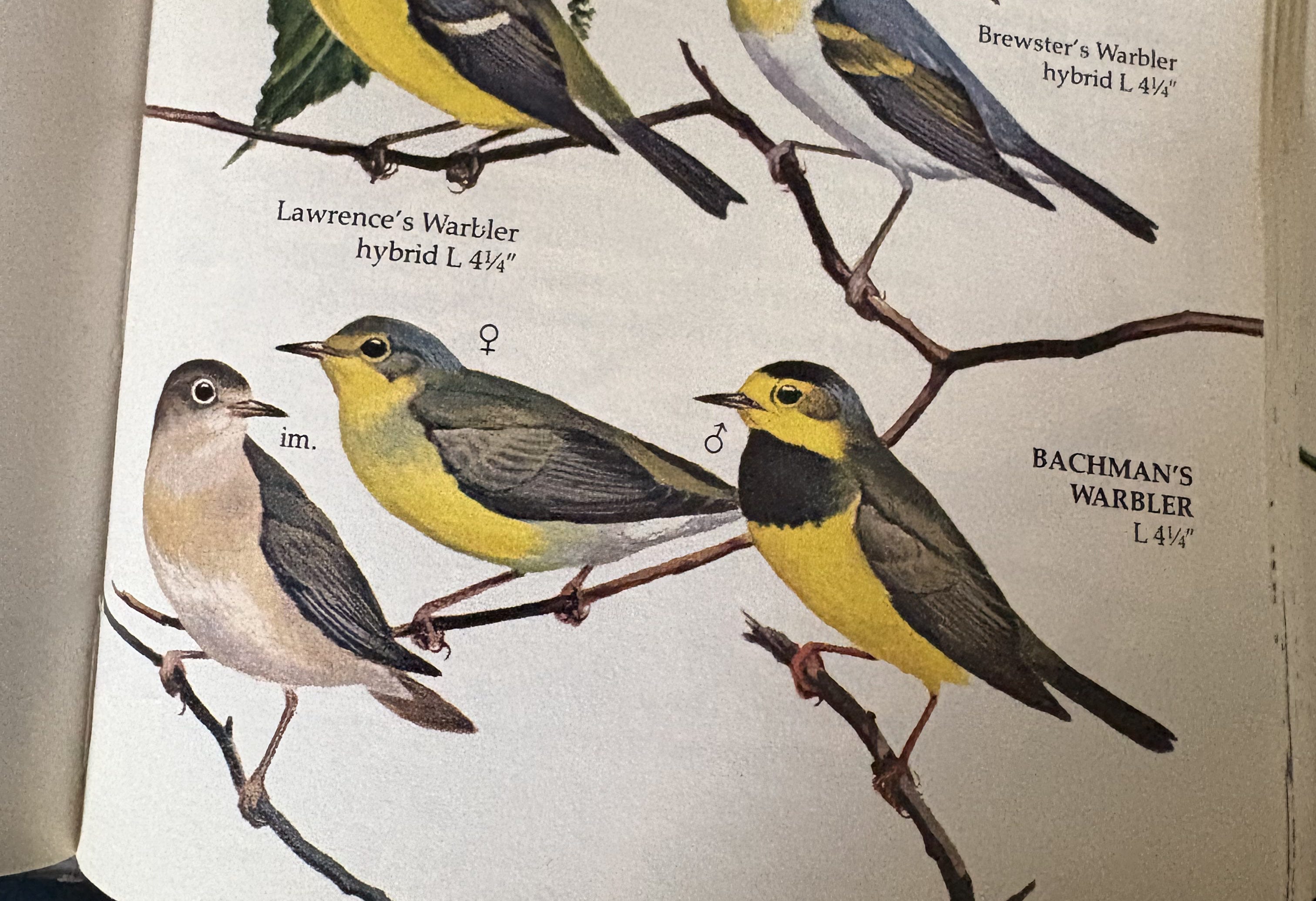
And what a shame, because look at this lovely little bird, the male reminiscent of a Hooded Warbler with its black cap and bib, the female less ostentatious but elegant in yellow, olive and gray.
More than that, of course, is that extinction is tragic, especially human-driven extinction. The bird had only been known to western science since 1832, when Lutheran minister and naturalist John Bachman discovered it in South Carolina, though certainly the bird was known to indigenous people long before the arrival of Europeans to the Americas. Less than two centuries after Vermivora bachmanii was identified and classified, it was gone. (For the record, my wife Alex thinks the Latinification of Bachman’s and other names for binomial classification is “so corny.”)
So what happened?
Welcome to Birding with BillBow, where I strive to entertain you with tales of birding adventures and podcast interviews with fascinating birders. If that sounds like your type of content, consider supporting my work with a paid subscription. Your financial contribution helps me dedicate more time to BWB as I endeavor to deliver passionate, (hopefully) funny, high-quality writing. As always, 5% of earnings donated to the American Birding Association.
For all their bluster about capitalism vs communism and democracy vs authoritarianism, the United States and Cuba proved quite an effective team in annihilating the Bachman’s Warbler. Habitat destruction in the southeastern US, where the bird bred, and in Cuba, where it wintered, was a one-two punch that led to a precipitous decline in population from which it seems there was no recovery. In 2021, the US Fish and Wildlife Service recommended the bird be declared extinct.
Two years later, it was.
All this to say, thanks to reckless deforestation, I have one, not two, eastern warblers missing from my life list. After finally conquering my longtime nemesis, the insufferably bashful Connecticut Warbler, at Magee Marsh in May of 2025, only the Swainson’s Warbler remained.
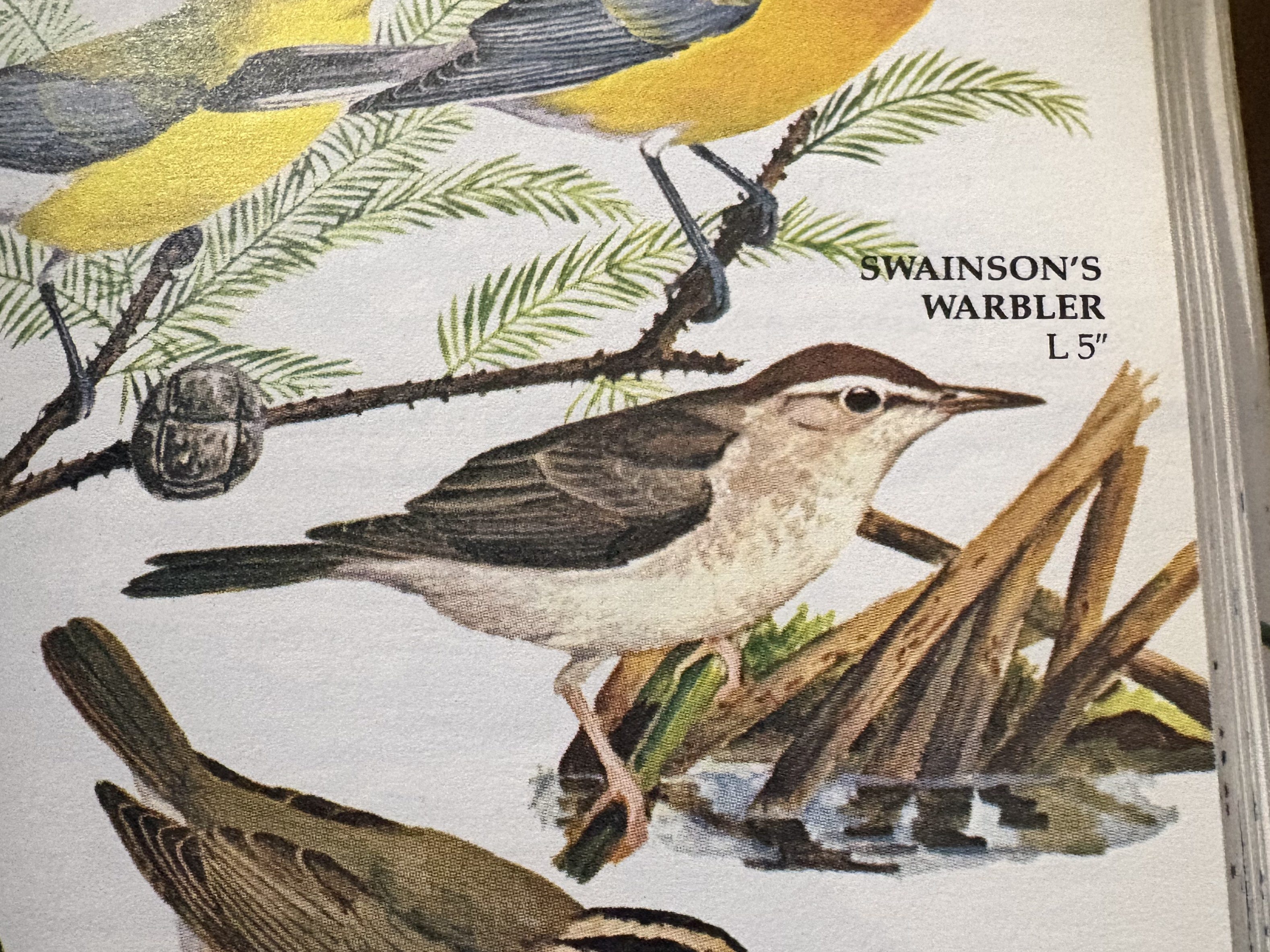
Grayish back, whitish underside, with a nifty chestnut cap and a cool eye stripe. The bird is elegant but understated. Even with that sabre-like bill, I don’t know if Swainson’s Warbler is going to win any pageant prizes, but beauty pageants are silly, and I don’t think I’m being contradictory when I call this bird beautiful and nondescript in the same breath.
There’s a lot of overlap in the historical ranges of Bachman’s and Swainson’s Warblers. In the warm months, both species favor the swampy forests of the southeastern USA. Southwest Pennsylvania represents the northernmost extreme of the Swainson’s Warbler’s breeding territory, a fact that wasn’t confirmed until spring of 2023, when a nesting pair was found at Bear Run Nature Reserve in Fayette County, about 70 miles south of our Pittsburgh home. That’s a big deal for a bird that has fewer than 100 documented sightings across the entire state.
There’s evidence that Swainson’s Warbler populations are stable and perhaps even increasing slightly (though numbers have dropped in parts of its range). And the Bear Run breeding pair suggests that maybe the bird is expanding its range north. Adaptability is perhaps why Swainson’s Warbler survives where Bachman’s couldn’t. Perhaps Bachman’s Warblers were too finicky, too dependent on certain habitats, and the shock of deforestation proved too cataclysmic.
Whatever the case, Swainson’s Warblers are here in PA. For reasons not entirely clear to me, I didn’t chase them in 2023 or over the next two years. For equally mysterious reasons, this was the year I felt ready to add them to my life list. The urge was sudden and acute, and I was undaunted when my birding friends Holly, Elizabeth, and Sophia were unable to go on the appointed day—Wednesday, June 3.
No humans would be joining me, but I wasn’t alone. Janet, our battery-powered Nissan Leaf (named for the not-a-robot, not-a-girl informational assistant in The Good Place), would be transporting me to the destination. I’d powered her up overnight, making sure she had enough juice to get me to Bear Run and back. After seeing our sons William and Santiago off to the bus stop at 7:00 a.m., Janet and I were on the road. According to Google Maps, I’d be on the trail at Bear Run by 8:30, with a great chance of hearing a singing male, according to recent eBird reports.
For all her charm, Janet (the car) isn’t much of a conversationalist, so I used the intervening 80 minutes to acquaint myself with the Swainson’s song and catch up on the latest (and delightful!) “This Month in Birding” episode of the American Birding Podcast. Time was flying, and I was feeling optimistic as we cruised down the Pennsylvania Turnpike.
Then I missed my exit.
We were 19 minutes away when that happened. There isn’t exactly a surfeit of cellular service in that part of the state, so it took a minute for the GPS to recognize my blunder and calculate the new route. Meanwhile my brain was doing some calculations of its own. Worst-case I’d get off at the next exit and have to double back. At most I’d added a half hour to my drive. Annoying, but no biggie.
Then Google delivered the news.
FUUUUUUUUUUCK!
That’s what I screamed when Janet’s screen informed me the next exit was almost 20 miles away, and an hour and ten minutes now stood between me and my lifer. That seemed impossible. Punitive even, a sinister retaliation cooked up by Google’s AI, but for what offense? Perhaps for the crime of having recently googled How to turn off Google’s AI.
Refusing to believe these new circumstances could hardly change them. I could only accept them, and the 70-minute delay. Except it wasn’t going to be a mere 70 minutes. Forget making it there and back on a single charge. By the time I made it to Bear Run, the battery would likely be depleted enough to make me nervous about Janet’s ability to reach a charging station. In a flash, optimism gave way to anxiety.
I got off the turnpike at Somerset, PA still in denial that one tiny missed exit had added almost another hour to my drive. I pulled into a gas station to see if I could find an alternate route, but Google had indeed calculated the quickest way to Bear Run. Alternate routes added another ten or twenty minutes. The only thing to do was suck it up, accept that I alone was to blame for my plight, and find a charging station.
Twenty minutes at a fast charger would get the job done. Unfortunately, there were no fast chargers in Somerset that I could find, so I settled for a standard charger, located at the Mary S. Biesecker Public Library, across the street from the Sheetz service station. After fumbling with the controls like an asshole and listening to the chatter of Chimney Swifts I could only interpret as mockery, I was able to activate the charger. I was also bordering on a full-blown panic attack for which I could see only one antidote—breakfast food, the greasier the better. The Sheetz would come in handy there, and soon I was sitting on Janet’s hood and getting intimate with a sausage, egg, and cheese biscuit that tasted way better than any gas station sandwich has a right to. I also took a moment to contemplate just who Mary S. Biesecker was and what worthy deeds she had done to be thusly commemorated (see below👇). I also had an eBird checklist going. Might as well take advantage of Somerset’s avian life to help sooth my jangled nerves. One hour and five species later, Janet’s charge was up to 51%. Not ideal, but hopefully enough to get me to the bird and, if not all the way back home, at least to a fast charger en route.
The road to Bear Run thankfully featured long downhill stretches that allowed Janet’s regenerative braking feature to keep the battery from draining. I was calm by the time I was 10 minutes from the reserve, and Janet’s charge incredibly was at 47%. Things were looking up, until this:
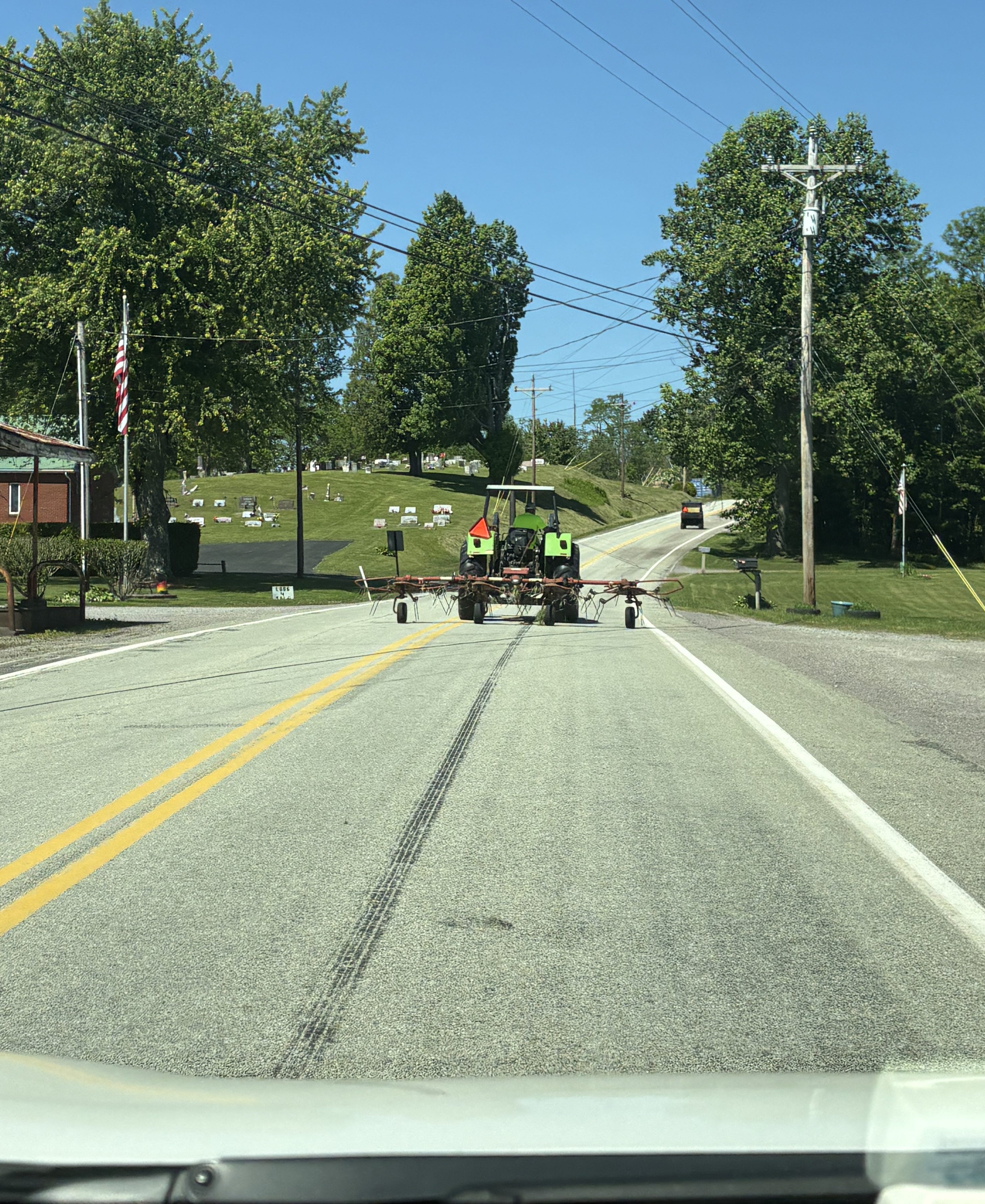
This vehicle, equipped with some kind of road-blocking sprayer, was moving roughly as fast as the corpses buried in the adjacent hillside, and I was beginning to believe my rising apoplexy would soon overwhelm me conveniently close to a cemetery.
By the time that glacial impediment was out of the way, rage had given way to resignation. Good thing too because that was not the end of the slow-moving traffic—the final leg was an interminable crawl to the entrance of Bear Run.
I have no memory of what happened between this moment and when I found myself standing in the Bear Run parking lot, Indigo Buntings, Chipping Sparrows, and Northern Yellow Warblers expressing awe at my prest-o, change-o trick of turning a pleasant 80-minute drive into a four-hour ordeal.
By now it was well after 11:00, and I wasted no time heading down the trail. My eyes were peeled, but of more use for this mission were ears. Swainson’s Warblers tend to stay hidden in the understory, and they would be near impossible to find as they foraged for insects on the forest floor.
My ears were telling me there were plenty of woodland species around. Black-throated Green and Black-throated Blue Warblers. Wood Thrushes. Scarlet Tanagers. Red-eyed Vireos. I wasn’t the only Homo sapiens in the woods, either. In the distance I spied a hiker, binoculars hanging from his neck, face wizened by, I assumed, a life lived birding. After greeting each other, I asked if he’d heard the Swainson’s Warbler. He had not, but Merlin had. He instructed me to continue along the path, where I’d eventually encounter some mist nets and people banding birds. I’m not sure they want people going back there, though, he warned.
Oh, I’m going back there, I replied to no one but myself. If my own stupidity can’t stop me, you think a some puny bird banders can?
I thanked him for the tips, and sure enough, several mist nets were set up along the trail, almost blocking it. But these nets were designed to ensnare birds, not humans. No way I was turning back after that hellish morning, so I maneuvered around them with a few dexterous steps.
I hiked on, encouraged that the bird was present, at least according to a stranger’s Merlin. I even dared get my hopes up when I heard voices that belonged to a couple of men who certainly looked the part of bird banders. They hurried toward me, gave me a brief How’s it going?, and raced right on by, despite my efforts to get their attention. No matter. They were working, and anyway I encountered another trio of banders further down the trail who appeared to be packing it in for the morning. One of them, deducing the reason for my presence, asked whether I had gotten eyes on the Swainson’s Warbler.
Nor eyes, nor ears I told him. They were super friendly and generous with the intel, informing me I’d have the best chance around where we were standing and up to a quarter mile in either direction. There were multiple singing males, they said. Only they tend to get quiet late in the morning and into the afternoon. They also took a moment to question why anyone hoping to find a rare bird would be dumb enough to show up at midday when any half-wit with a pair of binoculars knows that songbirds are most active and vocal in the morning.
Obviously they didn’t say that last part, but what they did tell me was discouraging, and it also proved right—nothing resembling the Swainson’s song could be heard, and the woods were growing quieter, not louder, as the morning turned to afternoon. Still, I was going to stick it out for as long as I was able.
Thank goodness I did. After two hours walking the path back and forth, my dogged determination was rewarded with a better look than I could have ever hoped for and the photo of my dreams!
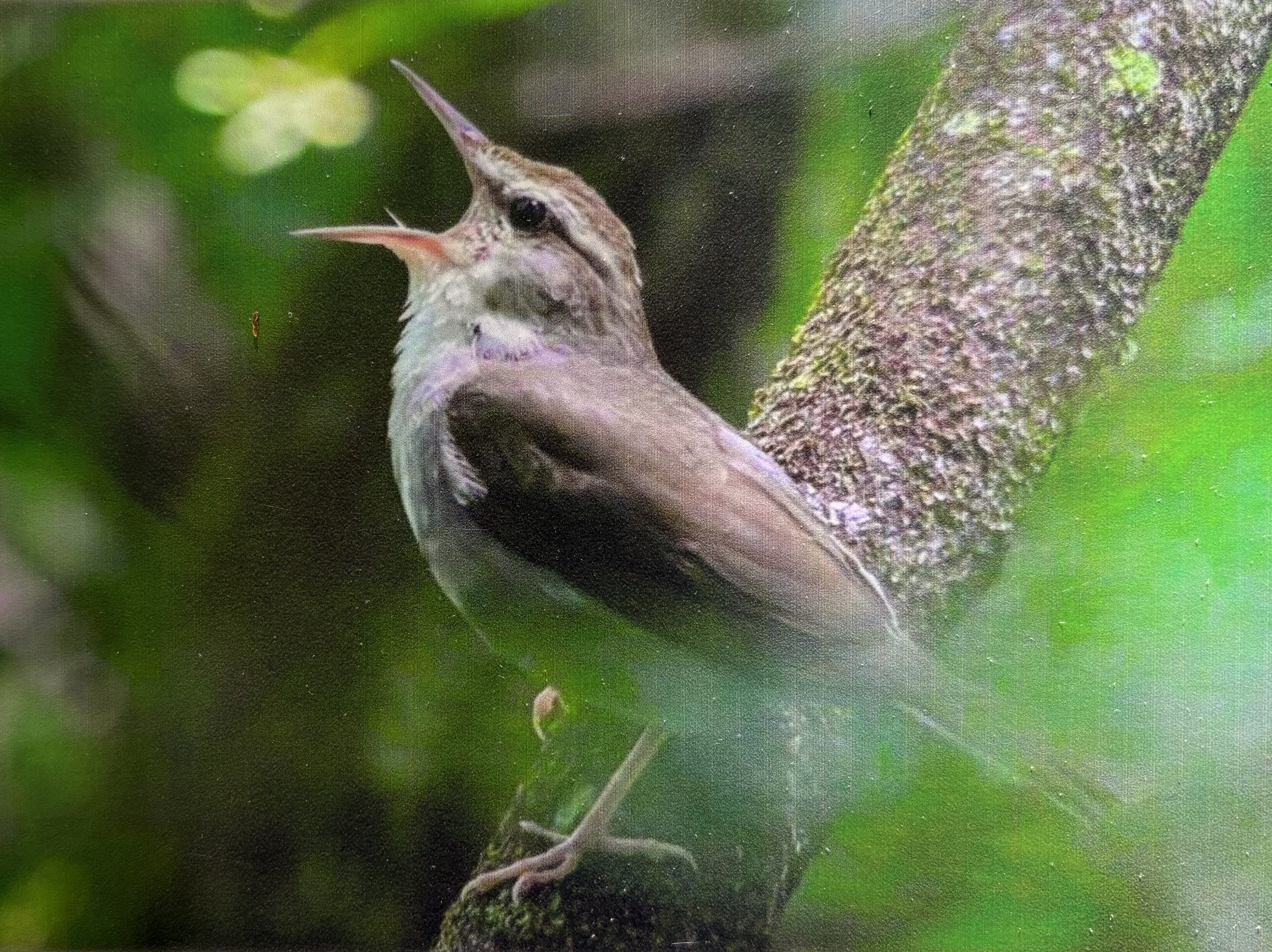
Lol no it wasn’t. I didn’t hear a peep out of the damn bird, much less see it. What I did get was a nice long look at this sign urging eager birders to be conscientious in our attempts to track down the rarity.
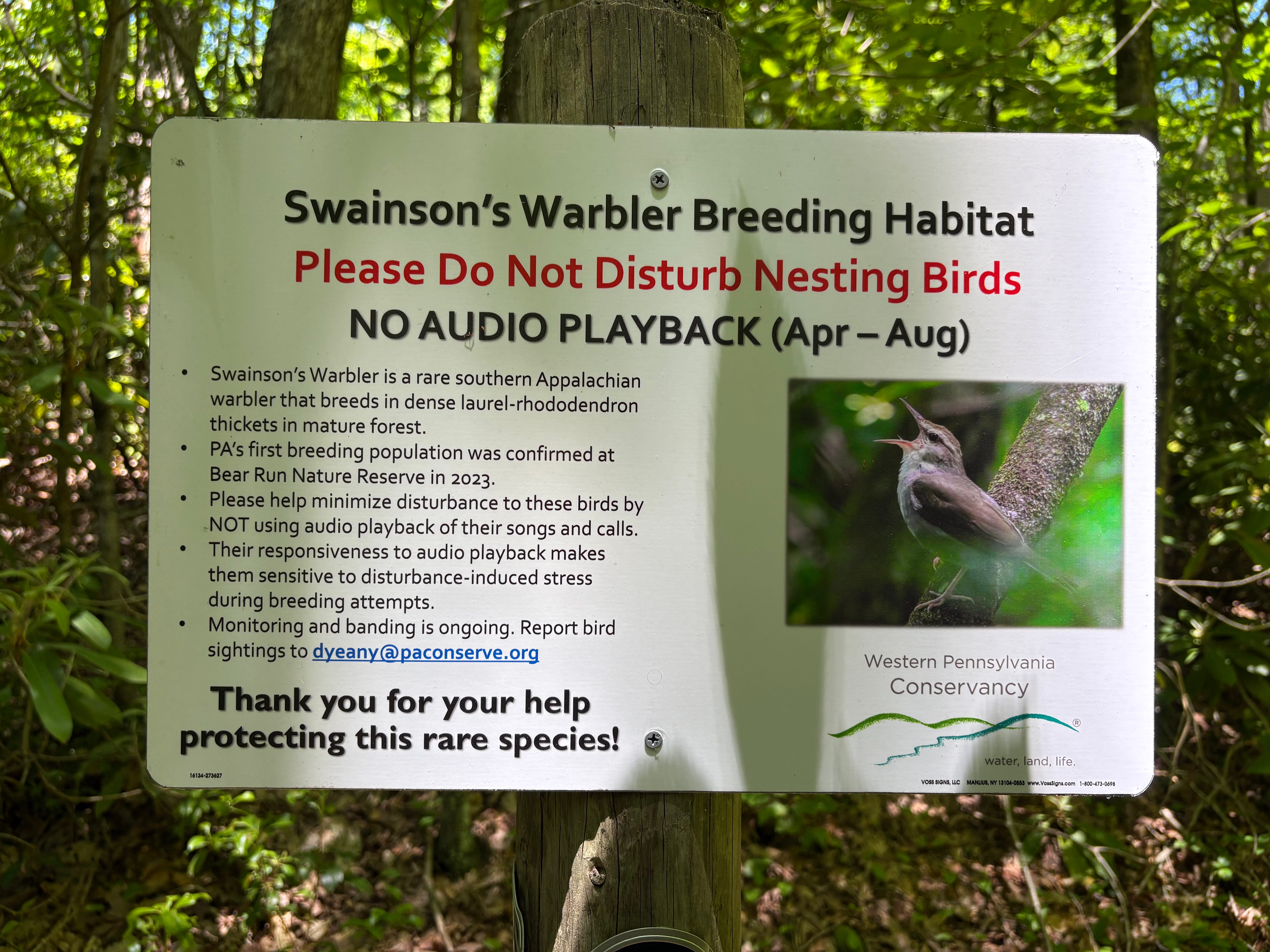
I’d be lying if I told you this was an enjoyable birding adventure up to this point. Objectively I could recognize the humor in all that had happened, but I wasn’t laughing. Frustration was kicking my ass, the only silver lining being that I hadn’t dragged my friends into this debacle.
I was about to accept the L and spend the rest of the day stewing in my own bile when it occurred to me that this was the perfect time to remember the wisdom of my latest podcast guest Holly Merker, one of the foremost practitioners and teachers of mindful birding. What would Holly do? I asked myself. Only Holly knows that, but I could make an educated guess based on our conversation. Under these circumstances, she might pause to look inward and recognize how she was feeling and why. And she might then try to make this moment more about the moment and less about the goal.
Here I was in a resplendent green forest listening to songbirds and Bear Run flowing through its rocky channel. Time to my head clear and stop worrying about potential life bird #579. I went from dejected to elated almost instantly. How could I not?
I’d like to tell you that this was the magical moment, after calm had washed over me, that the Swainson’s Warbler revealed itself in all its beautiful/nondescript glory. But Bear Run Nature Preserve isn’t Hollywood. Nor is it in business of serving up happy endings.
But that doesn’t mean I didn’t get one.
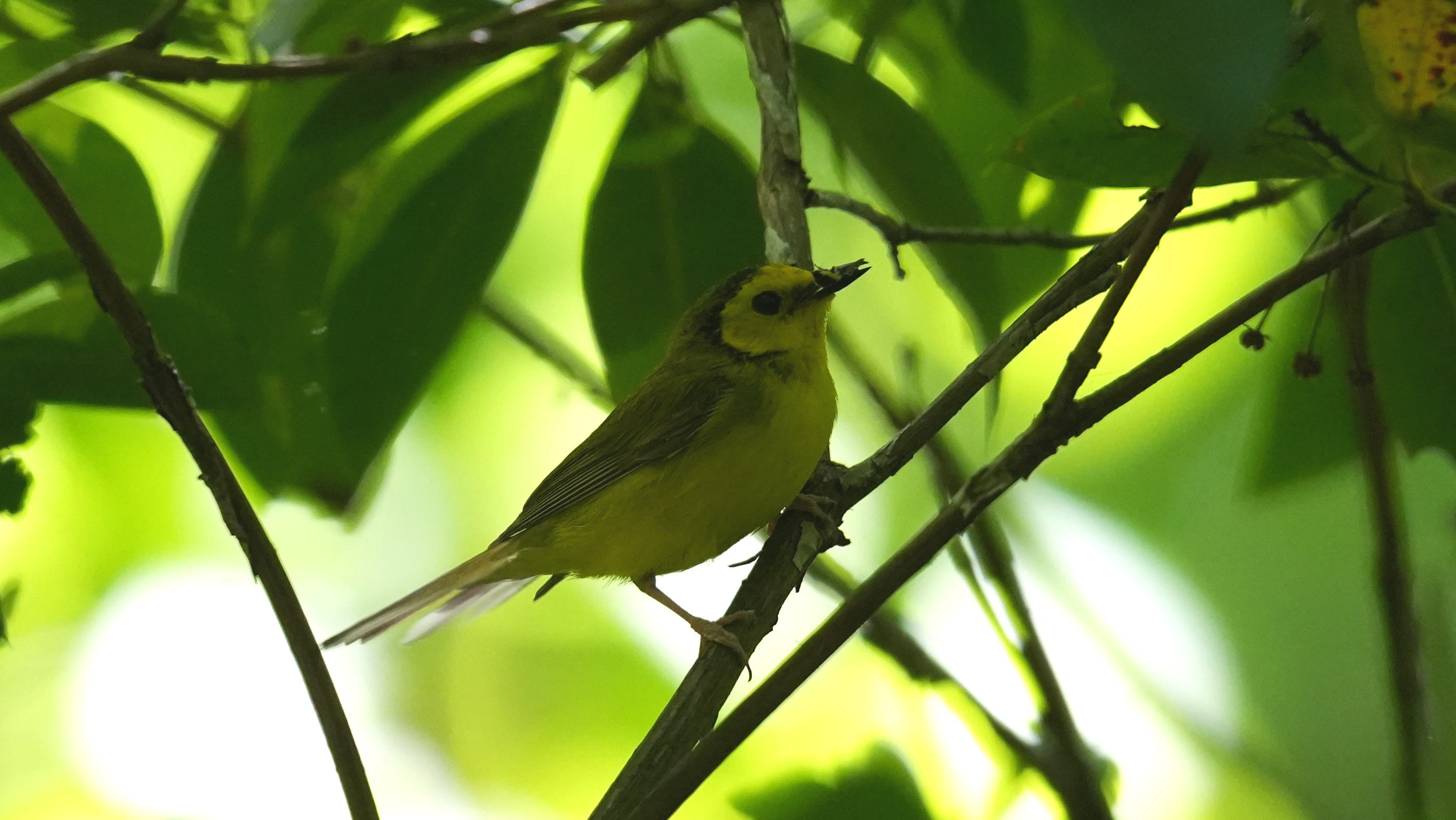
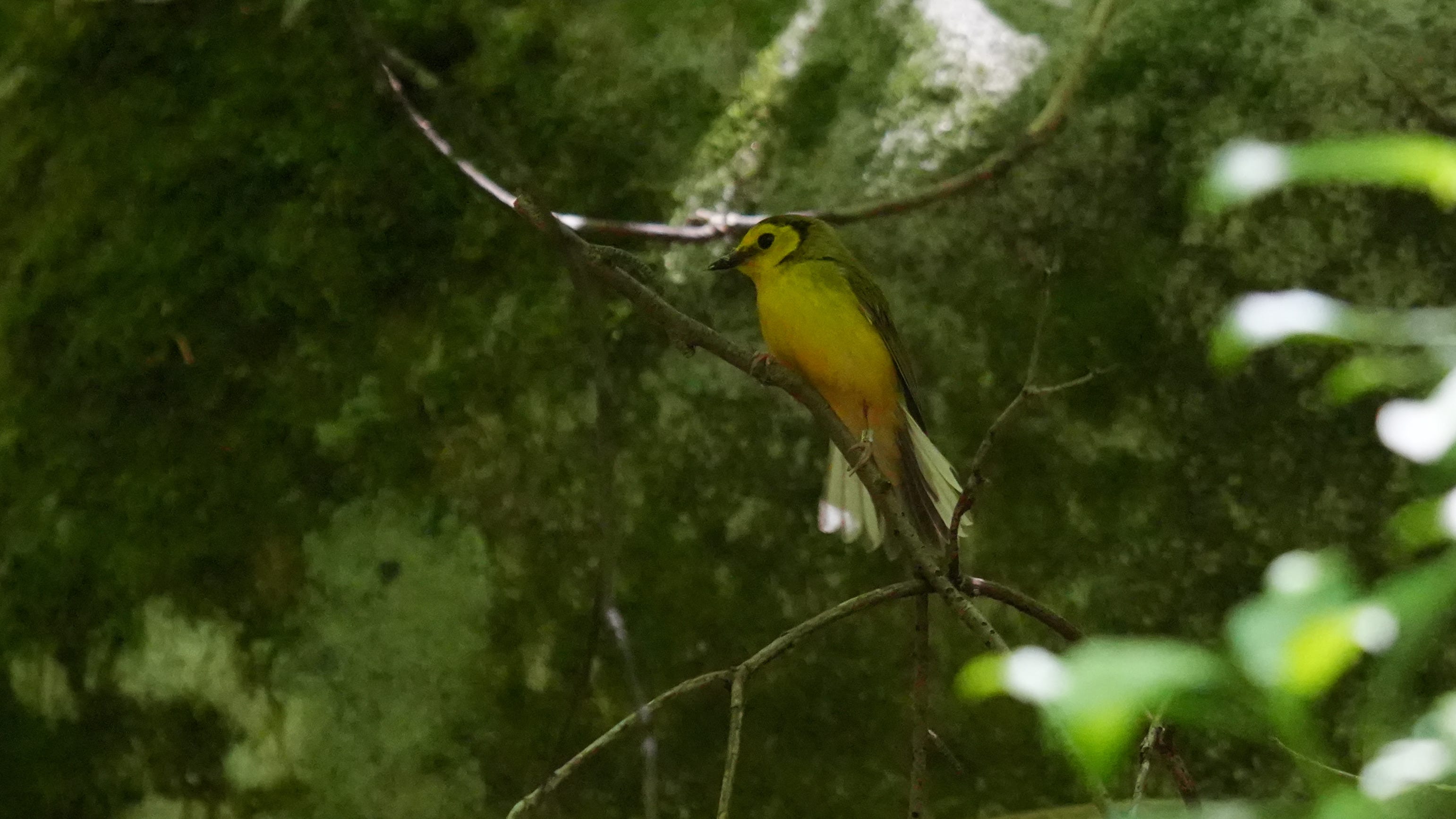
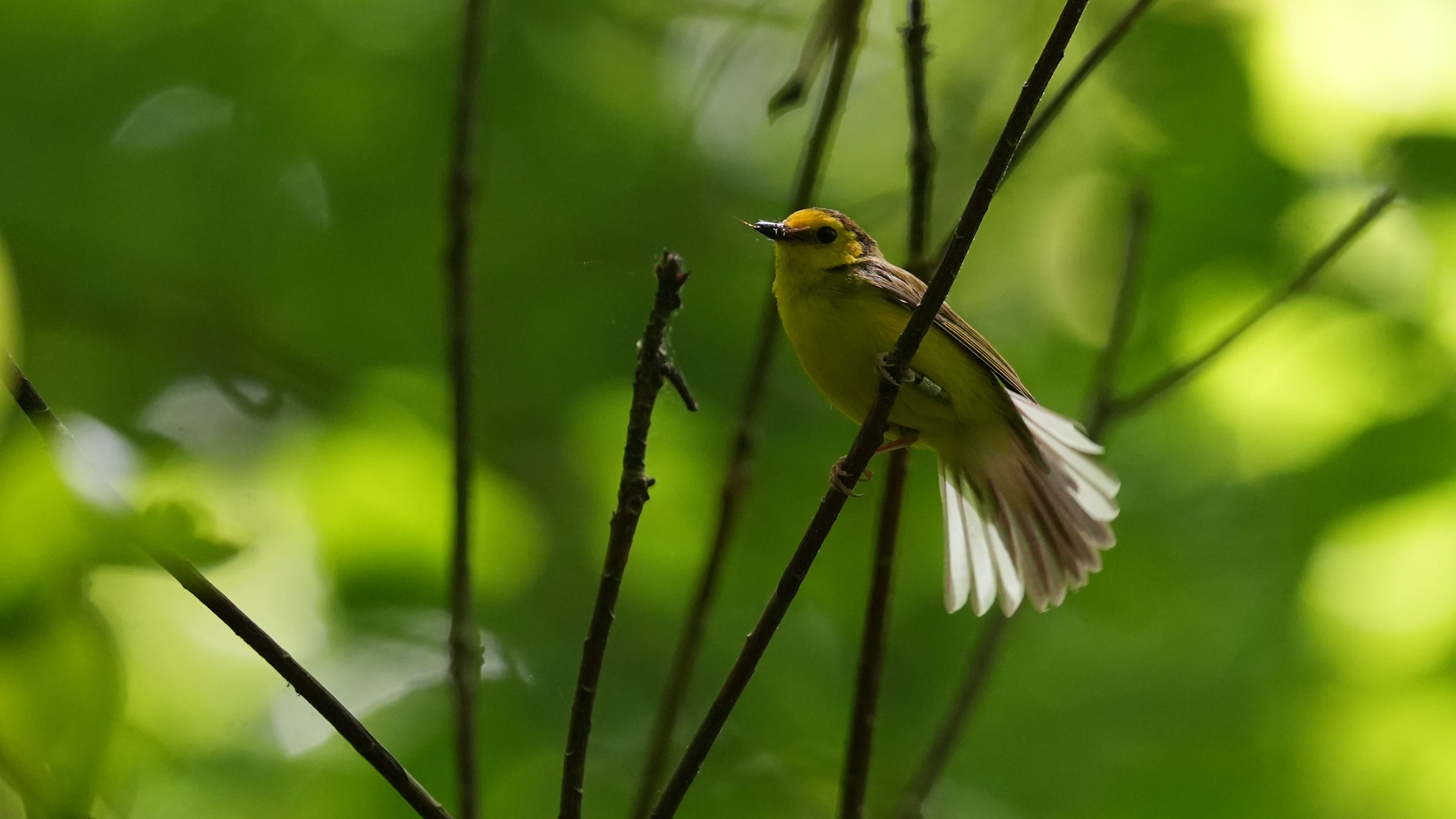
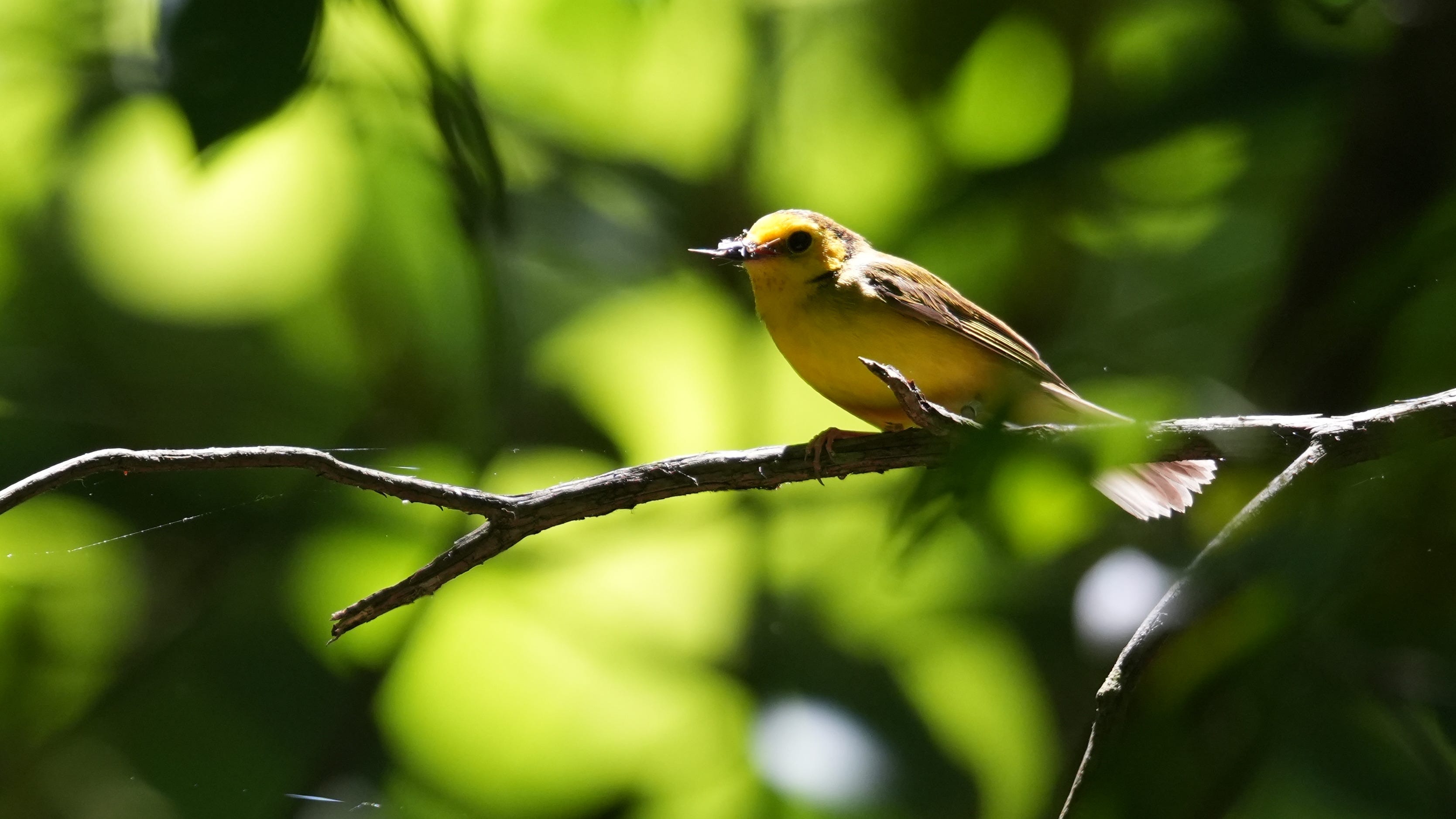
I didn’t recognize the high-pitched peeps coming from the brush near one of the bridges that cross Bear Run, but a quick look through binoculars revealed a pair of Hooded Warblers foraging at eye level. The male became coy when I readied the camera, but his mate was one of the most cooperative warblers I’ve ever encountered.
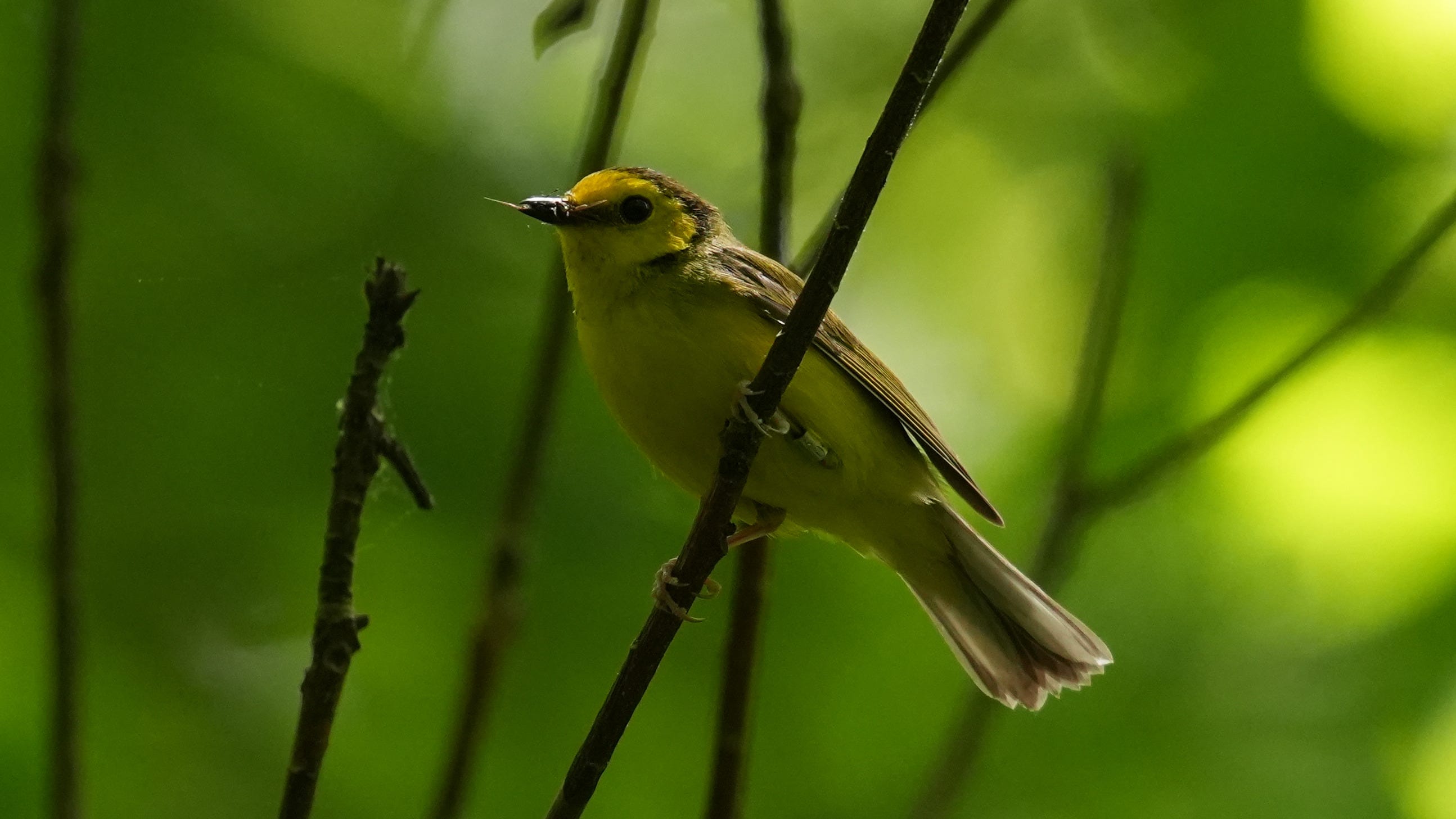
If you look closely, you can see this bird is not only beautiful but also banded. Perhaps she’d been caught in the mist nets and banded that very morning. Perhaps her ultra close encounter with humans explains her lack of shyness with me.
It occurred to me that I couldn’t remember ever seeing a female Hooded Warbler before, and I’d certainly never photographed one. That’s a lifer of sorts. More than sufficient to banish the last traces of my rotten mood as I watched her adorably terrorize the local insect population for almost an hour.
At around 3:00, Janet and I headed home. Turns out she had plenty left in the battery. No need for a recharge.
As for the The Swainson’s Warbler? That will have to wait until spring of 2027. I’m not making that infernal drive again this year. I’ll go earlier next year, and I’ll go with my friends.
Featured Video—Acadian Flycatcher
My regular readers know I frequent another “run” located very close to our home—Crouse Run. Every spring Crouse Run becomes home to several mating pairs of Acadian Flycatchers, who build shitty-looking, loosely woven nests, usually hidden in some pretty dense foliage. The goal is to remain hidden, but Acadian Flycatchers are active foragers with a boisterous song, and if you keep an eye on them as they move around from tree to tree, they’ll eventually lead you to their nest. Last week I was able to observe this female busily constructing her nest while her mate hovered protectively nearby. Here’s wishing them better luck than I witnessed last year, when the nest I monitored was parasitised by Brown-headed Cowbirds.
On Mary S. Biesecker
The Somerset Public Library was established in 1914 through the efforts of 100 residents who wanted to share their love of books and reading with the wider community. The library was later renamed the Mary S. Biesecker Public Library for local philanthropist Mary Scull Biesecker who had been one of the driving forces behind its opening. Beyond that, I was unable to dig up much more about her. I ever find myself in Somerset again, I’ll stop in. The library seems like a wonderful establishment with some interesting original art that’s worth checking out.
That’s all for this week. Have you ever seen a Swainson’s Warbler? What’s your biggest bird chase gone wrong? How do you stay calm and collected when a birding expedition goes sideways? Have you ever been stranded in the middle of nowhere with an electric car? The comment section awaits! 👇
Until next time, thanks for reading, and for the love of god, don’t miss your exit!
nwb
Like what you read but aren’t ready for a subscription? Consider tossing a few coins into the virtual tip jar.
Paid or not, every bit of engagement, every like and comment, is truly appreciated. Please consider sharing this post, a wonderfully free way to help spread the bird joy.
This post was human-generated. All media by Nathaniel Bowler.
Developmental edit by Alexandra Hidalgo.
Comments
Nothing yet. Say the first thing.
Sign in to join the conversation.