
My dear physiology and performance enthusiasts,

With every new holiday season comes the focus on this mythical barrier: 2 hours for the marathon in the media, and perhaps 3 hours in the immediate future for us amateur runners. Will Santa Claus leave this official record under the tree? Perhaps. But for you, coaches and athletes living the reality of the field, the real question lies elsewhere.
Beyond the dreams of the elites, what is the priceless gift you could offer yourself? Not another gadget, but the key to progressing without breaking yourself, nor sacrificing your personal life to hours of useless training.
The true gift is efficiency. It is the method that allows you to respect your physical integrity while maximizing your potential. For 40 years, the field has been my laboratory. Thanks to advanced ambulatory devices, we have dissected the reality of effort to distinguish marketing hype from what actually makes you run faster.
This week, I offer you an unprecedented confrontation: the data synthesis of the very latest international science (Grivas 2025) versus our own field discoveries.
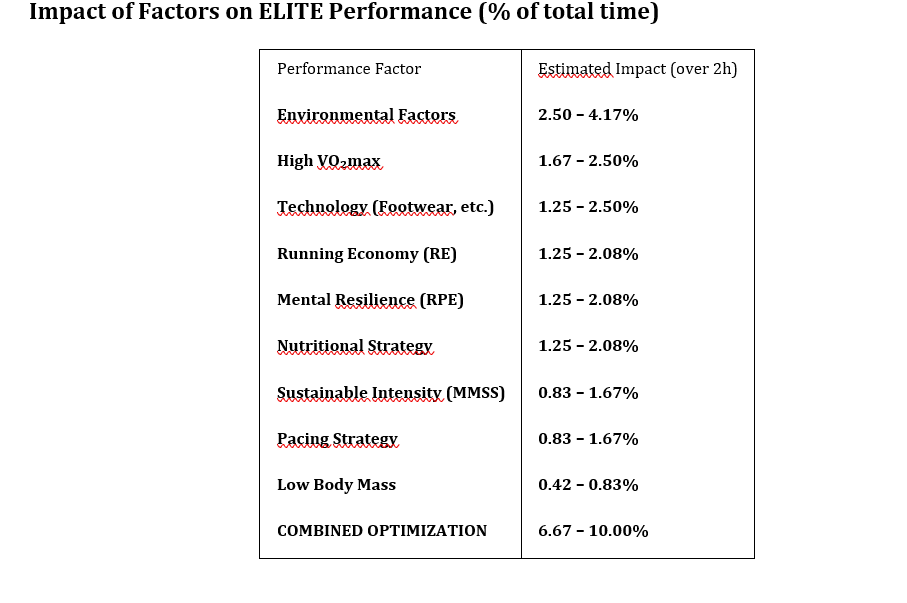
The Table of Truth: Where to Gain Your Minutes?
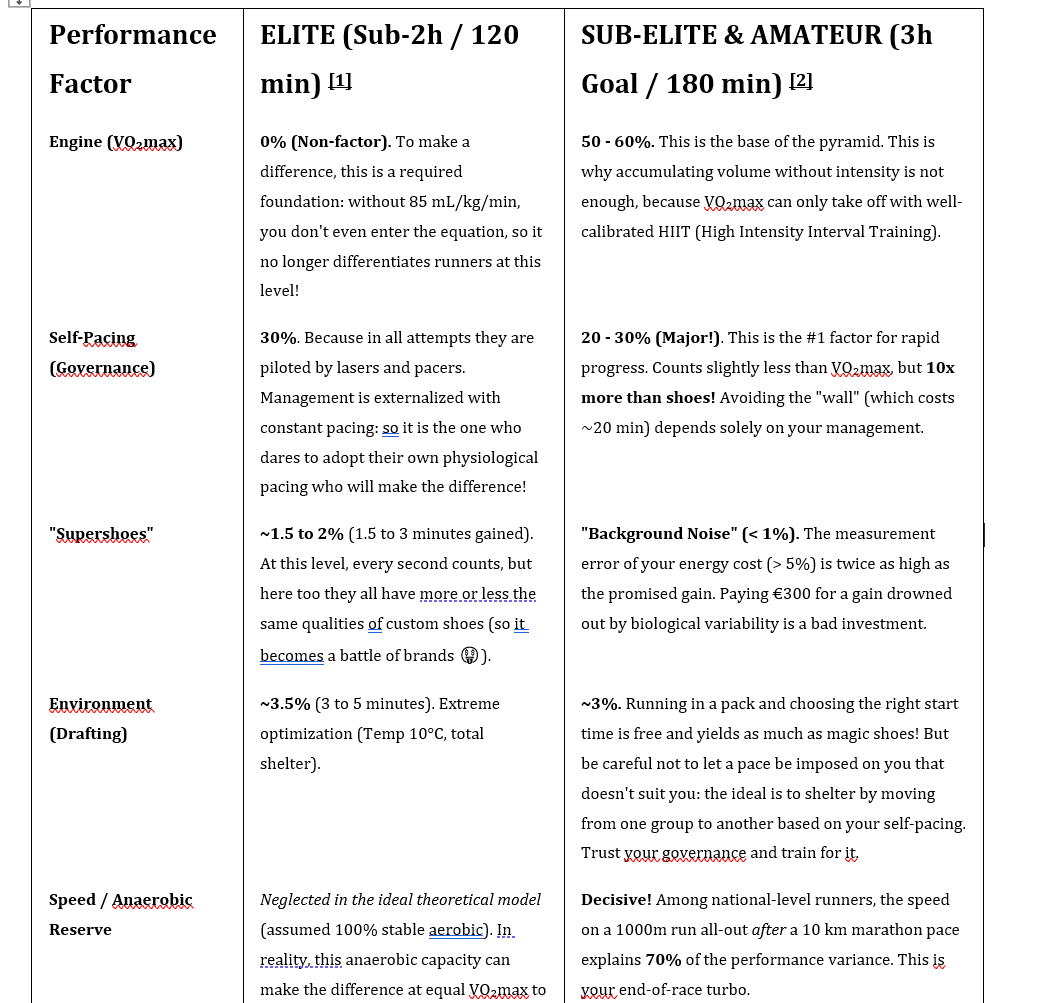
I have calculated the real weight of each factor for you. For the Elite (Sub-2h), gains are marginal and cumulative. For YOU (3h00 goal), the levers are totally different.
Look at the “Self-Pacing” row: that is where your gift lies.
Performance Factor

What the Numbers Tell Us (And What Salespeople Forget)
The “ideal” Sub-2h model sells us a stable thermal machine that claws back seconds thanks to technology (1.5 to 3 min for shoes).[1]
But for you, reality is disruptive.
For a 3-hour runner, physiological uncertainty is greater than 5%. Buying shoes to theoretically gain 1.5% is a statistical illusion. On the other hand, Self-Pacing (your ability to manage yourself) carries heavy weight. Poor pace management can cost you 15 to 20 minutes (the famous wall at the 30th km), or 10% of your total time!
This is where your margin for progress lies: much more than in the sole, it is in your brain and your sensations.
My Gift in Your Sleigh: 2 Self-Pace Sessions!
For Christmas, I am not offering you fragile carbon foam, but autonomy. I am slipping two Self-Pace sessions into your training plan.
This is the best way to test and develop your “effort governance” competence (a concept I detail in my book Courir à la sensation: Available here on Amazon).
The Challenge of the Week: The “Rabbit” Test
The best way to validate your Self-Pace skill is to repeat the “Rabbit” session:
· The Goal: Run a given distance by adjusting your speed purely by sensation, without looking at the watch, and see if you are capable of reproducing the performance without excessive cardiac drift.
· The Challenge: Try to chain at least 3 “Rabbit” sessions every two days.
It is radical. You will see that fatigue does not lie, but your brain knows how to manage it if you listen to it.
Speaking of which, next week I will give you the surprising results of Arnaud, who took up the crazy challenge of completing 8 Rabbits in 7 days. His data shakes up our certainties about recovery and load!
Example of a session on a 10 km:
Alternating medium and hard zones around critical speed.
For a runner with a critical speed of 4 min/km (15 km/h) and a marathon record at 90% of critical speed (3h06min).
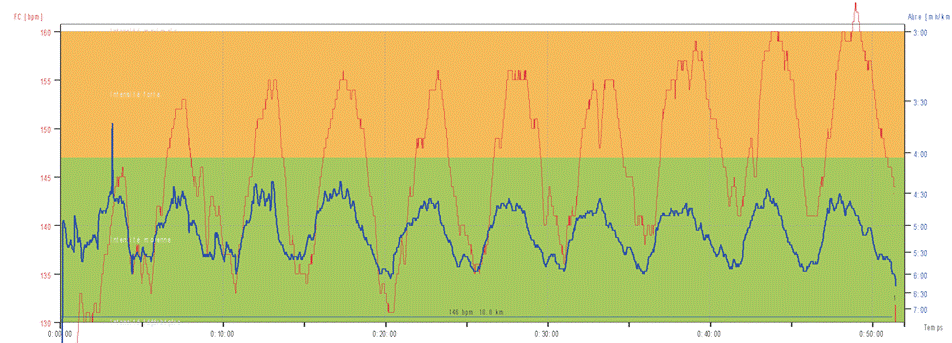
· Protocol: Start by doing the same thing on 2 x 5 km to begin with, interspersed with 1 km at an easy pace.
Happy holidays and happy intelligent preparation!
Véronique Billat
References:
Grivas, G. V. (2025). Toward a record-eligible sub-2-hour marathon... European Journal of Applied Physiology.[1]
Billat, V. L. et al. (2001). Physical and training characteristics of top-class marathon runners. Medicine & Science in Sports & Exercise.[2]
Pycke, J. R., & Billat, V. (2022). Marathon performance, oscillations... Int. J. Environ. Res. Public Health.[4]
Billat, V., Vitiello, D., Palacin, F., Correa, M., & Pycke, J. R. (2020). Race Analysis of the World’s Best Female and Male Marathon Runners. International Journal of Environmental Research and Public Health, 17(4).[3]
Aucun post
Comments
Nothing yet. Say the first thing.
Sign in to join the conversation.