
Traditionally, cycling performance has often been reduced to maximal oxygen consumption (VO2max), a key indicator of aerobic capacity. However, during final sprints or race surges, the real limit lies elsewhere: in the pedals, meaning the ability to turn muscular force into speed through efficient technique.
Rémi Castells’ thesis (2022) shows that maximal power output (Pmax), measured maximal cadence, and the capacity to sustain high lactate power (30’’ Wingate average power) are even more decisive indicators of sprint success than VO2max alone.
Torque (T) is defined as:
T = F × L
F = force applied on the pedal (in N or kgF).
L = crank length (in meters).
This torque, multiplied by cadence (angular velocity), determines final power:
P = T × ω
where ω is angular velocity in rad/s.
The force–velocity (or torque–cadence) profile describes a cyclist’s ability to produce torque at various cadences. Each cyclist has a specific signature: some are strong in force (high torque at low cadence), others are strong in velocity (high cadence with lower torque).
F₀: theoretical maximal force extrapolated at 0 rpm (theoretical isometric maximum force).
fMax: extrapolated cadence at which force would be zero (indicator of maximum potential velocity).
In practice, the actual maximal cadence (~110–120 rpm for sprinters) is always lower than fMax.
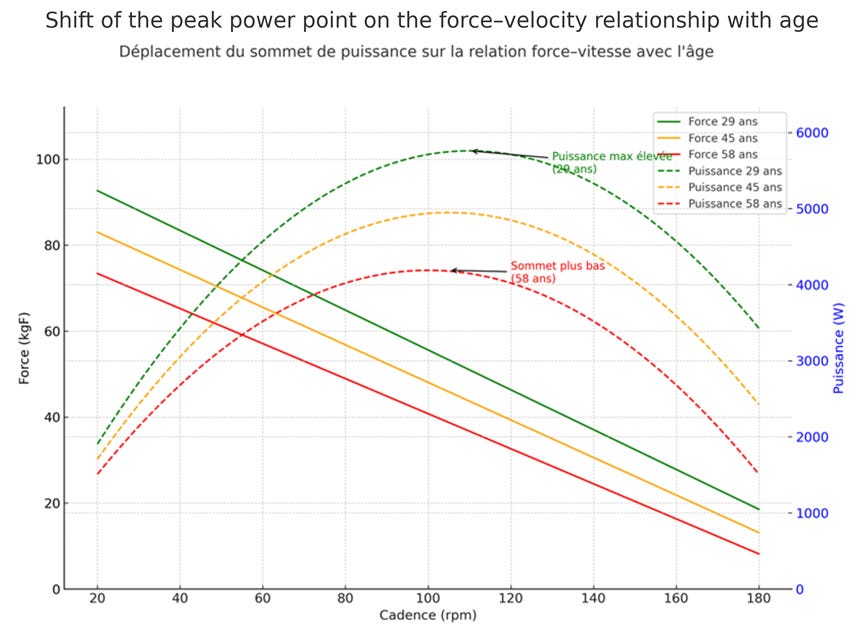
With age, maximal dynamic force (MDF) and the extrapolated force (F₀) decrease (~20–25% by age 58). Champions thus shift from a force-oriented style to a velocity-oriented style.
Maximal power (Pmax) always lies at a compromise between force and velocity.
With age, F₀ declines more than maximal cadence.
The peak power point therefore shifts downward (less force), rather than leftward (slower cadence).
Thus:
- The optimal cadence for power remains relatively stable.
- Older cyclists preserve their ability to spin the legs to compensate for lost force.
The case of centenarian Robert Marchand, described by Billat et al. (2017), is emblematic.
At age 101, he covered 24.25 km in one hour; at 103, he improved his record to 26.92 km (+11%).
How? Thanks to polarized training (80% low intensity, 20% high intensity) and focusing on cadence: he increased his maximal pedaling cadence from 69 to 90 rpm (+30%).
This proves that even after age 100, it is possible to offset force loss by improving velocity and technical efficiency.
In 2025, the average age of participants in the Étape du Tour cyclosportive is 45 years: a generation of young seniors already facing age-related muscular adaptations.
These cyclists should anticipate this transition:
- Preserve F₀ through strength training.
- Develop cadence to maintain power despite the gradual force decline.
Example: gear ratio 54 x 11 (~10.3 m per revolution).
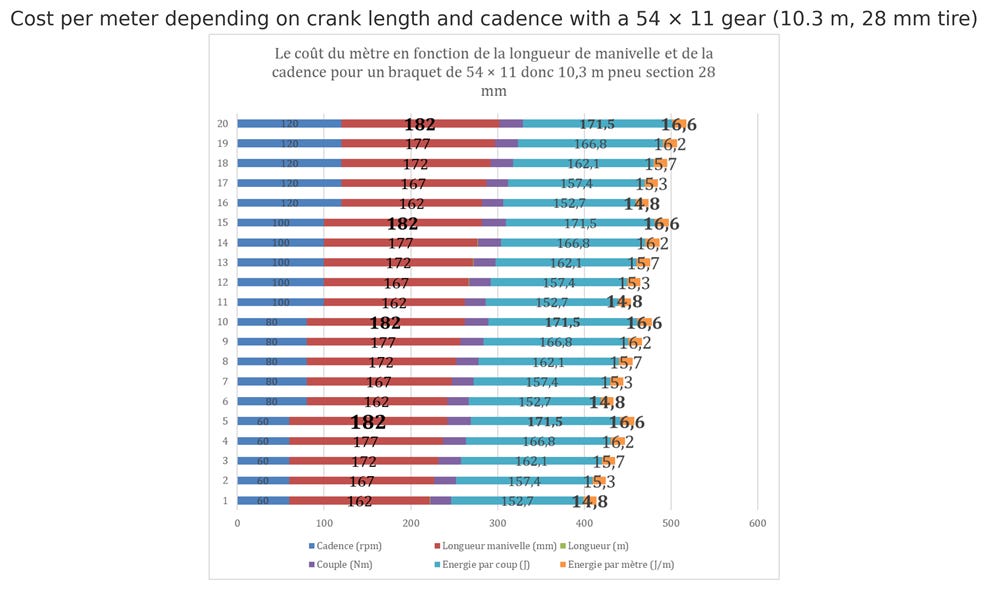
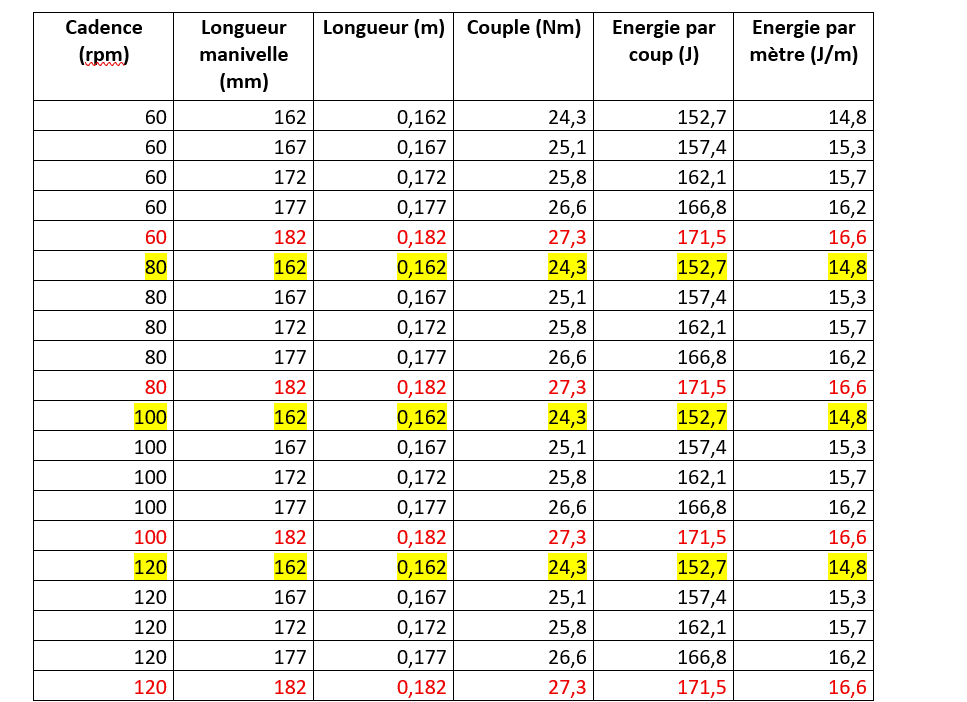
- Longer crank (172–175 mm) → more torque but lower maximal real cadence.
- Shorter crank (165–170 mm) → higher cadence, favors velocity.
From our models:
✅ A longer crank increases energy per pedal stroke.
✅ Higher cadence reduces instantaneous muscular effort.
✅ With age, favoring smoother cadence and moderate torque becomes essential.
What matters is not just oxygen uptake, but how this capacity is turned into watts, speed, and above all mechanical efficiency.
The force–velocity test allows:
- Identifying whether a cyclist is strong in force or velocity.
- Personalizing crank length and gear choices.
- Predicting the optimal pedaling strategy depending on age and muscle profile.
VO2max ≠ final destiny: the force–velocity profile is decisive.
F₀ declines with age, requiring compensation via cadence and mechanical optimization.
Personalization of gear ratio and crank length is crucial.
Robert Marchand proves we can improve even after 100.
Young seniors of the Étape du Tour are already in this anticipation phase.
“On the pedals,” it all comes down to each cyclist’s unique force–velocity balance.
Beyond VO2max, the true battlefield is torque, cadence, and crank choice. It all comes down to “pedaling.”
Sarcopenia is a progressive and generalized loss of skeletal muscle mass, accompanied by decreased muscle strength and physical function, which appears with aging. It increases the risk of falls, fractures, dependence, and mortality.
Maximal isometric force (Fmax iso) declines gradually:
- Up to 30 years: stable or slightly increasing strength.
- From 30–35 years: start of a slow decline (~1% per year).
- After 60 years: more rapid decline (~1.5–3% per year).
Compared to 25 years old:
- At 50: ~15–20% loss.
- At 70: ~30–40% loss.
- At 80: up to 50% or more loss.
This loss is often more pronounced than muscle mass loss alone, due to qualitative changes and dynapenia.
Dynapenia refers specifically to age-related loss of muscle strength not fully explained by muscle mass loss.
It results mainly from neuromuscular alterations:
- Reduction in the number and quality of motor neurons.
- Degeneration of neuromuscular junctions.
- Lower recruitment and voluntary activation of muscle fibers.
- Qualitative shift in fiber type (type II fibers).
Thus, an elderly person can maintain reasonable muscle volume yet lose much of their capacity to produce rapid or explosive force, increasing fall risk and reducing functional performance.
Summary:
- Sarcopenia = loss of muscle mass (quantity).
- Dynapenia = loss of muscle strength (function), even without major mass loss.
Aucun post
Comments
Nothing yet. Say the first thing.
Sign in to join the conversation.