
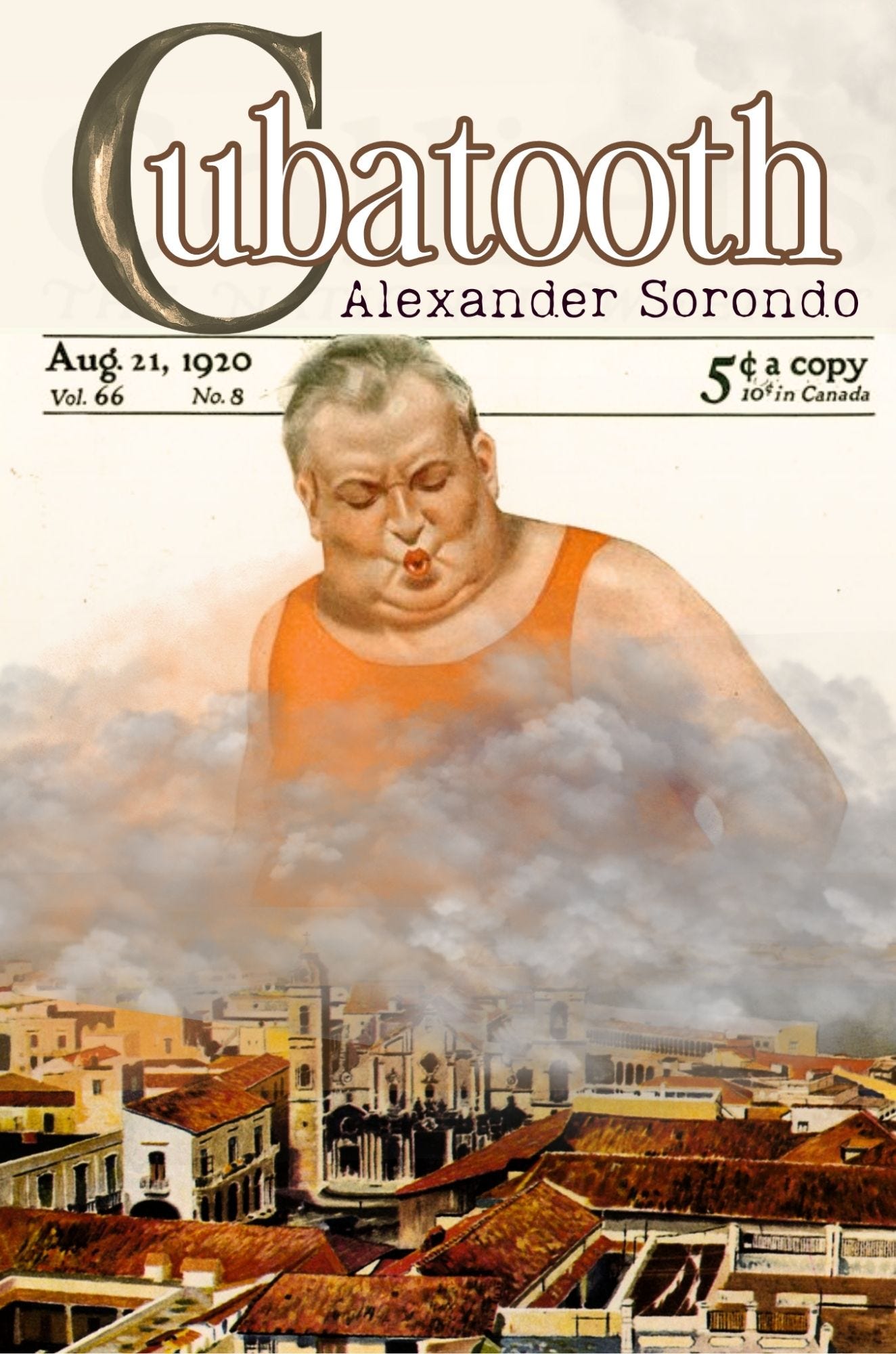
My book Cubatooth is out today, on digital! just about anywhere you get ebooks!
It had a partial release on Saturday, by accident, when I made a mistake on Amazon and accidentally cancelled all the preorders and deleted the book, what TV painter and sickday companion Bob Ross would call “a reely big fuckup,” and so I had to upload the ebook three days ahead of its original August 11th release day.
But since that’s the date I kept eyeballing on the calendar, the deadline that kept snapping me upright at 4 a.m. and giving me a much-needed sense of direction after losing my job as month, today (August 11) is when my circadian countdown’s BIG ZERO; and now, as if to give me something to celebrate, the wee hours of August 11 is when Cubatooth has finally appeared, after a slight delay, on Apple, Barnes & Noble, Kobo and Smashwords and several other outlets.
I’m celebrating the whole week but today is Cubatooth’s proper pubday.
The Big Mistake That Made a Short Novel into a Five-Year Project
I’ve talked a lot about Cubatooth’s development on Notes and I won’t belabor those points again so here’s the data:
I wrote a novel like this in 2019 and tossed it.
Started writing it from a new angle in 2022.
I read roughly 50 books to research it and I dunno some godless number of articles.
I filled ten or eleven notebooks and when it was all typed up the first draft was 198,000 words, or 1,098 pages.
Over the next four years I shaved it down to 250 pages.
I decided I wanted to write a novel about the 1920s and Prohibition, bootlegging, organized crime. But I didn’t know anything about it. Al Capone, I knew, is a figurehead for all those things — “I’ll start reading Capone books!”
These are the three good ones:
Capone: The Life and World of Al Capone by John Kobler.
Capone: The Man and his Era by Laurence Bergreen.
Scarface vs The Untouchables by by Max Allan Collins and A. Brad Schwartz
Notice how none of these Capone biographies just about Capone.
That’s because Capone was basically a mid-level gangster. We remember Capone, culturally, cuz he’s the only one who liked getting photographed, something avoided by leading figures of an east coast crime syndicate; but Al Capone was a twentysomething coke-addled narcissist with a brain disease who never said anything interesting.
So there wasn’t much to write about. I almost dropped it; but I noticed that his relationship with the press was really interesting…
I read David Nasaw’s amazing biography of newspaper mogul William Randolph Hearst, called The Chief. There’s a great section where the newspaper boys go on strike. They’re like a gang unto themselves. So I read Nasaw’s book Children of the City — one of the most enchanting things I’ve ever read. It is the basis for the batman musical Newsies.
I learned that William Randolph Hearst was instrumental in fomenting the Spanish-American war with all these headlines saying we have to invade Cuba, liberate them from that lisping tyranny, and then when it finally happened, and Cuba was a “democracy,” it became a booming tourist destination and also a major port for bootleggers during Prohibition. Suddenly I had my triangle of plot:
Hearst —> Cuba —> Prohibition —> Capone —> etc
So I now had my Known Unknowns. I knew what I needed to study.
I treated my ignorance like a slow fire in a big house and every page I read was a little foamy jet on the blaze: nixing a curtainflame here, a smoldering piano key there; really your ignorance is just a cosmic black thing and there’s no beating it.
So I read Hugh Thomas’s 1,100-page history of Cuba. It’s title is Cuba. It was amazing. I got what I needed. But no. I needed to know the American side. Well it was President William McKinley who ordered the invasion. So I read three books about McKinley. The best one was Margaret Leech’s In the Days of McKinley (1959) which reads like a great Victorian novel. Anyway McKinley wasn’t that interesting either; but his assistant secretary to the Navy, Theodore Roosevelt, was the one who came in screaming about war. The need for it. “Boats!” He wrote a book about em. Said we needed to command the waterways of the 20th century or America was fucked. His teeth were enormous.
So Roosevelt leaves his post and joins the war effort in Cuba. He joins a cavalry unit called the Rough Riders. The outfit is khaki. The hat is good. He kills a lotta Spaniards. He gets promoted. The rest of his life and even as president he wants people to call him “Colonel.”
I read the firs two volumes of Edmund Morris’s biographical trilogy about Theodore Roosevelt and they are absolutely transcendently good, especially (to my surprise cuz I hate reading about young people) the first one. I read H.W. Brands’ biography of Roosevelt called TR which is big, but it’s fast, and it’s thorough, and very friendly to someone who’s not that well-versed in political biography. I had the privilege of interviewing H.W. Brands a few years ago about his Ronald Reagan biography, which is also extremely good. I told him, “My favorite thing about your Reagan biography is that, on page 30, Ronald Reagan is 30.”
Turns out Teddy Roosevelt and William Randolph Hearst went to Harvard together and hated each other — a hatred that got spicier when Roosevelt won the presidency, because Hearst’s whole media empire was basically a long slow fuse toward his own campaign…
This became the fodder for a ~200 page subplot in Cubatooth. Took roughly a year to write.
I cut the whole thing.
I was learning a lot, but I wasn’t really writing a lot, which was frustrating, and I wished it was different, and then the monkey paw curled its finger and suddenly I was writing a LOT, piling up pages, but the story wasn’t really advancing; or it advanced but it kept veering into sidestreets about, for instance, a family of Appalachian moonshiners who (and this is kinda the true story) were making moonshine since the mid-19th century, illegal and off the books, and so c. 1915 they bought a gas station, out in their vicinity of Midlan, WR, and that was just a front, a laundromat for their moonshine cash, but then, c. 1920, all these civilian motorcars started coming through and turns out that their bullshit gas station was now, like, the only gas station for a hundred miles, and motorists pulled up more and more often, cars a’sputter, needing gas, willing to pay top dollar — and suddenly these moonshiners were sitting on their very-remunerative moonshine operation but, “well hold on nah,” this motorcar business was lookin pretty nifty, and suddenly there are two gas stations, and the moonshiners are kinda wondering which liquid racket to capitalize on, because moonshine, well that’s tradition, but gasoline is the future—
All this niche research and I still didn’t really know what daily life was like for the average urban-set American c. 1920, so I started reading broader histories, cultural survey-type stuff, the best of which (or the most enjoyable) is definitely Anything Goes, by Lucy Moore, and Bill Bryson’s One Summer: America, 1927, where each chapter addresses some major cultural event in 1927, like the big Jack Dempsey fight, or the Capone-orchestrated St. Valentine’s Day Massacre, or Charles Lindbergh’s flight across the Atlantic.
Then I read Gerald Leinwand’s more scholarly attempt at the same thing, a book called 1927: High Tide of the 1920s, which could use a little Crisco in the prose but was otherwise more fact-crammed than Bryson’s book — then I read the Eric Burns book 1920: The Year That Made the Decade Roar which is a good and informative read but, my guy, it did not make the decade roar. Big year for radio, though! They called it “the talkin box.” They were big as shit and crazy-expensive but the price rolled down and, by 1924, one-third of household furniture sales were these radio cabinet things. He also gives one of the starker views of how evil and horrible Prohibition was. Bootleggers using anti-freeze out of motorcars to fluff their booze and give it a kick. Winston Churchill visited the US during this time and said, “There is less drinking, but it is worse drinking.” He also pisses on the grave of Wayne Bidwell Wheeler, whose tombstone is thirsty for it; Wheeler led the Anti-Saloon League (ASL), a pro-Prohibition political outfit, a Westboro-adjacent death cult; when Wheeler and his minions learned that there was lots of industrial need for alcohol (for “cleaning agents, insecticides, and explosives” for use in war and construction) and that bootleggers were getting hold of that stuff to make their cocktails — which is already deadly as shit — they lobbied (i.e. “leaned on”) legislators to mandate that all industrial-grade alcohol be manufactured with extra methanol. Why? Cuz it would make the alcohol more deadly without reducing its industrial efficacy. Wheeler said that, if people knew the industrial alcohol would kill them, they wouldn’t drink it.
OK but wait, said people like Jesus, what about the schoolteacher, a nice lady, who goes for a date to a speakeasy? She orders a martini. She doesn’t know where it comes from. The bartender makes it. He doesn’t know where it comes from. The bar owner buys it from a guy named Lenny, whose bottles don’t have labels, because Lenny is Swedish, he can’t read English, he doesn’t follow the papers. What Lenny does is he buys ten bottles of Beefeater and cuts it with a few splashes of “industrial” alcohol because that’s an English word that he knows when he sees it on a bottle. Lenny isn’t that smart. He just wants to turn ten bottles into twelve because there’s a postwar economy slump. He’s got kids.
How can any of these people knowingly abstain from the industrial alcohol if don’t know they’re drinking it?
Wheeler proudly said he didn’t give a fuck. That it was their problem. They knew they shouldn’t be drinking alcohol in the first place.
Credit to Eric Burns’ book for making me way madder than almost anything else I read — but it is instructive to be angry with dead people because we don’t have to see them and it helps to sharpen our values. It becomes introspective.
And therein resides the trap. If you go hard into a historical rabbit hole you start seeing things that shaped your current moment. You start looking at your own world differently. Arguing with it. Arguing with yourself.
It is a deeply enriching, enlightening, expanding experience.
It gets nothing done, though. The storyline that was really taking me too far, and made me finally snap into focus and start cutting shit out, stemmed my attempt to do something with this weird historical detail: Al Capone was in his Atlanta prison cell, 1932, when he heard about the Lindbergh baby getting kidnapped. He told some official at the prison that, if they let him out, he could find the kid in like 24 hours. Lindbergh heard about it and there was brief but, apparently, serious conversation, among feds, about letting Capone outta prison to find the Lindbergh baby.
If you want to write a historical novel, or a novel oriented around some vast topic, do not go to the research material telling yourself, “I’ll do the reading and find my story.” That is lethal. Instead, figure out your story, map your characters and their arcs a little bit, and then go to the research, so you can flesh things out.
What I felt in the last couple weeks of working on the book, checking facts, fixing timeline problems, cross-referencing sources, formatting the book, is what something akin to what Cormac McCarthy talked about after finishing his 1985 novel (maybe his masterpiece) Blood Meridian. He’d been working on it for roughly a decade. He traveled all through Mexico, learned Spanish, and read more than 300 books to inform the project. When it was done he knew that it was great. He was proud of it. Maybe prouder of that book than anything else he’d ever done in his life. And somewhere around that time he was asked about the research, the labor, everything that went into the book and what he learned from the process. And really, above all the history and the travel and culture and the new language he’d picked up, he’d learned one deeper thing about himself: I’m never doing that shit again.
Comments
Nothing yet. Say the first thing.
Sign in to join the conversation.