
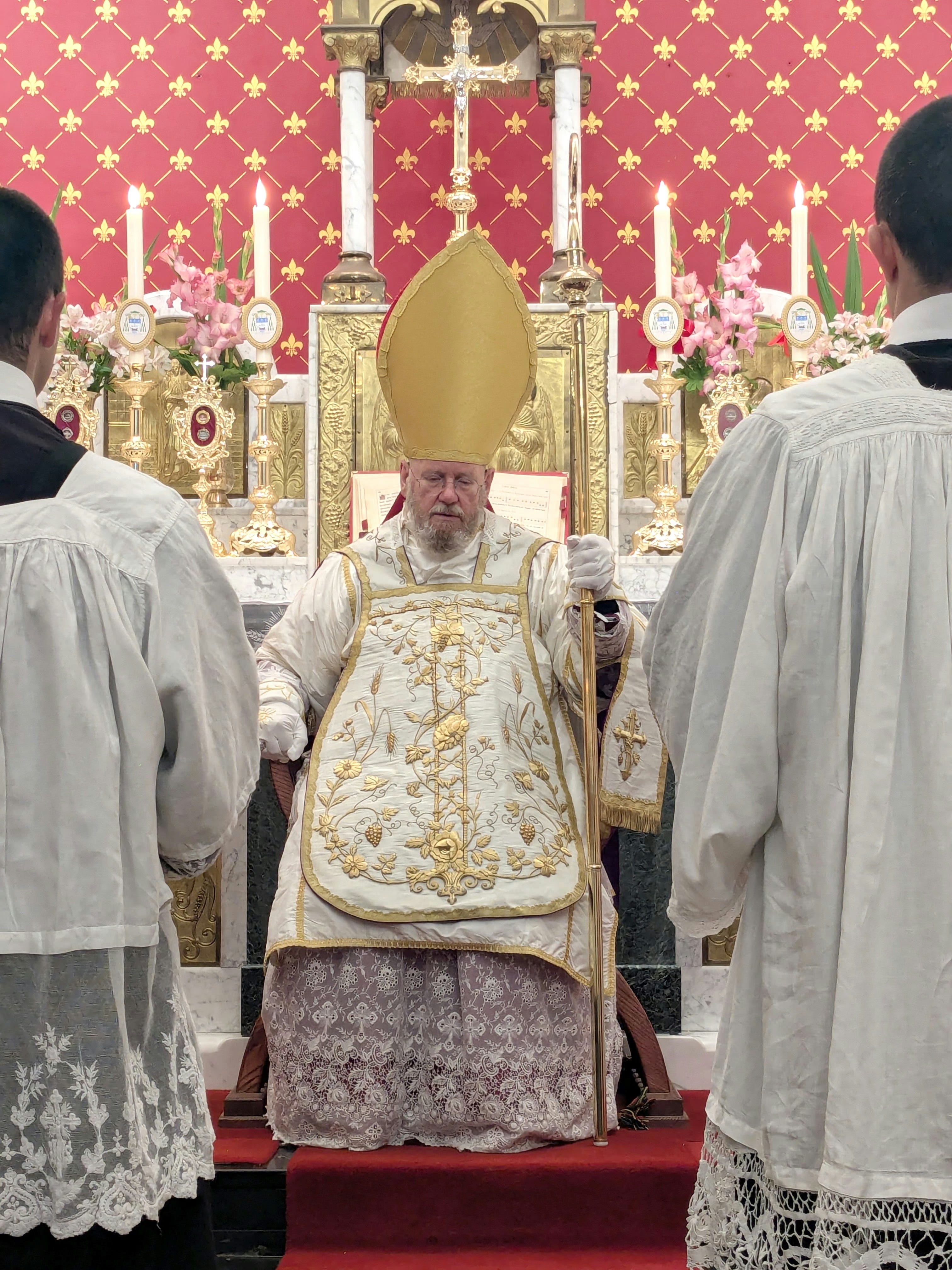
Two announcements appeared on July 25.
In Scotland, the Diocese of Aberdeen declared Father Michael Mary Sim excommunicated, removed him from ecclesiastical office, and prohibited him from celebrating Mass or the sacraments. His principal offense was schism: he had publicly embraced sedevacantism, rejected Leo XIV as a true pope, and questioned the validity of postconciliar ordinations. The diocese added that his episcopal consecration by sedevacantist bishops later that day compounded the rupture, although the canonical judgment itself had already been completed before the ceremony.
In Rome, Leo XIV appointed Archbishop Christophe Zakhia El-Kassis as the Holy See’s Permanent Observer to the United Nations in New York. El-Kassis had served as nuncio to the United Arab Emirates and Yemen and as apostolic delegate for the Arabian Peninsula. He had publicly praised the Abu Dhabi Document on Human Fraternity as the “culmination of constructive and sincere dialogue” between the Catholic Church and Al-Azhar and supported efforts to integrate its principles into educational systems.
The contrast deserves more than the usual complaint about inconsistency.
Rome is capable of acting. It can investigate, judge, depose, prohibit, declare, and warn the faithful to have no dealings with the condemned. What changes is the object of its authority.
A priest who says the postconciliar hierarchy has forfeited its claim to govern receives the full apparatus of canonical discipline.
A diplomat who praises the theological charter of the new interreligious order receives New York.
A German auxiliary bishop publicly participates in precisely the lay homily Rome has just forbidden, and the photographs go online.
The machinery is not broken.
It knows whom it serves.
The Diocese of Aberdeen had been pursuing its canonical process for months. Its May statement said the matter concerned statements and alleged actions of the Sons of the Most Holy Redeemer and had been referred to the competent Roman authorities. By July 25, Bishop Hugh Gilbert announced that Michael Mary had been found guilty of the charges, “most notably that of schism.” The judgment excommunicated him, dismissed him from office, and prohibited his sacramental ministry. Gilbert said the penalties could be lifted following repentance and reparation.
The judgment was based primarily upon the community’s adoption of sedevacantism, its denial that Leo and the bishops united with him should be recognized, its doubts about postconciliar ordinations, and its opposition between an “old” and a “new” Church. The consecration later that day brought further potential canonical consequences but was not the offense adjudicated in the completed trial.
I wrote an open letter to the Translapine Redemptorists on May 6, 2026, urging them to turn the canonical process back on Rome. I stated:
So the Redemptorists’ first answer should be: you may not smuggle your conclusion into the charge. Before accusing us of refusing submission to Leo XIV, prove that Leo XIV possesses the office. Before accusing us of breaking communion with his bishops, prove that these bishops profess the Catholic Faith. Before declaring us outside the Church, prove that your own hierarchy has not publicly defected from the religion it claims to administer.
This is the move. Not “we refuse to answer, because you have no authority.” Answer, but answer by challenging the premise.
Rome says: “You are in schism because you refuse Leo.”
The monks should answer: “Prove Leo.”
The Redemptorists’ canon lawyer in the case disagreed and thought that would be a bad idea. Apparently he had better ideas, which involved both getting his client excommunicated and letting Rome and Leo get off scott-free.
Bishop Michael Mary’s position touches the central institutional claim. He denies that Leo possesses the papal office. He does not request reform within the recognized system. He says the system represents a different Church and has lost the authority it claims.
That is the one kind of dissent the postconciliar establishment cannot metabolize.
Progressives may reject doctrines, disobey liturgical law, demand female ordination, contradict Roman instructions, and remodel Catholic life from inside the institution. They continue to recognize the authority whose commands they ignore. They preserve the structure while altering its religion.
A sedevacantist does the reverse. He may preserve a great deal of the old doctrine and worship while denying the legitimacy of the structure administering the new settlement.
Rome understands the difference immediately.
The German revolutionary still needs Rome.
The sedevacantist says Rome, as presently constituted, is the problem.
Only one of them threatens the center.
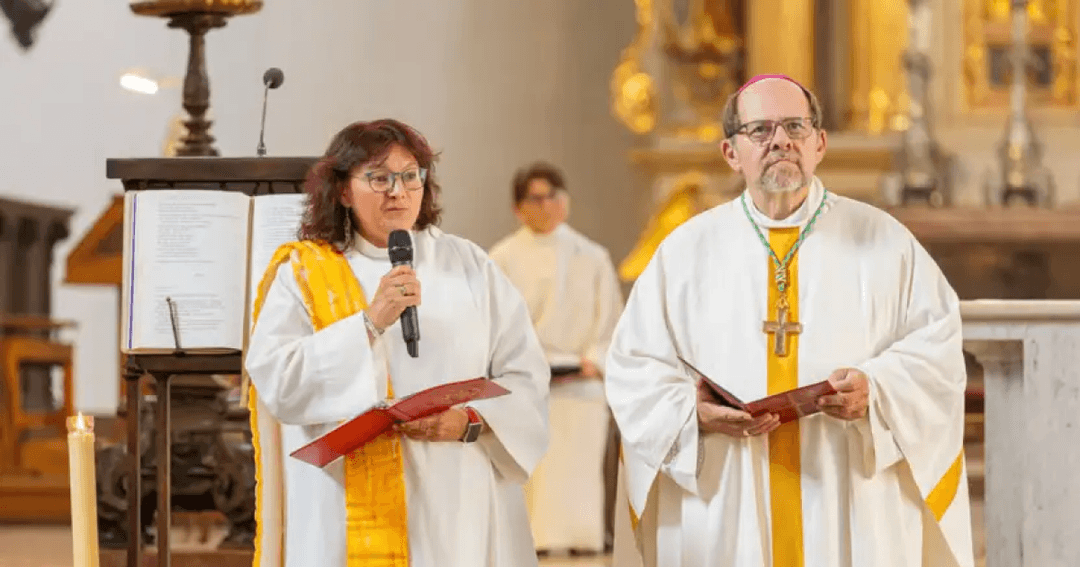
On June 17, the Dicastery for Divine Worship gave the German bishops an unusually clear answer.
They had requested permission for a qualified layperson, in exceptional circumstances, to preach in the place of the homily during Mass. Rome refused. The reservation of the homily to a priest or deacon, the dicastery explained, was not simply a changeable disciplinary custom. It arose from the nature of the liturgy, the sacramental mission of the ordained minister, and the unity of Word and Sacrament.
Five weeks later, Auxiliary Bishop Wolfgang Bischof of Munich and Theresia Reischl, head of the archdiocesan Women’s Commission, delivered what the archdiocese called a “dialogue sermon” during Mass at St. Michael’s Church.
This was no unauthorized surprise smuggled into the liturgy by an excitable parish committee. The Archdiocese of Munich announced the arrangement before the event. Its own website advertised that Reischl would give a Dialogpredigt during the episcopal Mass for the feast of St. Mary Magdalene.
The word “dialogue” did the usual postconciliar laundering.
Rome said a layperson could not give the homily or a homiletic contribution occupying its place after the Gospel. Munich placed a laywoman beside a bishop and called the resulting sermon a dialogue. The prohibition remained intact on paper. The prohibited action occurred in public. Everyone could then pretend the addition of a second voice had transformed disobedience into a new liturgical category.
The Mass also featured a woman dancing through the central aisle while large inflatable balls were bounced over the congregation. The archdiocese published images and material from the event rather than concealing it. As of this writing, no subsequent public Roman sanction has been announced.

Sign of the Cross@CatholicSOTC
Germany: Woman delivers “dialogue sermon” with Auxiliary Bishop Wolfgang Bischof. This appears to contradict the Pope Leo's ban on lay preaching. A 'liturgical dance' also took place during Mass.
8:07 PM · Jul 24, 2026 · 4.7K Views
28 Replies · 17 Reposts · 69 Likes
Compare the timelines.
Aberdeen spends months conducting a canonical process and issues a public judgment against a sedevacantist superior.
The Vatican rejects the German bishops’ request in June.
Munich publicly announces its workaround.
An auxiliary bishop participates in it in July.
The event is promoted afterward.
Then comes the familiar silence in which everybody waits to see whether open defiance will eventually become accepted practice.
The German strategy is far more dangerous to Rome’s authority than a small monastery on a remote Scottish island—at least if authority is understood as the power to preserve doctrine, worship, and ecclesiastical order.
Yet Germany has learned how the new system works.
Never deny the pope.
Praise dialogue.
Invoke synodality.
Declare fidelity to Vatican II.
Describe each act of disobedience as a pastoral response to lived experience.
Demand permission. When permission is denied, proceed through a “grey zone.” Once the practice becomes ordinary, cite the ordinary practice as proof that the law no longer corresponds to reality.
Most importantly, remain inside.
The revolutionary who stays within the canonical enclosure possesses buildings, salaries, commissions, universities, media offices, tax revenue, diocesan machinery, and episcopal titles. He can ignore Roman instructions while invoking communion with Rome against anyone who objects.
Michael Mary’s community did not merely defy an instruction. It denied that the man issuing the instruction had the right to issue it. That offense demanded a verdict.
Munich’s organizers understood the assignment. They violated the rule while maintaining the ideology of the institution. Their “dialogue sermon” advanced the synodal redistribution of teaching authority without formally announcing a rival hierarchy.
The system can live with that.
Indeed, it has been living on it for sixty years.
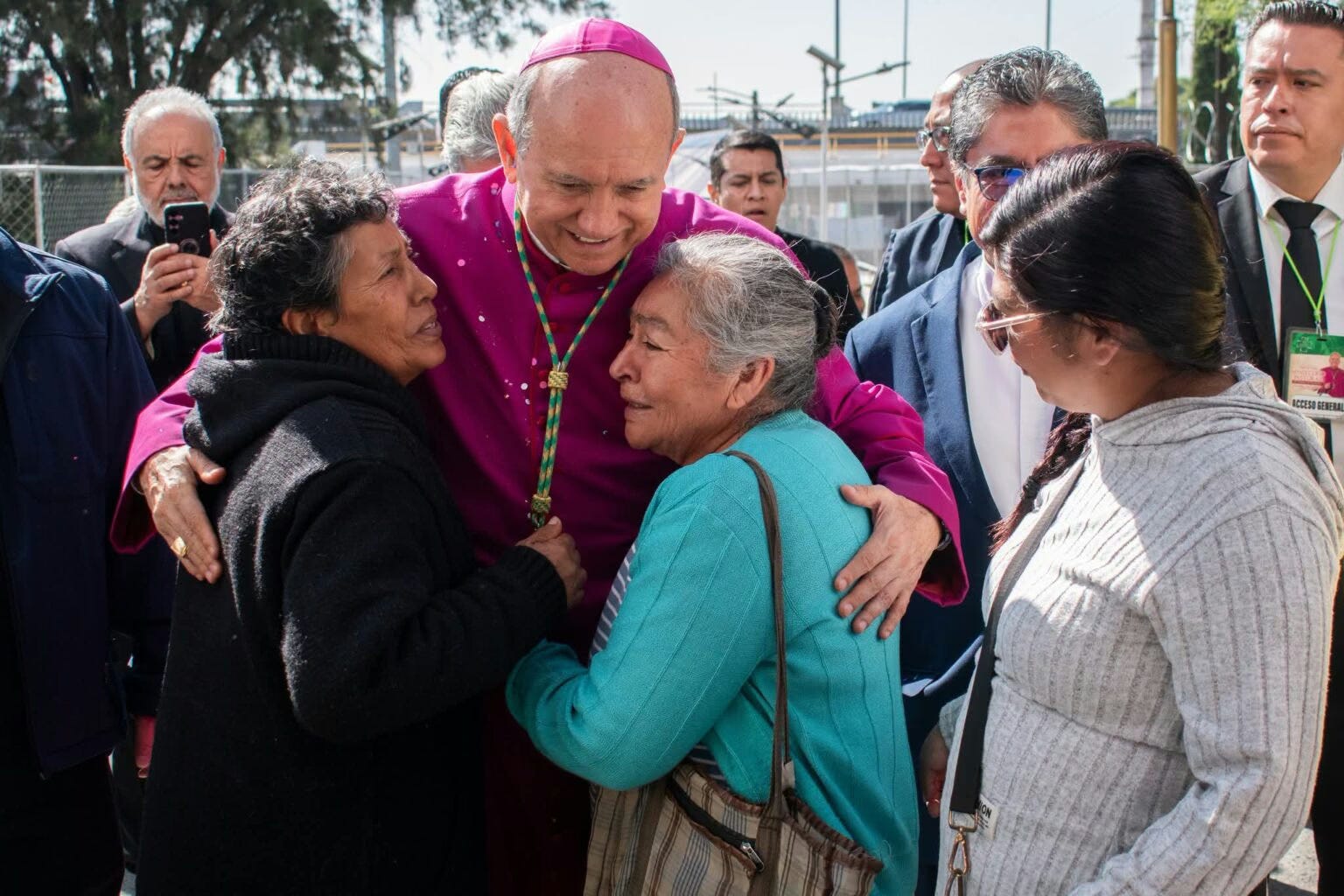
Three days before the Aberdeen judgment, José Guadalupe Torres Campos was installed as Bishop of Ecatepec, Mexico.
Leo had appointed him in May after Torres Campos had spent more than a decade ministering in Ciudad Juárez. His previous public work placed heavy emphasis on migrants, humanitarian assistance, dialogue with civil authorities, and pastoral proximity at the United States–Mexico border.
At Ecatepec, he said he came with a sincere desire “to listen before speaking, to know before deciding and to love before asking.” He promised to be a close bishop who walked among his people and said clergy and faithful would listen to one another and discern together what the Holy Spirit was asking of the local Church.
To be fair, his installation address also affirmed that the Church exists to evangelize and that the people need an encounter with Jesus Christ, who transforms hearts, heals wounds, rebuilds families, and restores hope.
The problem lies in the governing order he chose.
A bishop should listen. He must know the sufferings, temptations, material conditions, and spiritual needs of his flock. A shepherd who never listens will preach abstractly to people he does not understand.
But the bishop does not listen in order to discover what Christianity is.
He receives the deposit of faith and teaches it.
He may listen before making a prudential administrative decision. He does not listen before knowing whether adultery is sinful, whether Christ founded one Church, whether the Mass is a sacrifice, whether men alone receive priestly ordination, or whether the bishop possesses a duty to teach rather than facilitate an endless communal discernment.
“Listen before teaching” sounds humble. As an episcopal program, it quietly reverses authority.
The old bishop listened so that he could apply the truth wisely.
The synodal bishop listens to determine what the community’s experience may require the truth to become.
That change usually arrives through temperament and vocabulary long before it appears as formal doctrinal contradiction.
Torres Campos’s migrant work is not itself objectionable. Feeding migrants, protecting families from violence, demanding humane treatment, and offering the sacraments to displaced Catholics belong to Christian charity. His former diocese maintained shelters and assistance centers, and he repeatedly spoke of giving hope to people caught between governments, criminal networks, and unstable immigration systems.
Yet the postconciliar hierarchy repeatedly turns legitimate charity into a substitute definition of episcopal office.
The bishop becomes the official of closeness.
He accompanies.
He listens.
He walks.
He builds bridges.
He convenes government officials, business leaders, activists, and religious organizations around a shared social program.
During the Ecatepec installation, the mayor welcomed a new stage of dialogue, accompaniment, and peacebuilding between Church and government.
Again, none of those words is intrinsically evil.
Their cumulative effect is the problem. They describe an institution that increasingly justifies its public existence through social mediation rather than supernatural authority. The bishop becomes useful to the civil order because he can encourage cohesion, calm unrest, support vulnerable populations, and add religious ceremony to political programs.
He becomes less useful when he announces that Jesus Christ is King, false religions are false, conversion is necessary, civil rulers remain subject to the moral law, and souls face judgment.
The modern state welcomes a bishop who listens.
It becomes nervous around a bishop who teaches.
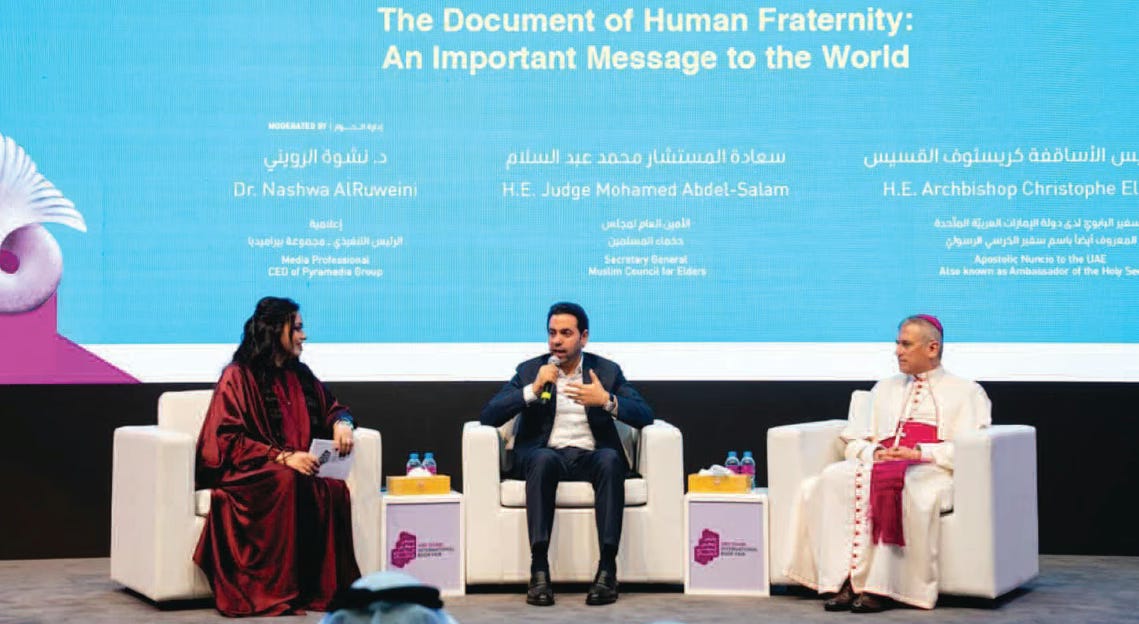
The appointment of Christophe El-Kassis supplies the international version of the same ecclesiology.
El-Kassis is an experienced Vatican diplomat and canon lawyer. Before his July 25 appointment to New York, he served as nuncio to Pakistan, then the United Arab Emirates and Yemen, and as apostolic delegate for the Arabian Peninsula. Leo’s decision sends a man formed by the Vatican’s Muslim-world diplomacy to represent the Holy See before the world’s largest political forum.
His public record fits the assignment.
At the Abu Dhabi International Book Fair in May 2024, El-Kassis called the Document on Human Fraternity the culmination of constructive dialogue between the Catholic Church and Al-Azhar. He praised Francis’s efforts to spread its principles through institutions, organizations, political decision-makers, and educational systems.
The document contains the notorious sentence declaring that “the pluralism and the diversity of religions, colour, sex, race and language are willed by God in His wisdom.”
Defenders later argued that religious error is “willed” only in the sense of God’s permissive will. Francis reportedly gave that private clarification to Bishop Athanasius Schneider. The official text, however, was never rewritten to make the distinction. Religion remains listed alongside sex, race, color, and language—created differences whose existence does not arise from humanity’s rejection or corruption of revealed truth.
The ambiguity became policy.
The Abrahamic Family House in Abu Dhabi placed a mosque, synagogue, and Catholic church beside one another as the architectural realization of the Human Fraternity project. The Catholic church’s altar was dedicated in November 2024; official accounts show Bishop Paolo Martinelli presided, with El-Kassis present as nuncio and the Holy See’s legal representative for the church.
This detail is important because the building teaches before anyone speaks.
Three houses of worship stand as parallel expressions of the religious aspirations of the human family. The Catholic presence does not visibly confront the others with the necessity of conversion. It joins them in a common institution of coexistence.
The cross remains.
So do the mosque and synagogue.
The arrangement communicates that their highest public relationship is fraternity rather than the conversion of all nations to Christ.
It would be comforting to treat the El-Kassis appointment as a bureaucratic continuation left over from Francis.
Leo has made the project his own.
In his January 2026 message for the International Day of Human Fraternity, Leo celebrated the seventh anniversary of the Abu Dhabi document and described human fraternity as an “unbreakable bond” uniting every person created in God’s image.
Now he has sent one of that project’s public advocates to the United Nations.
The symbolism is difficult to miss.
The UN does not need a Catholic archbishop to tell it that different religions should coexist peacefully, governments should pursue sustainable development, and institutions should promote human dignity and dialogue. The UN already possesses entire departments devoted to such language.
The distinct reason for a Holy See mission should be the truth entrusted to the Church: the natural moral law, the dignity of life from conception to natural death, the rights of the family, religious liberty properly understood, peace grounded in justice, and ultimately the kingship and saving authority of Jesus Christ.
Instead, the diplomatic establishment increasingly presents Catholicism as the world’s oldest nongovernmental organization—uniquely experienced, spiritually decorated, and eager to assist the international order in discovering values it already professes.
El-Kassis’s promotion does not look like a deviation from Leo’s program.
It looks like its international deployment.
Place the four stories together.
Michael Mary rejects the legitimacy of the postconciliar hierarchy and is declared excommunicated.
Munich’s auxiliary bishop participates in a lay “dialogue sermon” weeks after Rome expressly states that such preaching cannot be authorized.
Torres Campos is installed under the banner of listening, closeness, accompaniment, and communal discernment.
El-Kassis, who praised the Abu Dhabi charter and its insertion into educational systems, is promoted to the United Nations.
The dividing line is not obedience.
Munich disobeyed.
The dividing line is the direction of disobedience.
Progressive disobedience moves further along the trajectory of the postconciliar project. It expands lay leadership, weakens sacramental distinctions, elevates experience, and relocates authority from revelation toward dialogue. Its participants may run ahead of Rome, but they run toward the same horizon.
Traditionalist disobedience runs backward toward the doctrine, liturgy, and ecclesiology that existed before the Council. It treats Vatican II as the rupture rather than the starting point. It therefore calls the postconciliar regime’s legitimacy into question.
The progressive says: “You have not implemented your revolution consistently enough.”
The traditionalist says: “You had no authority to make this revolution.”
Rome can negotiate with the first complaint.
The second threatens the foundation.
A sedevacantist analysis need not claim that every act of hypocrisy independently proves the vacancy of the Holy See.
Nor does it require pretending that any man who opposes Vatican II automatically exercises sound judgment, possesses canonical authority, or should be followed into every consecration and jurisdictional claim.
The deeper question is cumulative.
What does this hierarchy recognize as the principal danger to the Church?
Is it the public violation of liturgical law by a bishop?
Is it the gradual transfer of ordained teaching functions to lay ecclesiastical activists?
Is it the elevation of religious pluralism into a divine and educational ideal?
Is it the transformation of episcopal office into listening, accompaniment, social partnership, and communal discernment?
Or is it the accusation that the men governing this program no longer possess the authority they invoke?
The record suggests that the final danger outranks all the others.
That does not automatically prove the sedevacantist conclusion. It explains why the conclusion keeps attracting Catholics who watch the system act like this.
They see a hierarchy uncertain when defending the distinctions of Holy Orders, accommodating when confronted by German defiance, enthusiastic about interreligious fraternity, and decisive when its own legitimacy is denied.
Eventually, Catholics ask whether they are witnessing weak administration inside the Catholic Church or efficient administration of something else.
The usual defense says Rome is divided, slow, burdened by procedure, constrained by local bishops, and reluctant to impose penalties in complicated pastoral situations.
Papa Stronsay gives the answer.
Rome and its local representative can act when they decide that an offense matters. A canonical process can be completed. A judgment can be published. Offices can be removed. Sacramental ministry can be prohibited. The faithful can be instructed to break contact. Roman dicasteries can be kept informed at every stage.
Perhaps Bishop Michael Mary expected the sentence. A man publicly embracing sedevacantism is unlikely to be surprised when the bishop he no longer recognizes declares him outside communion.
The more revealing defendants are the ones who never reach the courtroom.
Munich was told no.
Munich advertised yes.
Munich proceeded.
The congregation bounced beach balls while a bishop and laywoman performed a “dialogue sermon,” and the same institutional culture that found decisive language for a monastery in Orkney has not publicly found comparable language for one of Germany’s most prominent archdioceses.
This tells us which acts are treated as existential and which are treated as premature stages of development.
Michael Mary denied the authority of the new Church.
Munich demonstrated how the new Church actually uses it.
One received the sentence.
The other may have supplied the future.
If you value independent Catholic analysis and want to help keep this work going, you can make a contribution or subscribe below. Every donation and subscription directly supports the writing, research, and production of Hiraeth in Exile.
Thank you for helping preserve independent Catholic journalism rooted in truth and tradition.
Comments
Nothing yet. Say the first thing.
Sign in to join the conversation.