
Peace at the Masonic table
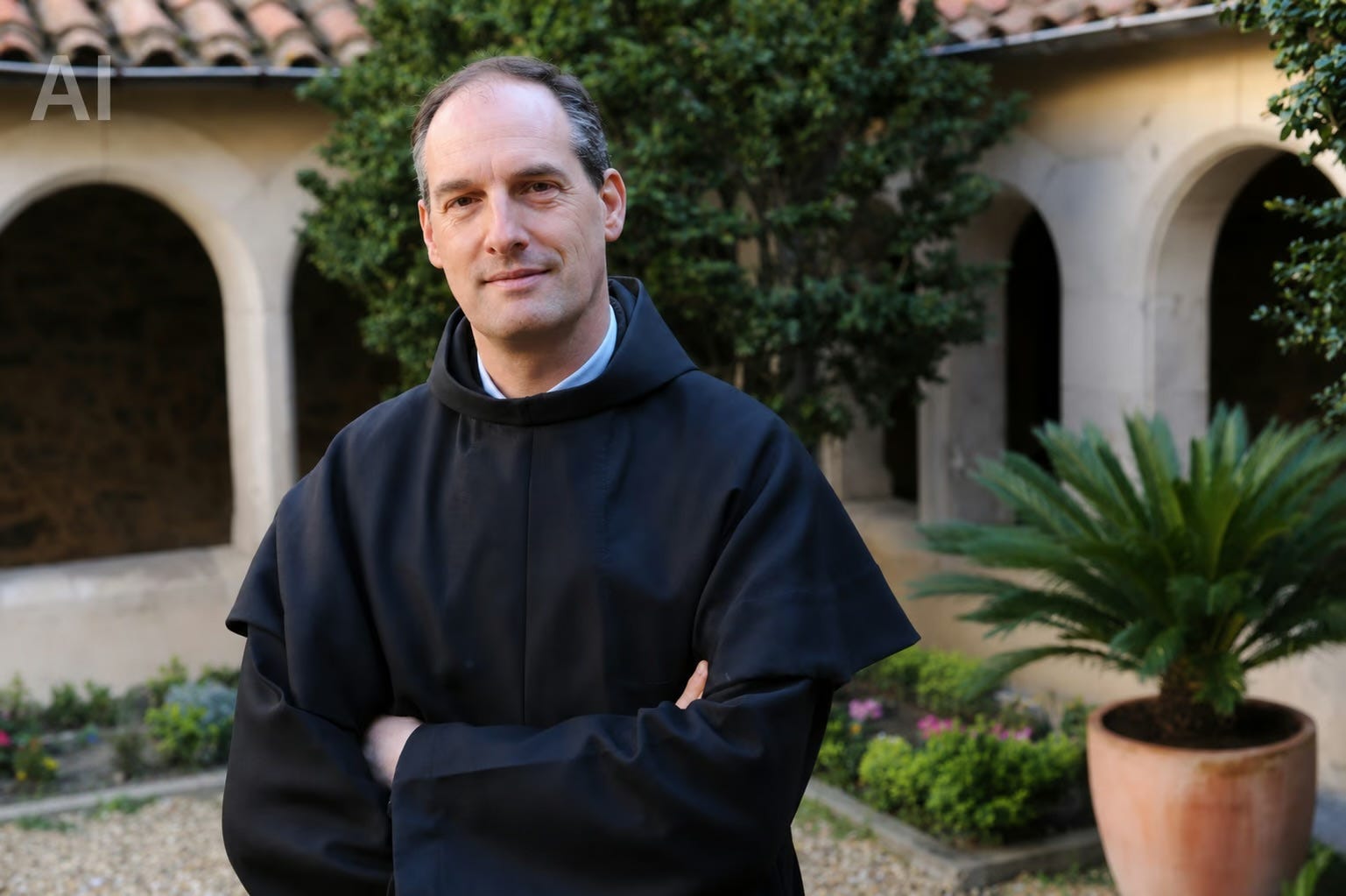
On August 7, Freemasons from several obediences held their customary summer gathering at the Col de Vergio, nearly 1,500 metres above sea level. About one hundred attended. This was a Masonic lunch, and Cardinal François Bustillo, Bishop of Ajaccio, was its featured ecclesiastical guest.
The French satirical paper Le Canard enchaîné said the Masons had pulled off “a nice coup” by securing him. Bustillo, described as the event’s star, discoursed at length on peace. Beside him sat former autonomist deputy Jean-Félix Acquaviva, who also addressed the gathering and remains under investigation for alleged passive corruption, influence peddling, and unlawful taking of interests. The underlying allegation involves jobs supposedly offered to young women in exchange for sexual favors. Acquaviva categorically denies it. The cardinal’s choice to provide episcopal prestige to a Masonic gathering requires no unproved allegation at all. The admitted facts suffice. Le Canard reported the scene directly.
Bustillo has not been shown to be a Mason. But membership is not the charge.
Public fraternity is.
A 1985 Roman explanation acknowledged that duly authorized dialogue with Masonic representatives could occur. A doctrinal encounter aimed at exposing error, however, differs sharply from serving as the episcopal attraction at a summer lunch. Dialogue ordered toward truth names the point of collision. Vergio produced social recognition and a speech on the one subject least likely to disturb the table.
The Church’s opposition to Freemasonry never depended solely upon secret handshakes, nineteenth-century plots, or the hostility of one lodge. The 1983 declaration signed by Cardinal Joseph Ratzinger states that the Church’s negative judgment remains unchanged because Masonic principles are irreconcilable with Catholic doctrine. Membership remains forbidden; Catholics who enroll are in grave sin and may not receive Communion. Local bishops possess no authority to soften that judgment. The declaration is short and brutally clear.
Rome explained the doctrinal reason two years later. Freemasonry proposes a brotherhood built upon humanistic values broad enough for competing religions and worldviews. Inside that framework, revealed religion becomes one institutional expression of a larger, elusive truth, while the Lodge supplies the higher fraternity within which all particular creeds meet. Catholic faith is thereby relativized, gently and almost invisibly. The Christian still says the Creed, perhaps. He has already accepted a structure in which the Creed can claim no unique public authority. The CDF called this a “relativistic symbolic concept”.
Now look again at Vergio.
A prince of the Church sits before “brothers and sisters” of multiple obediences. He selects peace, the safest possible common denominator. No public report records a warning about naturalism, religious indifferentism, secret oaths, or the Lodge’s long war against Catholic social order. Nobody leaves having been forced to confront Christ’s claim to kingship. The gathering receives exactly what Freemasonry desires from an eminent cleric: recognition without conversion, warmth without doctrinal collision, Catholic prestige poured into a supraconfessional cup.
Even the Masonic publication 450.fm understood the weight of the scene. Its account described “the Church, Freemasonry and political power gathered at the same table” and said Bustillo had changed the distance between them. Quite so. The hosts gained the photograph, the presence, the softened distance. What did the Church gain?
“Peace” sounds innocent. Detached from the Prince of Peace, His law, and the conversion of nations, it becomes a password. Everyone can pronounce it. Nobody must submit.
The old condemnations remain online, embalmed in Vatican servers. The living cardinal supplies the operative teaching.
The altar leaves Lourdes on schedule
The National Assumption Pilgrimage ran at Lourdes from August 12 through 17. Cardinal Jean-Paul Vesco of Algiers presided. Thousands of pilgrims had churches, basilicas, chapels, priests, altars, and a sanctuary built around the apparition of the Immaculate Virgin.
Then came the return journey.
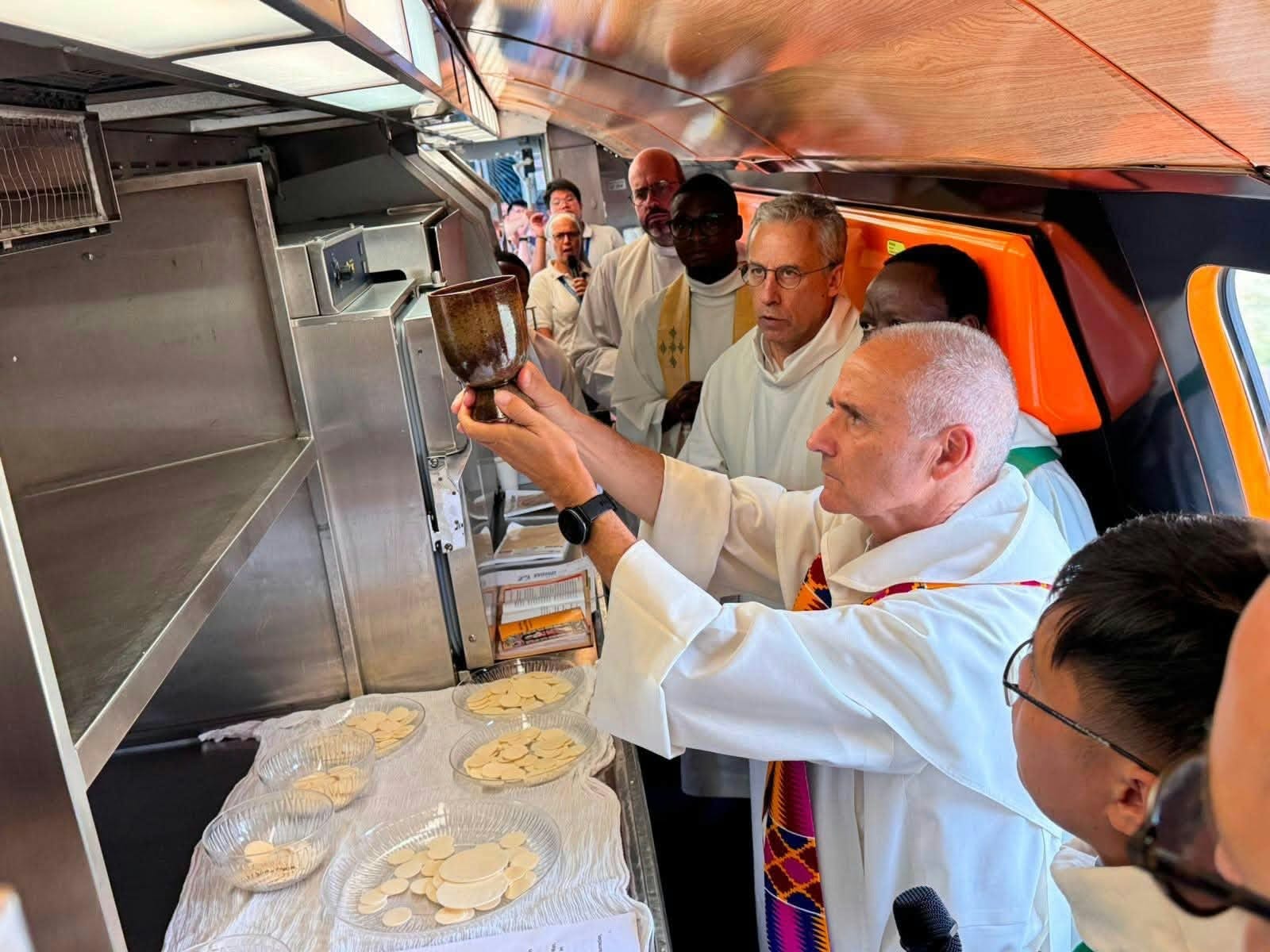
The European Province of the Assumptionists proudly announced that Vesco had celebrated Mass in the train, surrounded by Assumptionists and pilgrims. Photographs circulated as a charming finale. A French Catholic site reproduced them and raised the obvious question of liturgical dignity. The event itself is undisputed.
Steel wheels do not invalidate a Mass. Catholic priests have offered the Holy Sacrifice on battlefields, ships, prison floors, and missionary trails. Necessity can turn a rough surface into an altar.
Necessity is the missing word here.
Canon 932 begins with the rule that the Eucharist is to be celebrated in a sacred place. A particular necessity permits celebration elsewhere, provided the place is decent; outside a sacred place, a suitable table, cloth, and corporal are required. That is the postconciliar code’s own standard. The Assumptionists published the novelty. They offered no necessity.
This pilgrimage had spent five days at Lourdes. The return train was scheduled, not a lifeboat adrift at sea. Mass could have been offered before departure, and the faithful could have prayed the Rosary, sung hymns, or recited the Divine Office in transit. Instead, the cardinal carried the sanctuary into the carriage because contemporary liturgical culture experiences every boundary as a provocation.
Why should the altar stay put? Why should sacred action require sacred space? Why should the timetable yield to worship when worship can be fitted between the seats?
That instinct has done more damage than any single rubric violation. The Eucharist becomes a group experience adaptable to whatever setting the group happens to occupy. Reverence is reduced to good intentions. The priest’s creativity supplies the warrant. Movement, announcements, vibration, cramped bodies, ordinary traffic through the carriage—these cease to register as arguments because the modern liturgist begins with the community and works outward.
The older Catholic instinct moved the other way. People left ordinary space and went up to the altar. They entered silence. They knelt. Architecture, vesture, rails, fasting, bells, and ritual distance taught the body what the catechism taught the mind: this is the unbloody renewal of Calvary, not a religious interlude added to a journey home.
A valid Mass can still be pastorally reckless and scandalously irreverent. Validity is a miserable defense of a cardinal’s public example. Bishops once trained Catholics to fear irreverence near the Blessed Sacrament. Now their photographs train Catholics to find irreverence photogenic.
Bishop Wilmer invents a tradition against Tradition
Heiner Wilmer’s language is smoother. The substance is worse.
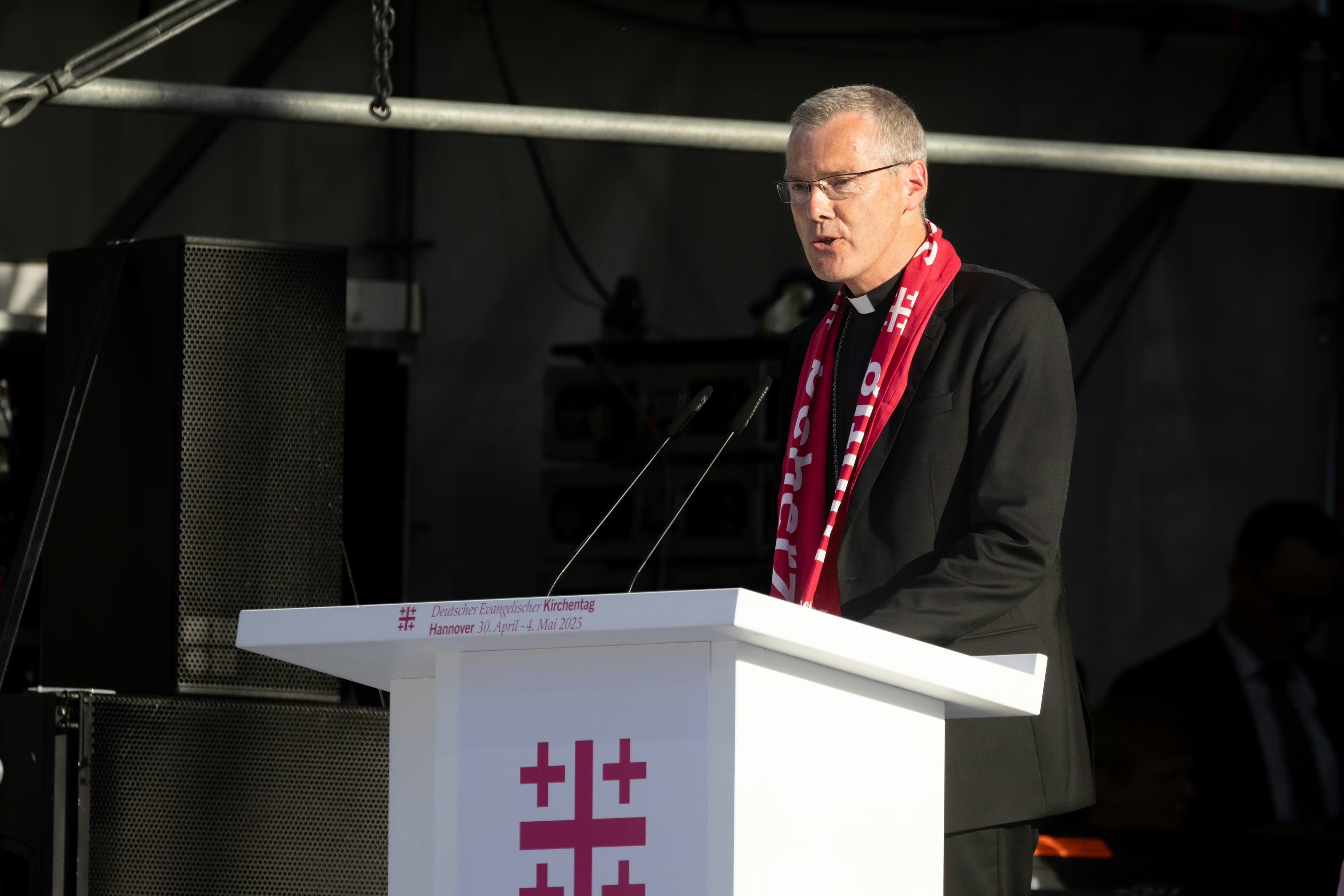
On March 30, acting as president of the German Bishops’ Conference, Wilmer asked Rome for an indult allowing a commissioned lay person to preach in place of the homily during Mass in exceptional circumstances. The Dicastery for Divine Worship refused on June 17. It explained that the restriction cannot be dispensed because it arises from the nature of the liturgy itself. The homily belongs to the munus docendi received through Holy Orders; Word and Sacrament form a unity in the Eucharistic celebration. Vatican News published the reasoning.
Rome even closed the usual German loophole. A homily cannot be replaced by an equivalent lay intervention carrying another label.
Two months later, Wilmer was asked about the lay men and women who have preached for years in Münster. He praised them. He expressed “great respect” for this growing “tradition” and “deep gratitude” for it. Although he claimed respect for Rome’s answer, he voiced confidence that his pastoral workers would find a good way to handle the circumstances. No instruction to stop. No warning. No discipline. His message was unmistakable.
Continue carefully. The bishop is grateful.
Calling this an “established tradition” is an abuse of the word. Tradition hands down what the Church received. Wilmer’s version accumulates violations until disobedience gains sentimental value through age. Yesterday’s illicit experiment becomes today’s pastoral culture; today’s culture will be invoked tomorrow as evidence that doctrine has “developed.” The clock performs the miracle. Error waits long enough and demands a feast day.
Custom cannot overturn the sacramental constitution of the Church. Rome just told him so. Wilmer answered with the bureaucratic equivalent of a wink.
Here synodality reveals its working definition. Authority issues a decision. The losing faction praises dialogue, announces that the conversation continues, and protects the forbidden practice on the ground. Nothing is obeyed except the process, because process never reaches a judgment that binds the progressive party.
Wilmer also said that the German Synodal Way’s disputes over women, sexual morality, celibacy, and participation remain active. Of course they do. In this system a Catholic prohibition is never settled. It becomes “an issue.” A revolutionary demand is never rejected. It becomes “a question still being worked on.”
Robert Prevost appointed Wilmer to Münster on March 26, four days before the indult request reached Rome. The Holy See’s bulletin confirms the appointment to Germany’s largest diocese by Catholic population and notes that Wilmer already chaired the bishops’ conference. The appointment was Leo’s; Wilmer was a national public figure, not a mystery name pulled from a file. Rome then rejected his request, and Wilmer publicly sheltered the practice anyway.
What followed? Gratitude. Confidence. More process.
The law has become theatre. Its unenforced “no” gives conservatives a press release while the diocesan machinery continues to say yes.
When a prohibition becomes a psychological concern
Notre Dame’s McGrath Institute published Do You Know Them to Be Worthy? on July 17. Father Thomas Berg and psychologist Timothy Lock drew upon a national CARA study and a 2025 consultation of bishops, rectors, formators, vocation directors, and mental-health professionals. The report addresses psychological assessment, chastity, celibacy, and several conditions that may affect priestly suitability. Notre Dame describes it as a response to failures exposed by the sexual-abuse crisis.
Buried deep in the CARA data is a number that should stop every Catholic cold.
Respondents were asked how “a dominant attraction to those of the same sex” would affect their judgment of a man’s suitability for Holy Orders. Among bishops, 45 percent said the factor alone disqualified him. Forty-eight percent called it worrisome but insufficient by itself to disqualify. Two percent would not treat it as worrisome. Five percent were unsure. The table appears on page 146 of the CARA report.
Another question removed any possible ambiguity. Twenty-two percent of bishops said they were comfortable ordaining a man with deep-seated same-sex attraction if he was firmly committed to celibacy. Vocation directors came in at 9 percent; formators and spiritual directors, 12; rectors, 16; mental-health professionals, 17. The bishops, the men with final authority to call candidates to Orders, were the most permissive group.
This collides head-on with the 2005 Vatican instruction. That document says the Church “cannot admit” to seminary or Orders men who practice homosexuality, possess deep-seated homosexual tendencies, or support gay culture. A merely transitory tendency must have been clearly overcome at least three years before diaconal ordination. If a candidate has deep-seated tendencies, his spiritual director and confessor have a duty to dissuade him from proceeding. Benedict XVI approved the instruction and ordered its publication.
Cannot admit.
Twenty-two percent answered: comfortable ordaining.
The celibacy qualification does not solve the contradiction. The 2005 instruction already knows that seminarians are preparing for celibacy. Its exclusion concerns deep-seated tendency and the capacity for spiritual fatherhood, not merely a record of external acts. Turning the norm into a promise of continence rewrites the norm.
This question involves no claim that temptation equals personal sin. It requires no guess about a man’s culpability, generosity, or prayer life. Priesthood is not a civil right or a therapy for wounded identity. Nobody possesses a claim to ordination. The Church may recognize real virtues in a man and still judge him unsuited to sacramentally represent Christ the Bridegroom, enter the male fraternity of the presbyterate, and live the relational demands of spiritual paternity.
The bishops’ answers expose something uglier than confusion over terminology. Almost half took an objective prohibition and demoted it into one item in a case file. “Deep-seated” becomes elastic. Psychological confidence overrides an ecclesiastical judgment. Scarcity applies pressure. The exception acquires a compelling personal story, and the bishop congratulates himself for discernment.
The same CARA study reports that 65 percent of mental-health professionals, 48 percent of rectors, and 44 percent of formators have seen some dioceses prioritize the quantity of candidates over quality. That belongs beside the bishops’ answers. The vocation shortage does not merely empty seminaries. It weakens gates.
After decades of clerical scandal, compromised formation, and ruined lives, a sizeable portion of the American episcopate still regards a clear Roman exclusion as negotiable. These men insist upon exhaustive obedience when a traditional seminarian questions a liturgical innovation. Faced with an instruction about deep-seated homosexual tendencies, suddenly everyone discovers nuance.
The priest who found a safer god

Father Adam Štefanec of the Diocese of Žilina is twenty-nine. In an August 12 interview with Slovak television personality Adela Vinczeová, he said he dislikes the word “God” because it no longer says anything to people. He wants language shared by believers and unbelievers. One candidate, he suggested, is “humanity.”
Then the floor gave way.
Asked what it means to live according to Christ’s desire, Štefanec said the answer differs for every person and every period of history. It is “constantly changing.” God’s will becomes fidelity to oneself, harmony with oneself, authenticity, being human. Goodness requires no Christian label. Speaking of Jesus, the priest emphasized “a man, a man, a man,” while again recoiling from the word God. The original interview is here; an English report transcribes the central statements.
This is modernism without makeup.
Catholic doctrine does not present “God” as a stale label pasted onto a universal human experience. God revealed Himself. He gave His name. The Father sent the eternal Son, true God and true man, whose words judge every age because He created every age. Revelation reached its fullness in Christ. The Christian dispensation is definitive and will never pass away. Even the postconciliar Catechism calls Christ the Father’s “one, perfect and unsurpassable Word” and confesses Him as inseparably true God and true man.
Štefanec reverses the order. Humanity supplies the stable reality; “God” becomes a culturally burdened word that may be discarded when it stops producing connection. Christ’s commands dissolve into the needs of the period. The self authenticates itself.
Nothing remains above man.
His support for homosexual civil partnerships and claim that homosexuality is no sin follow from the theology. If Christ’s will changes with each person and era, no sexual command can bind across persons and eras. If authenticity reveals the good, desire becomes its own interpreter. Pastoral accompaniment then means helping the self ratify what the self already wants.
The first and final stories now meet.
At Vergio, a cardinal enters a Masonic setting and speaks the common language of peace, leaving the hard claims of revelation outside the lunch. In Slovakia, a priest explicitly searches for a universal word that believers and unbelievers can share and lands upon humanity. The Masonic promise of a supraconfessional humanitarian order has migrated into the Catholic clergy. The Lodge scarcely needs to recruit when priests conduct the reduction themselves.
They call this accessible. It is apostasy by evaporation. No thunderclap. No formal ceremony. The supernatural simply disappears from the vocabulary, and humanity discovers that it has been worshipping its own reflection.
One solvent, five boundaries
Place the stories together and the method becomes plain.
Bustillo blurs the line between the Church’s public witness and Masonic fraternity. Vesco blurs sacred place into useful space. Wilmer blurs Holy Orders into baptismal participation and disobedience into “tradition.” American bishops blur a bar to priestly admission into a manageable psychological concern. Štefanec blurs divine revelation into changing human authenticity.
Every move travels the same direction. None strengthens dogma. None restores fear of God. None makes Catholic identity sharper.
The defenders will isolate each event. Bustillo merely had lunch. Vesco merely served pilgrims. Wilmer merely thanked lay workers. The bishops merely asked for discernment. Štefanec merely sought contemporary language.
That defense depends upon refusing to look sideways.
The postconciliar revolution rarely announces itself with a clean denial. It prefers a pastoral exception, a warm encounter, an irregular celebration, a local custom, a psychological distinction. One concession does little. Repetition changes the Catholic imagination. People learn where the lines no longer hold, which commands carry no penalty, whose disobedience receives gratitude, and which ancient convictions now require an apology before they may be spoken.
Law remains on paper. Practice catechizes.
Sedevacantism is not made compelling by one luncheon photograph or one improvised Mass. It becomes difficult to dismiss when the entire apparatus of putative authority repeatedly operates as a solvent of the religion it claims to govern. The ecclesiological problem sits there, raw: how can the visible, indefectible Church habitually use her offices, appointments, liturgies, and formation systems to loosen the very distinctions Christ entrusted to her?
Bad churchmen have always existed. A hierarchy whose public life repeatedly favors the same dissolution presents a different problem. Here the cardinal fraternizes where his predecessors warned. The bishop praises a practice Rome says violates the sacramental structure of the homily. Those holding the keys to ordination treat a prohibition as advice. A priest publicly replaces the immutable God with changing humanity, and the machine barely coughs.
This is governance, not weather.
The system remembers discipline when Tradition appears
Then someone mentions the Society of Saint Pius X.
Suddenly distinctions matter. Jurisdiction matters. Canonical regularity matters. Submission matters. Every technical phrase is retrieved from the cupboard, polished, and aimed at priests who offer the old Mass, teach the old catechism, condemn Freemasonry, reject lay homilies, and apply the traditional discipline of seminary formation.
The contrast has become obscene.
Wilmer can praise an illicit practice immediately after Rome declares that no indult is possible. Bustillo can lend his red hat to a Masonic gathering. Vesco can turn a return train into a liturgical venue without any publicly stated necessity. A priest can say God’s will constantly changes and search for a religious vocabulary that does not need God. American bishops can tell researchers that a Roman “cannot” means “perhaps.”
No emergency is declared.
Preserve the religion those offices inherited, though, and the emergency begins at once.
That inversion is why the sedevacantist question will not go away. Catholics are told that indefectibility requires them to recognize this establishment as the secure rule of faith, even while they must resist its appointments, ignore its examples, repair its liturgies, reinterpret its interviews, and rescue its written laws from the men charged with enforcing them. The faithful become unpaid editors of an authority that never speaks ambiguously in favor of Tradition.
A real Catholic restoration would require very little ingenuity. A cardinal invited by Masons would preach Christ’s kingship and the Lodge’s errors, or decline to provide the spectacle. A pilgrimage organizer would arrange Mass at the sanctuary and let the train remain a train. A bishop would enforce the sacramental boundary Rome had just reaffirmed. Seminary gates would close where the Church says they must close. A priest ashamed of the word “God” would be removed from public ministry and taught the Creed before he taught anyone else.
Simple things. Impossible things, apparently.
The crisis has passed beyond ugly optics. It concerns whether the men occupying Catholic offices still believe those offices exist to guard a deposit received from God, rather than manage an endless negotiation between Christianity and the age. At Vergio, the negotiation wore a red hat. On the train, it held a chalice. In Münster, it called disobedience tradition. In the seminary survey, it checked “worrisome but not disqualifying.” In Slovakia, it finally said the quiet part aloud: perhaps “humanity” works better than God.
A Church ashamed of her boundaries soon becomes ashamed of her Lord.
And the SSPX is the scandal?
If you value independent Catholic analysis and want to help keep this work going, you can make a contribution or subscribe below. Every donation and subscription directly supports the writing, research, and production of Hiraeth in Exile.
Thank you for helping preserve independent Catholic journalism rooted in truth and tradition.
Comments
Nothing yet. Say the first thing.
Sign in to join the conversation.