
Hello from Bavaria, where I’m visiting for the weekend. Last night, as the 4th of July approached, I heard a garage band next door playing for some kind of benefit show. There were a few British tunes (e.g. “Song 2”)—but also a lot that reminded me of where I’m from—Joan Jett, Nirvana, White Stripes, Neil Young, Blink-182, all in charming Bavarian twang.
“Say it ain’t so, I will not go, turn the lights off, carry me home.”
My ancestors came to the United States at very different times, in very different places, for very different reasons. I got to know the country from the inside for a few decades and from the outside for a few years. I grew up in Dallas, TX during the euphoria of the 1990s (which then, to me, felt like a timeless default). I was a kid on 9/11. I remember being on YouTube in the early days and seeing a thumbnail for a strange new kind of video—“Loose Change.” I remember one of my teachers, in chapel on a Tuesday, warning of the coarsening of American culture by our prurient interest in the lives of celebrities, as curated for our amusement by reality TV. “Say it ain’t so.” I had no idea how coarse our political culture could become, how untethered from any shared reality, how spiteful, how despairing.
And yet, I don’t despair. The euphoria of the 1990s didn’t last forever. Why should the bad vibes of the 2020s?
America keeps finding ways to surprise me—things I’ve only just discovered, things I’ve only just remembered, things that didn’t stand out to me until I saw them from a different point of view, heard them in a different accent.
Happy 4th of July, everyone. May we be the last Americans to live amidst such enmity—and to that end,
we mutually pledge to each other our Lives, our Fortunes and our sacred Honor.
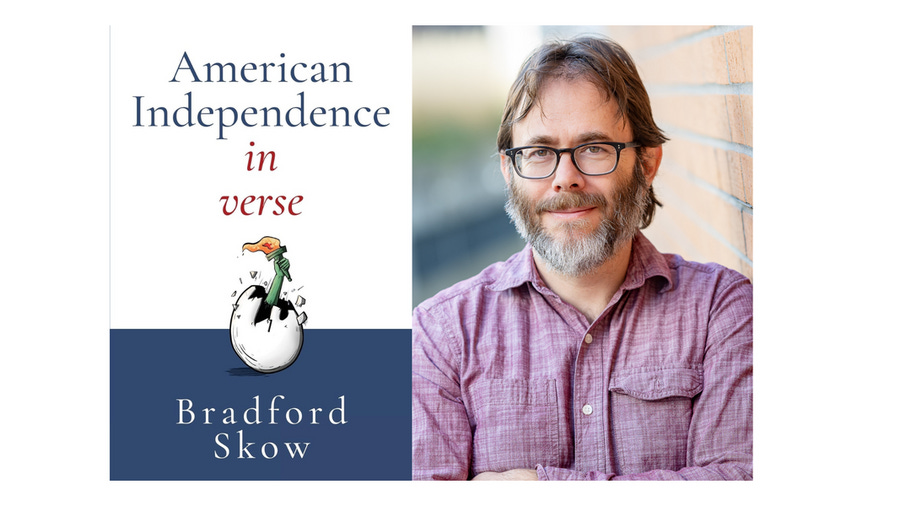
Enough preamble! For today’s post, I’m delighted to share my chat (recorded this week) with the brilliant Brad Skow, author of Mostly Aesthetics—and one of the people who actually appointed me a graduate.
We talk about:
Brad’s new book, American Independence in Verse
How Brad got into philosophy (and how he never remembers such things)
The “moving spotlight” theory of time (Objective Becoming)
How mathematical explanation works
What they don’t tell you about iambic pentameter
My next project (called “Priceless Taboos”)
There’s so much more I wanted to ask—how does Brad think about the moral grayness of the founders?—but we kept it on the short and sweet side. (Maybe we’ll do another chat focused on US history?) As always, I ask my guests for a beloved book or article. Brad’s answer:
Tosi & Warmke, Why It’s OK to Mind Your Own Business

Thank you Discourse, Hrishikesh Joshi, Victor Wu (of Selim Berker-metaethics fame), S.M., Adam Smith, Grant Pollard, and others for tuning in!
If you want to help keep Big iff True weekly and free, consider becoming a paid subscriber. (You’ll also get a couple of perks, like being able submit questions during livestreams.)
Available for iOS and Android
P.S.
As promised on stream, here are some of Brad’s counterexamples to the “five iambs” theory of iambic pentameter—though you may just want to go read his Theory of meter: introduction to an introduction.
First, here’s a line by Robert Frost that’s in iambic pentameter, but it doesn’t have five iambs (where an iamb = a two-syllable foot with stress on the second):
1: [Gives up] [his err-] [-and, and] [lets death] [descend.]
Now, you might say that this is just an “allowable substitution.” Iambic pentameter sometimes lets you swap in the occasional foot that doesn’t exactly fit the rules. But then why is this clearly not iambic pentameter, even though it has the exact same substitution?
2: [Gives up] [his way,] [and al-] [-lows death] [to come.]
Whatever iamic pentameter is, it’s something else!
Comments
Nothing yet. Say the first thing.
Sign in to join the conversation.