
Thanks to everyone who shared or wrote me about my post on job talks. One of my inspirations was Paul Bloom (of Small Potatoes fame), so it was a treat to see that he liked it.
The post also ended up on Daily Nous, where there’s been a bunch of commentary—including one grim, highly upvoted comment from a poster going by the name “Stop letting grad students waste their lives.”
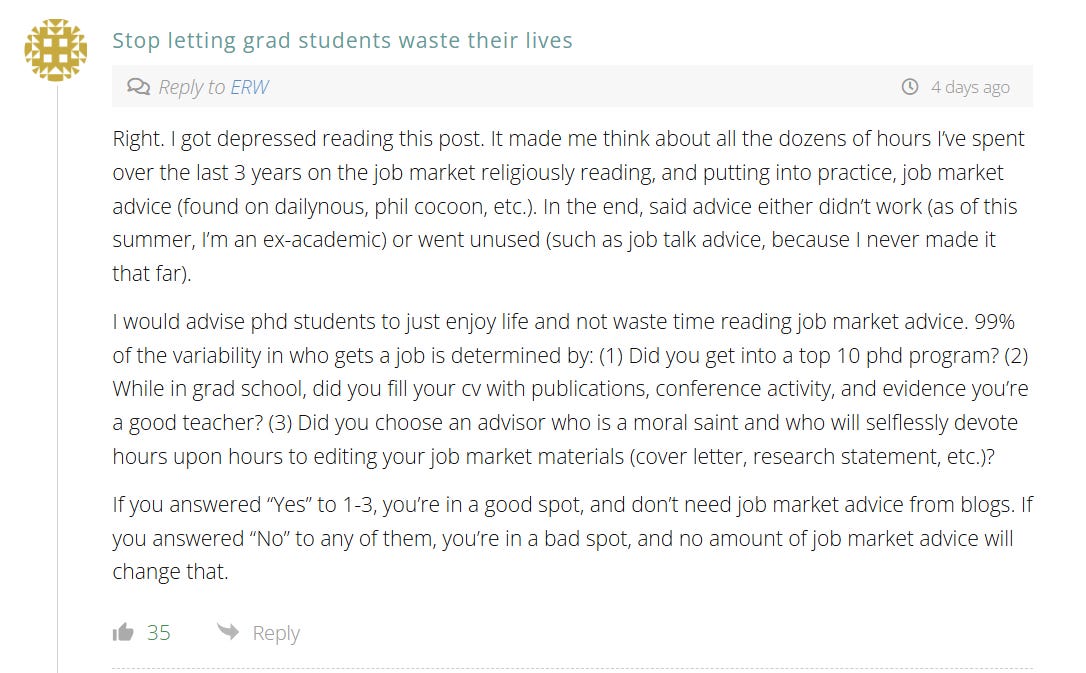
Dr. Stop says no one should read career advice, because getting a job is 99% just a matter of having a fancy pedigree.
I have some thoughts on this.
My sympathy to Dr. Stop. It sucks being on the academic job market, and everybody hates being rejected by prospective employers.
That said, if you’ve already left academia, why are you reading advice for PhD students?
Also, the main advice here is catastrophically wrong. Your job talk doesn’t just matter 1%. It can easily sink an otherwise strong candidacy. This happens many times every year.
Corollary: beware highly confident job talk advice from people who have neither given a job talk nor been on a hiring committee.
Advisor quality matters, of course, but that’s no reason to ignore career advice. Great advisors are great in part because they give you career advice. That’s one of the main reasons why I posted my job talk advice in the first place—to level the playing field for students who didn’t hit the advisor jackpot. (See also Charles Torres on advisors as promoters.)
The best point in here is that the reputation of your PhD program matters a lot—and not always for legitimate reasons. Even students with a strong CV and strong letters might struggle to get interviews if they’re coming from a program out of the “top 20.”
Corollary: hiring committees owe it to the field not to overrate pedigree.
Of course, I agree with the advice not to make yourself miserable. That’s why I said as much in my post. Read to the end before commenting!
A lot of what you do in PhD programs is meant to get you a job—and kind of worthless otherwise. Not so for giving talks. Public speaking is an invaluable skill, and great talks are intrinsically good. They are a kind of achievement, which puts them among the best things in life. Of course, it’s nice if your talk is a smash hit that brings fame and fortune. But you can be proud of a good talk even if nobody else appreciates it.
The single most important piece of advice I got while applying to graduate school was: “Don’t go for the sake of getting a job. Imagine you get hit by a bus right after defending your dissertation. Would you regret spending the last five or six years of your life on a PhD? If so, don’t do it.” This was fairly standard advice given to undergrads at UT Austin. It’s absolutely correct, even though in practice it’s hard not to get one’s hopes up once you’re on the PhD track.
There was also a follow-up from a certain satisfied palindrome:
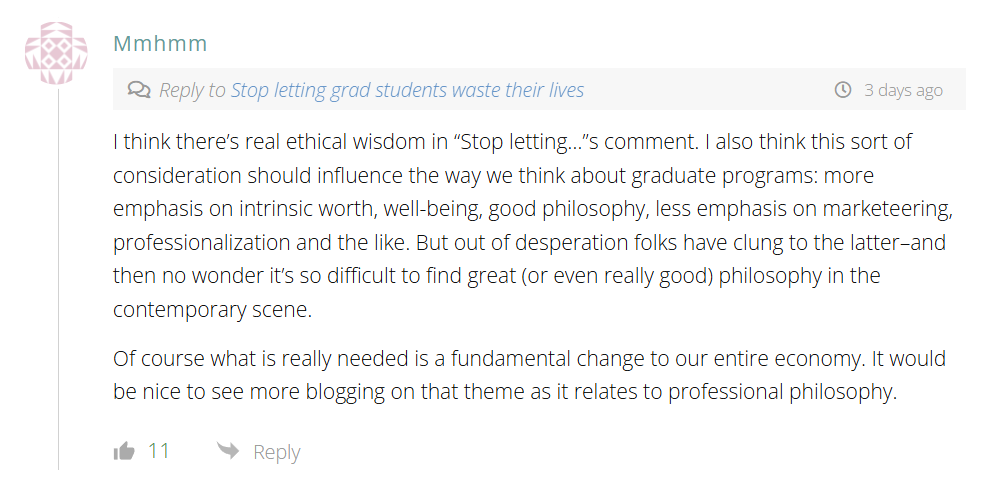
I agree that intrinsic worth is good. But I couldn’t disagree more with the claim that contemporary philosophy is bad. Philosophy is great, actually! If you don’t believe me, read some Jake Nebel (formal ethics), Julia Staffel (epistemology), David Builes (metaphysics), Joe Heath (philosophy of social science), Agnes Callard (ancient), Laura Valentini (political), Lindsay Brainard (creativity & AI),, or Brian Hedden (ethics, etc.)—just to pick some authors off the top of my head.
Also, I have no idea what kind of “fundamental change to our entire economy” is supposed to benefit professional philosophers. More funding for universities would be nice, but that’s not “fundamental.” Maybe Mmhmm wants to bring back the philosopher-king?
Thankfully, there were other comments that I can more easily recommend. For example:
Louis deRosset says: don’t forget to “rehearse, rehearse, rehearse.”
Tom Hurka says:
“A crucial part of the job talk is the Q&A afterward: the audience want to know if you’re ‘in control of your material’…”
“I find the ‘this is the structure of the talk’ bit at the start of a job or other talk a waste of time. If I haven’t heard the talk yet, claims about what section 4 or 5 will be about mean little to me, and am I going to remember?”
UK Context adds: if there’s no teaching demonstration, people will use the job talk as evidence of a candidate’s teaching ability.
See also Kyle van Oosterum (make your talks “double-clickable”), Bryan Frances (look for non-academic talk advice), Paul S (brace for rejection), Kenny Easwaran (most people should use one-page handouts), and Graduate Student (at some point you just have to use your best judgment).
Now I want to share a thought-provoking comment from Caligula’s Goat, which is about the idea of talks as “performances.”
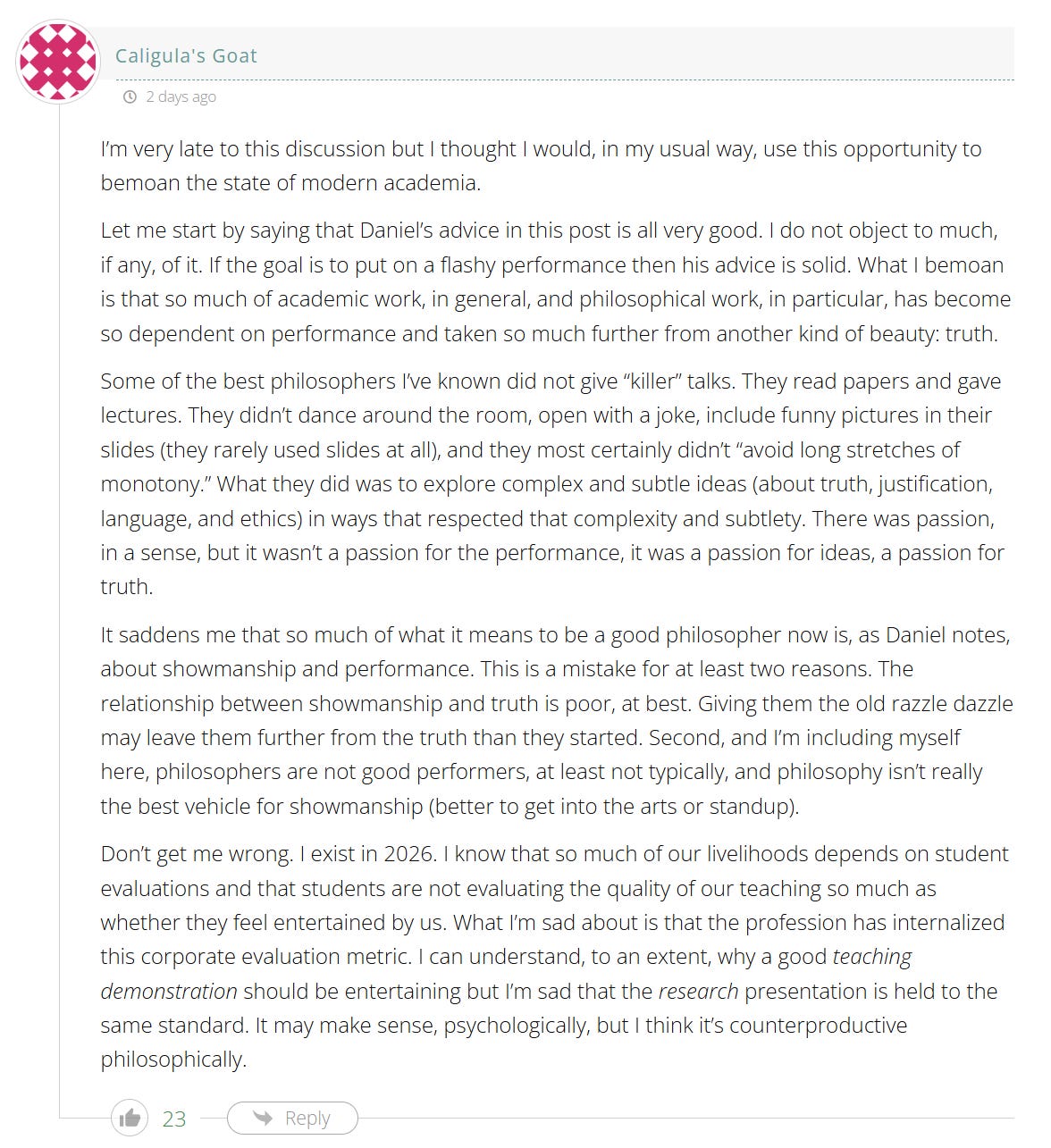
I partially agree. Caligula’s Goat is right that we should prioritize substance above style—“dumplings over flowers,” as the saying goes.1 What ultimately matters in philosophy is the truth (understanding, wisdom, etc.). If we give jobs and accolades to those who merely cloak themselves in the trappings of truth, offering only truthy infotainment, we are going to do serious damage to the field over time and lose touch with our raison d’être.
That said, I don’t think a “good performance” is just a matter of entertainment value. When you go to the symphony, you want to be in touch with the deep stuff that composers are trying to get across. Nothing will kill that experience faster than a bad performance. If the performers are out of tune, out of sync, etc., the entire audience will be unable to get absorbed in the piece. The same is true for an academic talk. If the speaker is stumbling over words, losing their place, apologizing for being unprepared, running far over time, etc., it becomes that much harder for the audience to lock in and think about the underlying ideas.2
A good performance needn’t draw attention to itself. Often the best performances are the ones that do the opposite. Think about the rituals of classical music—the black-and-white dress, the performers’ silence between pieces—which tend to put the performers’ personalities in the background and keep the focus on the music.
That’s not to say that every musician should make the same choices about what goes in the background. Sometimes the clothes and makeup are supposed to stick out. See e.g. the alien outfits of Quebec’s Angine de Poitrine.
Emulating the rockstars of planet Earth, time-traveling explorers Klek and Khn de Poitrine marvel at hot dogs, pyramids, and rock in all its grandiosity. Their music acts like a vortex where dada rock, pythago-cubist mantras resonate.
So while I agree with Caligula’s Goat about the need to be substantial, I also agree with this reply from Not so fast:
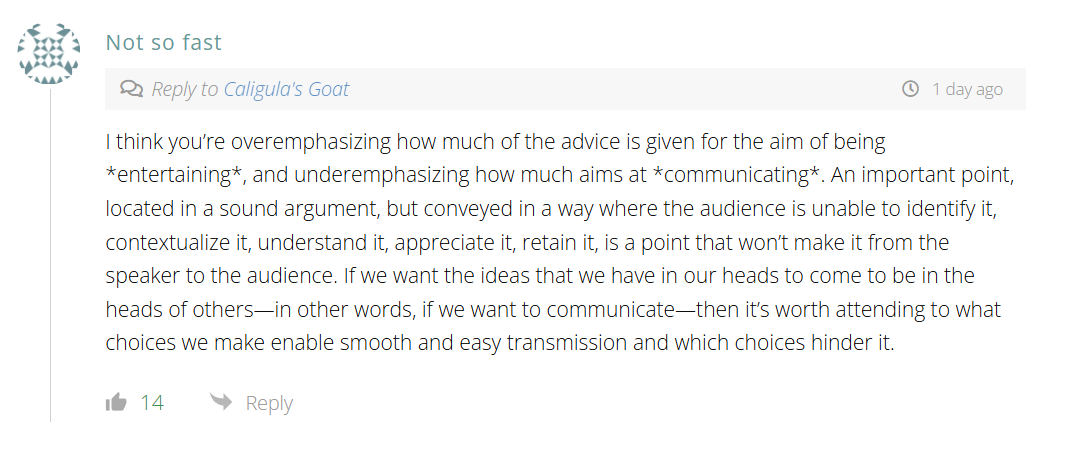
Exactly. Academics need to be good at communication, both among ourselves and with the outside world. We can’t expect the public to trust us if we can’t even competently explain what we’re doing—ideally not just to each other!
A final story. Once, when I was preparing for a job talk, Kerah Gordon-Solmon recommended taking lessons from an acting coach. This ended up being excellent advice. I liked doing the silly warm-ups and being forced to notice when I’m rushing, and it was refreshing to think about academic talks from the perspective of an actor. Yes, in a talk, the focus should be on the ideas. But until someone invents an idea ray capable of directly zapping our thoughts into the brains of others, we still have to resort to the ancient art of “saying words,” perhaps with the less ancient aid of “Powerpoint slides.” Since speaking is part of the process, we might as well try to do it properly.
So in closing: thank you, NYC-based actor and acting coach Stacey Linnartz, who I see is still taking new students. Next time I give a talk, I’ll do a silly warm-up in your honor.
“Dumplings over flowers” is one of my favorite Japanese proverbs (kotowaza)—up there with “Even monkeys fall from the tree” and “Failure is the mother of success.”
If a speaker has a stutter or other speech impediment, that’s different. Audiences know how to focus on the signal in such cases. It’s the obviously avoidable stumblings that are distracting.
No posts
Comments
Nothing yet. Say the first thing.
Sign in to join the conversation.