

“Professor Cohen, how many Fellows of All Souls does it take to change a lightbulb?”
“Change?!?”
The Marxist philosopher G.A. Cohen, who spent much of his career at Oxford’s All Souls College, was one of the funnier academics of his time. Here’s his bug-eyed impression of a distinguished German political philosopher (the key word being “German”):

No greater freedom can be imagined for a man than absolute, blind submission to an unjust law.
Or take Cohen’s impression of his advisor Gilbert Ryle:
Thinking and meaning are the same kinds of thing, but they’re not the same type of thing, because kinds and types are different sorts of things, even though they’re alike in nature, since sorts and natures, though similar in character, differ in dimension, because characters and dimensions, though akin to another in form, are contrasting in significance.
Peak analytic philosophy.
Now, about the Marxism. Cohen wrote a number of important books and articles on socialist political philosophy. My favorite older Cohen article is “The Labor Theory of Value and the Concept of Exploitation,” which rejects Marx’s theory of value while trying to recover the argument that capitalism is exploitative. Of the later papers, I might pick “Rescuing Conservatism,” in which Cohen returns to the topic of value, this time arguing that valuable objects should be preserved for their own sakes—not created or destroyed merely to maximize the total quantity of value in the world. (He considers the “ghastly scenario” of a man who gradually replaces more and more of his “fleshy parts” with slick artificial substitutes. Today, one might imagine the man outsourcing his mental labors to AI.) I’ll also shout out “Reason, Humanity, and the Moral Law,” which shows off Cohen’s deep knowledge of the history of thought. His students tell me Cohen was a slow reader; his papers prove he was using that time wisely.
But if you’re a student of philosophy, you most likely encountered Cohen through a tiny book with a rose on the cover called Why Not Socialism?

Here’s my even tinier synopsis.
Many people think socialism would be not only infeasible, but undesirable as a model for big, modern societies. But consider a smaller sort of society: the camping trip. When camping, people aren’t trying to take advantage of each other; no one is withholding their help in order to bargain for a bigger payday from the other campers; no one has to be afraid of being ripped off by anyone else; no one is trying to amass a fortune and become the pooh-bah of the forest. Instead, people treat each other as equals, always in a spirit of fellowship. When I cook your dinner by the campfire, I’m not just after your money. Nor am I doing you a favor (whether to put you in my debt or merely to express my affection). No: I’m serving you because I value the community we’re a part of, in which we all serve each other. We are all in it together, and—in contrast to our actual society, where rich and poor live in two disparate worlds—on the camping trip, we all can relate to one another.1
Cohen’s hope is that you will see something attractive in the camping trip even if you don’t consider yourself a socialist. In particular, he thinks you’ll be drawn to two features of the trip:
Equality: no one has a head start merely because of things like race, gender, parental wealth, or natural talent.2
Community: people act out of mutual benevolence (we want to be serving each other), and we’re all able to relate to one another.3
Now then. Given that these principles are desirable on a small scale, wouldn’t they also be desirable on a larger scale?
Cohen admits we’re not going to have the same kind of community in a big society like the UK or USA that we might have in a tight-knit group of 12. It would be incoherent to have 300 million BFFs. As Judy Thomson puts it in The Realm of Rights,
the possibility of X’s forming a personal attachment to Y rests on the possibility that at least some of Y’s interests will come to be more in X’s own interest than is the interest of the group as a whole—X has to be capable of preferring Y to the group. (p. 223)
Still, Cohen thinks, friendship comes in degrees. We can’t all be BFFs, but wouldn’t it still be nice if we could all be friendlier? Cohen’s term for this is “general social friendship” (p. 52).
Perhaps one component of Cohen’s imagined community is what sociologists call “thin” trust, i.e. the kind of trust that people have towards anonymous strangers in their community. Think of people who leave their homes unlocked, or who ask a stranger at a coffee shop to keep an eye on their laptop.
But Cohen emphasizes something else—viz. that social intercourse should be nontransactional. When we buy and sell things on the market, we are trying to get something from each other. The butcher and baker aren’t giving you food because they love you. They’re transacting. To Cohen, that means they’re each obeying two terrible masters—fear and greed. They’re greedy for your money and afraid you won’t hand it over. They know that whatever they get from you is going to be conditional on providing what you want. This is the fact that made Adam Smith so impressed with the “invisible hand.” Cohen thinks it’s disgusting. The desirability of socialism consists in the promise that we might have a prosperous society that runs on mutual benevolence instead of base selfishness.4
Is that feasible? You’d expect Cohen to argue “yes,” but he doesn’t—even if he could win the political battle to abolish markets, he doesn’t think we know how to make socialism sustainable. Cohen doesn’t believe in Soviet-style central planning. He rejects the speculative schemes put forward by other academics (such as Joseph Carens). Cohen’s position is merely that the socialist shouldn’t give up hope. Someday, somehow, someone might be able to make socialism work. As a defense of socialism, this is—to quote Joseph Heath—surprisingly “tepid.”5
Why would Cohen write a book like this—one that’s so ambivalent about the system that Cohen so badly wants to see realized?
One possibility is that Cohen isn’t thinking all that strategically. He’s wary of the current proposals for socialist planning, but still deeply connected to socialist ideals. The book is just an honest window into his conflicted soul ca. 2009. I do like this reading, but it makes the book out to be a rather sad confessional. The author has given up on socialism until further notice, but simply can’t bear to admit to himself that he’s—by any objective standard—a capitalist. (If he prefers capitalism to all the going alternatives, what else could he be?)
That said, I want to propose a different reading. I think Cohen sees himself as a tragic figure—born too late to have faith in totalitarianism, but too early to know what the alternative will be. He knows there isn’t going to be socialism next week. But this can’t be the end of economic history, he insists. There has to be something better than this—something that comes after the “predatory phase of human development.”6
Think of Cohen like a suddenly enlightened ancient Roman—call him Jerrius. He’s at a gladiator fight, watching this barbaric spectacle of two human beings hacking each other to the death. This is disgusting, Jerrius thinks. Civilized people shouldn’t treat each other like this—and any system that forces them to do so is intolerably brutal. But when Jerrius tells his Roman buddies about his misgivings, they laugh him off. Sure, it would be nice if we could all be entertained by harmless foot races. But there’s no way it could work. Any society as prosperous as Rome needs a colosseum-like “escape valve” for the population’s violent energies. There. Is. No. Alternative. They’ve got a point, Jerrius admits. I can’t imagine an alternative now. But humanity is young! Who knows what kind of enlightened ideas will emerge in the next two millennia? Given how manifestly base and cruel the gladiator fights are, surely there will be some way, however unforeseeable, for us to get by without them in the future. I bet against the indefinite survival of such barbarism.
That, I think, is the essential core of Cohen’s objection to capitalism. Yes, the present alternatives are all bad, and the future alternatives are unknown. But given how absolutely terrible capitalism is—the greed, the fear, the barbarity—he bets against its indefinite survival. To give up on socialism in the third millennium would be like accepting the inevitability of gladiator fights in the first.7
Why do I keep going back to Cohen’s book? I guess there’s something inspiring to me about the way he wants more community than the world can give him. Again, there’s the image of someone tragically confined to a sliver of the timeline, in which their aspirations are not only out of reach but inconceivable in anything but the most schematic terms. We could have it so much better, but I can’t yet tell you how. I’ll admit that this didn’t seem terribly impressive to me the first time I read it. But now, living in the early years of super-powerful AI, I suppose I’m more open to the possibility that I have no idea what the future will look like.
Is Cohen right, though? Given how modest Cohen’s aims are—and again, I want to emphasize that this is my interpretation, not the Word of God—it’s not obvious what would count as a flat-out refutation. One could argue that Cohen’s principles would be undesirable to implement in large-scale societies. Or one could try to come up with some inductive evidence to argue that the principles aren’t feasible to realize except in camping trips and similarly small, recreational endeavors.
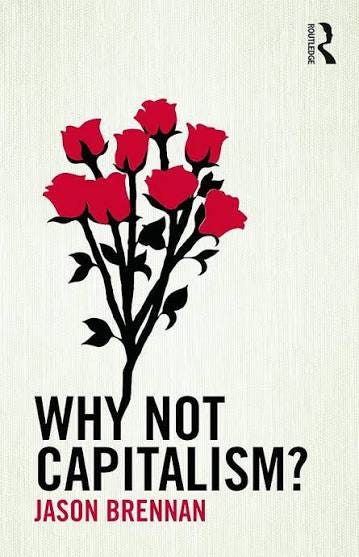
But there’s another possibility. What if Cohen’s style of argument—i.e. laying out a thought experiment, extracting some moral principles, then proposing them as a guide to political economy—could be used in unintended ways? What if there’s a version of the camping trip that supports some other system? What if that system was the exact opposite of the one to which Cohen dedicated his working life?
Stay tuned.
For the philosophy students out there, here’s my mnemonic for the socialist camping trip: NES.
No hierarchy.
Enjoyment as a shared aim.
Shared facilities and understandings.
Note that “facilities” (for Cohen) can refer to anything from a fishing rod to a campsite. And don’t just run your eyes over the phrase “shared understandings”—it’s maybe the single most underrated phrase of the book. Cohen is assuming that people both (i) know how the “economy” of the campsite works, and (ii) succeed in coordinating across the entire society. This is, in effect, sweeping both the knowledge problem and Prisoner’s Dilemma under the rug at once. (What happens if people disagree about who should get to use the good fishing rod today? How do we know who’s the better fisher? How do we know who enjoys fishing more relative to their next best option?)
By contrast, Cohen imagines the capitalist trip as being conflictual and atomistic—my mnemonic here is RPB:
Rights over things and talents.
Private ownership of facilities.
Bargaining to determine prices.
Should we be against the camping trip if we believe in the value of rights? See p. 47 for Cohen’s answer.
Cohen calls this principle “socialist equality of opportunity,” contrasting it with “left-liberal” and “bourgeois” alternatives, as well as with “equality of outcome.” Students often get distracted by Cohen’s belaboring of these distinctions, which makes it appear as though they will matter greatly to the book.
They don’t.
For one thing, I doubt that the allure of the camping trip has much to do with “socialist equality of opportunity.” Suppose you have a natural talent for appreciating nature, while I don’t. Should you be prevented from hiking on the grounds that this would create an “inequality” with me? Or perhaps I should be required to hike twice as long, or in an area with twice as much natural beauty? Such procedures would equalize opportunity, but they seem antithetical to the spirit of any non-psychotic camping trip.
(This objection presupposes that the “equal opportunities” on the trip have to do with enjoyment. Maybe they don’t—but then what are they opportunities for? Very obscure.)
More important: Cohen isn’t even that committed to equal opportunity. Suppose we have equal opportunities, but you save your money whereas I waste mine. It’s likely that you’ll end up much wealthier. But this unequal outcome, Cohen thinks, would be a threat to community—specifically, to relatability. We no longer live similar lifestyles; we can no longer see eye to eye. So community would call for equalizing outcomes, even though this violates Cohen’s socialist ideal of equality.
Cohen is rightly disturbed by this tension between his two principles. But while he doesn’t explicitly say how he’d resolve it, my strong impression is that he’d probably save community by throwing equal opportunity under the bus. Hence my frustration that Cohen squanders so many pages on fine points about equality—and all at the expense of community, which is so much more important, and so much less developed.
For more on community and socialism, I recommend Barry Maguire’s papers “Rescuing Socialism from Equality” and “Efficient Markets and Alienation.” In “Rescuing Socialism,” whose title echoes Cohen’s “Rescuing Conservatism,” Maguire argues that Cohen became too concessive over time. Instead of warming up to principles of equality, he should have doubled down on community—or as Maguire calls it, “Caring Solidarity.”
And let me be clear: by “socialism,” Cohen doesn’t just mean “high taxes and generous government services.” Cohen means the abolition of markets. Even market socialism isn’t enough for Cohen. Letting markets rip and redistributing money from the winners still allows for market transactions, which means more fear and greed—and therefore less community.
For Heath’s reply to Cohen, see “On the Scalability of Cooperative Structures,” Ch. 1 in his Cooperation and Social Justice (2022, U of Toronto Press). Heath’s paper will be our topic in Part 3.
For Cohen’s take on central planning, see p. 67 (“a poor recipe for economic success, at any rate once a society has provided itself with the essentials of a modern productive system”). This fits with what some distinguished modern economists say.
Cohen is quoting Einstein quoting Veblen. Annoyingly, Cohen doesn’t cite anything here (he just name-drops Einstein), so a student can read Cohen’s book cover to cover without realizing that its title is taken from Albert Einstein’s 1949 essay, “Why Socialism?”—whence Cohen cribs the line about predation.
Einstein’s essay defends socialism against the economic arguments of his day, making two main points:
Contemporary economics applies to the “predatory” present—it won’t apply to the socialist future, when humans have developed further.
Economics (like any science) is just about means: socialism is a theory of ends.
I don’t find either point persuasive.
Yes, we should be cautious about extrapolating any trend into the future. But social science also gives us general wisdom, which isn’t merely overfitted to the present data. For example, consider these hard-won lessons:
Humans aren’t entirely altruistic, nor entirely egoistic.
Groups may easily fail to promote their shared interests, either because of a lack of interpersonal trust or individuals’ incentives to defect.
Humans make quick affective judgments of each other based on visual processing. (Obviously this doesn’t apply to me and other blind people.)
Printing lots of money will cause inflation, which causes people to save less and spend more.
Large human organizations tend to be hierarchical. (Seriously, look at some of the social science on this. Even institutions that are designed to be “flat,” like kibbutzes, devolve over time into more hierarchical structures, which slashes decision-making costs and improves cognitive tractability.)
Sure, science can’t tell you what your ends should be. But there’s no way to just magically make your ends appear in the world. You need to concretely realize them! Any attempt to do so, however, comes with a risk of unintended consequences—including the risk of disaster. The only way to guard against such risks is to learn as much as you can about how human societies actually work. If some particular end can’t be feasibly realized, or turns out to be a nightmare in practice, that means the end is as good as dead. (Or perhaps you should look for ways to partially realize your end. More on this in Part 3.)
Do any of you know how the Romans actually felt about gladiator fights? I’m using the example tongue-in-cheek, but it’d be good to know the history.
No posts
Comments
Nothing yet. Say the first thing.
Sign in to join the conversation.