
“But now that we have all graduated, what happens? Wargames have largely stagnated in the last decade. There has been an endless repetition of the same themes, chiefly those involved with NATO and World War II.”
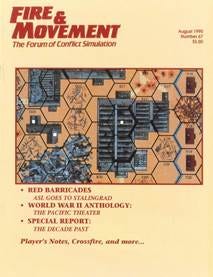
Joseph Miranda wrote that in Fire & Movement #67, August 1990. He was the managing editor. He was not being rude about the hobby I suspect he was mourning it as he saw it then.
Miranda’s claim was that wargaming had done something remarkable and then stopped. His generation, raised on Avalon Hill and SPI, had absorbed more military history than the average serving officer:
“Wargaming served as a sort of unofficial national university for military studies. It taught people military terminology and history, strategy, geography, and decision making.”
His test for that was a good one who else, he asked, automatically knows what a division is, how NATO’s order of battle stands, and where the Fulda Gap is?
Then came the diagnosis. Wargames had stagnated, and the usual explanation that they’d got too complicated in the eighties was only half of the assessment. His second reason is the interesting one:
“another, paradoxical, reason is that wargames became less military. They lost some of their value as military instructional tools.”
Two specifics. Counters stopped using NATO standard symbols and went over to silhouettes. And:
“instead of developing logistics and intelligence systems, wargames either ignored them, or utilized rules which had no connection to the realities of these fields of warfare.”
Indeed the article also hits a very solid point as reason three. Role Playing Games [RPG’s]. People gathering together to use their imaginations and bits of paper and a rough drawn dungeon or space ship to have fantastic adventures. Its pretty hard to compete with the thrill of a magical sword vs a 1d6 CRT.
He wasn’t only complaining. On page 62 he answered a reader from issue #65 who’d asked how to make wargames more realistic without juggling numbers or tinkering with zones of control. Miranda’s suggestions were concrete: replace the ZOC with a one-hex area of influence and a two-hex area of interest march-order units entering the first must deploy or take losses, concealed units entering the second are revealed. At tactical scale, drop “zone of control” for field of fire. Give each arm its own combat results table, so artillery produces suppression and attrition, armour produces penetration and breakthrough, and infantry takes ground. In the main, some terminological [is that even a word lol] swapping.
What is interesting is that later that year Dean Essig and The Gamers publishing would ‘storm onto the playing field.’ With 11 titles from 1990 to 2000, that I have in my collection. All bringing new concepts to WWII as well as Napoleonic’s, ACW and more.
Fifty pages later in the same issue, two subscribers wrote in to disagree with the editorial and with each other. This is why these letters are gold! On one page, three futures for the hobby.
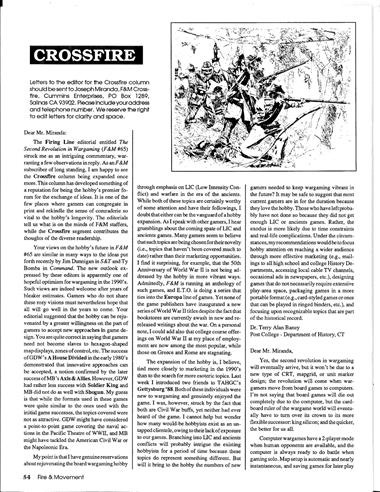
Baney teaches history at Post College in Connecticut, and he grants Miranda the point about formats before taking it somewhere better:
“You are quite correct in saying that gamers need not become slaves to hexagon-shaped map displays, zones of control, etc.”
Then he looks at which format experiments actually sold, and finds the variable isn’t format at all:
“The success of GDW’s A House Divided in the early 1980’s demonstrated that innovative approaches can be accepted, a notion confirmed by the later success of MB’s Axis & Allies. However, GDW had rather less success with Soldier King and MB did not do as well with Shogun. My guess is that while the formats used in these games were quite similar to the ones used with the initial game successes, the topics covered were not as attractive.”
Same mechanics, different subject, different outcome. Topic beats format. Good analysis, still true to my mind. That proof sits on our groaning shelves. A plethora of new topics, never covered before or covered with new insights.
Having got the mechanism right, he uses it to make a call:
“I have genuine reservations about rejuvenating the board wargaming hobby through emphasis on LIC (Low Intensity Conflict) and warfare in the era of the ancients… I doubt that either can be the vanguard of a hobby expansion.”
And it isn’t arbitrary he has evidence from the day job: “college course offerings on World War II at my place of employment are now among the most popular, while those on Greece and Rome are stagnating.”
His actual prescription is where it gets uncomfortable. He says the problem is reach, not subject, and lists the fixes:
“…focus hobby attention on reaching a wider audience through more effective marketing… designing games that do not necessarily require extensive play-area space, packaging games in a more portable format (e.g., card-styled games or ones that can be played in ringed binders, etc.), and focusing upon recognizable topics that are part of the historical record.”
Card-styled games. Written in 1990. We The People is three years away. Storybook games took fire in the last 24 months. Was he wrong?
He also has the anecdote that ought to be on a poster. He taught two friends Gettysburg ’88, both loved it, and:
“both are Civil War buffs, yet neither had ever heard of the game. I cannot help but wonder how many would-be hobbyists exist as an untapped clientele, owing to their lack of exposure to our games.”
The second letter goes the other way entirely:
“Yes, the second revolution in wargaming will eventually arrive, but it won’t be due to a new type of CRT, mapgrid, or unit marker design; the revolution will come when wargamers move from board games to computers… the cardboard ruler of the wargame world will eventually have to turn over its crown to its more flexible successor: king silicon; and the quicker, the better for us all.”
He is not speculating from the outside. He’d subscribed since issue #1 and had already left: “my interest in board games [dwindled] and was replaced by computer gaming.” His closing line is the thesis:
“If there is to be a second revolution in wargaming, it will be due to the computer, for without it, wargaming will grow stale.”
One thing he saw clearly. He describes a hybrid “using the printed map and counters with the computer serving as the referee and moderator” which is VASSAL and Cyberboard, twenty years early, and he was right that it was coming. Now of course vassal has no moderator, but has given us a window to community, to team play via remote and the ability to leave the game set up!
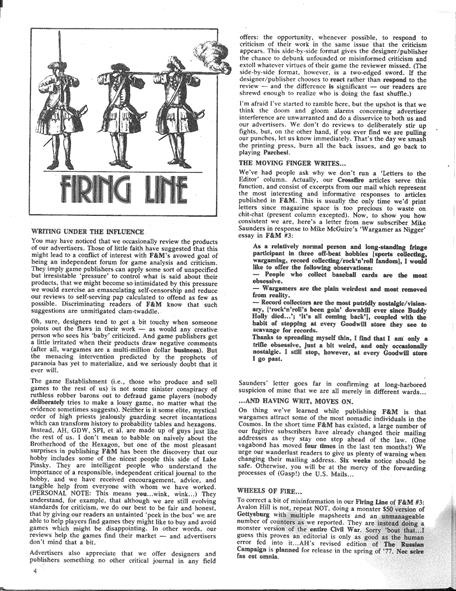
Just note there is current day inappropriate language in column 2. I was going to block it. But figured we are all adults here
On the diagnosis he was right, but has it aged into an indictment? Thirty-six years later the WWII share of this hobby is not smaller. I ran the numbers across my own library and video output earlier this month: ancients are the best-supplied and least-exploited era I own, and the Cold War is the thinnest at roughly a fifth of a source per video. The repetition Miranda complained about in 1990 is the shape of my own collection in 2026. But looking closer reveals that since 2020 I have still bought WWII titles. 63 out of the 458 I have owned or previously owned to be exact. With just 93 with a 1963 to 1990 publishing date.
We still see new titles on WWII, we still see new systems for WWII conflicts. We are also seeing more and more topics that have not been covered by the generic SPI one rule-set suits them all model, or the often partially baked AH efforts to cover a topic.
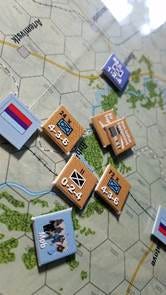
New research, new topics, new designers and their fresh takes. New Publishers with print on demand capability, smaller print runs requiring less capital, and higher quality components to draw in the crowd. I think the art argument is a false one too. Very few will die on the hill of NATO symbols or bust. As wargamers I think we can move beyond that, past that, and look at the intent, the design, the scale. Its also a bigger picture thing. — Visual appeal matters. A LOT! This is how we draw money from wallets! This is why Shrink rips as much as we love to hate them are so damn popular. Everyone wants to know “what does it look like” almost more than how it plays.
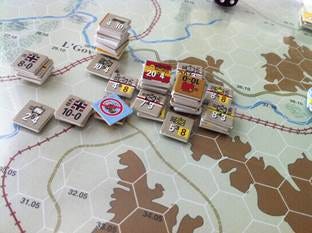
On logistics, intelligence and complexity he was right too, and then partly overtaken. OCS exists and is about almost nothing else. TCS makes you write orders and live with them. Those are exactly the systems he said were missing. That is just one designer.
The SPI ‘monster game’, the simulation vs game evolution has now evolved into camps. We see plenty of playable and not so playable complex monsters being released. We also see a plethora of easy games, introductory games that are aimed at not just a topic, but to be consumable by entry level players and more seasoned players too.
The market saw the PC game market grow, and adapted and innovated. Area movement, point to point, Card Driven Games all still wargames and kinetic. But using new methods and modes borrowed from consumer Euro style games to make the transition a bit easier. Not every conflict need be confined to a hex grid format.
And on the prescriptions..,well.. this is the part that surprised me, the hobby did what he asked, just slowly. Area of influence exist in various formats, are now unremarkable. Per-arm combat resolution while not common is seen being used. He was describing 2010s design in 1990.
And on computers, the line that reads oddest now is the one he got right.
“What’s needed is something to get us excited about board wargaming again. We do not need to retire to the blissful fields of computer gaming.”
He is not predicting the machines will win. He is refusing to concede to them. In 1990, with the PC market climbing and every second editorial writing the hobby’s obituary, the managing editor of Fire & Movement says: stay in cardboard, and go and recruit. That is the call, and the hobby made it, it faded, it waned, it did not die. The two now happily co-exist.
Its an old saw. Ever since the late 70’s the sky is falling, the hobby is greying out, we are doomed, we few, we brave grognards. Like some hokey badge of honor. He was one of the few not selling it.
Ancients and low-intensity conflict. Those are the two Baney named as incapable of leading an expansion, and they are the two that did or have potential to.
GBOH is one of the systems this whole channel runs on. Ancients is, by my own count, the best-supplied and least-exploited era on my shelves not a fringe, a backlog. In the early days of my blogging and youtube adventures, you may recall the stop motion videos I created of famous GBOH titles and battles. The AAR’s. I’m rectifying that with a new series of plays set in the ancient era, and being worked on as we speak. Low-intensity conflict didn’t merely find a following; it became one of the most successful design lines the hobby has produced. Not my cup of tea, but the games sell and draw in players from wargame adjacent spaces
But he wasn’t guessing. His WWII courses were full and his Greece and Rome courses were emptying, and he reasoned straight from that. The bit he couldn’t see is that a wargame table is not a lecture hall, far from it. The subjects that fill a syllabus and the subjects that make a good game are not the same list, and ancients turned out to be one of the best things you can put on a table. Trust me on that one.
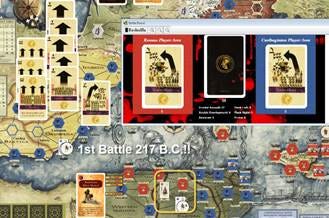
And on everything except the subject, he was right early. Card-styled games. Small-footprint games. Recognisable topics. Reaching people who like the history and have never heard of the games. He wrote that in 1990 and the hobby spent the next thirty years doing all four.
Rohrer got the tool right and the verdict backwards. We do play across a screen now, with the computer as store of record and the counters on a printed map a perfect replica in digital format. Exactly his hybrid. It just didn’t take the crown off cardboard.
Me – exactly 50% of my plays this year have been WWII. Thirteen sessions across 11 titles.
Three men on one page in August 1990, and the hobby went a fourth way.
Miranda said broaden the subjects. Baney said don’t bother, fix the reach. Rohrer said cardboard is finished. What actually happened is that the subjects broadened, the reach got fixed, the hybrid tools arrived and none of it came at cardboard’s expense. It all just got added, our pie grew, our audience grew, we flourished after a dip.
Baney is the one worth reading twice. He was wrong about the two topics he named and right about nearly every method he proposed, which is a better hit rate than most forecasts manage and the opposite way round from how we usually score them. We remember the miss because it’s quotable. The card-styled games line isn’t quotable and it was three years early.
And the last word goes to the page itself. Rohrer’s argument was that without the computer “wargaming will grow stale.” Thirty-six years on, board wargaming is not stale and Fire & Movement, the magazine he was writing to, is gone. The magazine ended up being the dinosaur that digital has killed. He had the extinction right and the species wrong. Digital came for the paper, not the cardboard! And it came for the paper that was carrying the argument about the cardboard. You are reading this on a screen because of it. Interesting and something to be explored further.
Almost prove me wrong
Are there five games published this year that are not WWII, Cold War or ACW?
Source note: Joseph Miranda, “Firing Line — What Do We Do Next?” and “Realism versus Sanity (continued),” Fire & Movement #67 (August 1990), pp. 4, 62. Letters from Dr. Terry Alan Baney (Post College, Department of History, CT) and Kevin Rohrer (Wadsworth, OH), “Crossfire,” same issue, p. 54 — both responding to Miranda’s “The Second Revolution in Wargaming,” F&M #65. #65 is not in the collection — it is described here only as the letters and the editorial characterise it, never quoted directly.
No posts
Comments
Nothing yet. Say the first thing.
Sign in to join the conversation.