
Climate change is already changing how organisms move. As temperatures warm, species are shifting their geographical ranges, adjusting the timing of their migrations, and modifying their foraging behaviors. Many of these changes in movement are a result of changes in animal behavior, and they are happening both on land and at sea.
In the oceans, however, rising sea temperatures are set to affect organisms’ movement by changing something even more innate than their behavior—their physics. “Most of the biomass in the ocean is actually really small, and it operates at a completely different scale of physics than we’re used to,” explains Dr. Brad Gemmell, our most recent guest on Big Biology. “One of the biggest things that changes the density and the physics of the water is temperature. And so if you start changing the temperature, you start changing those physics.” Such changes can impact how organisms feed, reproduce, and move through their environment, with potential ripple effects through ecosystems.

The physics involved in these movements relate to a concept known as Reynolds number, which is the ratio between the forces of inertia and viscosity. Inertia is the tendency of an object to resist changes in motion and is directly proportional to an object’s mass. Heavier objects are harder to stop when they’re moving, and they’re harder to move when they’re at rest. Viscosity describes a fluid’s resistance to flow and is commonly thought of as “stickiness”—molasses has a much higher viscosity than milk.
Humans and other larger-bodied animals have high Reynolds numbers, which is to say that “the inertial forces are hundreds of thousands or millions of times…greater than the viscous forces,” explains Gemmell. When we push off the wall of a swimming pool, for instance, we glide easily and effortlessly through the water because the viscosity of the water—water’s “stickiness”—is no match for our inertia.
Most ocean life, however, is extremely small and therefore has very low Reynolds numbers. For these tiny creatures, water becomes very sticky indeed. “To envision what it’s like to be a low Reynolds number swimmer,” Gemmell says, you can imagine jumping into “a pool filled with honey or corn syrup and trying to go underwater and push off that wall…You’re going to come to a stop pretty darn quickly.”
For us humans, few things sound more unpleasant than jumping into a pool filled with honey. But for the small organisms that make up most of the ocean’s biomass, this sticky water is the environment in which they evolved and upon which their life processes depend.
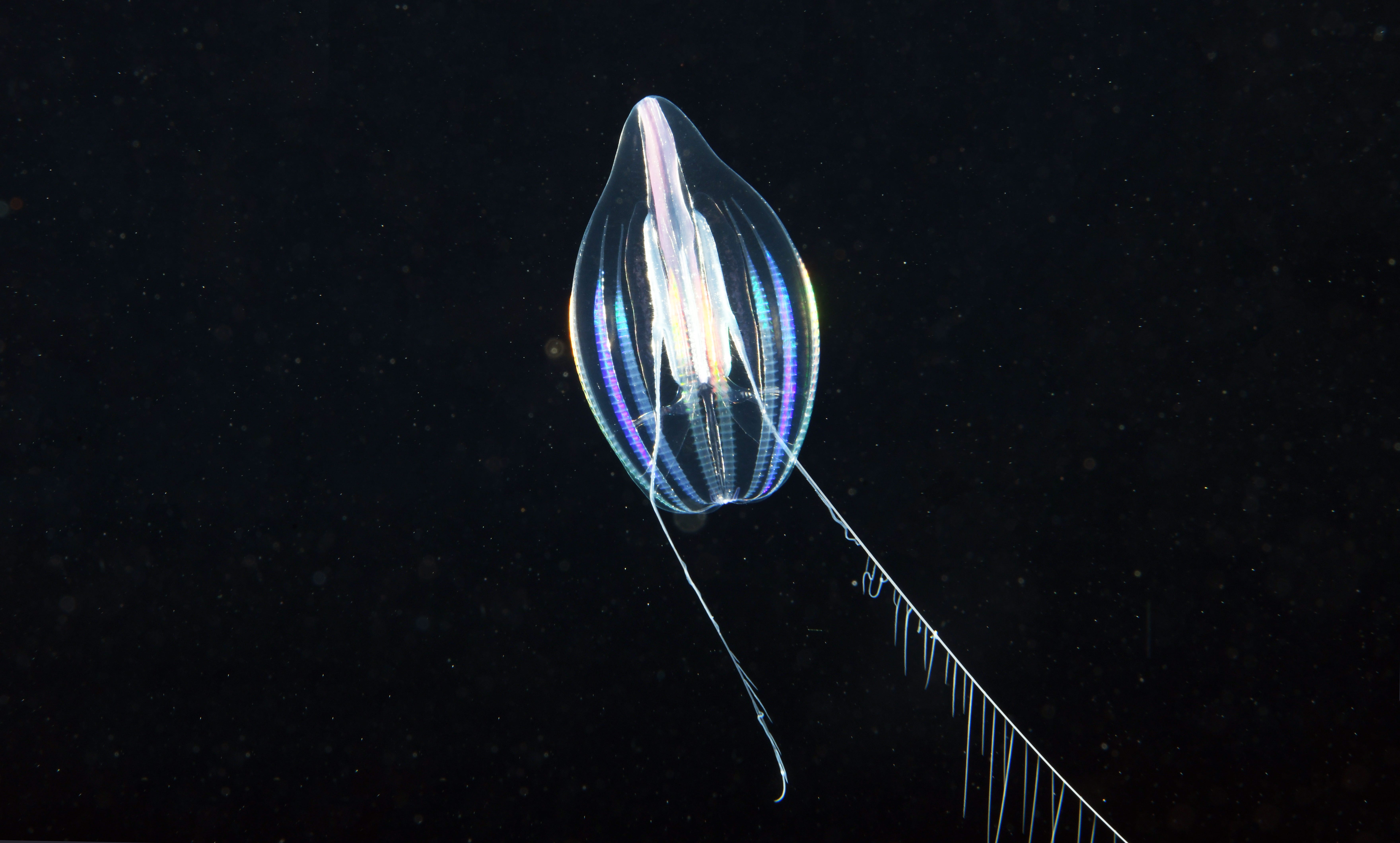
As oceans warm, ocean water becomes less viscous, meaning that the Reynolds numbers for these small marine organisms increases. This means that their environment starts to feel less sticky, which may present challenges for these creatures who are adapted to a particular fluid regime.
“If you’re something that’s evolved to be just in that viscous regime, and then you change the temperature, you’re sort of pulling that organism into a more inertial fluid regime, something that it may not be well adapted to do something,” says Gemmell. “It may take more energy to swim from point A to point B. It may not capture food as efficiently, and we don’t have a good handle on how these major taxonomic groups of organisms, you know, fish, crustaceans, cephalopods, how they’re going to be able to deal with that.”
And it won’t only be the smallest ocean creatures that are affected by this change in the ocean’s viscosity. “Most life in the ocean, even the big stuff, starts out really small, and it has to transition from this viscous dominated, physical fluid regime into an inertially dominated regime, the one that we’re familiar with,” Gemmell explains.
For example, cod, anchovies, and bluefin tuna—all commercially important fish species, the latter of which can exceed 500 pounds as adults—start life as small larvae and experience the ocean as an extremely viscous environment. But as they grow into adults, their Reynolds numbers increase dramatically, turning the ocean into a place where water feels less like syrup and more like a freely moving fluid.
Jellyfish are creatures that start out small and grow much larger, leading to a transition in their Reynolds number. Video: Gemmell lab
Changing how and when transition in their Reynolds number happens can make an already dangerous early life stage even more perilous. “Mortality is already the highest at these early life history stages” when organisms are in their larval, low Reynolds number state, points out Gemmell. “So if the balance shifts one way or another, and makes those life history stages even a little bit more vulnerable…a little bit of change or increase in mortality can have massive ripple effects throughout the population, and population growth and the amount of biomass we can sustainably extract from that population.”
As humans, our experience of the world is biased by our senses and size. For us, water is most certainly not sticky. Gemmell’s research is a reminder that to truly understand our impact on life on Earth, we must do our best to view the planet from other species’ perspectives—perspectives from which water becomes quite sticky and movement is governed as much by physics as biology. As the climate warms, those physics are changing in real time, altering the ecology of the ocean in ways we are only just beginning to understand.
Learn more by listening to the full episode:
Comments
Nothing yet. Say the first thing.
Sign in to join the conversation.