
Historically, neuroscience has been strictly a lab discipline, relying on highly controlled experiments performed within a controlled environment. In these synthetic, sterilized environments, organisms commonly used in neuroscience research like mice and rats are far removed from the ecological contexts in which they evolved and are often tasked with doing behaviors they would not naturally perform.
Such simplification and sterilization is “part of what we do in science,” acknowledges Dr. Nachum Ulanovsky, our most recent guest on Big Biology. “But, if we simplify too much,” he adds, “then this might be too far removed from behavior in the real world, which is very context dependent, very rich, very complex. And then we, as a field, may invest decades in studying the detailed mechanisms of behavior that, at the end of the day, bear very little relevance to the actual behavior that interests us.”

Dr. Ulanovsky, a Professor of Neuroscience at the Weizmann Institute of Science and author of the book Natural Neuroscience: Toward a Systems Neuroscience of Natural Behaviors, is helping push the field of neuroscience towards studying more ecologically relevant behaviors. In the book and the Big Biology episode, he discusses how studying brain activity in more naturalistic settings (for example, recording neurons in bats as they fly, navigate, and/or interact with other animals) can help us understand not just how neural circuits work, but why they evolved the way they did. “If we really want to understand how the brain operates in the real world and generates behavior and generates interactions with the environment and with other organisms,” Ulanovsky says, “We need to let go a little bit of the over controlled setups.”
Importantly, Ulanovsky makes it clear that he isn’t advocating for the abandonment of traditional lab work. Instead, he argues for a “both/and” approach where controlled experiments provide the mechanistic “how” and naturalistic studies provide the ecological and evolutionary “why”.
“I think the best way for neuroscience is to combine these controlled experiments that do allow us to look at one factor at a time, but also to acknowledge that this is, to some degree, misleading ourselves, and then do the more the full, naturalistic experiments where we allow much richer environments, much richer interactions, and then compare what the neurons are doing under the two conditions,” he proposes.
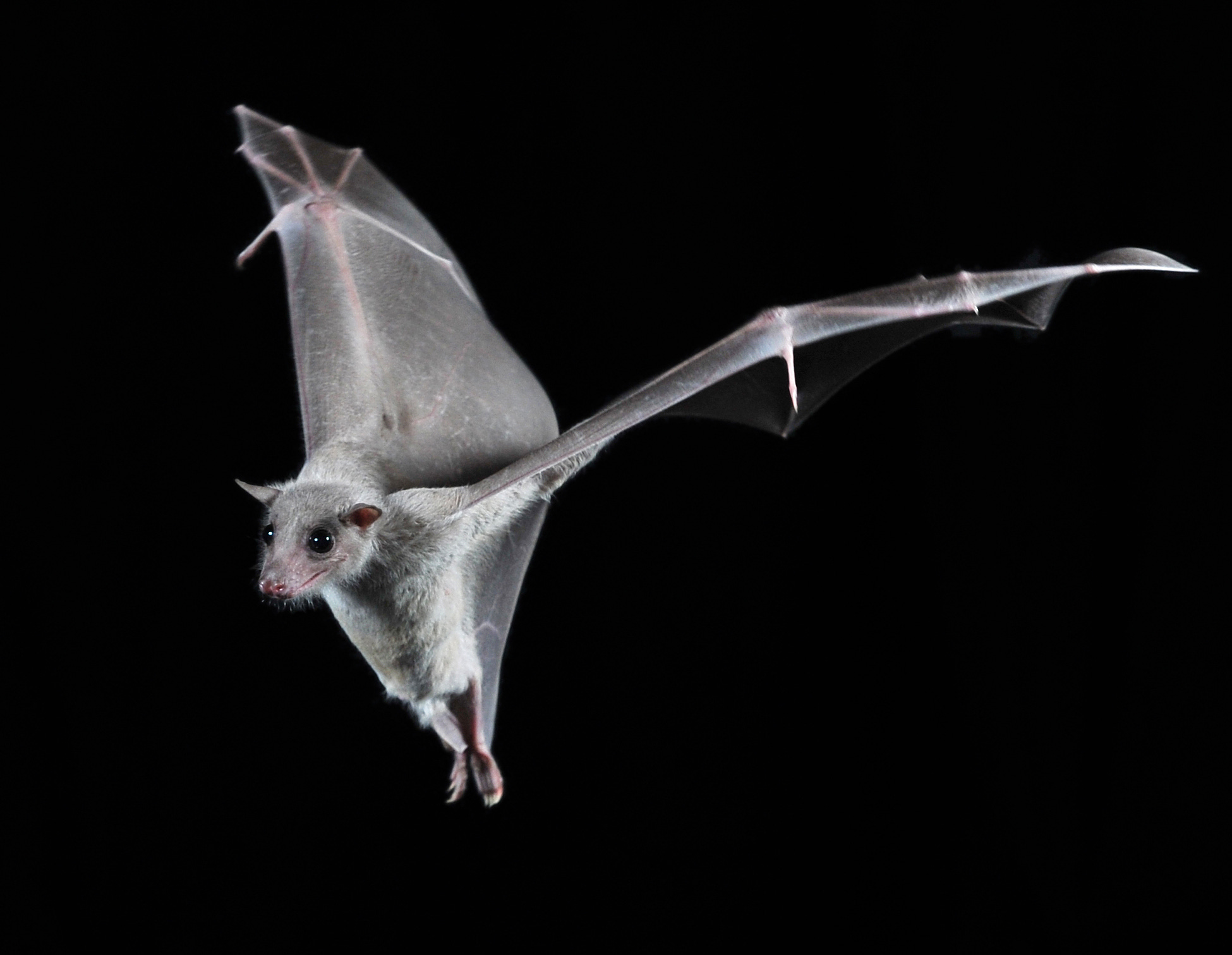
Until recently, this vision was technically impossible. Recording brain activity has typically required animals to be tethered directly to laboratory equipment, restricting their movements to small arenas. But in the past two decades, rapid advances in neural recording technology have begun to change how scientists can undertake neuroscience experiments. Miniaturized sensors, wireless recording systems, and new tracking tools now allow neuroscientists to monitor brain activity while animals move freely through the world.
Below I describe a few of the technologies and methodologies that have helped enable this shift—and some of the discoveries that Ulanovsky and his colleagues have made using them.
Miniature wireless neural loggers
One of the key technologies that is making naturalistic neuroscience experiments possible is the miniaturization of neural recording devices. Traditionally, electrophysiology experiments required animals to be connected to recording equipment by cables, limiting their movements to small enclosures. To overcome this barrier, Ulanovsky and his team, who study bats, developed tiny wireless-electrophysiology devices called neural loggers that can be mounted on a bat’s head and record the electrical activity of more than 100 neurons while the animal moves freely.
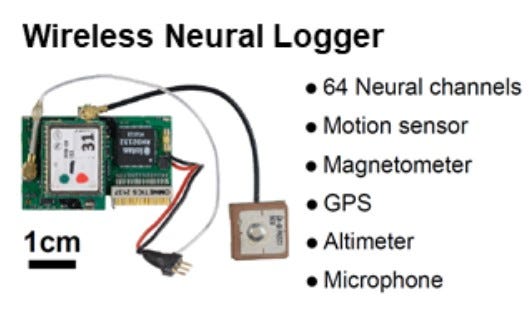
Using these neural loggers, Ulanovsky and colleagues have discovered neurons that fire when a bat is in a particular location, forming an internal map of space similar to place cells (neurons that become active when an animal is in a specific location and help form an internal map of its surrounding) first identified in other mammals. At the same time, their work has shown that bats can build spatial maps without relying on a particular pattern of brain activity that scientists once thought was essential for navigation (i.e. theta oscillations, for the neuroscientists reading), suggesting that the brain’s mapping system is more flexible than previously assumed and may operate differently across species.
More recently, Ulanovsky’s team has expanded this approach, using these neural loggers to record brain activity from multiple bats simultaneously as they interact with one another.
These experiments helped lead to the discovery of “social place cells”—neurons that respond not only to a bat’s own location, but also to the position of other bats nearby. In this way, the brain appears to map not just physical space, but social space as well, extending the idea of a cognitive map beyond navigation to include interactions between individuals. Together, these advances are allowing researchers to link neural activity not just to where an animal is, but to how it moves and interacts within a broader environment.
Large-scale flight environments
Another way Ulanovsky’s lab is pushing neuroscience toward more natural conditions is simply by building bigger experimental environments. Many classic neuroscience experiments take place in arenas only a few meters across, but animals in the wild move through spaces that are much larger and more complex.
“I was invited to give a talk at the Ecological Society of America, which is not the typical conference I go to,” Ulanovsky recounts. “And I was presenting this study that was done in bats flying in a five by six by three meter room…So I thought: ‘Oh, we’re so great. We’re recording bats in a five by six meter room. We’re amazing.’ And then I come to the ecologists and they say: ‘Well, it’s very interesting. It’s wireless, it’s natural behavior, nice, but don’t bats normally navigate kilometers outdoors? I mean a few meters.’ They were so under-impressed.”
To address this mismatch, the lab constructed large flight tunnels and arenas where bats can travel tens or even hundreds of meters. Experiments in these environments revealed that hippocampal place cells behave differently at large spatial scales. Individual neurons often become active in spaces of different sizes, suggesting that the brain represents space at multiple scales simultaneously. This finding indicates that the neural map of space is more flexible than previously thought and may adapt to the scale of the environment an animal inhabits.
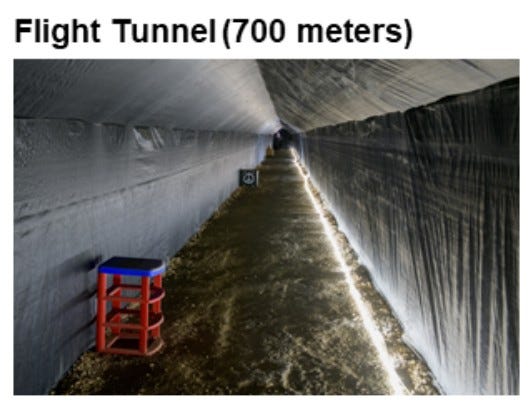
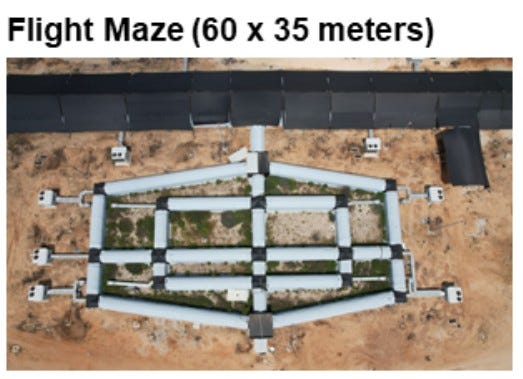
Large-scale flight environments used by the Ulanovsky research group. Source: Ulanovsky Lab Website
Studying brains in the wild
In some of his most recent work, Ulanovsky and colleagues have pushed these technologies to their limits by studying bats not just in large laboratory environments, but in the wild—on a remote oceanic island. This represents a major step beyond even large flight arenas, placing neuroscience directly into a natural ecological setting.
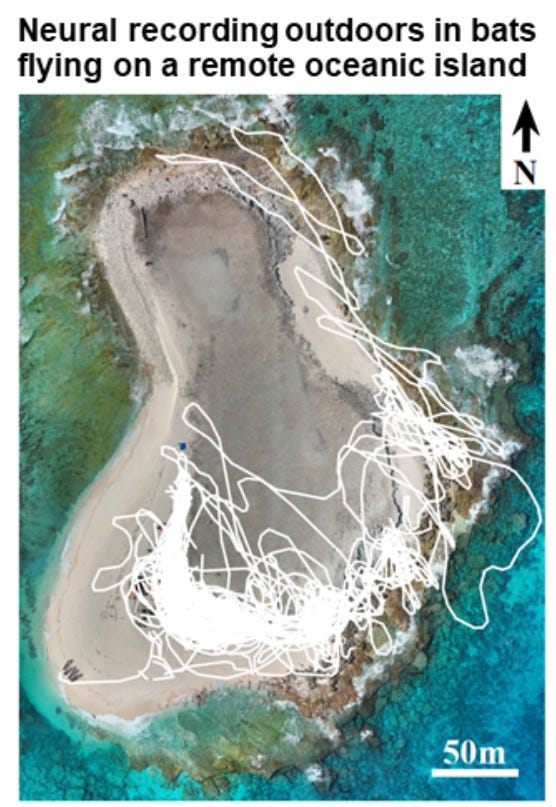
On the island, bats were equipped with neural loggers and then released to fly freely across an open landscape. This setup allowed researchers to record brain activity while the animals navigated an environment filled with the kinds of challenges they encounter in nature, rather than the controlled conditions of a lab.
Experiments in this setting revealed that key navigation-related neurons, such as those that act like an internal compass, remain stable even in these highly complex and uncontrolled environments. In other words, the same neural systems that help guide movement in the lab also appear to operate reliably in the real world, also supporting navigation across large, natural spaces.
This work highlights the power of combining neural recordings with field-based approaches. By taking animals out of the laboratory and into the environment, Ulanovsky and colleagues are showing that effective neuroscience requires more than just precise control—it also requires context. By studying brain activity in the environments where behavior actually unfolds, researchers like Ulanovsky are beginning to reveal aspects of brain function that would otherwise remain hidden.
To learn more about Ulanovsky’s work, listen to the full episode:
Comments
Nothing yet. Say the first thing.
Sign in to join the conversation.