
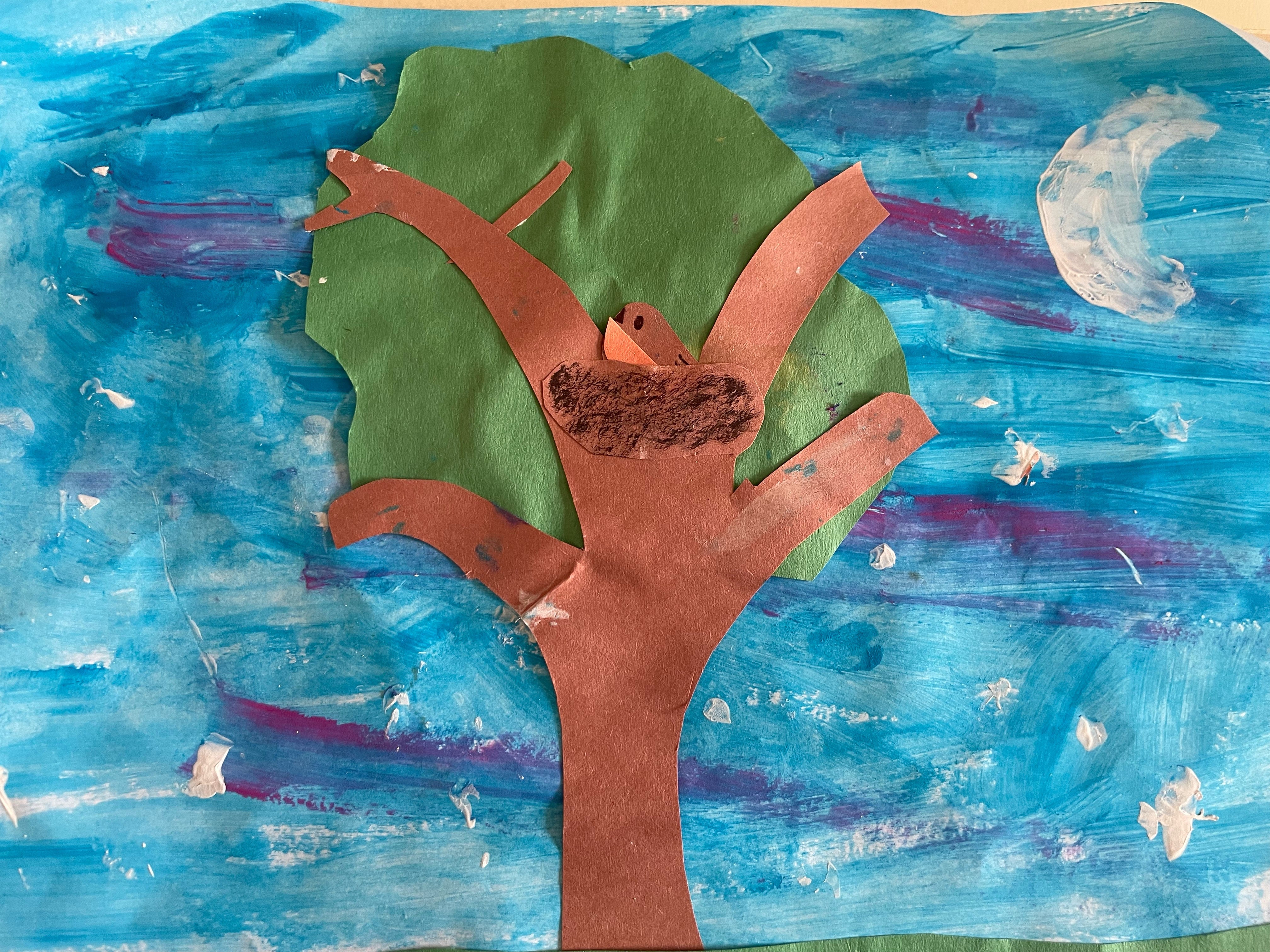
(Painting of a robin, by our daughter, age 8.)
We’re currently working on a kid’s book about a bird. And because of it, Jake and I have both started noticing birds more than ever before.
I’ve always loved the sound of the birds chirping; I notice their return in the spring, and I love lying in bed early summer mornings with the windows open, listening to their cheerful songs. But before writing this book, I’d always lumped together in my mind all “birdsong” as one vague entity—a non-descript noise in nature that I enjoyed but didn’t really stop to consider the different sounds different birds make at different times, etc.
For the purpose of this book I had to look up the different sounds robins make. In reading and writing about birdsong, then, I started paying attention to it in real life. I tried to attribute words to the sounds I was hearing. I stopped to notice birds flitting in our yard or among the trees. I stopped to wonder what they were doing, what they might be communicating to each other, etc.
On a recent bike ride with my family, we heard a bunch of crows squawking fiercely at another crow. They sounded upset, and they were sure letting that other crow know it. This made me wonder about the lives of crows and what they might be thinking, feeling, striving for, etc.
Notice. Wonder. Then notice more. Then wonder more. And so forth.
This is what reading and writing does for us.
It causes us to pay closer attention, to notice beauty or pain or nuance or chaos that we might not have paid much attention to otherwise. I commented on this phenomenon in our first post about why we should all write. I’ve included that excerpt again here because it bears repeating:
As I learned how to better arrange, construct, and refine language myself, it spurred me to pay attention to the world I was writing about. Anne Lamott in Bird by Bird describes this phenomenon: “[I]n order to be a writer, you have to learn to be reverent.” Lamott describes reverence as “awe, as presence in and openness to the world.” “There is ecstasy in paying attention,” she writes, “You can get into a kind of Wordsworthian openness to the world, where you see in everything the essence of holiness” (99-100). In other words, the habitual act of writing trains our brain to observe the world more closely—maybe at first so that we have material to write about. But over time, our interesting observations beget more observations, more awareness, more reflection, and so on.
This presence, as I’ve discovered, is a profoundly beautiful gift. John Green also echoes this sentiment: “Almost everything turns out to be interesting if you pay the right kind of attention to it,” he says. It’s like shining a flashlight in the dark; we focus our attention—and therefore our readers’ attention—on whatever objects, thoughts, ideas we choose. And like a sculptor meticulously shapes clay to bring her subjects to life for others to experience, writers use language to do the same.
So, what are you paying attention to? Whatever it is, consider writing about it. It just might spur you to notice it—and the world around it—more fully.
No posts
Comments
Nothing yet. Say the first thing.
Sign in to join the conversation.