
n.b. this post may have erred away from an “artist’s statement” and closer to an essay. it may also be too long for email form. the painting i had made that inspired this writing is at the very end of the post; i debated a lot about its placement. should you want to see the full painting without/before the influence of the writing, click here.
“οὐ πᾶσα σὰρξ ἡ αὐτὴ σάρξ, ἀλλὰ ἄλλη μὲν ἀνθρώπων, ἄλλη δὲ σὰρξ κτηνῶν, ἄλλη δὲ σὰρξ πτηνῶν, ἄλλη δὲ ἰχθύων. [...] οὕτως καὶ ἡ ἀνάστασις τῶν νεκρῶν. σπείρεται ἐν φθορᾷ, ἐγείρεται ἐν ἀφθαρσίᾳ·” (1 Corinthians 15:39, 42)1
All flesh is not the same flesh, rather there is flesh of men, another flesh of animals, another flesh of birds, and yet another flesh of fish. [...] Also, in this way [i.e. differences of kinds], is the resurrection of the dead; it is sown in death, it is roused in immortality.2
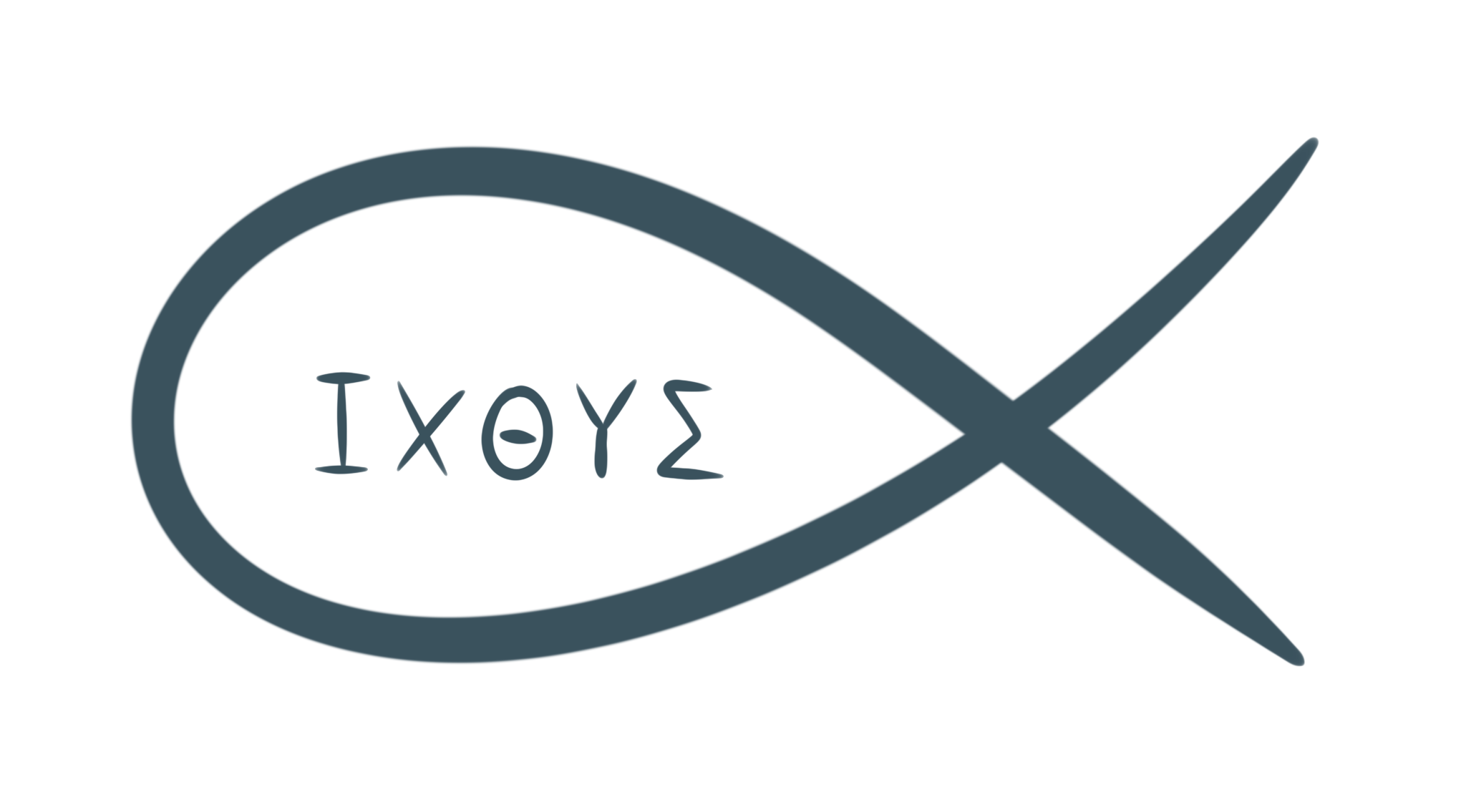
The Ichthys (ἰχθὐς) is both the Ancient Greek word for “fish” and also a Christian symbol for Christ. As a symbol for Christ, it makes a minor acrostic poem where each letter represents a Greek word to form the phrase: “Jesus Christ, Son of God, Savior” (Ἰησοῦς Χριστός Θεοῦ Υἱός Σωτήρ, Iēsoûs Chrīstós Theoû Huiós Sōtḗr). Although the symbol may have its origins in pagan traditions, it grew to be a way for early Christians to identify one another as a secret code during a contentious period of religious syncretism and Christian persecution.3 There is even a reference to the followers of Christ themselves as “little fish” found in Tertullian’s On Baptism:
“sed nos pisciculi secundum ἰχθύν nostrum Iesum Christum in aqua nascimur, nec aliter quam in aqua permanendo salvi sumus.”4
But we little fishes, following our Ichthys [Fish], Jesus Christ, are born in water; in no other way are we safe than remaining in water.
What if, for a moment, we briefly entertain this metaphor. In what other ways can we think of Jesus as a fish?
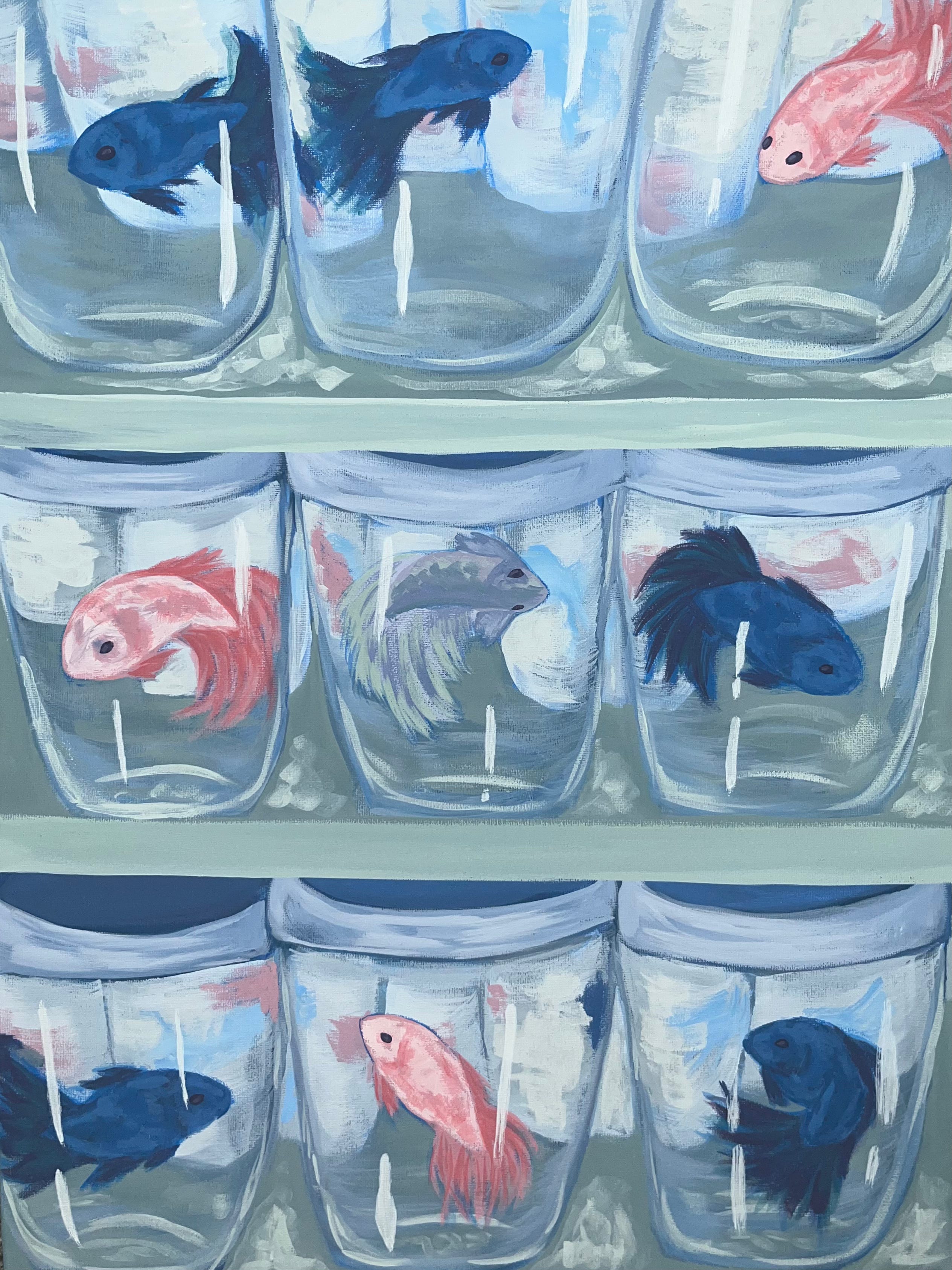
Walk into any pet store and you will likely find a shelf or a wall lined with small plastic cups housing individual betta fish. Many of these fish will be visibly lethargic, sick, or dead—so much is this the case that I don’t personally think an expert opinion is needed to examine the evidence of things like fin rot, or see the psychological and physical distress; one only needs to have the courage to act as a witness and not avert one’s eyes. These illnesses are preventable.5 However, these betta fish are confined to suffer a slow, agonizing death in the face of the public unless freed from the restraints of their own sort of crucifixions. In this way, have they not, too, died for our “sins”?
Let us take a hypothetical: since the Crucifixion and death of Jesus in 33 CE,6 what if he has risen and died again, doing so every three days as with the Resurrection (for consistency). That would give us a formula looking something like this, ((x-33)(365))/3 = y, with “x” being the present year and “y” as the number of resurrections. At the time of this post, the year is 2025 CE, making y = 242,360 resurrections. This is all approximate, as I have not factored in leap years, the precise date within the year, nor taken considerations for whether death and resurrection should occur on the same day; someone who is more mathematically inclined than I is encouraged to do so. If Jesus rose again, could he have risen in the form of a fish at least 1/242,360 times?
No. That would take us away from the territory of resurrection and into reincarnation. We can think back to 1 Corinthians 15:39 as cited at the beginning of this post to keep our position grounded in the Biblical tradition. Here, we get a statement on differences of kinds in relation to flesh (that of man, animals, birds, and fish). The flesh of Jesus as a human would be different from the kind of flesh of Jesus as a fish; even the Bible aligns with this logic. The change in flesh from one kind to another would make Jesus’ hypothetical rising from the dead qua fish a reincarnation, not a resurrection. A resurrection implies a restoration of life, not a new one with a different form. However, Jesus is a bit of an exceptional case when it comes to his ontology.
The First Council of Nicaea, held in 325 CE, settled a debate between Arianism and Homoousianism on the nature and relationship between God and Jesus. Arianism was the belief that Jesus was created by God, having not existed previously whereas God has always existed, and therefore making the Son less than or second to the Father. An extreme form of Arianism, known as Anomoeanism (ἀνόμοιος, anomoios “dissimilar, unlike”), declared that Jesus was not like God in essence, that the Son was different from the Father. More moderate forms of Arianism were called Semi-Arianism or Homoiousianism, from the Greek ὅμοιος (homoios, “like, similar, resembling”) and οὐσία (ousia, “substance, essence”), refers to the belief that Jesus is “similar to,” though not the same substance as God. Homoousianism, from the Greek ὁμοούσιον (homoousion, “consubstantial”), refers to Jesus as “one substance of God” or, to phrase it another way, “the same essence as God.” Ultimately, the Homoousians won and the Nicene Creed declared the belief in Jesus (the Son) and God (the Father) as being of one essence.7
There is a joke about how this debate is concerning a single iota, “ι,” and how that one letter holds the weight between dogma and heresy. Fortunately and unfortunately, this is how language works. Playing with metaphors and puns is all good fun, yet language continues to hold epistemological consequences. An iota (pun intended) truly does make a difference.
Nevertheless, I still believe that there is a benefit to exploring the use of metaphors; both in this context and others. When we draw comparisons of like or unlike things, we are making attempts to uncover truth by seeing how far we can stretch language and thus ask questions both where friction or symmetry arises.8 Tertullian, as quoted earlier, is using his fish metaphor to draw comparisons between birth and baptism. For him, baptism is a form of birth—the emergence of a new life—where one finds safety through faith and adherence to Christian principles. This metaphor helps create a sense of impact or importance. Like a fish needs water to breathe, as we humans need air, so too do followers of Christ need their “water.” These are not one to one comparisons, yet they express how a change in belief of any sort may feel like an end of one manner of living and the beginning of a different one.
Metaphorical language is pervasive in Christian texts and theology. However, this may not be as much of a fault in theological epistemology as one might expect. What if this type of hindrance is a useful, defining feature?
Former Archbishop of Canterbury, Rowan Williams, explores the use of metaphors and the limitations of language as it relates both to general human communication and the ways in which we speak about God in his book, The Edge of Words: God and the Habits of Language. The book does not aim to prove the existence of God, rather it sets out to explore an alternative path for natural theology by crafting an argument centered on language to synthesize a revelatory and active God with a passive and discoverable God who is situated in the shared environment of our natural world. Through recognizing the unusual habits of language, where it falters, its silence, metaphors, oddities, and embodied nature, Williams maps human speech as a sort of territory where language about “revelation” or God emerges.9 Williams’ writing is expansive and careful, and I worry that summarizing it will fail to do him any justice. For that reason, I will keep my focus on what he has to say in regard to metaphors.
In a particular passage of relevance, Williams says:
Odd as it sounds, our (quasi-) representing of God is least off the mark when we are furthest from anything that looks like a fully coherent schema. Which is not an excuse for slackness, but an implicit plea for our words about God to be—as it were—carefully calculated shocks. This is simply to repeat Aquinas’s point early in the Summa (a point originally articulated in Pseudo-Dionysius) that the ‘crudest’ metaphors for God are often the most successful, just because no-one could mistake them for accurate depictions. We do not try, in seeking to speak truthfully of God, to find words or images that will reproduce or imitate the divine; we specify a ‘situation’ or possible range of situations through a dramatic metaphor (God as a rock—to stand on or shelter under; God as a fire—to purge, to destroy, to give light) and so on.10
Here, Williams discusses our use of metaphors about God as an attempt to convey something which eludes expression. He does not consider these choices of language to be arbitrary: they are not quite “representations,” yet they come close in the sense that they manage to at least find some words for what may be otherwise thought ineffable. Additionally, he believes (in agreement with St. Thomas Aquinas) that these metaphors are successful and truthful when they are not attempting to replicate God, but rather strike us as nearly incoherent, bizarre, or take the form of narratives. Williams’ states that “God is represented by a whole narrative” as he goes on to discuss parables and scripture.11 Perhaps, in this way, we could also think of God as being more similar to the effects of the language used to describe Him than the language itself. Though, like Williams, I neither aim to prove nor disprove God, merely expand upon how we may talk about and understand Jesus representationally.
Williams’ framework for the language of God in tandem with the Homoousianism ruling of the Nicene Creed may help us make sense—at least in part—of imagining Jesus as a fish. If Jesus and God are of one shared essence/substance, then it seems fair to speak about Jesus through narrative or metaphors as we do with God himself. Williams considers Jesus’ body to be one that goes through many transformations: alive, active and speaking, helpless and suffering, dead, absent and present, as the community itself, as food, as shared ritual, and as narrative. He states that, “[t]he story of Jesus’ body represents the unrepresentable God by tracing a movement towards silence and motionlessness within the human world: its climax is not a triumphant theophany but a death and its complex aftermath.”12 Through this reasoning, to me, it seems aligned with theological tradition to take seriously or investigate the fish metaphor.
Animal metaphors in relation to Jesus take other, non-fish forms as well. In addition to the Ichthys, we can think of the many references to Jesus as the “Lamb of God” (“ὁ ἀμνὸς τοῦ θεοῦ,” ho amnos tou theou).13 Then, there is also St. Jerome’s use of a calf fattened for slaughter as a symbol for Christ: “The fattened calf who is sacrificed for the salvation of the repenting, is the Savior himself, whose flesh we daily feed, whose blood we daily drink,” (“Vitulus saginatus qui ad poenitentis immolatur salutem, ipse Salvator est, cujus quotidie carne pascimur, cruore potamur.”).14 I would not say that these metaphors are pleasant. They draw our focus to the suffering of Christ and animals alike. We may think of them as opportunities to reflect on our interactions with non-human animals and our role in their pain, torture, and executions.
Even in non-linguistic forms, we may find parallelism between Jesus and slaughtered animals. In, The Cry of Nature: Art and the Making of Animal Rights, Stephen F. Eisenman, notes how himself and other scholars have drawn formal and iconographic comparisons of Rembrandt’s Raising of the Cross (1633) and his Flayed Ox (1655); this is partly done in relation to the aforementioned quote from St. Jerome.15 From a compositional level, the two paintings have situated Jesus in his Crucifixion and the carcass of a butchered ox in a way that that puts the paintings in conversation with one another: from the stretched hanging carcass mirroring the pose of Christ on the Cross, the figures looming in the darkened background, to the way the lighting accentuates both bodies in the foreground. The light shining on the bodies contrasts with their situational contexts, where Jesus and the ox both hang as illuminated figures in their own respective death scenes.
Eisenman’s book explores the role of art in the formation of animal rights as a concept. He is particularly interested in the “Cry of Nature,” both in reference to the title of John Oswald’s treatise on animal rights, in addition to the concept as an animalistic scream that serves as the basis for human language and common linguistic ground for non-human and human animals. Eisenman describes Oswald’s “cry of nature” as “multiple”:
it is the wrenching expression of the animal that is killed, the tears of the family and companions who mourn the dead, and the outcry of Nature who deplores the injustice and ingratitude of humans who would kill and eat animals despite the abundance of plant-based foods. […] The ‘cry of nature’ is thus unmediated nature: the sound of animals—non-human and human alike—in pain and anguish, and the direct speech of Nature herself.16
The “cry of nature” represents something unrepresentable in language as we tend to understand it. It moves away from speech in a way that resembles William’s description of Jesus as “movement towards silence,” while also allowing one to think about the pain, the tears, and anguish of Jesus and his followers at the Crucifixion. The cry of nature is an embodied expression—a scream, a noise, a cry—that occupies the peculiar, communicative place in language where “there is sense before we make sense.”17 Not only is there historical precedent—from antiquity to modernity—for comparing Jesus to animals, there seems to be much more to probe in terms of how non-human animals may help us think about linguistic barriers surrounding God.
What if we doubt the possibility of a multispecies (Man-Fish-Calf-Lamb-God) Jesus, entirely rejecting the basis of these metaphors. Then, I suppose we could take the hypothetical down another path: what if Jesus Christ, the man and Judaean, rose again this morning in his home of Bethlehem—a Palestinian city located in the West Bank. Are the present conditions of Palestinian territories, i.e. war, genocide, displacement, destruction, famine, ones we would wish to welcome him home to?18 And are the Palestinians not trapped in the Gaza Strip—their suffering a public display treated with indifference by those in power—in similar ways as the betta fish on display in pet stores? This comparison is meant to evoke a bit of unease; it simultaneously dehumanizes and anthropomorphizes. The situation is unnerving and horrific. We should be upset by the inhumane treatment of others. We should strive to be better than the persecutory, crucifying Romans.19
I’m not sure what the best call to action would be here. Due to the inability for aid to get into Gaza, I will not be urging people to donate. However, I do think that we should use our voices—be thankful that our language abilities extend beyond a cry of nature—and contact our representatives. You can find your representatives here (for Americans) and a drafted letter here to use as reference; it may still be worth contacting representatives who have already spoken out, giving encouraging words of support. We can condemn the actions of the Israeli government, the role the United States plays in providing military funds and weapons, and recognize that this is a genocidal slaughter without endorsing or resorting to antisemitism.
I want to be clear that when discussing Jesus, I aim to do so in as secular a manner as possible; we can simultaneously or separately think of him as a literary, historical, or religious figure.20 I think it is possible to regard Jesus as an exemplar of ethics without necessarily subscribing to theism or religious doctrine; I am not arguing that we need religion for moral foundation, though it is a possible route. However, and somewhat anecdotally, I believe that there is a habit to act dismissively toward questions concerning the nature and existence of God. We do not need to believe in (a) God to recognize that there are millennia of scholars taking these matters seriously and treating arguments with care through rigorous logic. Disregarding the entire field of theology seems ignorant at best and sheer arrogance at worst. Even without supporting theism, there is value in the questions of theology and their implications within and outside of the field.
Then again, I am merely laying out some of my thought processes behind a painting:
𓆟21
This is my own translation, which was mostly done to save time and not cross-reference every Bible translation in existence. My use of “death” and “immortality” for φθορά and ἀφθαρσία respectively differ from other translations, which tend to take them as “corruption” and “incorruption.” All these words seem fitting to me as given in the Abbott-Smith NT dictionary; although, I substituted “death” for “decay” in the case of φθορά. I am not making any claims about translation here.
Williams, Rowan. The Edge of Words: God and the Habits of Language. Bloomsbury, 2014, p. 235-242
Eisenman, Stephen F. The Cry of Nature: Art and the Making of Animal Rights. Reaktion Books. 2013. p. 74-74
It is important to note that this is a reference to both the Romans’ Crucifixion of Jesus, and also the Battle of Alesia as described in Caesar’s De Bello Gallico, where the Romans use starvation and barricades as a military tactic against the Gauls to “settle” their land, wholly change their “rights and laws” by the means of weapons (“axes”), and subject their people to “perpetual slavery” (“At ei, qui Alesiae obsidebantur praeterita die, qua auxilia suorum exspectaverant, consumpto omni frumento […] Romani vero quid petunt aliud aut quid volunt, nisi invidia adducti, quos fama nobiles potentesque bello cognoverunt, horum in agris civitatibusque considere atque his aeternam iniungere servitutem? Neque enim ulla alia condicione bella gesserunt. Quod si ea quae in longinquis nationibus geruntur ignoratis, respicite finitimam Galliam, quae in provinciam redacta iure et legibus commutatis securibus subiecta perpetua premitur servitute,” VII.77.1-16; see Perseus for Latin and English translations).
For transparency and because I am aware of the impact bias has on thoughts, I presently consider myself to be a sort of agnostic Catholic, non-Catholic; I will not be elaborating further for the time being.
For fun (and in a footnote because I am still learning formal logic), we can put my thoughts on the relationship between God, Jesus, and the Ichthys into modal logic, where God is represented by “G,” Jesus by “J,” and the Ichthys as “𓆟” (a fish symbol, of course):
(1) □(G≡J)
(2) ◇(J ≡ 𓆟)
∴◇(G ≡ 𓆟)
Equivalently, it can also be written as follows:
((G ≡ J) ∧ ◇(J ≡ 𓆟)) ⊃ ◇(G ≡ 𓆟)
Keep in mind, this is assuming that the Nicene Creed’s stance on Homoousianism is true with God and Jesus being consubstantial. There may be better ways to write this, and I welcome feedback!
No posts
Comments
Nothing yet. Say the first thing.
Sign in to join the conversation.