
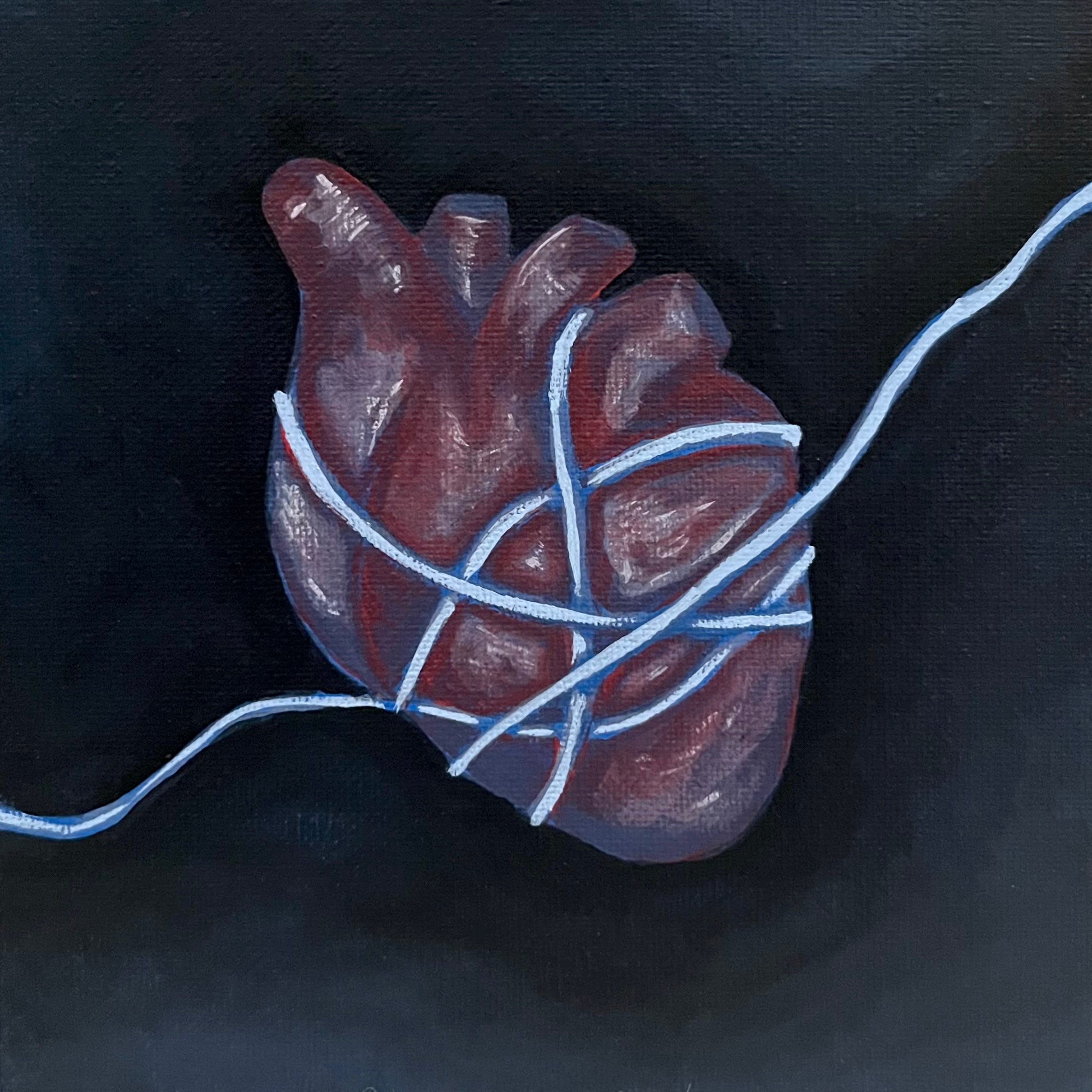
In linguistics, one of the phrases used to describe words that appear similar across languages, yet have different meanings and etymological roots,1 is the French “les faux amis du traducteur,” or “the false friends of the translator.” Other ways to refer to them are simply as “false friends” or “false cognates.”2 These words can make the task of language acquisition or translation difficult and erroneous if not done with caution. However, I think that there is a case to be made for playing with these “false friends” for creative aims. This painting is one such case.
The Latin word for "heart” is “cor, cordis.” It is where English derives its roots for various words, such as: cordial, record, accord, and discord to name a few.3 I, mistakenly, wondered to myself if cor had any relation to “cord.” The word stem in Latin when declining is “cord-,” after all. The two words share neither meaning nor root; I had found a myself a pair of false friends. Despite my misjudgment, I began to wonder: what if these words have gained a relationship, become tangled and intertwined over time, as we have developed idioms using both hearts and cords? Do we not pull on heartstrings?
When we form relationships—romantic or platonic—we invite others into our hearts. We open the most vulnerable parts of ourselves and, if the bond is strong, it becomes a cord. Along this cord are all the memories and moments shared, the laughter, the sorrow, the love. The cords tighten with our emotional bonds, loosen with distance, and in the worst possible case, restrict. The pain of a betrayal from those whom we care for most, an insult, discouragement, a fight, or an act of violence can all result in a tangled cord around the heart; one that digs deep enough to sever the pulse. We misjudge people, mistranslate them in our minds. These relationships deceive us as “false friends” and we can become trapped, knotted in words of dishonesty, manipulation, and insincere flattery. Working out these knots can be a challenge (we may not even know they are there). It is not an easy task, especially to untangle the knots and free ourselves from ties we thought our hearts would keep forever. Nevertheless, it is likely you have given someone else knots before, too.
Instances of false friends can occur where roots are shared. At some point in their development, the words diverged and took different paths toward meaning; while the starting point was the same, the path and the result were not.
Vrbinc, Marjeta, and Alenka Vrbinc. “Friends or Foes? Phraseological False Friends in English and Slovene.” AAA: Arbeiten Aus Anglistik Und Amerikanistik, vol. 39, no. 1, 2014, pp. 71–87. JSTOR, <http://www.jstor.org/stable/43025870.>
Schaffer, Rudolf F. Latin-English Derivative Dictionary. “Cor.” American Classical League, 1960, p. 13.
No posts
Comments
Nothing yet. Say the first thing.
Sign in to join the conversation.