
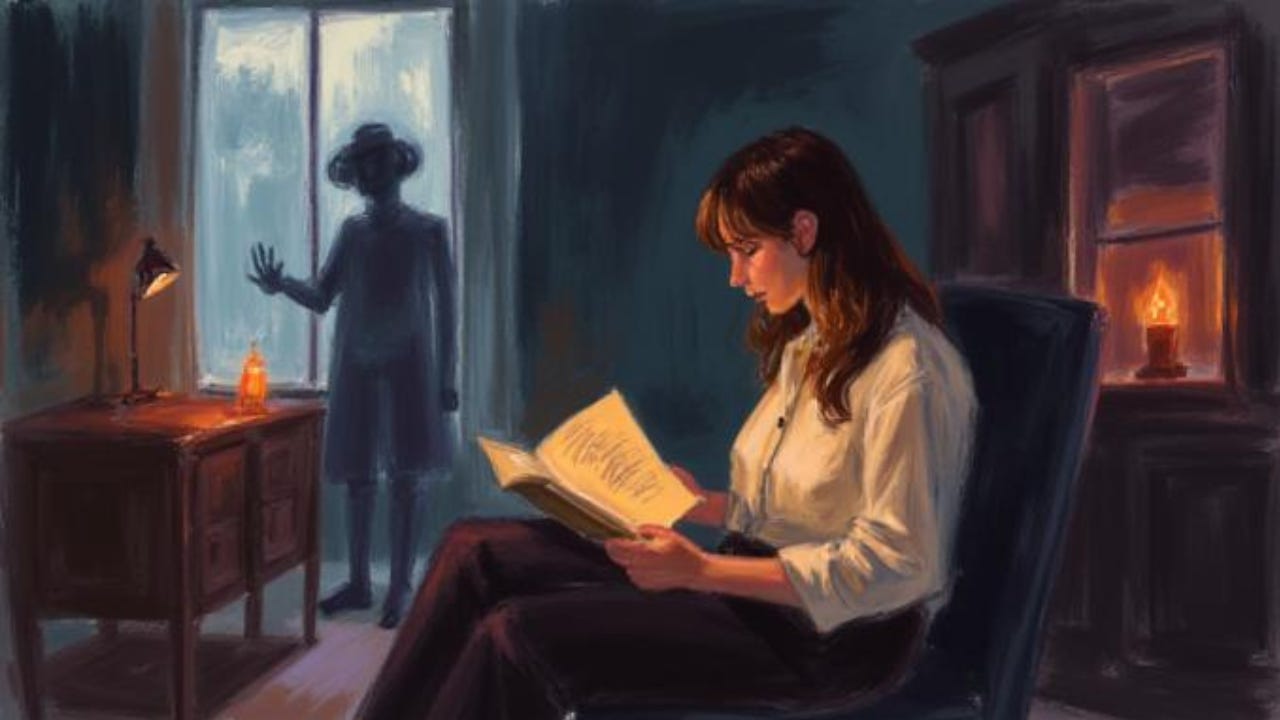
It sounds like terrible advice: if you are anxious, read something that will frighten you.
Yet many anxious readers, myself included, keep returning to horror, knowing that what we may read will be most certainly worse than what we might be imagining yet we proceed with devouring the narrative in front of us. Eventually we shut the book, and feel, strangely, a little more settled.
Mary Shelley left us one of literature’s clearest accounts of this transformation. In her introduction to the 1831 edition of Frankenstein, she recalled waking from a terrifying vision and being unable to shake the image from her mind. This led her to writing a full-blown novel about it. (Here is the orinal manuscript of it on Project Gutenberg: Shelley, 1831)
This seems like a contradiction until we consider the kind of fear horror offers. We often look at horror as something that provokes fear in the present. However if we follow through, horror has an ending. And the very fact that it has an ending, tells us we can get through this. And everything in the middle is exposure therapy. Exposure therapy is deliberately organised around a person’s particular fears and usually aims to build new, non-threatening associations through repeated contact and the violation of fearful expectations (Craske et al., 2014) Horror offers some of the same ingredients: approach, uncertainty, arousal and survival .
Every day anxiety is difficult to confront because it can feel overwhelming and overpowering. It can interfere with everything and anything you are doing, and it’s often very hard to switch off from. And just when we have resolved on thing, there is something else to worry about. So there is this never ending anxiety that continues to haunt us in daily life.
Horror in literature, by contrast, has a structure - it has a beginning and an end - all confined within the pages of book.
For an anxious reader, that confinement can be a relief. The fear in the book may be more dramatic than the fear we carry through daily life, but it is also more manageable. We know where it begins. We can anticipate it, but also predict the ending to some degree.
Research into ‘recreational fear’ suggests that this balance matters. In a field study of 110 visitors to a haunted attraction, Marc Malmdorf Andersen and his colleagues found an inverted-U relationship between fear and enjoyment: too little fear was dull, too much became unpleasant, but somewhere between the two was the Goldilocks zone of arousal. A novel allows the reader to search for this point personally, moving closer to or further from fear one line at a time. The study focused on a haunted attraction rather than reading, but it offers empirical support for the idea that fear can become pleasurable when its intensity remains within manageable boundaries. (Andersen et al., 2020)
Similar to exposure therapy, literature helps a reader approach and navigate what they fear in a controlled and gradual way. The reader is able to stay present with their fear, tolerate the uncertainty until the fear passes. The reader learns through experience, that fear can be endured, and lived through and that eventually it’s power reduces until we are back to a sense of safety and calm.
The therapeutic lesson during each encounter is that either the situation that the reader was catastrophising about does not indeed happen or that the reader can cope even feeling anxious. In what is known as the inhibitory-learning model, rather than removing or avoiding the original fear, a new memory is built beside the brain: a memory of approaching, remaining and surviving. In that limited sense, every horror story may offer an anxious reader another imagined memory of having stayed. (Craske et al., 2014)
Horror gives us a rehearsal of managing and processing fear through fiction. While reading, the body may respond as though the danger were real. The shoulders tighten. The eyes move faster across the page. A noise elsewhere in the house suddenly seems to deserve our full attention. Some primitive part of us is preparing to run.
But we are consoled by the boundary and essentially safety of the pages. We are aware the threat belongs to the story. We are living in two different spaces at the same time, the physical space of where we are reading but also the mental space of the book. And this paradox of being in two different places at the same time, essentially allows us to hold fear and refer to it from different perspectives, reducing its power over us. The emotion of fear may be experienced in the body as something very real, that we can connect to and easily relate to, however the danger is not real or present in physical form. And this aids the processing of fear, leading to emotional regulation.
The chapter ends. The character survives, or does not and still we remain where we were, perhaps moved a little, having travelled in time, space and emotions, but otherwise unharmed. Each time this happens, the body is offered a modest piece of evidence: we can survive fear, we can live with uncertainty and everything will be okay.
There is scientific evidence that suspenseful reading really does recruit brain systems involved in prediction and in imagining the experiences of others. In a small fMRI study, 23 participants read E. T. A. Hoffmann’s uncanny story The Sandman at their own pace (Lehne et al., 2015) The passages they experienced as most suspenseful were associated with activity in brain regions involved in social cognition, perspective-taking, prediction and possible cognitive control.
Researchers sometimes describe this distance between fictional terror and actual danger as a “safe frame.” Some part of us enters the story completely, while another remains just outside it, holding on to the knowledge that the threat has been constructed. We can surrender to the experience without surrendering our actual safety.
The idea has a close counterpart in the Distancing-Embracing model developed by Winfried Menninghaus and his colleagues. Their model proposes that the mental categories of art, representation and fiction create psychological distance by implying personal safety and control over whether we continue the experience. That distance then allows us to “embrace” emotions that would otherwise be unpleasant. Fear does not cease to be fear, but fiction changes the conditions under which we encounter it. (Menninghaus et al., 2017)
Long before psychologists gave this process a name, the Gothic novelist Ann Radcliffe was making a similar distinction. In her 1826 essay “On the Supernatural in Poetry,” she argued that uncertainty-filled terror “expands the soul,” while overwhelming horror “contracts” and “freezes” it. Her own novels repeatedly lead readers towards supernatural explanations before drawing back the curtain to reveal something human, material or explicable. Radcliffe’s work underpinned the idea that the imagination needs darkness, but also enough distance in which to move. (Radcliffe, 1826)
We know that the fear experienced in horror is temporary. The tension in the horror narrative builds initially and then also releases, liberating us. In this way horror can feel almost cleansing.
Comments
Nothing yet. Say the first thing.
Sign in to join the conversation.