

One of the genuine “goods” of our crazy digital age—yes, there are some—is that anyone with only a little bit of knowledge and curiosity, and a laptop with internet connection, can study, at will, decent reproductions of almost any masterpiece from our world’s vast collection of fine art. I was recently reminded of how fortunate we are to have this kind of access while reading biographies of John Ruskin, in whose day (the relatively recent mid-Victorian era) public art museums were few, and one could only see, say, some of Turner’s masterful seascapes, or a Madonna by Titian or Tintoretto, if one were fortunate enough to be invited to the home of a wealthy London collector, or rich enough to travel almost yearty to France, Germany, and Italy.
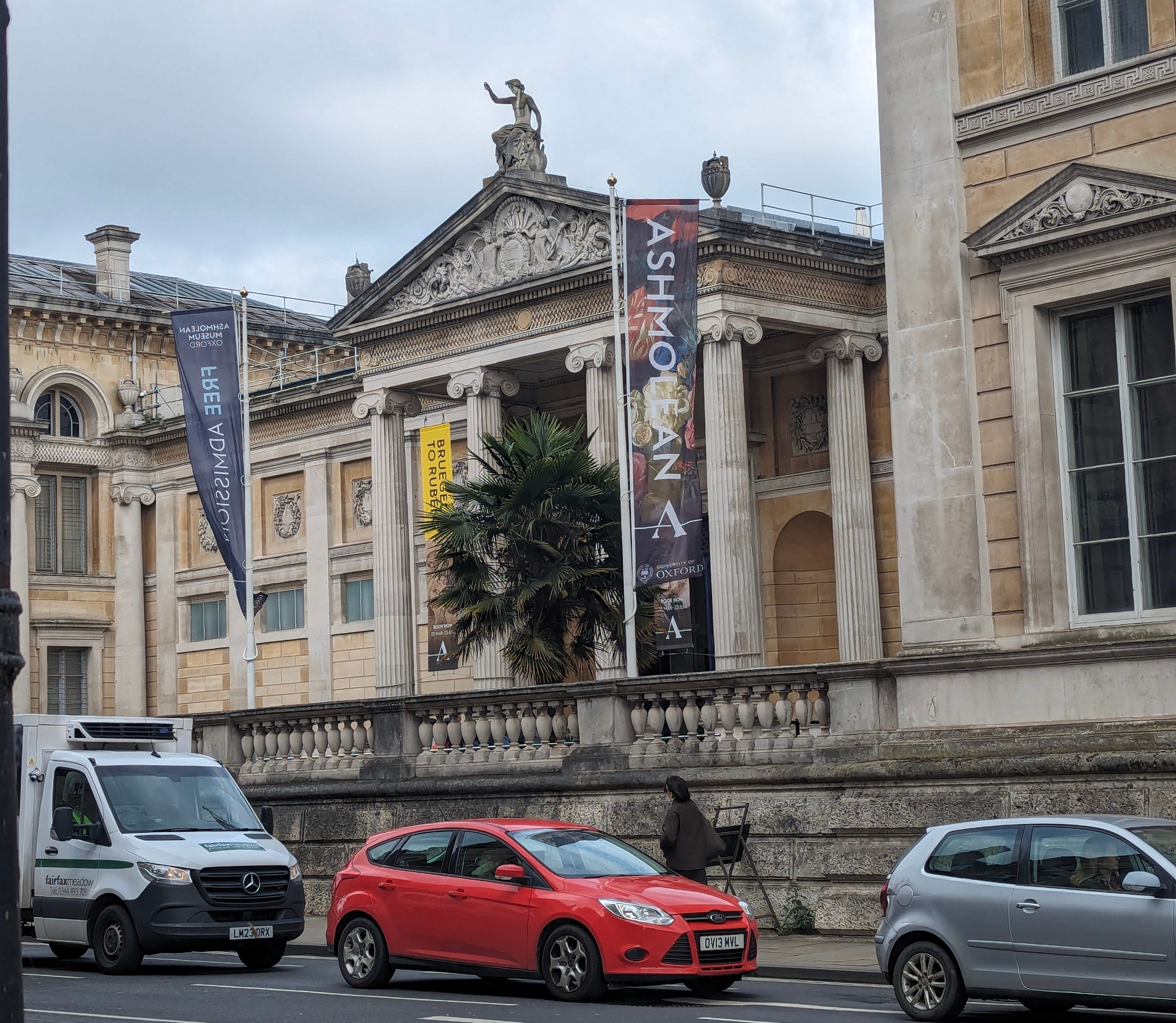
The first purpose-built museum in Europe, Oxford’s Ashmolean, which today, after renovations, holds about 39,000 square feet of display space—a roomy but, for the most part, still manageable size, especially if one can afford time for several separate visits. The Ashmolean wasn’t built, however, until the late 17th century, and for some time housed only the so-called “cabinet of curiosities” donated by the eccentric Elias Ashmole. (One of these days I must read a bio of that fellow!) The addition of paintings and other fine art to the collection came later.
The Louvre, on the other hand, by all accounts the first purpose-built museum focused exclusively on the fine arts, wasn’t opened until 1793, as a result of the French Revolution, and now boasts almost a million square feet of display space. That’s simply staggering, and for the visitor, often overwhelming.
If I’m honest, I’d have to say that, where I sit, huge public art museums like the Louvre, while valuable and perhaps even indispensible, provide their access to art on a sliding scale of diminishing returns. Years ago, on a study-abroad program, I was fortunate enough to visit the Louvre with some pals, but after much wandering and jostling about, could only see the paintings I really wanted to see—the few that I could find, that is—from a disappointing distance. I never got closer to the Mona Lisa, for example—it’s a relatively small painting to begin with—than maybe thirty feet because of the host of other visitors. Such a distance, alas, is wholly inadequate for someone as nearsighted as myself.
Last year, meanwhile, during our most recent month in Oxford, we braved the cavernous National Gallery in London, weighing in at about half the size of the Louvre at some 495,000 square feet of display space. While I long ago learned, when approaching these great houses of art, that it is best to focus on only a few works at a shot—in my case, a few paintings of Turner and perhaps a pre-Raphaelite or two, if I could find any—I, who am known in my family as someone who never gets lost, and who always seems to know which direction she’s facing, no matter where she finds herself—was so quickly turned around and befuddled that I actually began to suffer a panic attack. It was everything I could do to struggle my way back to the meeting spot, my blouse soaked in sweat.
The upshot: I got a glimpse of a Turner seascape behind a wall of tweens in a very noisome school group, but I couldn’t now for the life of me tell you which one it was; nor did ever find any pre-Raphaelites. Indeed, by the time I got my head to stop spinning, I frankly didn’t care: I just wanted to catch the train back to Oxford and my beloved (and far more navigable) Ashmolean.
But then, last Fall, by the grace of a family connection, I had the one-on-one Great Art encounter of a lifetime.
Comments
Nothing yet. Say the first thing.
Sign in to join the conversation.