
When I was a wee thing, maybe eight or nine, I bought a battered copy of the 1952 edition of the Pocket Book of Quotations at a used bookstore for something like fifty cents. It remains the best book of quotations I’ve encountered (I bought a second copy recently when the old one vanished) because, unlike Bartleby or Oxford, it goes heavy on poetry. This is how I first met Arnold, Longfellow, Kipling, the Rossettis, Edward Young, Thomas Hood and scores of others. And because poetry is (or was) written in such a way that it sticks in the memory, by the time I entered the sixth grade I was walking around school with bits of the great poets rattling around in my head (much to the vexation of my P. E. instructors). My classmates became accustomed to hearing me say, seemingly at random, “His aunt Jobiska made him drink / Lavender-water tinged with pink,” or, “He does not win who plays with sin / In the secret house of shame.” (I had seen the Gene Wilder Willy Wonka and come away with the impression that if I hoped to create a striking figure, the aim of all ten-year-old boys, I must quote Oscar Wilde often and remain majestically unaffected by the maiming and deaths of fellow children.)
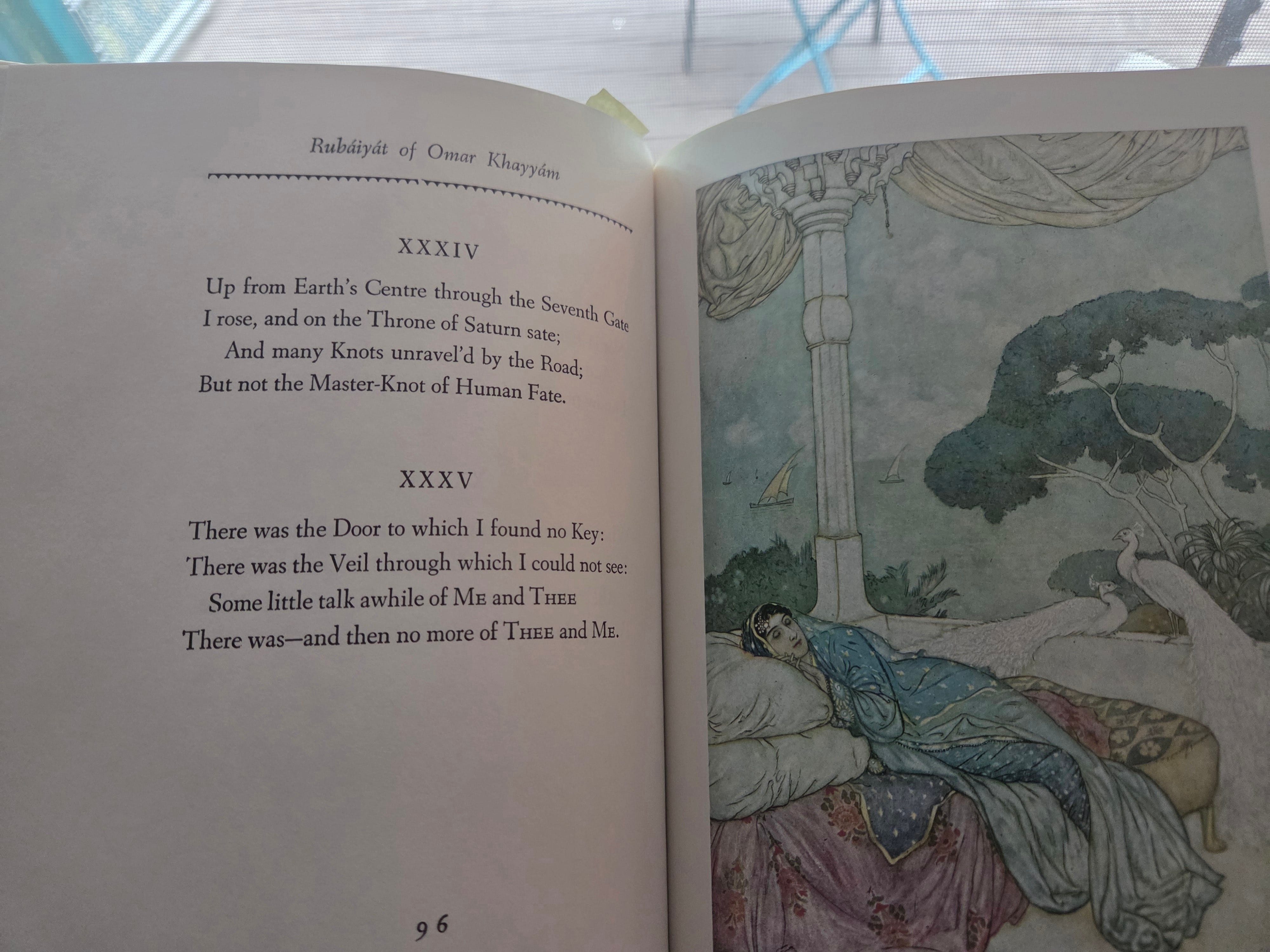
Of the most frequently cited works in the collection, there was one that especially intrigued me. It was The Rubaiyat of Omar Khayyam, written or translated by someone named Edward Fitzgerald. At nine years old I didn’t know anything about Fitzgerald or Omar Khayyam or Persian poetry more generally; nor, in 1996, was there much information about them online. I gathered that it had been written in the Victorian era; that the author had some rather unorthodox beliefs about God and the world to come (for which I pretended to be scandalized); and that the original text was likely much older than Fitzgerald’s version. That was all I knew. But the selected quatrains (I would learn, many years later, that “rubaiyat” meant “quatrains”) exerted an hypnotic pull. The meter, the imagery, the author’s slightly unnerving heresies, were rich and seductive. I puzzled over the following stanzas, and others, till I’d inadvertently committed them to memory:
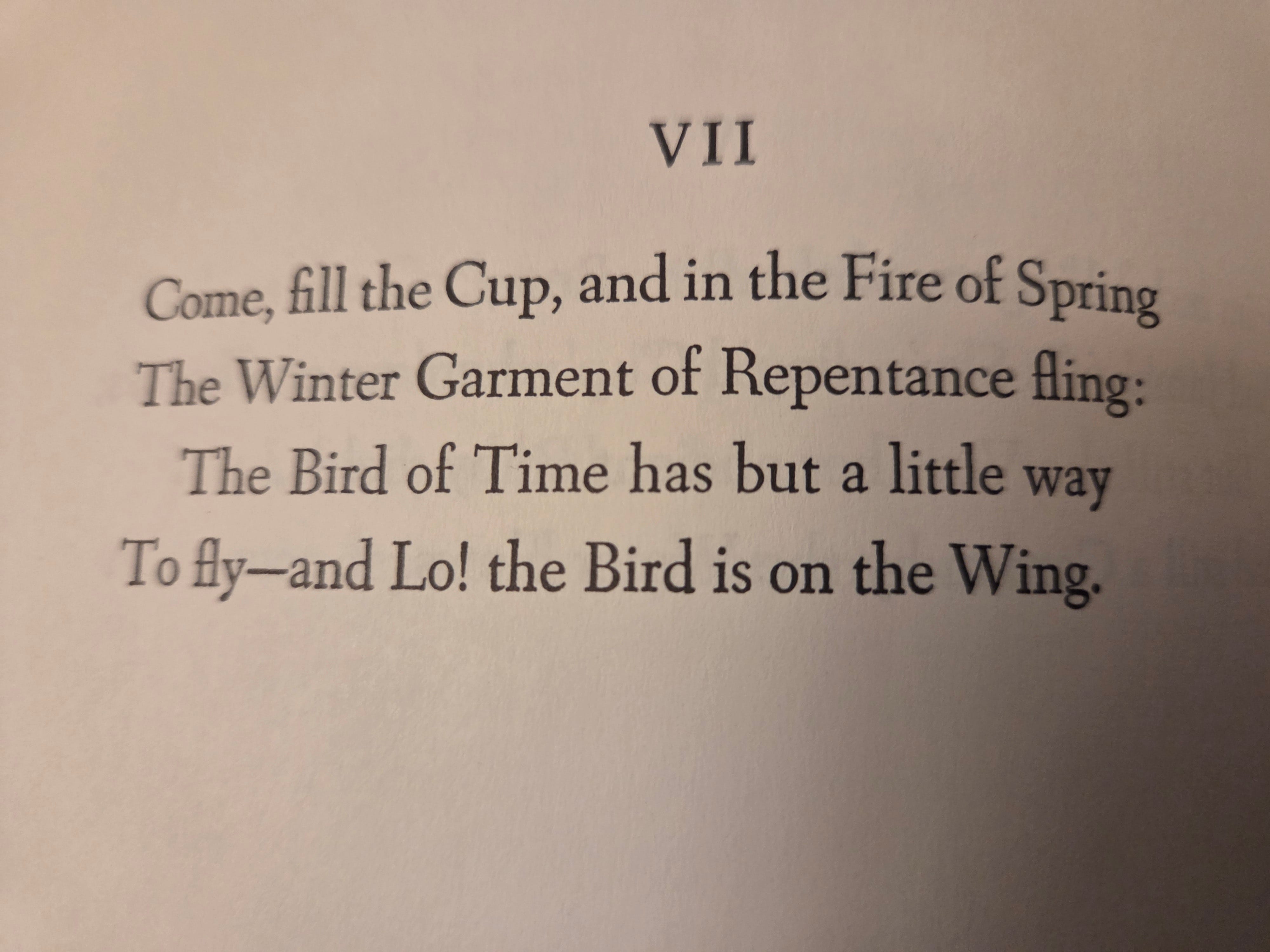
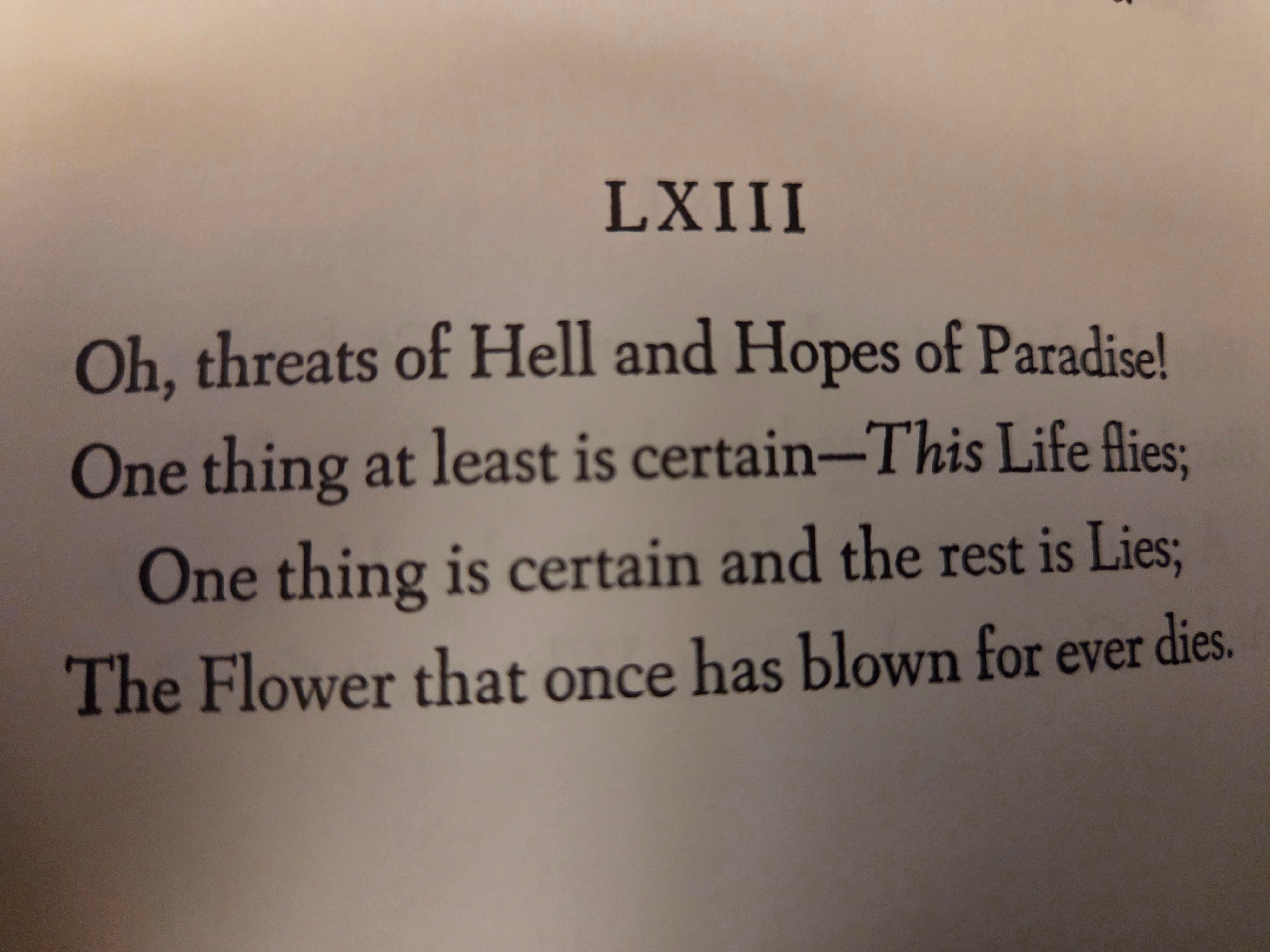
On closer inspection, there wasn’t much here that I hadn’t already read in the Bible. My favorite biblical text, the Book of Ecclesiastes, scarcely mentions God at all, and talks a great deal about the swift passing of time and the brevity of human life. (I was a morbid, melancholy child.) It reminded me, too, of another oft-quoted poem from the PBOQ, Thomas Gray’s “Elegy Written in a Country Churchyard.” (“The paths of glory lead but to the grave,” Gray, no doubt tremendous fun at parties, had written.) The Rubaiyat possessed all the morbidity of Solomon and Gray, but added to it a striking declarative style, sensuous imagery and a confidence in its own brilliance. You could tell that Khayyam, or at least Fitzgerald, knew he had written a work of exceptional power. Conviction blazes in every line.
It wasn’t until university that I sought out and read the complete Rubaiyat in the bowels of the library. I still think about it often; I read it again late last year. And then, on Friday, Rach brought home this exquisite beauty from an antiques store:
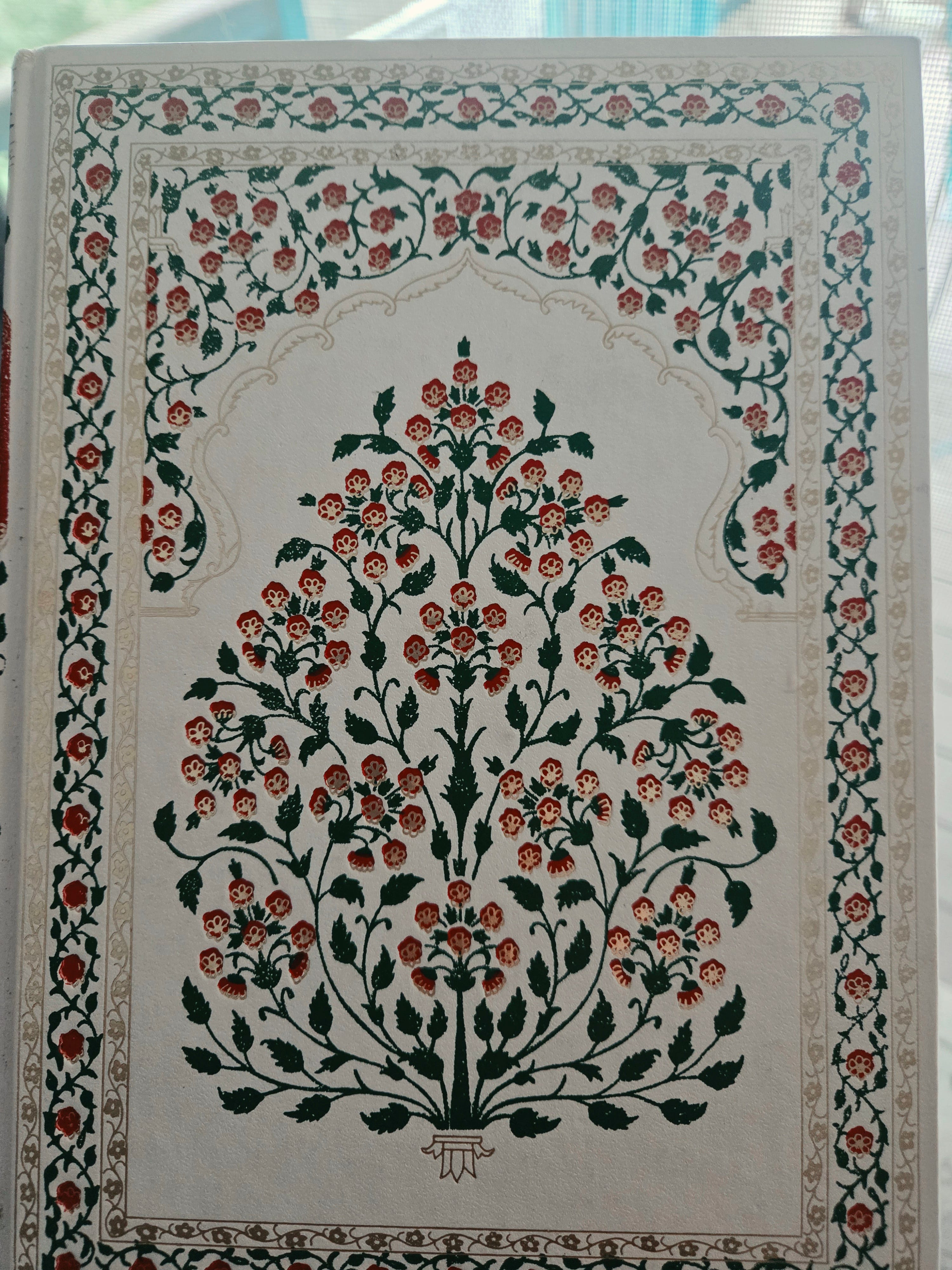
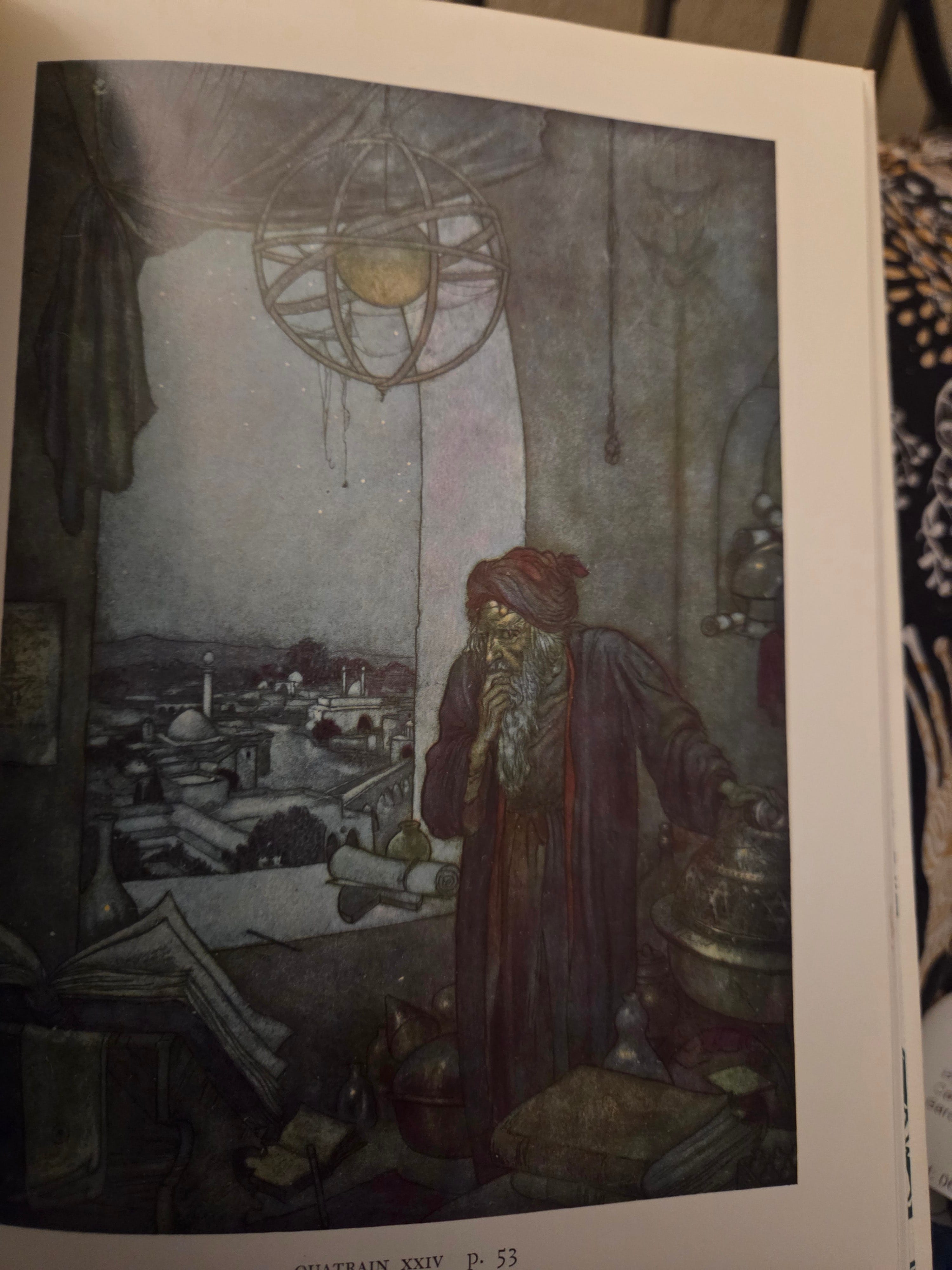
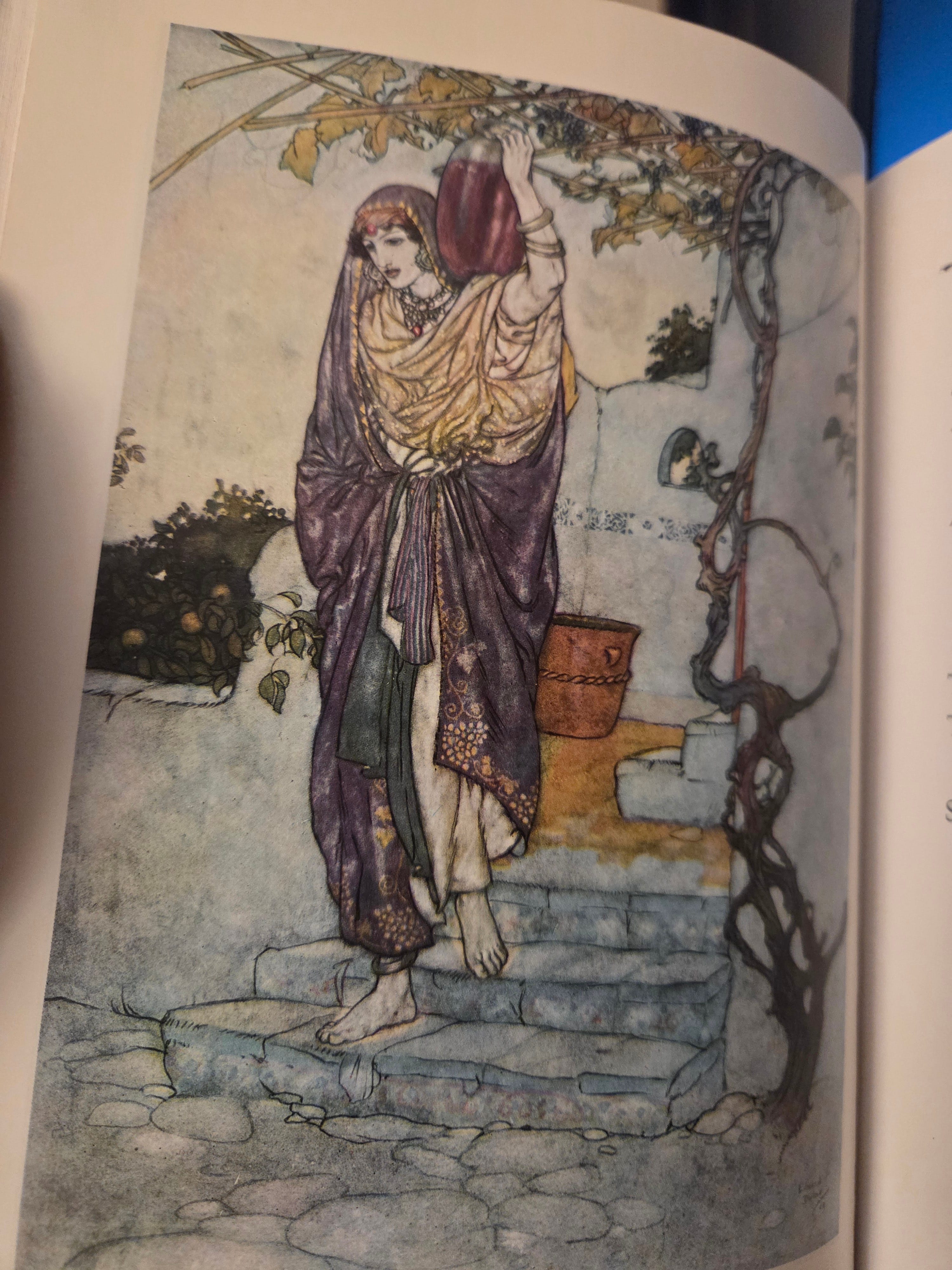
Handsomely printed by Doubleday in 1952, it contains the full text of the first, second and fifth editions (Fitzgerald’s translation having gone through a number of revisions, the fifth and last being generally considered the definitive version). The text is illustrated by Edward Dulac (1882-1953), who, as Rach noted, ranks with Beardsley and Rackham among the great artists of the Golden Age of Illustration.
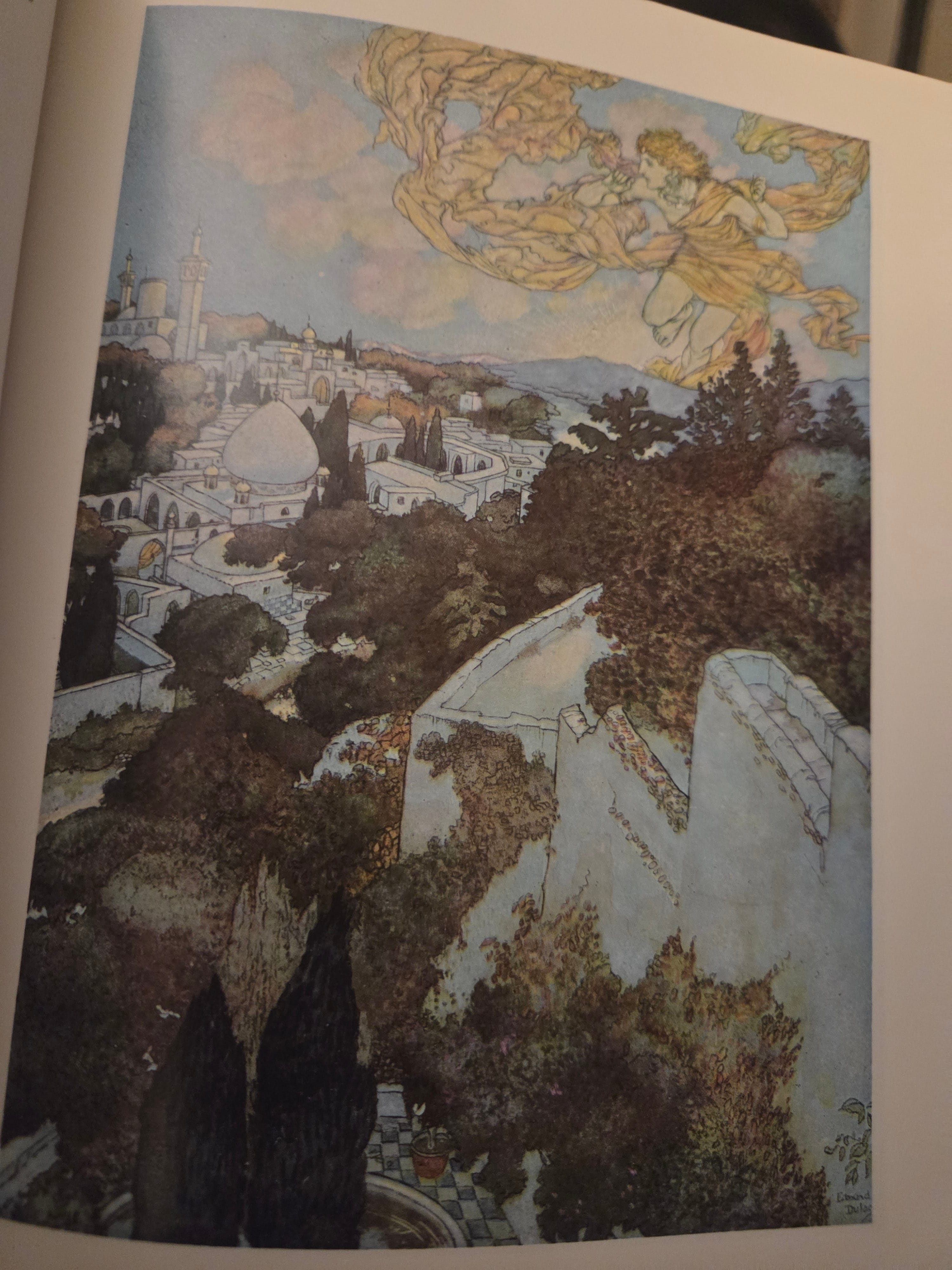
The above is Dulac’s interpretation of the striking opening lines:
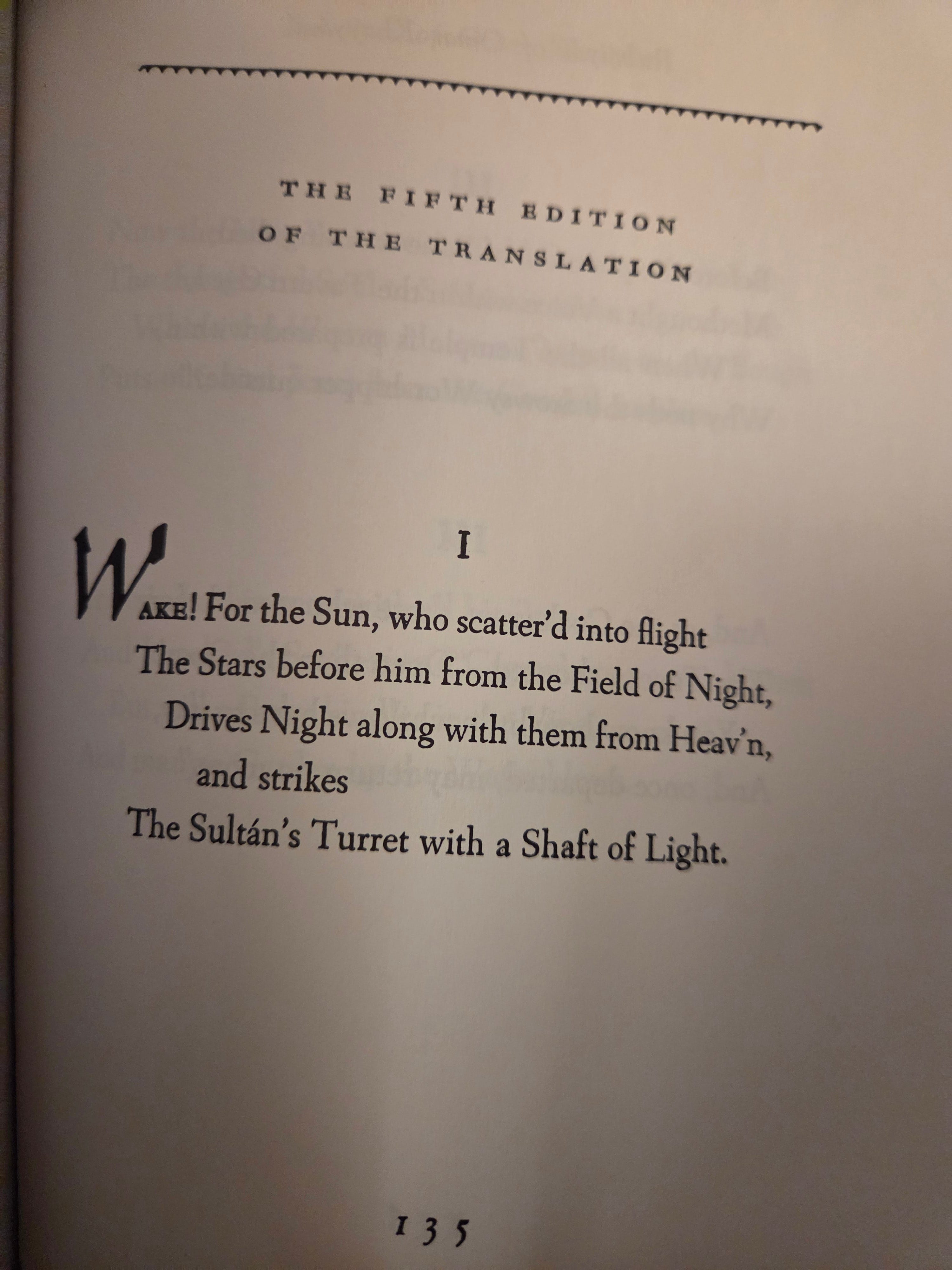
The degree to which Fitzgerald put his own stamp upon the material (to the extent that it’s considered more of a poetic interpretation than a translation proper) can be shown by comparison with a more recent translation, this one by Peter Avery and John Heath-Stubbs for Penguin Classics. Here’s Stanza 174 from their self-avowedly more literal version:
“The Pen of Destiny is made to write my record without me,
Why are its good and its bad accounted to me
Yesterday without me, and today likewise with neither you nor me?
Tomorrow on what evidence shall I be summoned before the Judge?”
Which Fitzgerald has rendered thus:
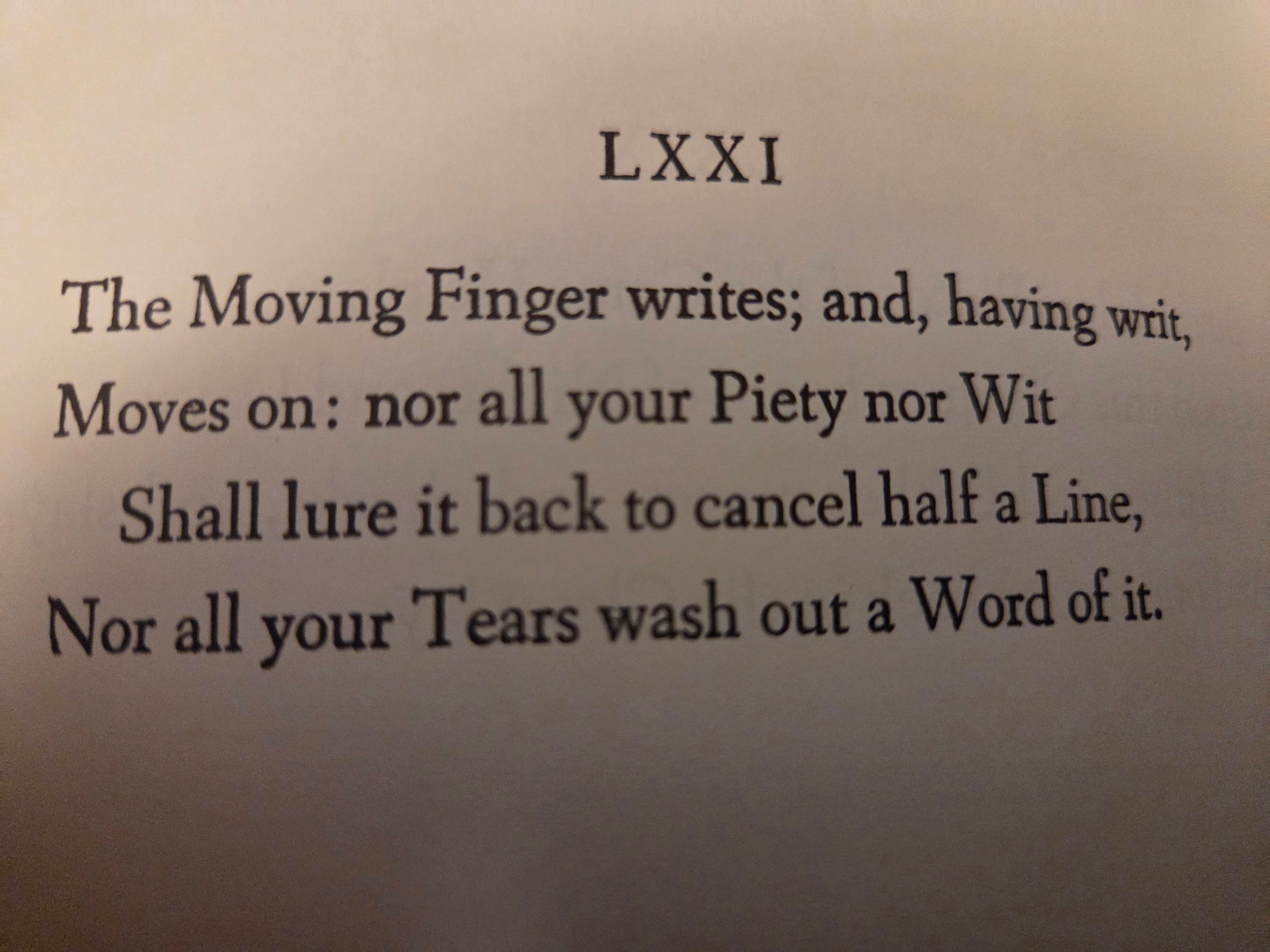
The Penguin translation, presumably, more accurately reflects the language of the original. And yet all the poetry is missing. Like Nabokov translating Eugene Onegin, their commitment to fidelity has sapped the magic from the quatrain. It’s not a poem any nine-year-old would feel compelled to memorize; and it’s hard to imagine Agatha Christie writing a murder mystery with the title Pen of Destiny.
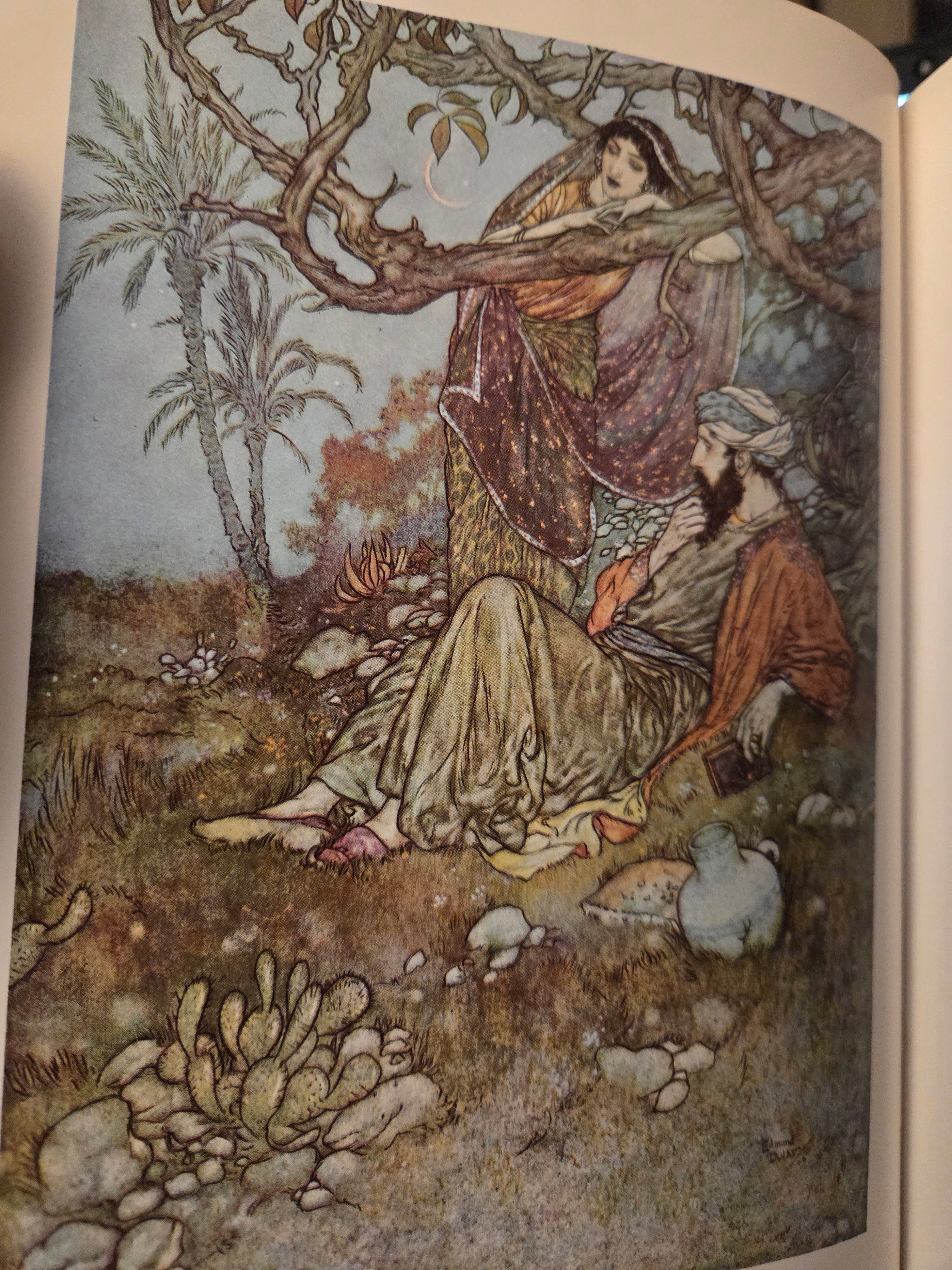
More poems, verses, and some biographical context, below the jump.
Comments
Nothing yet. Say the first thing.
Sign in to join the conversation.