
As HaShem told us in Ezekiel 36: 26–27 –––>
26 A new heart I will give you, and a new spirit I will put within you; and I will take out of your flesh the heart of stone and give you a heart of flesh. 27 And I will put my spirit within you, and cause you to walk in my statutes and be careful to observe my ordinances.
This is the Gospel, the Good News
We are not left to our own devices which are corrupted beyond practical use. All we have to do is ask the Jews who were given this path to walk with no internal Holy Spirit. The book of Hebrews lays all of that out to us clearly. Before Jesus it was a beautiful non-functional mess. No one was enabled to walk in righteousness without falling into legalistic works—which were impossible to maintain.
The plan was glorious. Sinful man was not able to do it. And there was no way given to truly get cleaned up. Plus, there was no direct power to help. Here’s an edited quote from She’s So Scripture.
The Siddur is the Jewish prayer book. The word comes from seder, meaning order. It’s full of prayers that Jewish communities have prayed for generations: the Shema, the Amidah, Psalms, blessings over everything from bread to seeing the ocean for the first time.
Many of these prayers and prayer patterns reach back to the Second Temple period and would have been familiar in the world Yeshua inhabited.
And the whole point of praying those same words over and over again, my rabbi explained, is kavanah.
When you’ve prayed the same prayer enough times that you’re not burning mental energy tracking what comes next, something else becomes possible. You stop performing the prayer and you start inhabiting it. You can slow all the way down on a single word and just live there. You could be moving through a Psalm you’ve prayed a hundred times and suddenly one word stops you cold, and you sit in it, and something opens. That’s kavanah doing exactly what it’s supposed to do.
We get the meaning of Kavanah is from the Hebraic Word Tool:
In Second Temple Judaism, kavanah is the technical term for intentional orientation of the heart during prayer, Torah study, and mitzvah performance. The Mishnah (Berakhot 2:1) establishes that the recitation of the Shema requires kavanah — not merely correct words but correct directedness. The rabbis debated whether mitzvot performed without kavanah (mitzvot tzerichos kavanah) fulfill the obligation.
The concept is not about emotional intensity or feelings of devotion. It is fundamentally architectural: is the self pointed at YHWH, or is it pointed at personal performance, social expectation, or habit? Kavanah is the inner tent peg (vav) that fixes the act of worship to its proper addressee.
I must admit the academic dryness of this type of data drives me nuts. Plus, there is no practical advice on how to bring this about. Let me tell you the hidden secret, in the flesh it is absolutely impossible to do over the long haul. To rephrase—
The problem is that this is impossible to do in the flesh
What she is talking about above and what the word tool tells us is what I now call the anointing of the Holy Spirit as a Spirit-filled believer. It sounds great. But, before rebirth it was just wishful thinking. Our undefended flesh cannot do it without being driven off the course by the minions of Satan. We do not have the power in us to manage this seemingly simple thing.
My religious resource was the Episcopalian Book of Common Prayer. I know all about praying by rote with no involvement. But even after I met the Lord and was filled with the Spirit, these rote prayers were dead as a post. Scripture is not, because scripture is authored by the Ruach HaKodesh who anointed Moses and the rest—to write them all for us. Remember, Moses was trained in the Egyptian Pharaoh’s schools. He knew how to write. But, by the anointing of the Holy Spirit, he could write with power.
That’s true for all the authors, male and female, of the scriptures—the Tanakh and the New Covenant. I tend to believe that the books with no attributions were probably at least partially written by women (which is why they have no attribution). No proof. Just a gut-level understanding of how the Lord works. Remember, I was married to an anointed woman of God for 44 years. I know how she was treated by the men (and worse, the women) of the church in many denominations throughout the years by the religious among them.
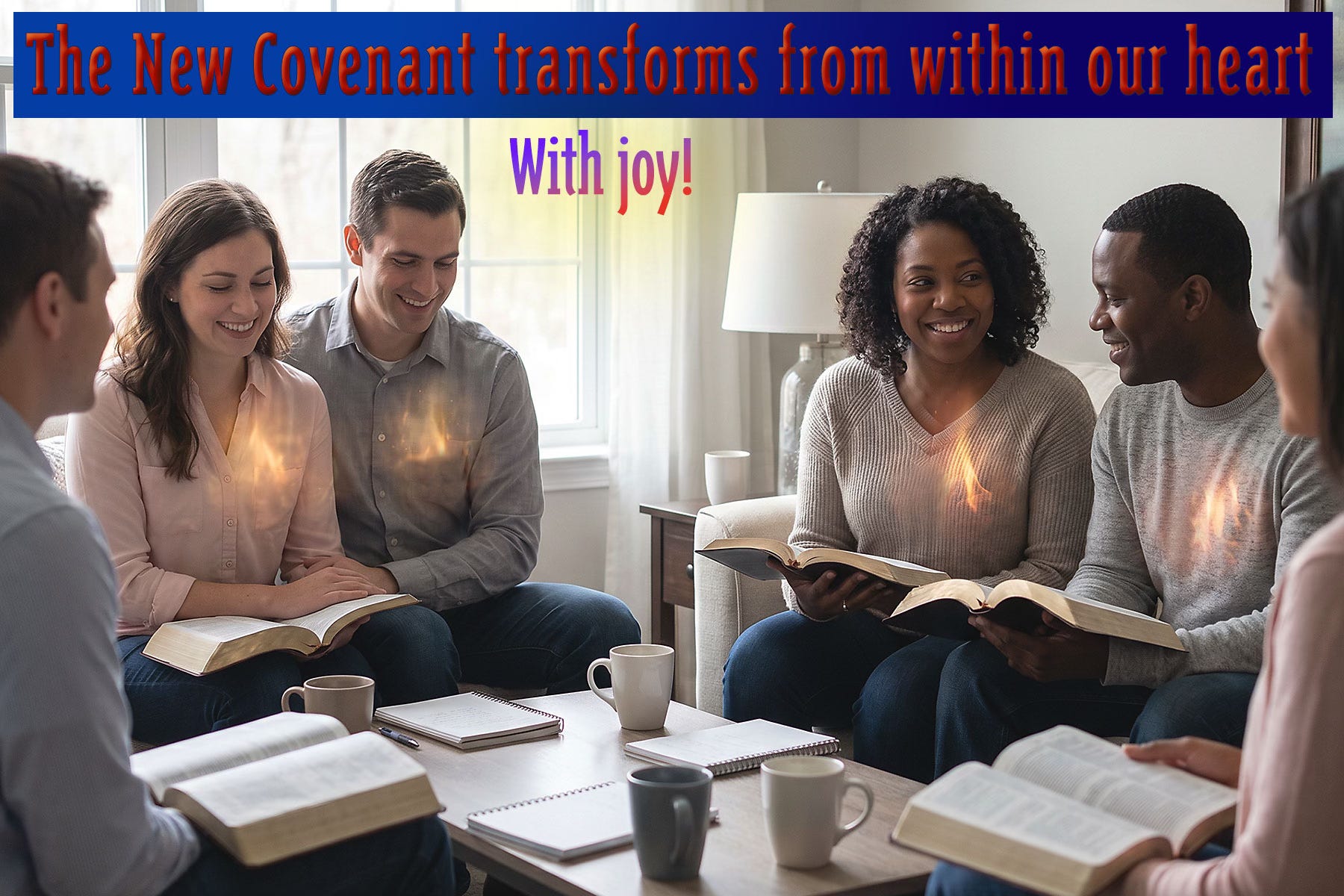
Be filled with joy!
In the New Covenant, the Lord has enabled us to walk in His ways, by the power of His Breath within. One of the clearest places this is seen is where Paul wrote In Philippians 2:13 —
for God is at work in you, both to will and to work for his good pleasure
In the New Covenant He works in us both to make us willing & to make us able to please Him. We are not left to our own devices. He has moved within to empower us to walk in the Spirit. Of course, as with almost all things in the Kingdom, we need to ask Him to do it. Our Lord never forces Himself upon us. Rape is something the enemy does in rage.
The Lord is a gentleman, polite, kind, loving, gracious, and on and on. He waits for us to ask. This is part of our daily bread which we are expected to ask for every morning.
Comments
Nothing yet. Say the first thing.
Sign in to join the conversation.