
Quick recap. In Part 1, we traced where the word “rapture” even came from — how it’s simply “caught up” (harpazō) from 1 Thessalonians 4, carried through Jerome’s Latin (rapiemur) and into our English word “rapture.”
We saw it’s a real biblical idea, even if the word took the scenic route to get here.
Because now we get to the hard part.
Now we open the puzzle.
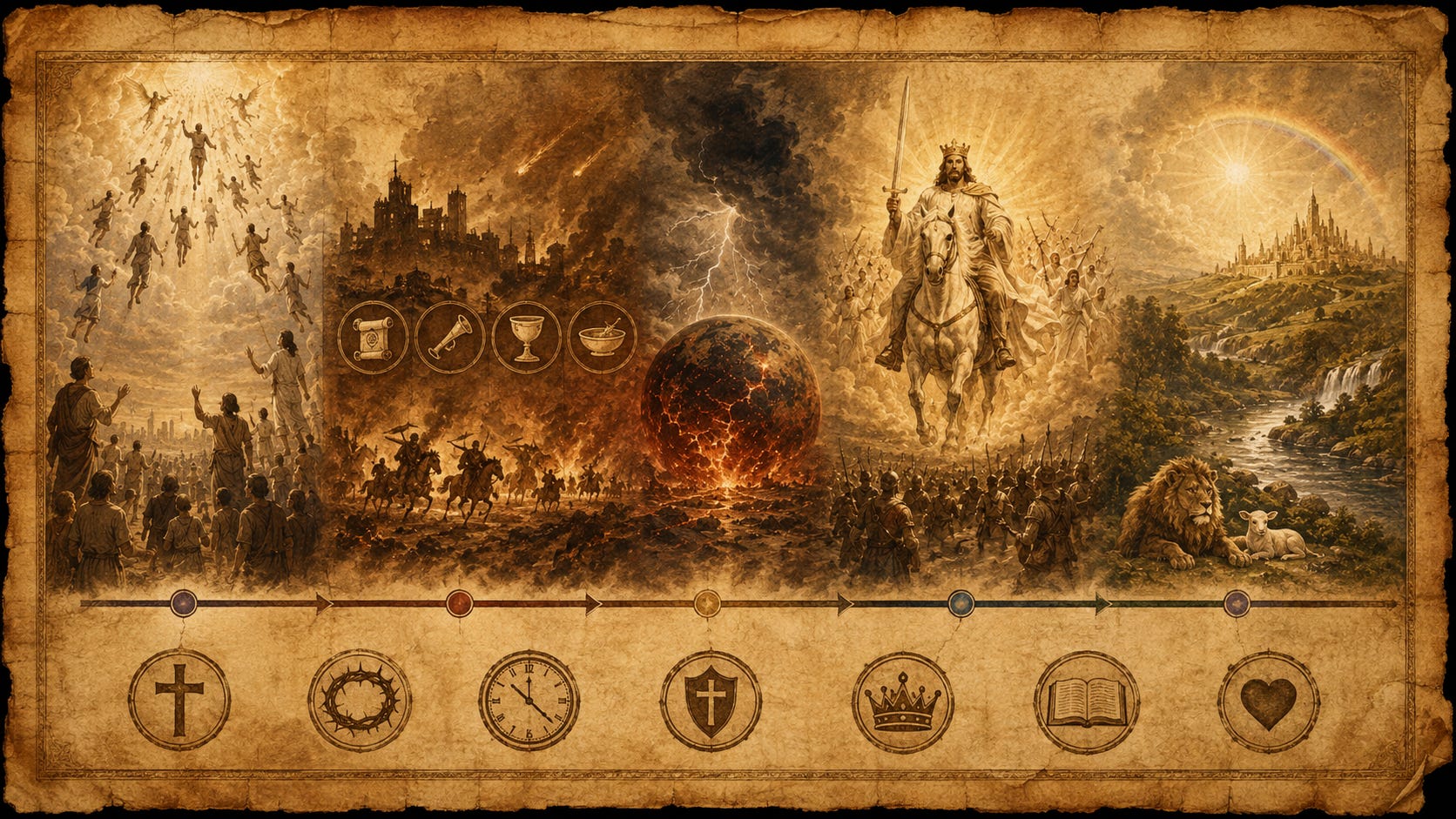
Here’s something almost nobody tells you when they’re arguing about the rapture:
ALL THE VIEWS — every single one — are trying to solve the same problem.They’re not five teams who picked sides for fun. They’re five honest attempts to fit together two things the Bible says that feel like they collide.
Look at the first one:
For God has not appointed us to wrath, but to obtain salvation through our Lord Jesus Christ. — 1 Thessalonians 5:9
Because you have kept my command to persevere, I also will keep you from the hour of trial which shall come upon the whole world. — Revelation 3:10
So Scripture promises God’s people are KEPT FROM His wrath.
Now, look at this:
In the world you will have tribulation; but be of good cheer, I have overcome the world. — John 16:33
These are the ones who come out of the great tribulation... — Revelation 7:14
Scripture also says God’s people GO THROUGH tribulation.
Jesus promised it. And Revelation shows a great multitude who came out of the great tribulation — meaning they were in it.
There’s the puzzle.
We are KEPT from wrath. And we GO THROUGH tribulation. Both are promised. Both are true.
So the whole debate is really trying to answer two questions:
1. Are we here for the tribulation — or not? Do we get taken out of it, or walked through it?
2. And if the “catching up” is real — WHEN does it happen? Before the tribulation? During it? After?
That is the entire debate. Every view you’re about to meet is one honest answer to those two questions. People in each camp are sincere, Bible-loving people reading the same verses and reconciling them in different ways.
So let's walk through it together — carefully, fairly, one view at a time. By the end, all five will make sense.
Let’s go.
If you remember only one thing from this entire article, make it this.
Much of the disagreement comes down to a single question: Are “the tribulation” and “the wrath of God” the same thing — or two different things?
But before we can answer that, we have to actually look at what these two words mean. Because in English we throw them around loosely — but in the Bible, they’re two different words, pointing at two very different things.
First: “Tribulation.”
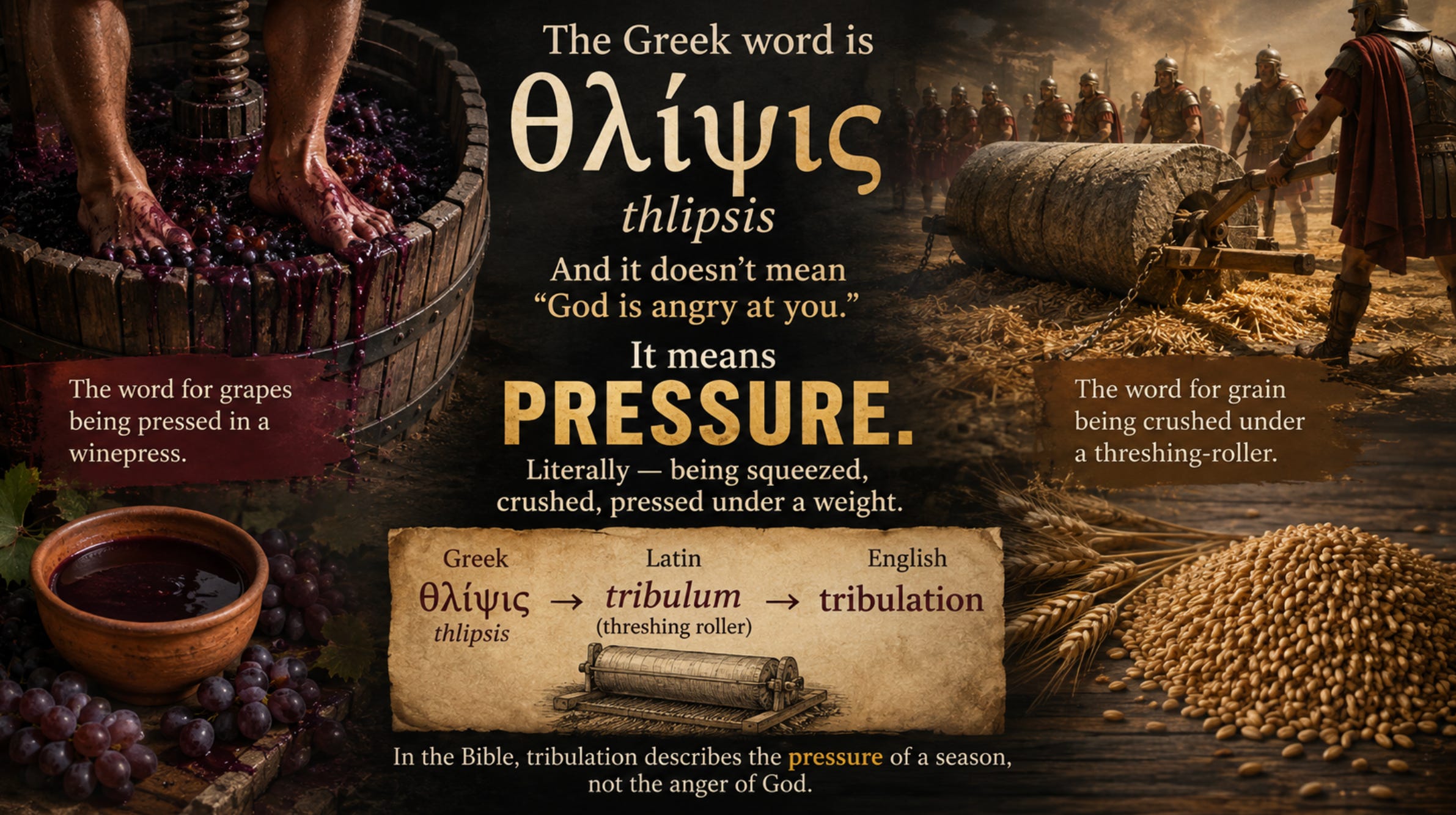
The Greek word is thlipsis. And it doesn’t mean “God is angry at you.” It means PRESSURE.
Literally — being squeezed, crushed, pressed under a weight. It’s the word for grapes being pressed in a winepress. It’s the word for grain being crushed under a threshing-roller. In fact, our English word “tribulation” comes from the Latin tribulum — the heavy roller the Romans dragged over wheat to crush the husks off.
That’s thlipsis. Pressure. Being squeezed by hard circumstances.
And here’s the thing — the Bible says this is normal for believers. It’s the ordinary weight of living for God in a broken world. Jesus flat-out promised it:
In the world you will have tribulation... — John 16:33
Paul said we enter the kingdom through many tribulations (Acts 14:22).
He even said we can rejoice in it — because pressure produces endurance, and endurance produces character (Romans 5:3–4).
So tribulation — trouble, pressure, hardship — is something believers are told to expect. It has NOTHING to do with God being angry at us. A person can go through the crushing pressure of losing a job, or persecution for their faith, and none of it means God is furious with them. It’s pressure. It’s the winepress. And God walks His people THROUGH it.
That’s the promise David clung to:
Yea, though I walk THROUGH the valley of the shadow of death, I will fear no evil; for You are with me. — Psalm 23:4
David doesn’t say God takes him out of the valley. He walks through it. But he’s not alone, and he’s not under judgment. God is with him in the pressure. That’s tribulation: the valley you walk through, with God right beside you.
Now compare that with another word entirely: “Wrath.”
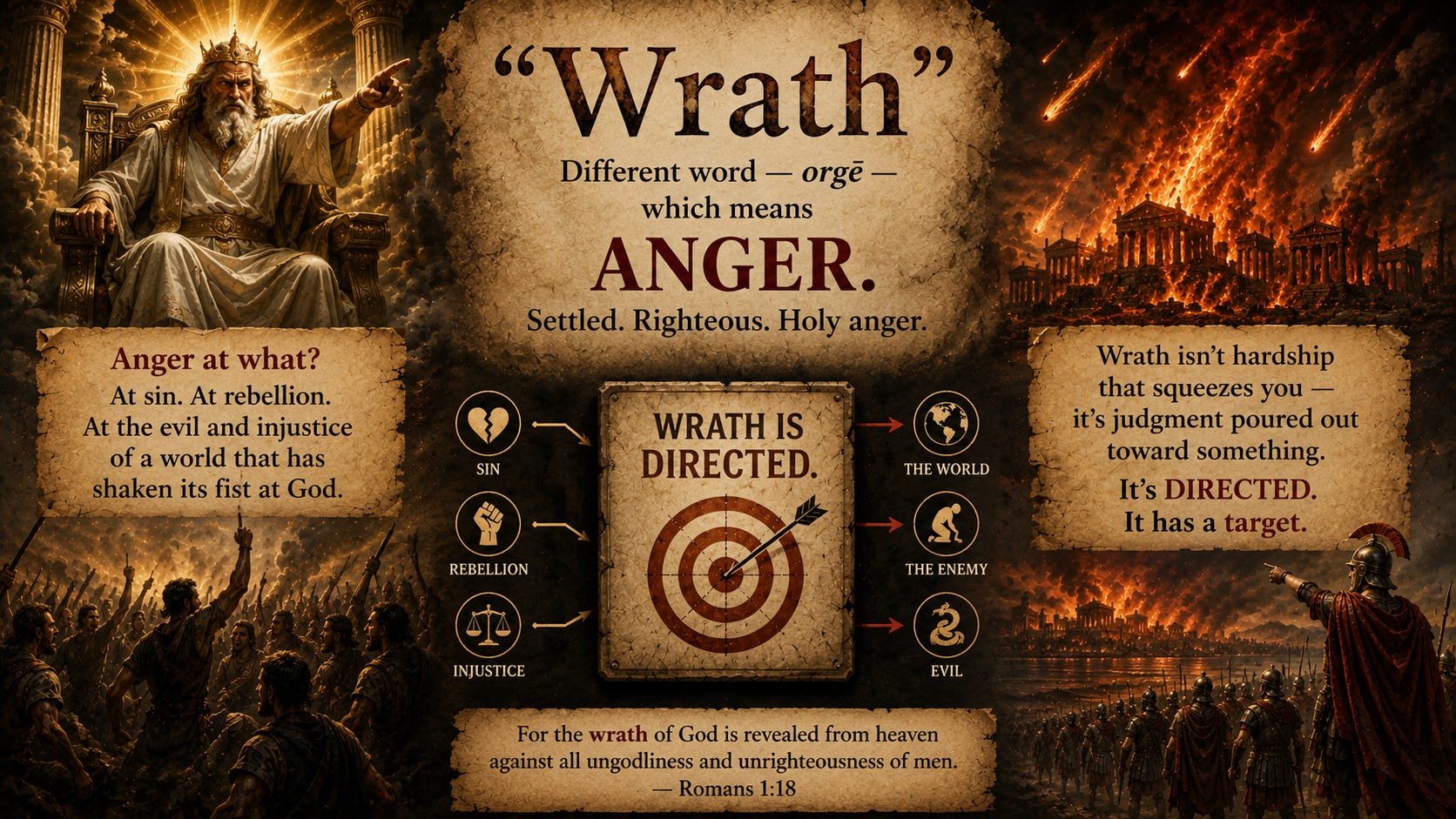
This is a completely different word — orgē — and it means something entirely different. Not pressure.
ANGER. Settled, righteous, holy anger.
But anger at what? At sin. At rebellion. At the evil and injustice of a world that has shaken its fist at God. Wrath isn’t hardship that squeezes you — it’s judgment poured out toward something. It’s DIRECTED. It has a target.

Want to see the difference with your own eyes?
Look at Jesus.
The night before He died, He went to a garden called Gethsemane. And here’s something most people don’t know:
The word Gethsemane means “oil press” — the place where olives were crushed under a heavy stone to squeeze out every last drop of oil.
In that garden, Jesus was crushed. The Bible says His soul was “overwhelmed to the point of death,” that He sweat drops like blood.
If there was ever a picture of thlipsis — of pressure, of being pressed under an unbearable weight — it’s the sinless Son of God, face in the dirt of the oil press.
Now ask the question:
Was Jesus under crushing pressure? YES. More than any of us will ever know.
Was Jesus experiencing the Father's wrath in Gethsemane? No. In the garden He was under crushing pressure, anticipating the cross that lay ahead.
Pressure — without anger. The whole distinction, standing right there in the garden.

And here’s the beautiful part — the part that turns this from relief into hope.
Why does an oil press crush the olive in the first place? To release the oil. The crushing was never the point. The oil is. Olives are not destroyed by the press—they become what they were meant to become. And all through Scripture, oil is a picture of the Holy Spirit — the oil that anointed kings and priests, the oil that kept the lampstand burning.
So when the pressure comes — when you’re squeezed by hard circumstances, pressed under a weight you didn’t choose — it is NOT God’s anger. It’s the press. And under that pressure, something holy is being squeezed out of you: the oil, the Spirit, the power of God pouring out through a life that’s been crushed and didn’t break.
That’s the promise as you walk through tribulation. The pressure has a purpose. It’s not wrath — it’s anointing.
In the garden, Jesus showed us pressure without wrath.
On the cross the next day, He took the wrath itself — the anger our sin deserved, falling on Him instead of us.
Which is exactly why Paul can turn around and promise:
For God has not appointed us to wrath... — 1 Thessalonians 5:9
So whatever else happens to God’s people, this is settled:
They are not appointed to stand on the receiving end of His judgment. The wrath our sin deserved fell on Jesus—not on those who are in Him.
So look at what we’ve actually got:
Tribulation = PRESSURE. Trouble. The winepress. Something believers go THROUGH.
Wrath = ANGER. Judgment. Aimed at rebellion. Something believers are saved FROM.
They’re not the same word. They’re not the same idea. One is a weight you carry. The other is a fire aimed at someone else.
“But wait — doesn’t one verse say we’re kept FROM the hour of trial?”
Good catch. It does. And it’s the pre-trib view’s single strongest verse.
I also will keep you FROM the hour of trial which shall come upon the whole world...
— Revelation 3:10
The pre-trib camp reads this as removal — kept out of the hour entirely, taken away before it starts. And there’s a real point here:
Jesus says “keep you FROM the hour,” and He could have said “keep you in it” or “through it” — and didn’t.
But there’s a strong counter-argument. The precise Greek phrase here — tēreō ek, “keep from” — appears only ONE other time in the entire New Testament.
Same author (John). Same speaker (Jesus). Watch what He says there:
I do NOT pray that You should take them OUT of the world, but that You should keep them FROM the evil one. — John 17:15
Same phrase.
And here Jesus practically defines it for us: not “remove them” — but “guard them while they stay in.”
Protection through, not escape from.
So which is it in Revelation 3:10?
Honestly — the grammar allows both, and godly scholars line up on both sides.
Pre-trib leans on “out of the hour.” The other views lean on John’s own definition a few chapters over. This one verse, by itself, won’t settle the whole debate — but John 17:15 is a serious clue that “kept from” doesn’t have to mean “taken away.”
Keep this in your back pocket. It’ll come up again when we reach the pre-trib view.
Now — back to the fork. Watch how that one question sends you down completely different roads.
IF TRIBULATION AND WRATH ARE THE SAME THING:Believers are promised to be kept from wrath. So they must be kept from the tribulation too. God takes them out before it starts.
→ This is the road to the pre-tribulation view.
IF THEY’RE TWO DIFFERENT THINGS:
Believers can go through the pressure of tribulation — and still be spared the anger of God’s wrath.
→ This is the road to the pre-wrath and post-tribulation views.
Now — to be fair, pre-trib has an answer. They’d say that in the final tribulation, the pressure and the wrath fuse into one inseparable storm — so being kept from one means being kept from both. That’s not a dodge; it’s a real, defensible reading, and you’ll see it in their view below.
This word study — the winepress, Gethsemane — builds a strong case that tribulation and wrath are two different things. And the word meanings really are facts. But whether they stay neatly separate during the end-times storm is interpretation — and sincere scholars land on both sides.
So take the word study as real light on a hard question. Then weigh all five views yourself before you decide.
That’s the hinge the whole debate swings on. Keep it in your hand as we go.
There’s one more phrase we have to understand before the views will make sense — because it shows up everywhere in this conversation, and WHERE you think it begins changes everything.
“The Day of the Lord.”
It’s one of the oldest phrases in the Bible. The Old Testament prophets used it constantly — and not as a single 24-hour day, but as a season when God steps into history to judge evil and set things right.
Alas for the day! For the day of the Lord is at hand; it shall come as destruction from the Almighty. — Joel 1:15
Woe to you who desire the day of the Lord! ... It will be darkness, and not light.
— Amos 5:18The great day of the Lord is near; it is near and hastens quickly. — Zephaniah 1:14
For the prophets, the Day of the Lord was that awesome, terrible stretch when God pours out judgment on a defiant world — and, on the other side of it, rescues and restores His people.
Now watch Paul pick up the exact same phrase and hand it to the church:
For you yourselves know perfectly that the day of the Lord so comes as a thief in the night. — 1 Thessalonians 5:2
And Peter too:
But the day of the Lord will come as a thief in the night, in which the heavens will pass away with a great noise... — 2 Peter 3:10
Here’s why this matters so much for the rapture debate.
If the “Day of the Lord” is when God’s wrath is poured out — then the question “when are believers caught up?” becomes “when does the Day of the Lord begin?” Because believers are promised to be kept from that wrath.
So some ask:
Does the Day of the Lord begin at the start of the tribulation? Then believers are taken before any of it.
Does it begin in the middle, or near the end, after a time of persecution but before the final outpouring? Then believers go through part of it and are caught up later.
The whole timeline of the rapture, for many people, is really a question about the timing of this one phrase. You’ll see it surface in nearly every view below.
One thing worth naming before we start: where you land on the rapture has little to do with the strength of your faith, or the name on your church sign. Two believers in the same pew — who agree completely about Jesus, the cross, and salvation — can walk out disagreeing about the rapture. The end-times timeline is a separate question from how a person is saved. Notice something remarkable: none of these views were invented because someone disliked the Bible. Each exists because people are trying to take all of Scripture seriously. They simply disagree on how the pieces fit together.
So as I note where each view “tends to be found,” hold it loosely. These are tendencies, not tribes. The real question isn’t who holds a view — it’s how they got there, and whether the text supports it. None of these views deny Christ’s return. They all affirm it. They simply disagree about the order of the events leading up to it.
Now — the five views, earliest to latest. Watch the “catching up” slide further and further down the timeline… until the last view erases the separate event altogether.
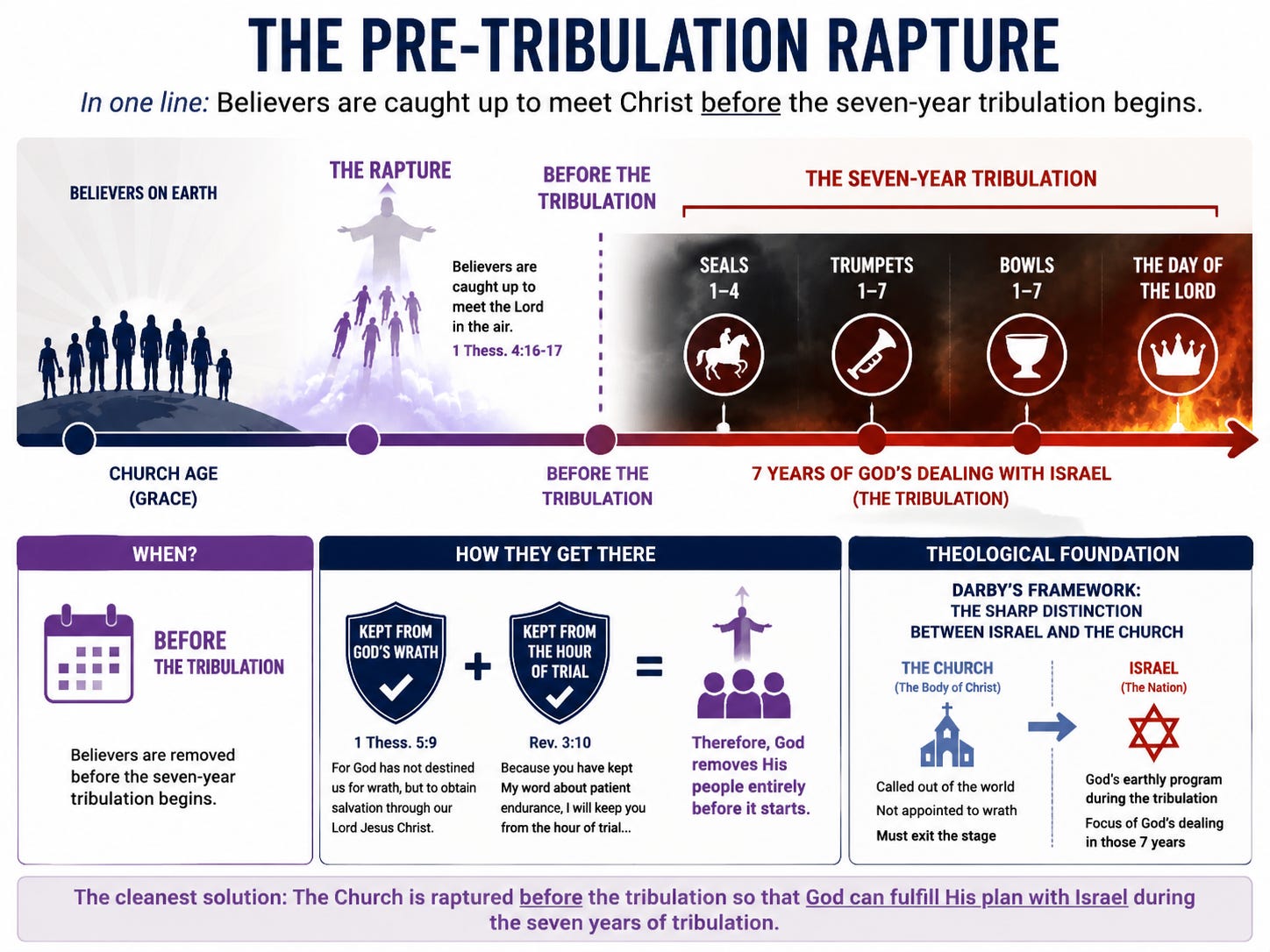
In one line: Believers are caught up to meet Christ before the seven-year tribulation begins.
When: Before the tribulation.
How they get there: They read “tribulation” and “God’s wrath” as essentially the same season. So if believers are promised to be kept from wrath (1 Thess 5:9) and kept from the hour of trial (Rev 3:10), the cleanest solution is that God removes His people before it starts.
This rides on Darby’s Israel-and-Church distinction from Part 1 — and they’d add that the “ages” idea isn’t invented: the word dispensation (Greek oikonomia) is right there in Scripture (Ephesians 1:10, 3:2), with a future age still owed to Israel (Romans 11).
Leans on:
I also will keep you from the hour of trial which shall come upon the whole world. — Revelation 3:10
For God has not appointed us to wrath... — 1 Thessalonians 5:9
Then we who are alive and remain shall be caught up... — 1 Thessalonians 4:17
They also point to 2 Thessalonians 2:3, where Paul says a “falling away” (Greek apostasia) comes first — and a minority even argue apostasia means a “departure,” making that word itself the rapture (though most scholars read it as a spiritual falling away, not a catching-up).
Why they’re confident: It fits a God who rescues His people before the storm — Noah in the ark before the flood, Lot out of Sodom before the fire. It takes the “kept from wrath” promises at full strength. It offers comfort: the worst is not for you. And it gives the tribulation a clear purpose — in their reading, it’s aimed at bringing a rebellious world, and unbelieving Israel, to repentance (Zechariah 12:10, “they will look on Me whom they pierced” and mourn) — which is Israel’s story to walk through, not the already-redeemed Church’s.
The hard question: Their strongest verse, Revelation 3:10 (”kept from the hour”), has a catch: the one other place that exact Greek phrase appears (John 17:15), Jesus uses it to mean protection through danger, not removal from it. And if the rapture is secret and separate, why does Paul describe it in 1 Thessalonians 4 with a shout, an archangel’s voice, and a trumpet — the loudest imagery imaginable? Why did Jesus place the gathering of His elect after the tribulation in Matthew 24?
Tends to be found among: American evangelicals, most Baptist and Pentecostal churches, and non-denominational congregations. Think Left Behind, Hal Lindsey, and popular prophecy teaching.
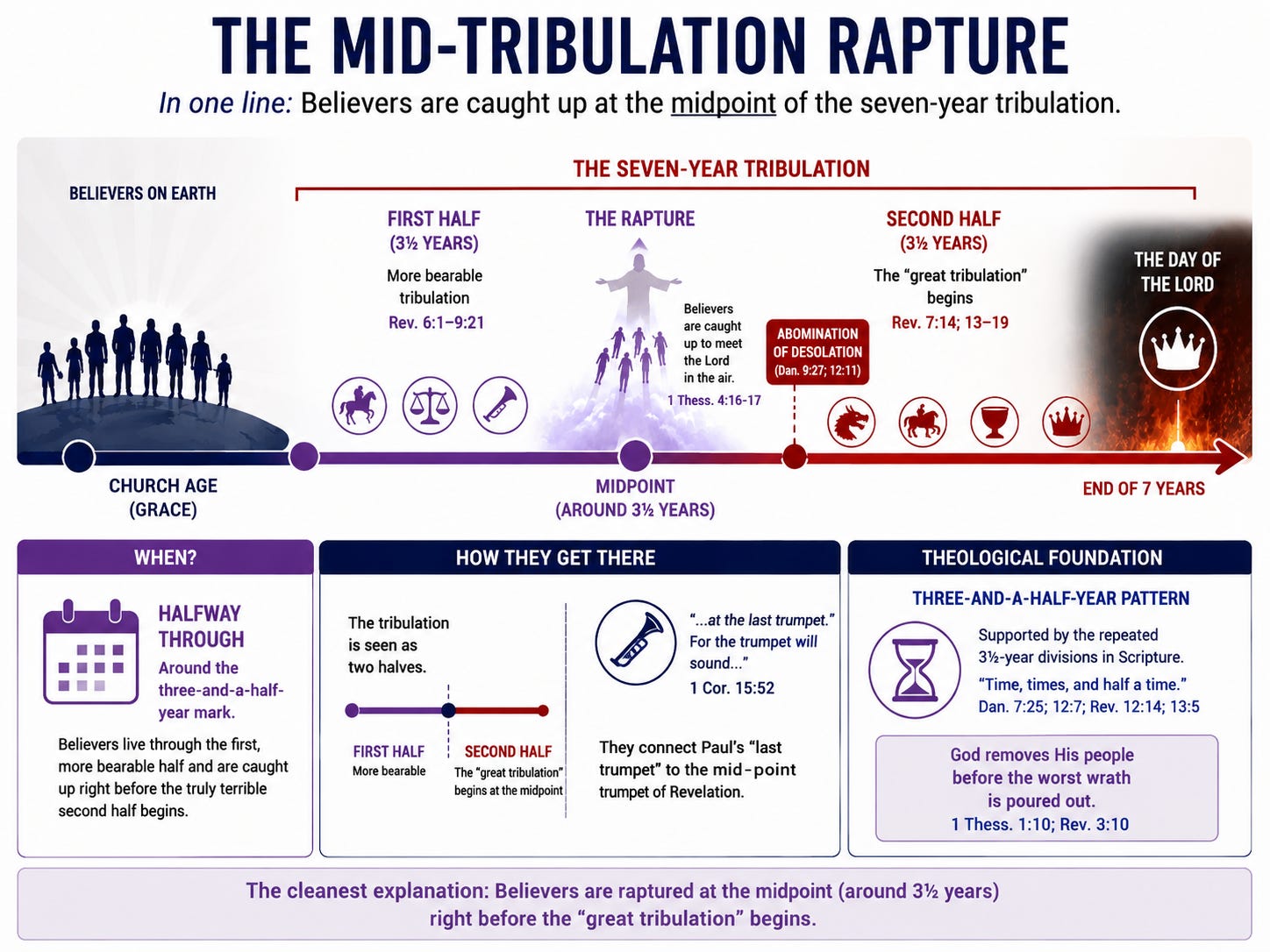
In one line: Believers are caught up at the midpoint of the seven-year tribulation.
When: Halfway through — around the three-and-a-half-year mark.
How they get there: They notice the tribulation seems to have two halves, and that the worst of it — the “great tribulation” — kicks in at the midpoint, when the “abomination of desolation” occurs (we’ll dig into that in Part 3). So believers live through the first, more bearable half, and are caught up right before the truly terrible second half begins.
Leans on:
...at the last trumpet. For the trumpet will sound... — 1 Corinthians 15:52
They connect Paul’s “last trumpet” to the mid-point trumpet of Revelation, and lean on the three-and-a-half-year divisions found in Daniel and Revelation (time, times, and half a time).
Why they’re confident: It honors the clear “two halves” structure of the tribulation timeline, and it lets believers be present for part of the end-times events (which Jesus seemed to expect) while still being rescued before the outpouring of the worst wrath.
The hard question: Is Paul’s “last trumpet” in 1 Corinthians 15 really the same trumpet as the mid-tribulation one in Revelation — or is that connection assumed rather than proven? Lining up trumpets across different books is harder than it looks.
Tends to be found among: A minority position — held more by individuals across various evangelical churches than by any denomination as a whole.
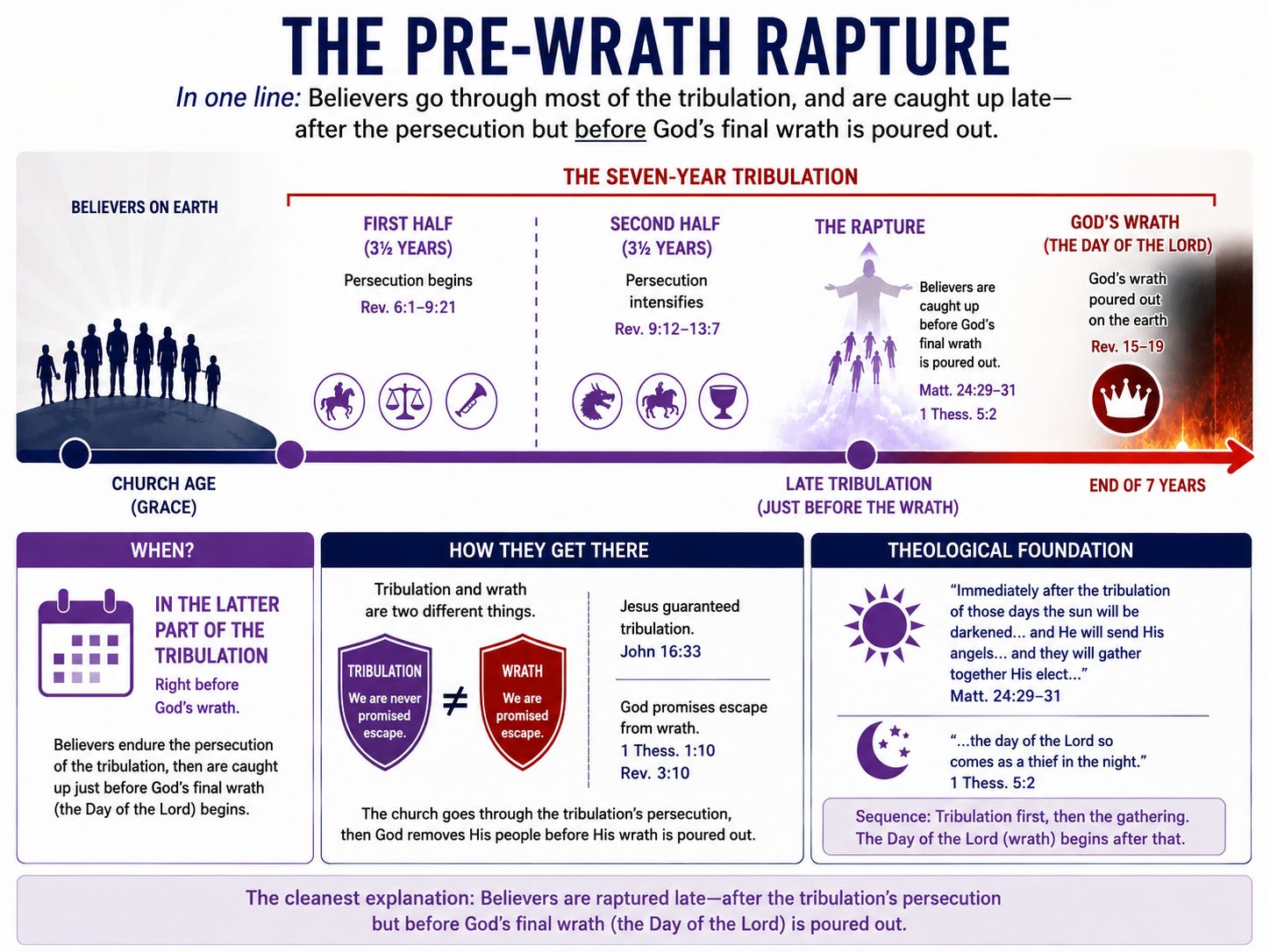
In one line: Believers go through most of the tribulation, and are caught up late — after the persecution but before God’s final wrath is poured out.
When: Late in the tribulation — caught up before the final wrath falls, leaving a gap before the very end.
How they get there: This is the view built directly on the key we talked about — that tribulation and wrath are two different things. Believers are never promised escape from tribulation (Jesus guaranteed it). They are promised escape from wrath. So the church endures the tribulation’s persecution, and then — just as God’s wrath (the Day of the Lord) is about to fall — they’re caught up and spared the wrath itself.
Leans on:
Immediately after the tribulation of those days the sun will be darkened... and He will send His angels... and they will gather together His elect... — Matthew 24:29–31
...the day of the Lord so comes as a thief in the night. — 1 Thessalonians 5:2
They point to the sequence in Matthew 24 (tribulation first, then the gathering) and argue the wrath/Day of the Lord begins only after that gathering.
Why they’re confident: It takes both halves of the puzzle seriously without forcing them together — believers really do go through tribulation (as Jesus said), and they really are spared wrath (as Paul said). It follows the actual order of events in Matthew 24. Many feel it’s the most textually careful reading.
The hard question: It requires drawing a precise line between where “tribulation” ends and “wrath” begins — and Scripture doesn’t hand us a neat, labeled boundary. How do we know exactly when one becomes the other?
Tends to be found among: A growing minority, especially among those who’ve studied Matthew 24 closely; associated with teacher Marvin Rosenthal, who helped popularize the term.
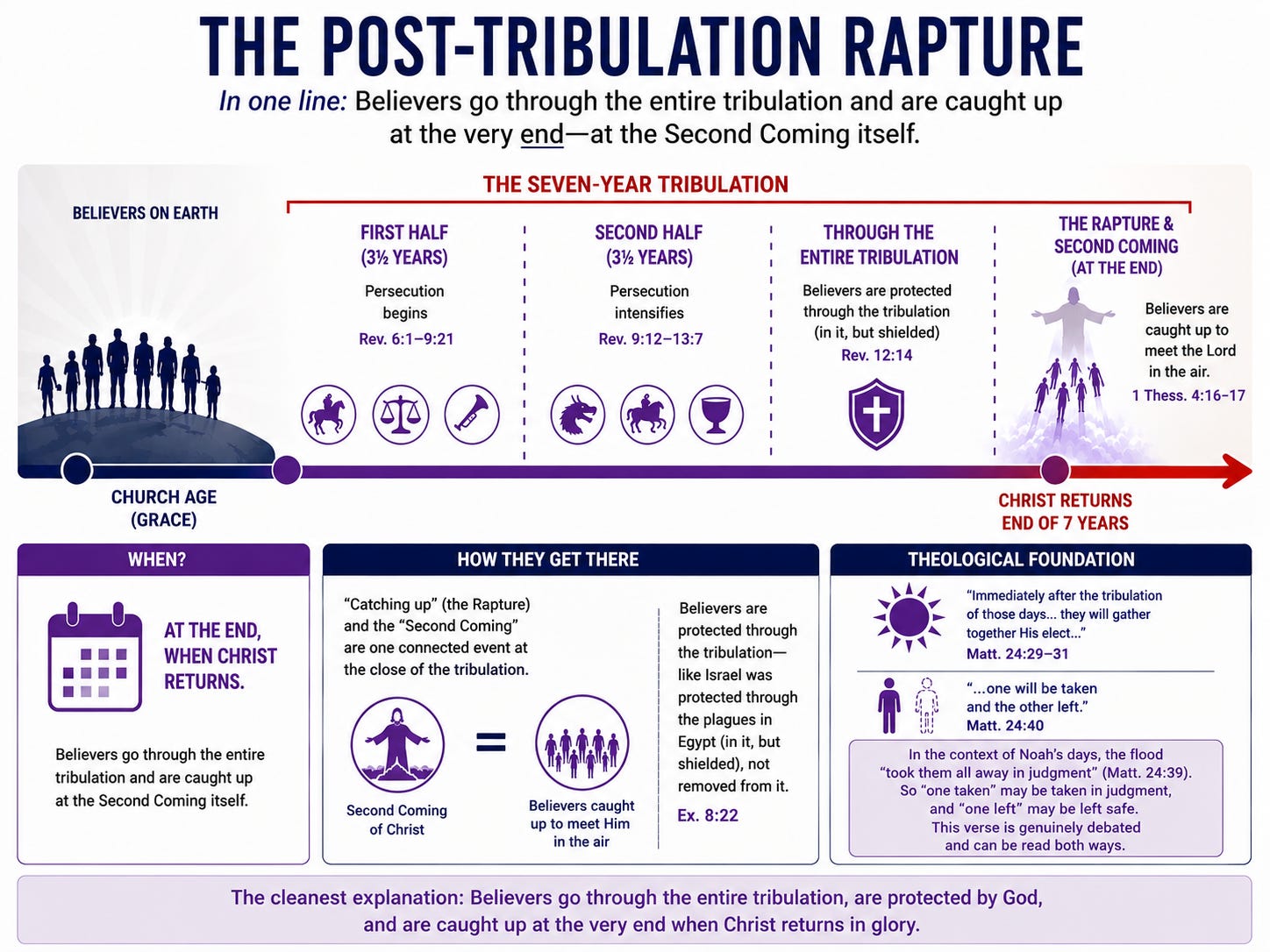
In one line: Believers go through the entire tribulation and are caught up at the very end — at the Second Coming itself.
When: At the very end — caught up at the Second Coming itself, with no gap.
Wait — how is this different from pre-wrath? One key thing: timing at the finish line.
Pre-wrath takes believers up shortly before the end, leaving a gap where God’s wrath falls on the world while the church is already gone. Post-trib says there’s no gap at all — believers are caught up at the very end, the same moment Christ returns. Pre-wrath is rescued just before the buzzer. Post-trib is rescued at the buzzer.
How they get there: They read the “catching up” and the “Second Coming” as parts of one connected event at the close of the tribulation. Believers are protected through the tribulation (like Israel was protected through the plagues in Egypt — in it, but shielded), not removed from it. When Christ returns, His people rise to meet Him in the air and immediately return with Him.
Leans on:
Immediately after the tribulation of those days... they will gather together His elect... — Matthew 24:29–31
...one will be taken and the other left. — Matthew 24:40
That last verse — “one taken, one left” — is the most famous rapture line in pop culture. But examined closely, it’s genuinely debated: in the surrounding context, Jesus compares those days to Noah’s flood, which “took them all away” in judgment (Matt 24:39). So some argue the one “taken” is taken in judgment, and the one “left” is left safe — the opposite of the popular reading. Honest teachers admit the verse can be read both ways. It’s a good reminder that our most familiar proof texts often carry more mystery than the bumper-sticker version suggests.
Why they’re confident: It’s the most straightforward reading of Matthew 24, where the gathering clearly comes after the tribulation. It’s also the view closest to how the early church and most of church history read these texts, long before the modern timeline charts.
The hard question: If believers are caught up to meet Christ in the air and then immediately come right back down with Him, what’s the purpose of the “catching up” at all? And how does this square with the “kept from the hour of trial” promise in Revelation 3:10?
Tends to be found among: Many Reformed and historic-premillennial believers; teachers like George Eldon Ladd and John Piper.
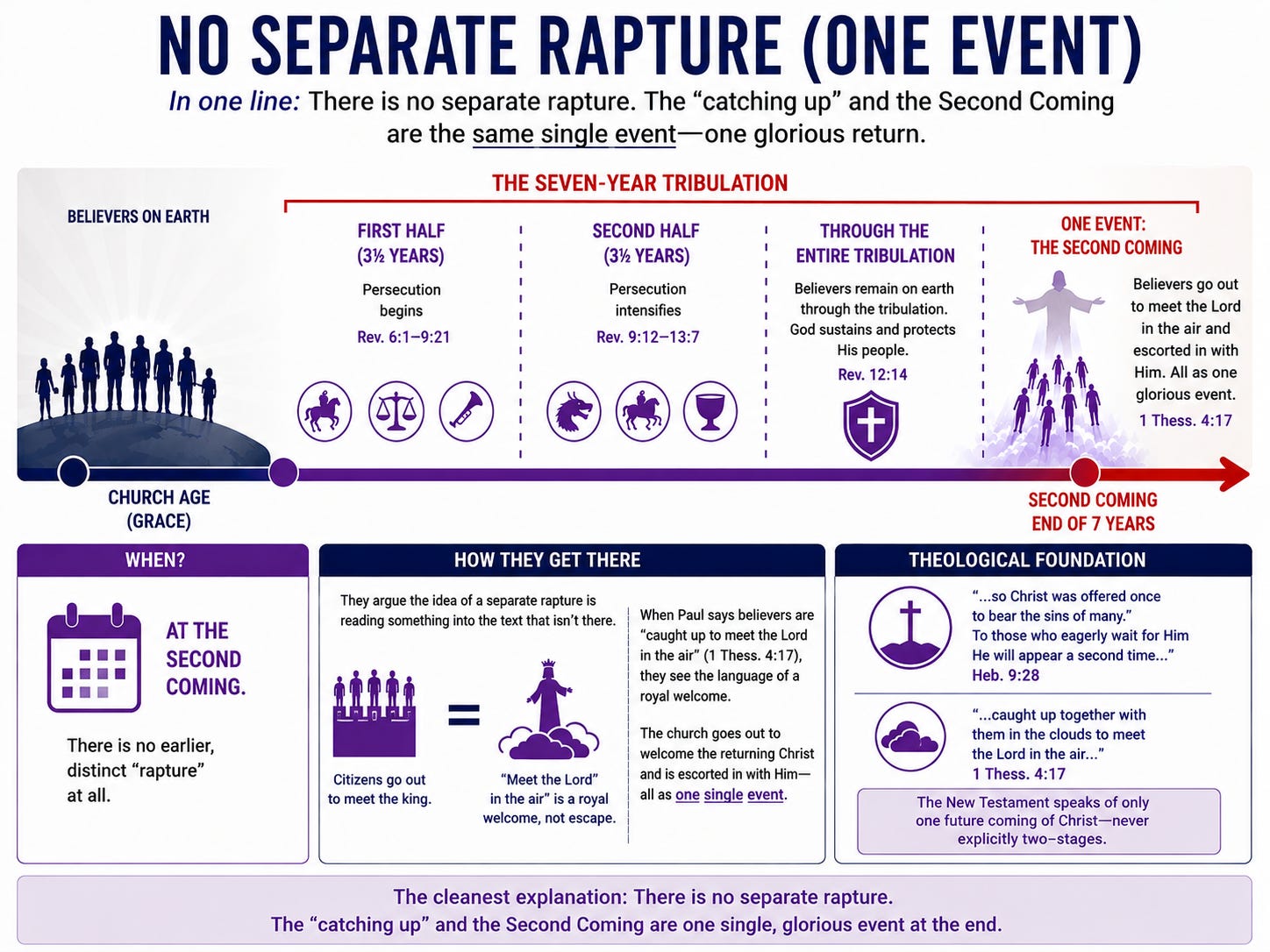
In one line: There is no separate rapture. The “catching up” and the Second Coming are the same single event — one glorious return.
When: At the Second Coming. There’s no earlier, distinct “rapture” at all.
How they get there: They argue the whole idea of a separate rapture is reading something into the text that isn’t there. When Paul says believers are “caught up to meet the Lord in the air” (1 Thess 4:17), they see the language of a royal welcome — a city’s citizens going out to greet the arriving king and escort him in, not fly away with him. So the “meeting in the air” is the church going out to welcome the returning Christ, all as one event at the end.
Leans on:
...so Christ was offered once to bear the sins of many. To those who eagerly wait for Him He will appear a second time... — Hebrews 9:28
...caught up together with them in the clouds to meet the Lord in the air... — 1 Thessalonians 4:17
They emphasize that the New Testament only ever speaks of one future coming of Christ — never explicitly two stages.
Why they’re confident: It’s the simplest reading — one coming, not two. It’s the view held by most of the church for most of history, including Augustine, the Reformers, and the historic church, and it’s the standard position of Catholic, Orthodox, and most Reformed and mainline Protestant traditions. The scholar N.T. Wright has argued forcefully that the “meeting in the air” is welcome-the-king language, not fly-away language. To this camp, the multi-stage timeline is a modern overlay on a simpler truth.
The hard question: If it’s all one event, how do you account for the passages that do seem to distinguish being “kept from” the hour of trial (Rev 3:10) — and what do you do with the strong sense in Paul that the catching-up is a distinct comfort for the living and the dead? Simplicity is a strength, but does it flatten real distinctions in the text?
Tends to be found among: The historic majority — Roman Catholic, Eastern Orthodox, Lutheran, Anglican, Methodist, and most confessional Reformed traditions; the dominant view for the church’s first 1,800 years.

I told you at the start I wasn’t going to tell you what to believe.
But I want to leave you with something — not a verdict, but a warning wrapped in hope. And it comes from the last time God’s people were all waiting for Him to come.
For centuries, Israel waited for the Messiah. They had the prophecies. They studied them. They built detailed expectations of exactly how He would arrive:
A conquering king, a military deliverer, someone to throw off Rome and restore the throne of David in Jerusalem. They were sure they knew what His coming would look like.
They were so sure that even His closest disciples — after walking with Him for three years, after the resurrection — still asked:
Lord, will You at this time restore the kingdom to Israel? — Acts 1:6
They were still expecting the political king. Right up to the end.
And here’s the thing: God came. Every promise was kept. But He arrived in a way almost nobody expected — a baby in a feeding trough, a servant washing feet, a Savior on a cross long before He’d be a King on a throne.
They got the event right. He came. But they missed the details so completely that when He stood right in front of them, they didn’t recognize Him.
And they weren’t flying blind. God had given them a prophecy — tucked into the book of Daniel — that actually pointed to when the Messiah would come. Many scholars believe it marked the timing to a remarkably precise window. The clock was ticking in plain sight. And still, most of them missed Him.
We open that prophecy all the way up in Part 3 — the Seventy Weeks of Daniel, the beating heart of this whole conversation. But sit with the irony: if God’s people could hold a prophecy that precise and still get the details wrong — how much more humbly should we hold our own?
So here’s my caution as you weigh these five views: hold the fact of His return with total confidence. He is coming. That is the rock. But hold the details — the timing, the sequence, the mechanics — with humility. Because the last time God’s people drew up confident charts of exactly how He’d come, the reality was bigger and stranger and more beautiful than any of their diagrams.
Be certain He’s coming.
Be humble about the how.
And keep searching the Scriptures for yourself — like a Berean — because that’s how you’ll be ready either way.
This is Part 2 of a 4-part series — the full story of the rapture, the tribulation, and the end times. No hype. No date-setting. Just Scripture, laid out plain, so you can search it out for yourself.
Here’s where we’re headed:
Part 1 — Where The Rapture Even Came From The word that isn’t in your Bible, the truth about John Nelson Darby, and the secret hiding in the order of Paul’s letters.
Part 2 — The Five Views, Side By Side (you’re reading it) Pre-trib, mid-trib, pre-wrath, post-trib, and the view that says there’s no separate rapture at all — each one with the actual verses behind it, laid out fairly so you can weigh them yourself.
Part 3 — The 70 Weeks Of Daniel The 490-year prophecy, the mysterious “gap” in the timeline, the abomination of desolation, and why some believe a third temple has to be rebuilt first. This is the engine room of the whole conversation.
Part 4 — So Should We Set Dates? What Jesus actually said about knowing the day and hour, why date-setting keeps failing, and the “timing signals” people love to point to — the fall feasts, the ancient Jewish wedding customs, and how to live watchful and ready without falling for the hype.
By the end, you won’t just know WHAT people believe — you’ll know WHY, and you’ll be able to stand on your own two feet in any end-times conversation.
This is Part 2. Next, we crack open the 490-year prophecy of Daniel — the mysterious "gap" in the timeline and the abomination of desolation that sits at the very center of this whole debate.
Unlock every part the moment it drops.
Go DEEPER into Scripture than ever before.
Get full access to the complete archive.
Love you guys. 🙏
If this BLESSED you, share it with a friend and bless them too!
No posts
Comments
Nothing yet. Say the first thing.
Sign in to join the conversation.