
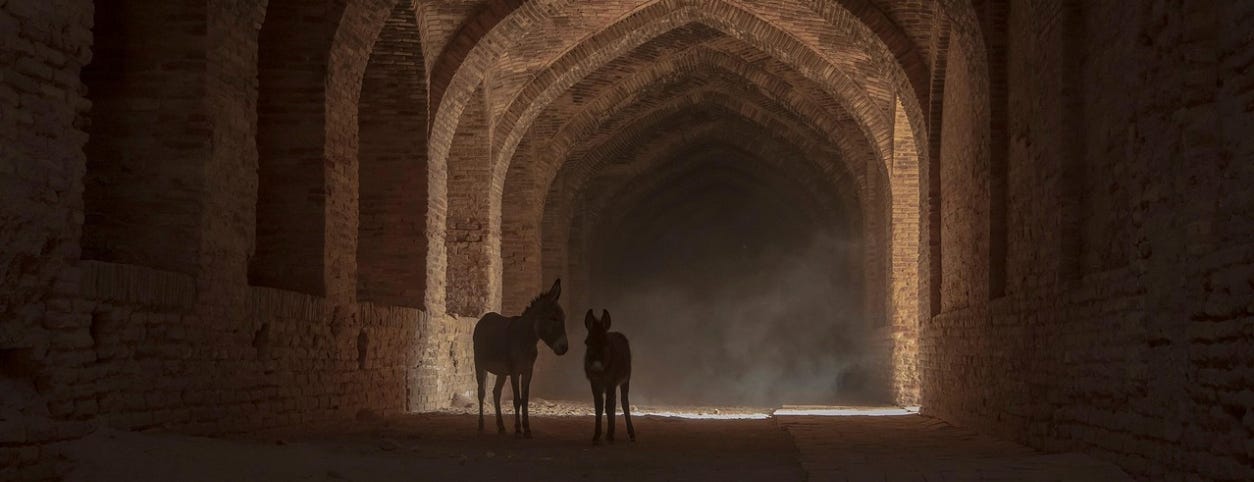
Behold, your king is coming to you, humble, and mounted on a donkey, on a colt, the foal of a beast of burden. — Matthew 21:5
Picture a Roman triumph. The general enters the city on a warhorse, armor gleaming, soldiers in formation behind him, the crowd roaring. Power, displayed the way power has always displayed itself.
Now picture this: a man on a small donkey, a colt barely grown, riding into Jerusalem while children shout and people spread their coats and lay palm branches across the road (John 12:13).
If you had stood there that day without knowing who he was, you might have laughed. This is a king? The King of kings, entering his own city, and this is how he comes?
The scene is strange enough that we should pause over it. All four Gospel writers recorded this entry (Matt. 21:1-11; Mark 11:1-11; Luke 19:28-40; John 12:12-19). Not one of them softened it. They could have left out the donkey. They could have given him something more dignified. Instead Matthew slows down and quotes the prophet, as if to say: look closely, this is the point.
Behold, your king is coming to you, humble, and mounted on a donkey. — Matthew 21:5
The Son of God enters his own city on a borrowed colt, and the Gospel writers record it without embarrassment. It looks almost comic. It looks like failure. But the longer we look, the more we see something else. The shabbiness is not the tragedy of this scene.
The shabbiness is the glory of it.
Of all the animals God could have chosen for His Son’s entrance, He chose this one. Matthew is careful with the words: the foal of a beast of burden (Matt. 21:5).
A beast of burden. Not a creature of beauty or speed or war. A donkey exists for one thing: to carry. Its whole life is lived under weight. Grain, firewood, water jars, whatever its master lays across its back. The donkey doesn’t choose the load. It carries what is placed on it.
And that, I think, is exactly the point.
We are carrying animals too. Every one of us. No one lives with an empty back. The only question, and it may be the most important question of a human life, is what we are carrying.
Some of us carry anxiety, strapped on so long ago we’ve forgotten it isn’t part of our body. Some carry the approval of others, a load that has to be re-earned every morning. Some carry ambition, or resentment, or the endless freight Jesus named precisely: what shall we eat? what shall we drink? what shall we wear? (Matt. 6:31). Heavy loads. And here is the hardest part: none of them were placed on us by God. We loaded most of them ourselves.
A donkey can't see its own back. It only knows the weight is there. And most of us, most days, live the same way: feeling the weight, never looking at it.
So the question this passage quietly asks is not whether you are a donkey. You are. I am. The question is: who is riding on your back?
Every earthly king enters in strength because strength is his argument. The horse, the armor, the army. These say: submit, because I can make you.
Jesus enters with no argument at all. Nothing about him could compel a single knee to bend. So if anyone bowed that day, it was for one reason only: because they saw who he was, and wanted to.
The word Matthew reaches for is humble (Matt. 21:5, quoting Zech. 9:9). We should not rush past it. In Scripture, humility is not a mood or a manner. It is a position: the low place, deliberately taken. The King who had every right to the highest seat chose the lowest animal. Paul would later describe the whole arc of it: he emptied himself, taking the form of a servant... he humbled himself (Phil. 2:7-8). The entry on the donkey is not an exception to who Jesus is. It is who Jesus is, made visible.
But a king this low can also be turned away. That is the cost of coming humbly, and Jesus knew it. He entered his city in a form so unguarded that anyone could reject him. And within the week, they did. The King of righteousness does not conquer his city. He gives it the freedom to break his heart, and comes anyway.
The impressive people missed him entirely. The chief priests and scribes, the ones who knew the prophecies best, watched and were indignant (Matt. 21:15). But the children saw. Hosanna to the Son of David! And when the leaders objected, Jesus answered with the psalm: out of the mouth of infants and nursing babies you have prepared praise (Matt. 21:16).
The wise could not recognize their own King. The children could. Recognizing him has never been a matter of knowing more. It’s a matter of what our hearts have room for.
Then he enters the temple, and the scene turns. The house of prayer had become a marketplace: money-changers, merchants, the noise of buying and selling filling the space meant for meeting God. And Jesus, the humble King from the donkey, overturns their tables. My house shall be called a house of prayer, but you make it a den of robbers (Matt. 21:13).
This isn’t a contradiction of his gentleness. It’s the other side of it. He is gentle toward the burdened. He is fierce toward whatever loads them down.
And Scripture says we are that temple now (1 Cor. 3:16). So the same question returns in a different form: what commerce is filling the house? What tables need overturning in me? He does not overturn them to shame us. He overturns them because he remembers what the house was built for.
Go back now to the beginning of the scene, because the most important detail is the one easiest to miss.
Before any of this, Jesus sent two disciples ahead: you will find a donkey tied, and a colt with her. Untie them and bring them to me. If anyone says anything to you, you shall say, “The Lord needs it” (Matt. 21:3).
Mark and Luke add a detail that arrests us: it was a colt on which no one has ever sat (Mark 11:2). This young animal, born into a line of burden-bearers, shaped in every muscle for carrying, had never yet carried anything at all. It stood tied to a post, its whole purpose still ahead of it, waiting.
Then one morning it was untied, and the first weight ever placed on its back was the King of glory.
Think about what that means. The colt didn’t work its way up to this. It didn’t prove itself with years of faithful hauling. Its first load, the load it was made for all along, was Christ himself.
Here is the picture this colt gives us. We were built to carry; a life carrying nothing is not freedom but emptiness. The question was never whether we would bear weight. It was always what weight we would bear, and for whom. And Christ does something no other master does. He unties us, lifts off everything we were never made to carry — the anxiety, the striving, the verdicts of others — and then entrusts himself to our backs. Take my yoke upon you... for my yoke is easy, and my burden is light (Matt. 11:29-30).
A colt tied to a post is going nowhere. The same colt, carrying the King, entered Jerusalem to shouts of Hosanna.
Same animal. Same back. Different rider.
The disciples laid their cloaks on the colt, and the crowd spread theirs on the road with palm branches (John 12:13). In a world where a coat was among the most valuable things a person owned, they took theirs off and let the King ride over them. They were not embarrassed by the humble procession. This is exactly how the King of righteousness comes.
We are the donkeys now. That was never in question. We were made to carry, and we will carry something until the day we die.
A donkey can’t see its own back. But we can turn and look at ours. So let us turn and look, honestly: what is resting there? The loads we strapped on ourselves: the worry, the striving, the verdicts of others? Or is He there — the humble King, riding on us as we carry Him through our streets, our homes, our ordinary days, entering His city on our backs the way He entered Jerusalem long ago?
We have carried things for years that the Lord never asked us to carry. Setting them down is harder than it sounds. But the colt in this story didn’t free itself either. Someone came, and untied it, and said: the Lord needs it.
Maybe he’s saying that still.
© 2026 Bible Portal. Free to share with attribution. Please keep the source and a link to Bible Portal intact. For other uses, contact us.
No posts
Comments
Nothing yet. Say the first thing.
Sign in to join the conversation.