
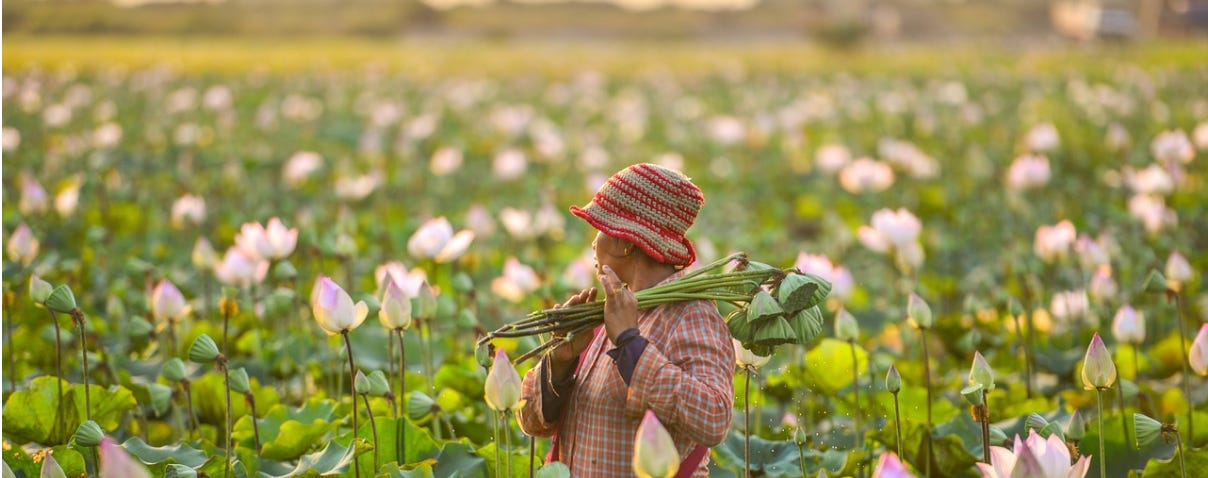
A sower went out to sow. And as he sowed, some seeds fell along the path, and the birds came and devoured them. — Matthew 13:3-4
Matthew recorded this parable with the precision of a man who had spent his life keeping accounts. Before he followed Jesus, he was a tax collector, despised, the kind of person his own community would rather forget. He sat at a booth in Capernaum, recording what people owed, collecting what Rome required.
Then Jesus passed by and said two words: Follow me (Matt. 9:9). Matthew rose and walked away.
The precision he had once used to record what people owed, he now turned to recording what Jesus said. The result is the most systematic account of Jesus’ teaching we have. A tax collector became the keeper of the Word. Matthew is himself a parable of good soil: the story of what happens when good seed falls on a heart that has been made ready to receive it.
This is one of the few parables Jesus himself interpreted, and the interpretation He gave is straightforward: the seed is the Word, the soils are the conditions of the human heart (Matt. 13:18-23). Jesus is not describing four different people. He is describing four conditions that any of us can inhabit in any season of our lives.
The path: hard, packed, closed. The seed never gets in. This is not about how many questions we bring, or how carefully we think. It is about what the heart has already decided before the Word arrives. Some come to Scripture to evaluate it. To test it. To see if it measures up. That posture keeps the seed on the surface. Faith is not an idea to be evaluated. It is a life to be entered.
The rocky ground: seed gets in, but roots cannot go deep. It springs up quickly and collapses just as fast when the heat comes. Shallow faith looks healthy until the day it is tested. Then the roots that were never there become suddenly obvious.
The thorns: seed gets in, roots go down, but the thorns crowd it out. Worry does this. The weight of what we don’t yet have, the endless calculation of what we need to feel secure. The cares of the world and the deceitfulness of riches (Matt. 13:22). Jesus names them precisely because He knows how quietly they move in, and how completely they can fill the space where the Word was supposed to grow.
The good soil: seed gets in, roots go deep, and in time, fruit comes. Thirty times. Sixty times. A hundred times what was planted.
If those first three soils sound familiar, that is not an accident. Jesus named them because He knew we would recognize ourselves in them.
But before we ask what kind of soil we are, it is worth stopping to ask: how did the seed get here at all?
In the back alleys of a Korean neighborhood, sometime in the last century, there was a Western missionary who strapped a large drum to his foot and walked the streets. Every step triggered a boom. He looked, by any measure, like a clown. Children followed him in packs. He did not speak the language. But he walked and he cried out the only word he knew: Yesu. Jesus. Over and over, in whatever way his mouth could form it. The women of the neighborhood sat together puzzling over the strange foreign sound. They couldn’t understand what he was saying. But they couldn’t stop talking about him either.
That is how the seed was sown.
Korea went from a land with no gospel to one of the biggest exporters of it. The seed that a clown carried through back alleys, crying a name no one could understand, became a harvest that now sends missionaries to over 170 countries. Thirty times. Sixty times. A hundred times over.
These were not eloquent preachers. They had no silver or gold, only, as Peter once said, what they had been given: the name of Jesus (Acts 3:6). And as Paul wrote, they carried even that in jars of clay, so that the surpassing power would belong to God and not to them (2 Cor. 4:7). The power was never theirs. The seed was not of their making. They only went out, foolishly, joyfully, with tears, and scattered what they had been given.
Those who sow in tears shall reap with shouts of joy (Ps. 126:5).
Wherever you are reading this, the seed that reached you came at a cost you will never fully see. It crossed oceans. It walked through alleys. It was carried in sermons and letters, in classrooms and online, in words typed onto a screen and sent to someone the sender would never meet. However it arrived, it was spoken by people who had nothing to offer but the name of Jesus. Unseen tears were shed for this gospel to reach you. It arrived as gift, carried by jars of clay, sustained by something far greater than those who carried it.
The seed reached us at great cost. Now the question returns: where is the fruit?
If it has not come, or not come the way we expected, this parable has something to say about that. Not a rebuke. A diagnosis.
You did not plant the wrong seed. You did not need a different Word, a different faith, a different God. The seed is the same for everyone. The sower is the same. What differs is what the ground does with what it receives.
A hard heart does not receive it. A shallow heart does not hold it. A distracted heart does not give it room to grow. But a heart that is open, that has gone deep enough to hold its roots and cleared the thorns of worry, bears fruit.
Luke’s account of this parable adds something that deserves to be read slowly. Good soil, Luke says, describes those who hear the word and hold it fast in an honest and good heart, and bear fruit with patience (Luke 8:15).
Three things, in order.
First: hear the word. Not skim it. Not evaluate it from a distance. Receive it. Let it in. This is where everything begins, not with effort or discipline, but with the simple, open act of truly hearing what has been spoken.
Second: hold it fast. The word that enters must be kept. Turned over. Returned to. Carried through the day. The seed that is received but not tended is the seed that the thorns eventually crowd out. Holding fast is not passive. It is the daily work of keeping the Word close enough to do what only the Word can do.
Third: patience. Fruit does not arrive the moment the seed enters the ground. It comes slowly, faithfully, in ways that are often invisible until they are suddenly not. This is not a sudden explosion of growth. It is the long, quiet bearing of what was planted in good ground.
Hear. Hold. Wait.
That is what good soil does. And it is within reach of anyone willing to tend the ground they have been given.
This parable has followed me for years. It never lets me off the hook.
What kind of ground am I right now?
The seed came at a cost most of us will never fully reckon with. People gave their lives to carry it, across oceans, through strange lands, in languages they did not speak, to people they would never fully understand. The details of how it reached each of us are different. But the cost was real, whatever form it took.
The seed is here. It has arrived. The question is not whether we have received enough, or whether the right conditions will someday appear. The question is what we are doing with the ground we have, right now, today.
Hear. Hold. Wait.
The harvest comes: thirty, sixty, a hundred times over. It always has, wherever the ground was ready.
© 2026 Bible Portal. Free to share with attribution. Please keep the source and a link to Bible Portal intact. For other uses, contact us.
No posts
Comments
Nothing yet. Say the first thing.
Sign in to join the conversation.