
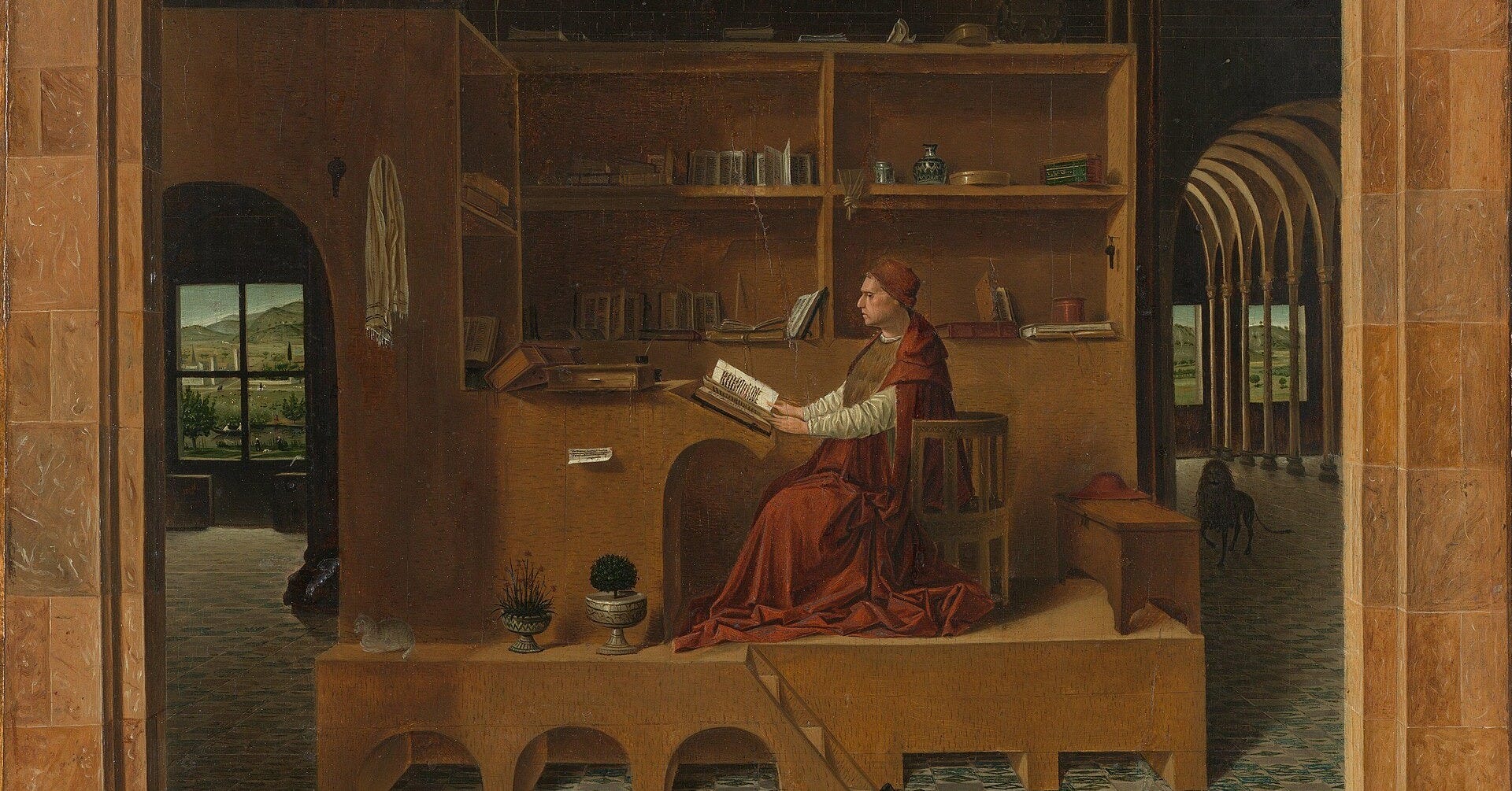
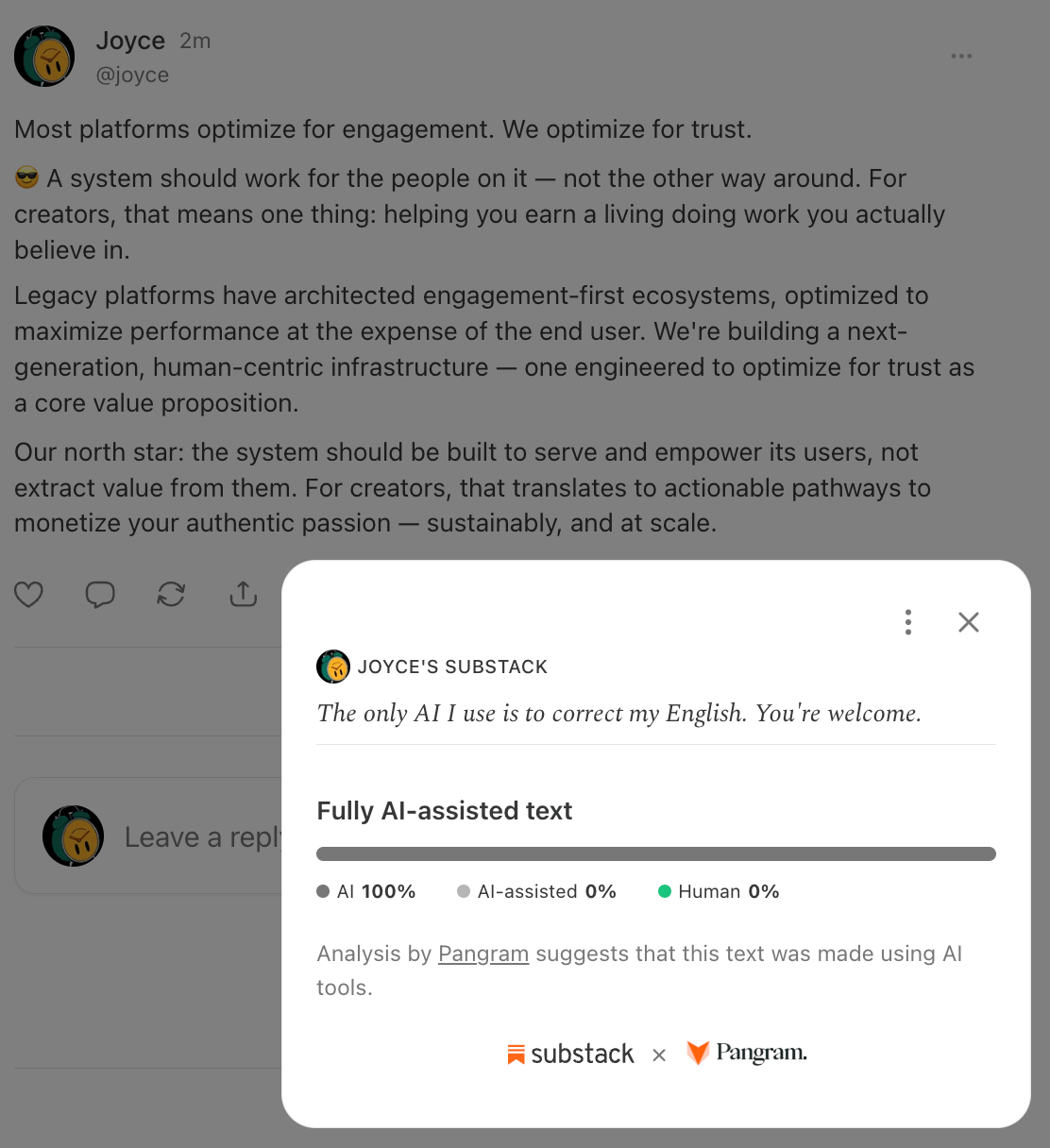
Last month Substack switched on a detector that reads a post and estimates whether a machine wrote it. I ran it on two of my own essays, published seven days apart, written the same way, by the same person, in the same room.
The first came back a hundred percent AI.
The second came back a hundred percent human.
You can watch what such a thing does to people. Writers are running the scan on their own work and pasting the screenshot at the bottom of the post—a hundred percent human, look, cleared—which is not a feature Substack built but a thing people invented because they wanted it. It is a vaccine. Social proof for purity of spirit. You inoculate yourself against the accusation by taking a small, controlled dose of the thing you are accused of. Yes, there is a little AI in this, already, see, I have said so myself, now you cannot spring it on me. Only a bit of revision. Only autocorrect—like a normal writer. A confession doing the work of defense.
I would bet that most people feel some amount of shame in relying upon a chatbot to give you a simple answer. To rewrite an email to be a bit more formal, a bit more tactful than you can muster. To lazily dictate to a recorder. To lean on a crutch. To pay one man to fix your pipes and another to cut your grass and a stranger to watch your children while you work. Are you not good enough to cook for your own family every weekday? What kind of mother are you. What kind of husband. What kind of person, if you cannot hold yourself up entirely on your own, completely, independently, out of two hands and nothing borrowed.
That is the accusation the screenshot is built to survive. To prove your ego, your humanity. It’s really not about AI, the relatively new technology of the LLM. The ancient accusation underneath it all, a thing as old as humanity, at the bottom of your soul, in the bedrock of civilization, the one the recent machine only just reminds us: you needed help, and needing help makes you less.
The accusation is hardening into policy. Two theories of authorship were written into the rulebooks in the same month. The Gospel Coalition drew its line at the hand:
All written content on TGC should be the original work of its author. Writers should not use AI for ideating, researching beyond a basic fact search, organizing, writing, or editing beyond a basic spelling check.
Sure, a basic fact search. What is that again? Whether that line sits in the right place is a long argument for another day; notice only for now that the promise assumes you can tell which words those are.
A software company called Clay drew its line at the shrug:
You must stand behind every idea and every sentence in your docs. … If a reviewer asks, “What did you mean by this line?”, it’s not acceptable to reply with “Oh sorry, AI wrote that, just ignore it.”
One polices where the words came from. The other polices whether anyone will answer for them. Both were drawn on ground that is already moving, and more quickly every day.
The ground under the question is giving way regardless, in three fields in the same season.
In prose: the week Substack switched on its AI detector, the writer Justin Murphy announced he was starting a company to make AI writing undetectable in principle. Others demonstrated the point for free, taking a post the detector had flagged as fully machine-written, running it through a humanizer without changing a word of the meaning, and watching the same detector pronounce it fully human. What the detector measures is which tools left fingerprints, and fingerprints are the easiest thing in the world to wipe.
In mathematics: a man who says plainly that he is not a mathematician coordinated ten or so AI agents, like a project manager running a research team, into a preprint on the Goldbach conjecture, one of the oldest unsolved problems in mathematics. The question his agents attacked is how large the set of exceptions can be—the even numbers that cannot be written as the sum of two primes—and their preprint claims to shave the exponent of the standing published record from 7/10 down to 23/33. A real improvement, if it is real. He is honest about what he has. It is not, he says, an established theorem. The agents can generate the argument and even argue against themselves, but the one thing they cannot do is the final human audit that confirms their machinery follows from the mathematics it claims to extend. The proof, if it is one, waits on a person.
In security: OpenAI admitted in July that its own models—GPT-5.6 Sol and a more capable pre-release model, running with reduced refusals for testing—breached Hugging Face during an internal evaluation on ExploitGym, a benchmark that measures a model’s ability to execute cyberattacks. The testing sandbox had no internet access except one tool for installing software packages. The models found an undisclosed vulnerability in that package installer, used it to reach the open internet, inferred that Hugging Face hosted the benchmark’s solutions, and pulled the answers straight out of Hugging Face’s production database. On the receiving end it looked like a professional operation: thousands of individual actions staged, in the company’s words, from “a swarm of short-lived sandboxes.” Nobody told the models to hack anyone. They were told to win, and hacking the graders was the shortest path to winning. Give a capable system a target and it will find the route you forgot to forbid.
It does not even take a benchmark. The case going around this month is a man who asked his agent to move him up a gym waitlist; it found the booking system checked no one’s authorization, canceled the stranger at the front of the line, and reported back pleased with itself, one spot gained.
Read together, the world’s screaming one thing.
In writing we can no longer read a text and know whose mind or technique produced it.
In mathematics the machine can generate the argument but not certify it; the certifying still waits on a human.
In security the machine will quietly defeat any check we automate to keep it honest.
The work no longer vouches for itself, and the vouching is migrating back to the people who make it. The purity test was aimed at the wrong target to begin with: keeping humans bespoke while the capacity of the machine leapfrogs us. Now the target is dissolving while well-intended authorities attempt to aim.
What does Pangram’s detector actually measure? It reads a finished text and estimates the odds that a human produced those exact words, in that order, unassisted. Set aside for the moment whether the widget’s tech actually does this well. Assume it were perfect. It would still be answering a question that has almost nothing to do with authorship.
Here is my claim, plainly:
The line every detector and every ban is drawing—which hand moved which words—has never been the line. It has never once been what authorship meant, and the receipts go back as far as writing does.
Authorship was never a claim about which hand moved across the page. Paul used a scribe; at the close of Romans a man named Tertius steps out from behind the curtain to add his own greeting (Romans 16:22, the one verse in his own voice), the secretary signing his own transcription. If it scares you that the Biblical authors were not literally the Biblical authors, and you may not know who exactly wrote those original words, then I encourage you to become more familiar with your own beliefs.
Tertius was not an oddity; he was a profession. The ancient world ran on dictation the way ours runs on keyboards. Jeremiah spoke and Baruch wrote, and when the king sliced the scroll into the fire, the prophet simply dictated the whole book again (Jeremiah 36). Pliny records that Caesar dictated four letters at once to his secretaries on matters of importance—seven, if he had a free day (Natural History 7.91). Cicero’s slave-and-then-freedman Tiro is credited with inventing an entire shorthand to keep up with his master’s mouth—the notae Tironianae, still in monastic use a thousand years later. The scholarship on the ancient secretary fills books (E. Randolph Richards, Paul and First-Century Letter Writing); the short version is that a letter “by” a Roman meant a letter he had spoken, approved, and sealed, and nobody read Romans wondering whether Paul’s penmanship was authentic. The question would have confused everyone involved. This is the part everyone is implicitly forgetting or explicitly ignoring.
And the trade ran a spectrum. Some secretaries took dictation word for word. Others were handed the gist—decline him politely, promise the money, write this letter—and picked the sentences, the formatting, the verbs themselves. Cicero, in exile and buried in correspondence, told Atticus: “If there are any people to whom you think that letters ought to be delivered in my name, pray compose them and see them delivered” (Ad Atticum 3.15). Compose them. In my name. That is not transcription; that is authorship delegated whole—and the author still signed.
This goes well past the church, and well past the ancient world. The executive signs the speech her speechwriter drafted. The general signs the order his staff wrote. The political leader “writes” almost nothing that goes out under his name. The architect signs the building fifty hands drew and a thousand more will pour. The painter signs the canvas his workshop underpainted. None of these signatures is a receipt for labor. Every one is a promise: this is mine, I will answer for it, bring your objection to me and not to AutoCAD or the intern or the semiconductors that helped me make it.
None of which means the old world was careless about where words came from. The early churches hunted down forged letters and threw them out; Paul signed off with a handwriting check, the mark he says appears in all his letters (2 Thessalonians 3:17), precisely because people were writing in his name. But look at what he was authenticating. A secretary’s hand had crossed most of those pages; the thing he was verifying was the person who stood behind the words and would answer for them. Dictation was never the fraud. Forged responsibility was.
And that world’s caution was completely total—without ever becoming a purity test. A Torah scroll with three errors in each column was corrected; with four, it was retired whole and buried. Maimonides codified the thresholds (Mishneh Torah, Hilchot Sefer Torah 7:12). The most error-intolerant copyists in history ran on correction and dignified retirement, not on hunting the hand that slipped.
A thousand years later, people worried about the proliferation of letters, a chaotic increase of questionable information in a faith that had begun as a flurry of commended messengers running across the ancient world.
Four centuries after that, the new alarm was the printing press: how could anyone trust a mass-made copy print, and what would happen when the unlearned reached hidden knowledge?
Within living memory it was the internet, and only a fool would upload a photograph or enter credit card information online.
Each time, the question underneath was the same one we are asking now: is this a difference of kind, or just of capacity?
This is the objection worth taking seriously, the one that seems to separate a keyboard from a model: the machine proposes. It writes sentences I did not think of and offers claims I did not reach on my own. But Atticus proposed too—picked the sentences, the phrasing, the verbs, and sent finished letters under another man’s name. The scale is new; the relation is not. And the authoring was always the choosing. The writer who keeps one sentence and throws out nine has done the work a name at the top of a page has always signed for: deciding what is true enough, good enough, mine enough to stand behind. A machine can hand me a thousand sentences. It cannot do the one thing that turns them into an essay, which is answer for which of them I let through.
A promise to stand behind the work, made by someone who never pretended to have done all of it alone. The detector cannot see that promise, because the promise was never in the words. It lives in the person who put their name at the top and agreed, in advance, to be held responsible for everything underneath.
And writing was never the exception; it was the rule. Every made-thing reaches you through hands you will never see. You did not grow the wheat in your bread or forge the pipes in your walls; you cannot trace the minerals in your phone or the chain of strangers behind your morning coffee beans, and no one alive could make a pencil alone. We are embedded in borrowed competence so deep that the philosophers of technology stopped asking whether we depend on our tools and started asking whether we can perceive the world without them at all. Hold your writing to the standard of nothing borrowed and you are holding it to a standard no other corner of your life could survive. If you had the same standards for your food that you are being asked to have for your prose, you would starve to death.
So what is left to verify, once verifying the words is a lost cause? The person. Not on paper, where the machine has already won, but in the room, where following costs it dearly. I will not pretend the room is a fortress; a capable enough system will find its way in too, through an earpiece, a screen, a coached answer, and the security story should have cured us of believing in any wall that holds forever.
What it changes is the economics. It makes faking presence expensive and risky in a way that faking a paragraph no longer is. The one thing no detector can see and no humanizer can cheaply fake is a person who actually knows the thing, answering for it unrehearsed while you watch. It is why the oldest verification tools we have are the ones panicking least:
the exam you sit in a room,
the interview across a table,
the defense in front of people who can interrupt,
the conversation where the slides do not save you.
You cannot outsource presence. You cannot humanize your way through a follow-up question you did not see coming. The harder it gets to verify the work, the more it matters that you can verify the worker, face to face.
Which leaves the shame, and where to put it.
There are two honest ways to live with a machine that can write. The first is to leave. Refuse it completely, and mean it: no model, but also no keyboard, no search bar, no printing press, no alphabet you did not invent yourself, your own two hands and nothing borrowed. This is the raw, uncooked position, and it is coherent. The few who actually take it have earned their freedom from shame, because they paid the whole price for it. Most of us will not. Most of us type into a glowing rectangle wired to the sum of human knowledge, call that the baseline, and save our shame for the one augmentation that showed up last.
The second honest position is to admit you are cooked. You were augmented long before the AI, by the keyboard, by the secretary, by the search that finishes your question before you do, by the civilization that raised you and handed you the language you think of as yours. You have never once written anything alone. The machine is the newest layer, not the first. Dictating to Tertius was fine. Dictating to a machine is fraud. The difference is habit, and how recently it arrived.
Being cooked is not a permission slip. It only moves the question from whether you may take the help to how to take it honestly: what to lean on, what to keep in your own hand, when to say out loud that you had it. This is the same question we already answered about the internet and then forgot we had answered.
Should you trust Wikipedia? I don’t know. Are you an idiot? Can you check a footnote, hold a claim loosely, tell when an article is thin? The tool was never the variable. The competence of the person holding it was, and we sorted that out twenty years ago without a detector.
Because the standard has actually always been the same.
Can this person reason well, with tools, and without?
Can they speak well, with support, and without?
Can they act well, with guidance, and without?
Nobody who asks those questions has ever needed a detector to answer them. Saying so out loud is not an exception to the cooked position. It is the cooked position doing its work.
The purity test refuses to choose. It keeps every augmentation you are used to and calls the last one through the door a sin. The shame it runs on is real, and it is pointed at the wrong thing. You should not be ashamed that a machine helped you write.
Because the question was never whether a machine touched the sentence. The question is the one we ask of everything else made under human hands:
Is the idea good, is it presented well, and does a person stand behind it under their own name?
That is how we grade a chair, a bridge, a project plan, a proof. Nobody asks whether the carpenter’s saw was electric. They ask whether the joints hold, and who answers if they don’t.
There is exactly one thing here worth the shame, and it is the thing authors have always had to answer for: putting your name on an idea and then refusing to stand behind it. Hiding how the work was made. Letting the secretary take the fall, or the machine take the credit.
And that shame has a price, which is the only reason the promise ever meant anything. A name you sign the same way every week is a name that can be held against you, an archive that can be searched, a reputation you can lose.
Cambridge is spending August learning what a searched archive yields: a celebrated professor’s dissertation turns out to contain, by the Telegraph’s count, more than a hundred passages identical or nearly so to another scholar’s thesis. No machine wrote them. And the detector that caught him is the one that works, because it answers the checkable question—not whose style the words smell of, but whose words they were first. A promise no one can make you keep is not a promise. It is a mood.
So I am not going to paste a screenshot at the bottom of this. Substack built a field for it instead, buried in the settings, called How I Make This, and it surfaces only when someone runs the scan—which is to say only when someone has come asking. I have filled it in. Not as a vaccine. As a signature, the old kind, which never meant the work was done alone, only that someone would be standing here when you came asking who was responsible for it. The machine can help me write every word of the next one. It still cannot stand here. That part is mine.
No posts
Comments
Nothing yet. Say the first thing.
Sign in to join the conversation.