
The early Church was born decentralized.
At Pentecost, tongues of fire didn't form a hierarchy, but they were distributed equally among all 120 believers. Each person heard the Gospel in their own language, not through a single translator. The Spirit fell on everyone, not just the preacher, Peter. This wasn't organizational chaos; it was divine protocol: a distributed network with Christ as the only central authority.
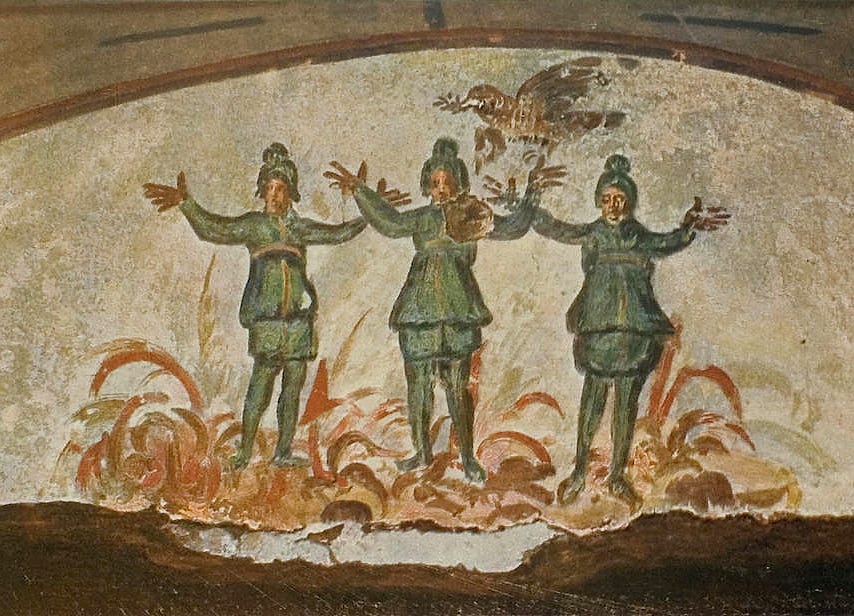
For three centuries, Christianity conquered the Roman Empire without headquarters, without popes, without formal institutional hierarchies. Local churches were autonomous nodes in a spiritual network, connected by common apostolic teaching, shared Eucharist, and circulating letters, yet without any formal domineering structure, center, or leader.
When Rome persecuted one node, the network survived. When heresy infected a region, the broader network provided theological and pro-social antibodies. The Church was anti-fragile because it was purposely designed — by wisdom of the divine Logos in eternity — as a decentralized system, growing grassroots from the ground up and infecting every human organization the Gospel could touch.
Decentralized religious authority:
networks of networks; councils of councils; churches of churches
American and post-Christendom Christians are far more used to top-down, hierarchical models of corporate governance, of the individual pastor-apostle hypothetically overseeing layers of middlemen. In the same manner as Rome’s original dictator — a magistrate given sole power to directly command the state to move quickly and decisively — so do confident, empowered, and centralized leaders unify their churches, or corporations, to move quickly and powerfully. For a time.
Yet the centralized system also inherits all the flaws and limitations of the singular man and loses most of the benefits of flatter and local polities. Decentralized companies consistently outperform non-decentralized ones in performance and revenue, highlighting the strategic advantage of distributing decision-making authority. Consider Johnson & Johnson’s hundreds of autonomously functioning business units or the 2010s mad mob genius of 4chan’s Anonymous.
Today's blockchain technology offers an uncanny parallel — and an unprecedented opportunity. Not to digitize faith, or exchange one idol for another, but to return to the original design. Smart contracts can encode what the apostles carried in their hearts: protocols for community governance that resist both chaos and control.
Consider how Paul and Peter functioned: independent operators with overlapping authority, publicly resolving disputes (Galatians 2), maintaining unity without hierarchy. Each apostle was essentially a validator node in a spiritual consensus mechanism. They couldn't unilaterally change doctrine — that required a council (Acts 15) to certify no longer requiring Jewish purity laws for inheritance in the Kingdom of God. They verified each other's messages and convictions through biblical and Christological cross-referencing. They even implemented what modern-day blockchain builders would now call reputation systems through letters of recommendation and reproof.
The kingdom of God is like a protocol:
invisible yet governing, distributed yet unified, encoded yet alive.
This wasn't primitive; it was sophisticated distributed governance. The Jerusalem Council functioned like a hard fork debate, establishing consensus on Gentile inclusion. The collection for Jerusalem's poor operated as an early decentralized autonomous organization (DAO), coordinating resources across the Mediterranean without central control.
Recognizing this fact of church history and design has major implications for revolutionizing the dying mainline denominations in the West. Church governance has more to do with accountability than leadership. The emphasis should be on spiritual formation, service, and mutual submission — not orders, titles, and tasks from powerful and charismatic leaders.
Practically, smart contracts could practically handle what currently consumes 80% of church administrative energy: donations, membership records, financial transparency, and decision documentation. This liberates human energy for what only humans can do: prayer, relationship, discipleship, and worship.

The theological challenge is profound: How do you encode spiritual reality into deterministic systems? The answer: you don't. You encode the scaffolding that supports spiritual life, not the life itself. See: ol’ Ben’s regula lattice for life.
A blockchain-based church network would implement graduated automation. Core doctrine — Trinity, Incarnation, Resurrection — becomes immutable, requiring near-impossible consensus to change. Administrative functions — budget allocation, facility scheduling — execute automatically. Between these layers lies the space for Spirit-led flexibility: prophetic words that redirect resources, mercy that overrides justice, miracles that break patterns.
Biblical precedent exists. The Old Testament law was essentially an algorithmic governance system: precise rules for sacrifice, purity, jubilee. Jesus didn't abolish this but fulfilled it, showing that protocols serve people, not vice versa. The Sabbath algorithm had an override function: human need.
Thanks for reading Endwise! This post is public, so please share it.
Paul's greatest fear for the early Church wasn't persecution but division: "I follow Paul," "I follow Apollos." A network church addresses this structurally. Leadership rotation prevents personality cults. Multi-signature requirements prevent unilateral decisions. Transparent time and resource allocation help prevent the Pareto Principle 20%-ers from dominating the conversation. The protocol enforces what Paul pleaded for: unity in essentials, liberty in non-essentials.
When disagreements necessitate separation, the network enables "graceful forking" — denominations can diverge while maintaining shared infrastructure and mutual recognition where possible. The Protestant Reformation's generational acrimony could have been a (more) peaceful protocol upgrade.
Early believers "had all things in common" not via compulsion but by emergence. A network state church could implement this at scale: universal basic provision for members, mutual aid protocols, and business incubation that returns profits to the community. Smart contracts ensure tithes reach intended destinations. Transparent treasuries prevent financial scandals. Algorithmic welfare eliminates bureaucratic humiliation and enables superior living situations, counseling matches, and more.
Imagine: no missionary family lacking healthcare, no church planter dependent on wealthy donors' whims, no member going hungry for shame of asking. The church can sell “property and possessions to give to anyone who had need" at a moment’s notice. Communal assets are available across geographies; borrow your neighbor’s tools out of the metaphorical garage at scale.
Decentralization isn't just efficient — it's persecution-resistant. Chinese house churches prove this: 100 million believers without headquarters, property, or formal hierarchy. If governments ban the network, it survives in encrypted fragments. If they seize assets, resources exist across jurisdictions and are distributed across individuals. If they imprison leaders, the network promotes new ones.
The comfortable Western church — such as it still exists — might resist this model. Strong networks of mutualistic relationships naturally subdue the domineering strains of shallow, false, televangelist, or nationalist Christianity. The suffering global church, however, will embrace it as a foundational necessity.
This isn't utopian fantasy. The technology exists. The theological precedent is clear. The need is urgent. As institutional Christianity collapses in the West while exploding in the Global South, a new wineskin is required.
The builders of Babel sought to concentrate power skyward.
Pentecost distributed power outward.
That's the difference between human blockchain projects and a Spirit-led network state: one seeks control, the other enables communion. Allow yourself to not take control, to not fight for your pride. Allow yourself to radically reconsider community.
The question isn't whether the Church should become a network state. The Church was born as one. The question is whether we'll reclaim that birthright or cling to Constantine's compromise.
The fire is falling. Will we distribute it or hoard it?
No posts
Comments
Nothing yet. Say the first thing.
Sign in to join the conversation.