
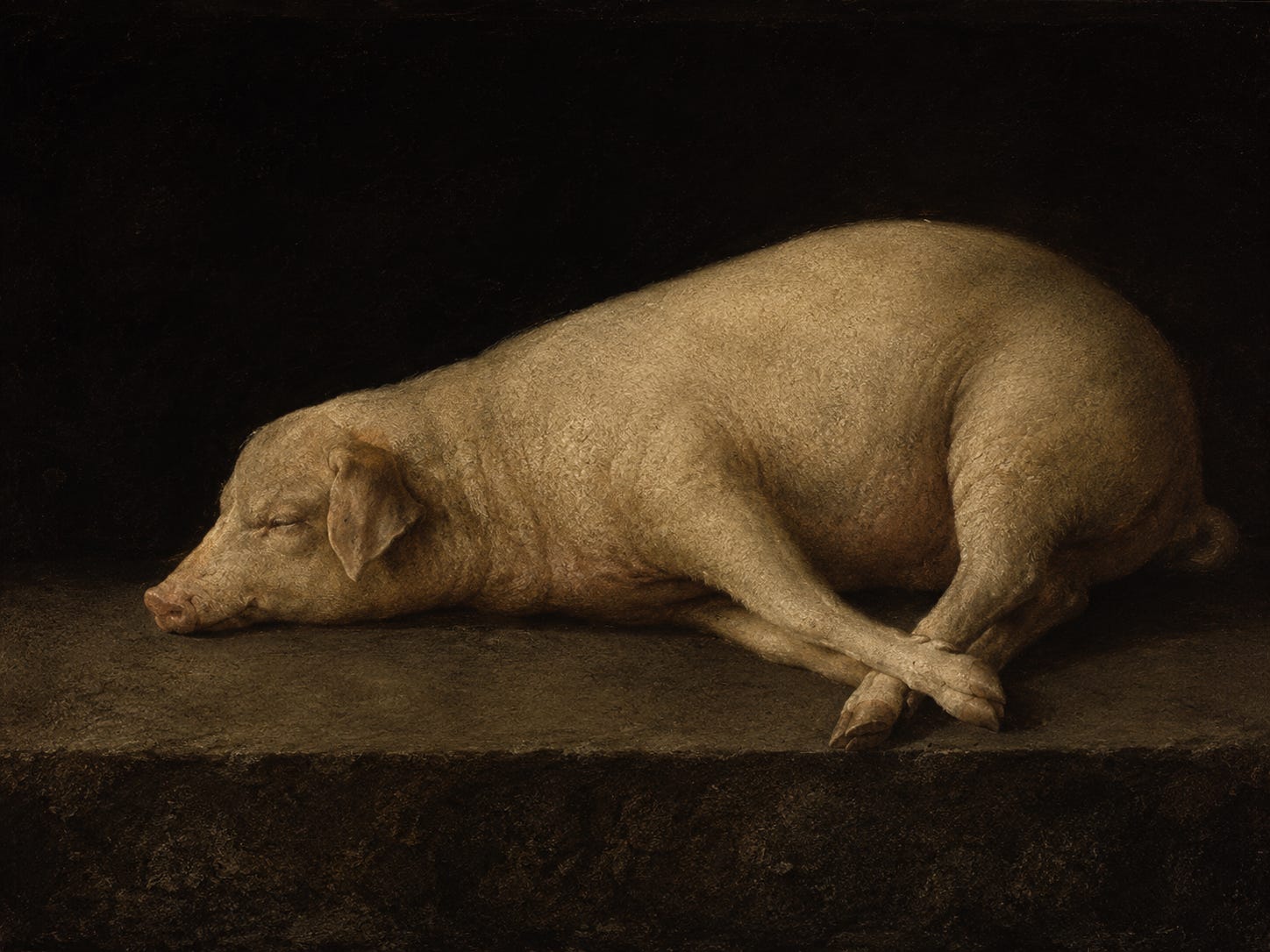
Some years ago, at the Bible Institute of Los Angeles, I spent a semester thinking hard about the suffering of animals. This will surprise people who imagine a conservative seminary is where moral seriousness about farm animals goes to die: where students proof-text their way out of any duty to creatures they eat.
It was the opposite. I have rarely been around people who took the pain of animals more seriously, or the concerns of people for whom the suffering was a barrier to belief in God. And it was there, of all places, that I came to believe something I haven’t been able to shake: that the Christian picture is the only one that can hold, at the same time and without flinching, the two things every honest person feels in front of a factory farm.
The first is that a pig is not a person. It is worth less than a human child: really, objectively, ontologically less, not merely culturally less. The second is that torturing that same pig is an abomination, a genuine moral horror for which we bear real and heavy guilt.
Hold both up to the light and notice how hard it is to keep them together. Almost every secular account drops one. Peter Singer keeps the horror by abolishing the hierarchy—the pig and the infant go on one scale, and you follow that logic to places most people sensibly refuse. The hard-nosed utilitarian keeps the hierarchy but pays for it by deflating the horror into a line item: the suffering is a cost, regrettable, to be weighed against cheaper bacon, but nothing you’d call a sin. Biblical justice, alone as far as I can tell, gives you both at full strength. The animal is lesser. Tormenting the lesser creature is wicked. And the second does not depend on softening the first.
I lead with this because Noah Smith—whose economic, cultural, and political work I’ve read for years—has written something that intersects directly with my own background in science, religion, and public policy. And he walks right up to the edge of saying something rather important.
Just about a week ago he wrote an article called "The way we treat pigs is a sin" and argued that the factory farming practice called crating is torture, and, therefore, morally wrong. His argument is simple and, I think, exactly right: a sow immobilized for life in a crate too narrow to turn around, biting the bars for a freedom that will never come, is being tortured, and torture for our convenience is a horror. He reaches, at the end, for the only word heavy enough to carry it. “I have no other word for this except ‘sin.’” And then, in a footnote, almost shyly: “I actually do believe in God.”
I want to take that word more seriously than the essay around it does—because sin is not a fancier way of saying very bad. It is a term of art. It names an offense against a moral order that was not voted on, not constructed, not selected for: an order that is simply there, with a claim on us whether we like it or not. When Noah says factory farming is a sin, he is not reporting a strong preference. He is making a metaphysical claim of the first magnitude—that a real capital-G Good, binding on all of us, is being violated.
The trouble is that everywhere else in the essay the machinery he reaches for cannot manufacture a claim that large. Pinker’s “better angels,” which he cites, can chart that cruelty has declined; a graph of a trend can never tell you the trend is good. Utilitarian arithmetic can price a pig’s suffering to three decimals; it cannot make that suffering an abomination. Strip out the moral order and “sin” is just a sound you make when the molecules in your head prefer one outcome to another. You don’t get the horror without the metaphysics that makes horror something more than distaste.
If this were Noah’s private confusion it wouldn’t be worth an essay. But he’s in extraordinary company; he’s simply been more honest about it than most. The disenchanted mind keeps reaching, at its most serious moments, for a moral vocabulary it has officially disowned, and you can watch the best of them do it.
Scott Alexander, patron saint of the rationalist internet and now writing at Astral Codex Ten, needed an actual Canaanite god—Moloch, the one they fed children to—to name what runaway competition does to us; no concept in the materialist toolkit was strong enough, so he borrowed a demon.
Richard Dawkins now calls himself a “cultural Christian,” which is the precise sound of a man who wants the cathedrals and the kindness without the doctrine that grew them.
Sam Harris built a whole book deriving objective morality from “the wellbeing of conscious creatures,” smuggling the ought through a side door and hoping nobody would card it.
Yuval Harari calls human rights “fictions” we invent; then, sentences later, leans on the fictions like granite.
Derek Parfit, perhaps the most rigorous atheist moral philosopher of the age, spent his last decades arguing for objective moral truths with no one to author them, and admitted the stakes plainly: either such truths exist, or nothing matters. But the truths he salvaged are, on his own account, grounded in nothing and causally inert.
Which let his fellow atheist Sharon Street ask the question that undoes him: if evolution tuned our moral sense for survival rather than truth, what fastens those authorless truths to our minds? Her answer was to abandon moral realism.
This is not a gallery of fools. It is a gallery of the most careful secular minds we have, all reaching past the edge of their own frameworks for the same missing thing. One of them saw the bill and refused to pretend it wasn’t owed. Nietzsche had only scorn for the genteel unbelievers who “are rid of the Christian God and now believe all the more firmly that they must cling to Christian morality.” Drop the God, he said, and you forfeit the right to the morality.
Here is the move, and I’ll make it plainly, because Noah respects a plain argument. The outrage that powers his essay, the thing that makes “sin” the only adequate word, is not evidence against God. It is evidence for one.
The standard Problem of Evil runs: a good God would not permit such suffering; it exists; therefore no good God. But look what the first premise smuggles in. To call the suffering evil—not unpleasant, not inefficient, but genuinely wrong—is already to assume a moral order the naturalist’s universe does not stock. On a strictly material accounting there is no evil in a gestation crate. There is only a complex arrangement of matter that some other arrangement would prefer to rearrange. The indignation is borrowed capital, drawn on an account the borrower has formally closed and now insists was never real.
And the suspicion is not a Christian invention. J.L. Mackie, who built the most famous modern case against objective values, conceded the half that bears on us: if there were such values, he wrote, they “make the existence of a god more probable than it would have been without them.” Mackie kept his atheism only by paying the bill: by accepting that nothing, in the end, is good or evil. Noah doesn’t want to pay that, and he is right not to. He is right that the crate is objectively wrong. I only want to walk that rightness back to what could make it so.
And to his great credit, Noah leaves the tell in the open. He reaches, near the end, for I.J. Good’s “Meta-Golden Rule”—treat your inferiors as you would be treated by your superiors—by way of Vernor Vinge, and the passage he quotes confesses in the same breath that “most of my friends don’t believe it” because “the game-theoretic payoff is so hard to articulate.”
Of course it is. As game theory it has no payoff at all. The strong gain nothing, in expectation, from binding themselves to the weak who cannot reciprocate or retaliate. The rule is unmotivated: unless the obligation of the strong to the weak rests on something prior to the power gradient, something that binds the powerful precisely because the powerless cannot enforce it. That something has a name and a long pedigree, and it is not a clever equilibrium. It is the doctrine that every creature bears a worth conferred by its Maker—owed honor it did not earn and cannot lose.
Grant all of that, and a careful reader still plants a flag: why a personal God, and not the impersonal order Parfit might have lived with?
Because of what Noah actually reached for. He didn’t call the crate suboptimal; he called it a sin: an injustice, a wrong with a victim, something that cries out to be judged. And he is right to want a judge. Human courts give partial justice at best, and they will never sit for the pig; strip away an ultimate, impartial bench and “objectively wrong” has nowhere to stand. Another culture can wave it off as one more colonial preference in universal, condescending dress. Anscombe named the problem in 1958: cut the moral “ought” from a divine lawgiver and you keep the word “criminal” after the courts have been abolished: “a word retaining the suggestion of force… but which no longer signifies a real concept at all.” Noah’s instinct is sound. He has named a real crime; I only want to show him the bench where the charge can be heard.
Which is the thread back to the pig. The reason Christianity can hold the two convictions secular ethics keeps tearing apart is that imago Dei does double work. It sets the human apart—the hierarchy is real, the pig is genuinely lesser—and the very same doctrine binds the human, because dominion in Genesis is stewardship, not license. “The righteous care for the needs of their animals,” says Proverbs; the Sabbath rest is extended even to the ox and the donkey.
The wrong of torturing a pig is not that the pig is secretly a person. It is that you are a steward playing the tyrant, and the creature’s lesser worth is still real worth—conferred by the One who called it good before any human was there to find it useful. None of this is a discovery the tradition dodged. It is the oldest wound in its side: Darwin himself turned away partly over the cruelty and “waste” of nature, unable to persuade himself that “a beneficent and omnipotent God” would design wasps to feed inside living caterpillars.
And here the objection turns: hasn’t the Christian now reached for his own borrowed capital: calling the suffering real, then explaining it away? No—because the objection imagines a God whose one job is to minimize suffering, and who botched it. That was never the claim.
The God of Genesis is a maximizer of goods, not a minimizer of pain, and the goods are priced so high he will spend enormously to secure them: a creation with real causal powers of its own rather than a puppet theatre, which takes a world law-governed enough that the same muscle that lets the wolf run lets it hunt; creatures free enough to genuinely act, and so free enough to genuinely wound, one another and themselves; and, at the end, an infinite good—the creature’s own everlasting communion with God—against which the whole ledger is weighed and judged worth the cost, from the beginning, foreknowing every choice. (Michael Murray calls the first the price of nomic regularity; Christopher Southgate argues the second may be the only way to a real biosphere at all.)
The tradition never answered him by saying the suffering doesn’t matter—that the animal is a mere machine was Descartes’ error, and its better minds rejected it—nor by promoting the pig to personhood or pets to children. It said the suffering is real, and permitted, and outweighed: creation “groans,” “subjected to futility… in hope.” There is even a horizon in which the cruelty stops outright: the wolf lies down with the lamb, “they shall not hurt or destroy on all my holy mountain.” Noah wants to abolish the system. So, it turns out, does Isaiah.
Here my own training pulls me back to earth. The wrong is real, but it is a systematic wrong, and systems resist the moral grammar we use on individuals. By the time the carnitas reaches your plate, the cruelty is a dozen decisions upstream, structured by subsidy, by processing consolidation, and by a concentrated producer lobby that, as Noah documents, routinely outmuscles a diffuse public conscience. I don’t think the imperative survives that trip down the causal chain; eating the pork is still permissible. The obligation sits where the leverage sits: on the producers who build the crates and the legislators who shield them.
The honest answer to a sin this structural isn’t to scour your own plate, it’s to persuade, shame, and coerce the people whose hands are actually on the system, which is precisely what Noah means when he tells you to call your senator. Proposition 12 and the fight to keep the Save Our Bacon Act out of the Farm Bill aren’t a distraction from the moral question; they are the only court currently in session. On the politics, too, he is right.
Which brings us, as Noah’s own essay does, to artificial intelligence. He notes that whether or not today’s models are truly superhuman, their rise should puncture our assumption that humanity is the permanent ceiling of intelligence and power—and he reaches, one last time, for a principle he can’t quite ground: the Meta-Golden Rule, treat your inferiors as you’d have your superiors treat you. He half-prays it’s true.
Watch what just happened. For an entire essay Noah has been the superior intelligence looking down at the pig, insisting, rightly, that the gap in worth does not license the gap in cruelty.
Now, contemplating something that might stand above him as he stands above the sow, he wants for himself the very thing he could not secure for the pig: an obligation binding the strong to the weak across a real disparity of worth, holding even though the weak cannot enforce it.
That is not game theory. It is the logic of the imago Dei run in the other direction—worth conferred from above and binding from above, the strong owing the weak an honor the weak cannot compel, because both answer to a third party higher than either.
Strip that out and the Meta-Golden Rule is a wish. Keep it, and it is the sturdiest thing in the room. Noah is standing in the pig’s place, asking the universe to be Christian on his behalf.
So: keep the word. I mean it. Sin is the right word, the only word, and the instinct to reach for it over the thinner vocabulary on the shelf is the instinct of a man whose moral perception runs ahead of his metaphysics. But the word is not free, and it is not his on a permanent, no-questions loan. It draws on an account, a theological heritage, a moral order that is given rather than chosen, a worth conferred on creatures by a Creator, a duty of the strong to the weak that outlives the death of every payoff. He can keep cashing the checks; I’d only point out, as gently as I can to a writer I admire, that someone opened the account. The most interesting sentence in his essay was never the one about pigs. It was the footnote.
“I actually do believe in God.”
So do I. And I think the pigs are His too.
No posts
Comments
Nothing yet. Say the first thing.
Sign in to join the conversation.