
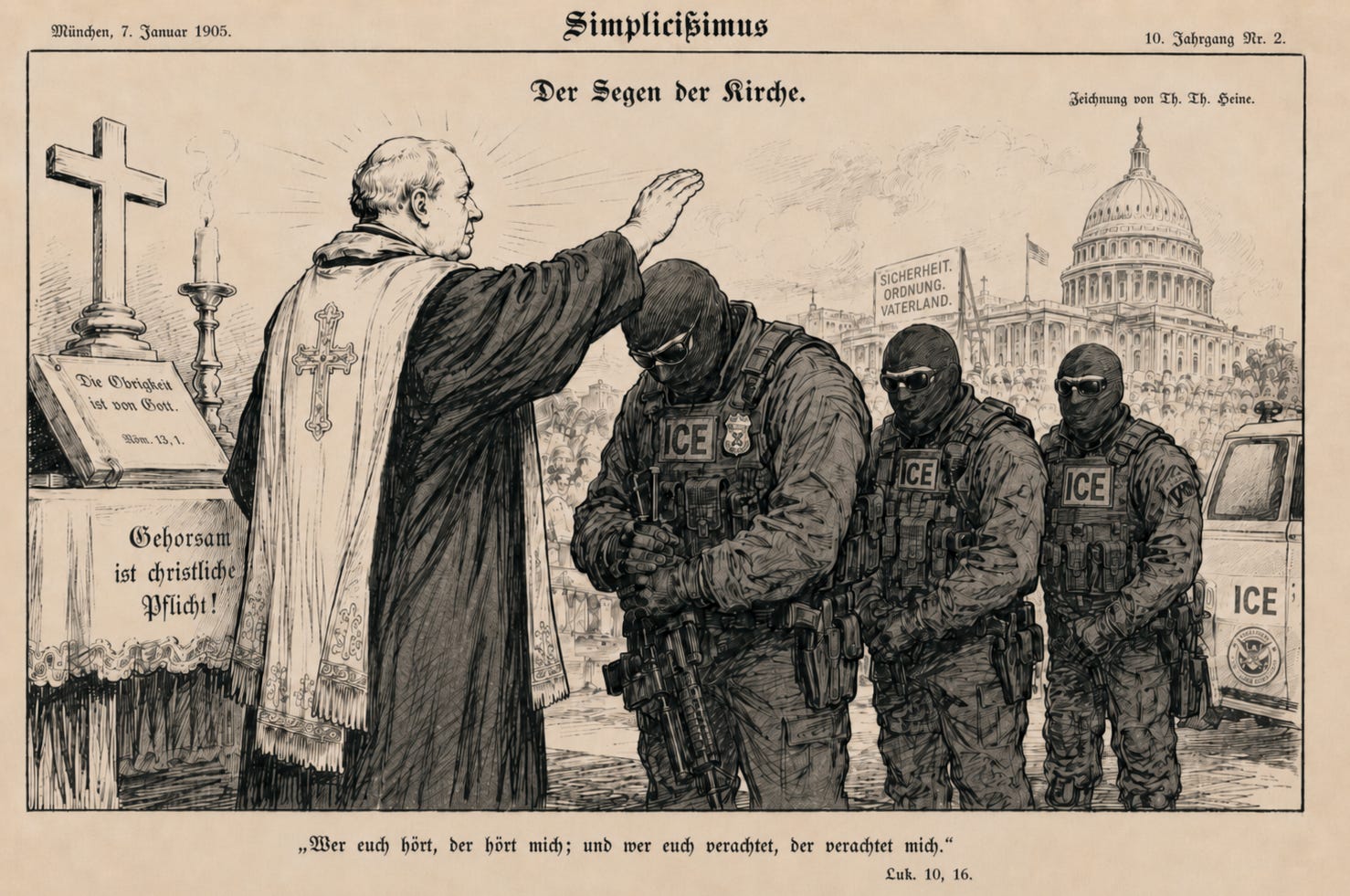
In January, a seminary professor in Minneapolis prayed that God would break his neighbors’ teeth.
The professor is Andy Naselli, who teaches systematic theology and New Testament at Bethlehem College and Seminary, and the prayer was not a slip of temper. It was written down, published, and circulated by the Center for Baptist Leadership as a model for other pastors to pray aloud on a Sunday.
The prayer takes its text from Psalm 58, one of the most violent of the imprecatory psalms: “Break the teeth in their mouths, O God.” The original target of the prayer was against the wicked Israelite rulers and judges who perverted justice, specifically leaders who use legal processes to oppress the innocent. Naselli, without a lick of self-awareness, applies the psalm to the protesters against ICE: “protect the ICE officers from wicked men and women who are violent lawbreakers” and turn the federal agents into “heroic servants” and “righteous avengers,” a phrase carried over, with a straight face, from Romans 13, the same passage this series has spent two essays analyzing without flinching.
The obvious question: how could someone who follows the executed rabble-rouser Jesus and obtained two PhDs in theology and New Testament exegesis miss the obvious irony of declaring the paramilitary enforcers as unambiguously good guys and the protesting civilians as unambiguously bad guys?
Naselli teaches at Bethlehem College and Seminary, the school of famously-nuanced pastor and author John Piper, in the city where Piper preached for thirty-three years and where he remains the seminary’s chancellor. And Piper, from inside that very same institution, had already written the exact refutation of this type of political theology. In 2020, weighing what a political ruler does to a people, he insisted that a leader’s person corrupts as surely as his policies: “flagrant boastfulness, vulgarity, immorality, and factiousness,” he wrote, are not merely “self-incriminating” but “nation-corrupting,” and “they move out from centers of influence to infect whole cultures.” Piper reached for the image of gangrene, the talk that “spreads” through a body. The chancellor named the moral disease; five years on, one of his own professors was praying it.
It would be easy, and cheap, to file this under aberration: one intemperate man, one fringe outfit, safely disowned by the rest of us, rational democratic citizens, and the real followers of Christ. Yet it is clearly not an aberration—not now. It is a symptom of a rot, an original disease, predicted verbatim millennia ago.
The first two essays traced a different corruption: what I called the Pharisaic leaven, the reflex of the hyper-religious that baptizes coercion as order, mistakes legality for morality, and reaches for Romans 13 as a conversation-ender rather than reading it beside the prophets who came before it and the Christ who fulfills it.
I promised, at the end of the second essay, that the third would follow the argument down from moral grammar to moral consequence, to the enforcement machine itself, where the abstractions collapse. I mean to keep that promise—but it turns out to need two essays, because you cannot understand a machine until you know who blessed it and what they were paid. This one is about the blessing; the next is about the machine. Call this the diagnosis of a guilty mind, and the next the description of the guilty act.
Because: Naselli’s prayer is not, strictly speaking, Pharisaic. The Israelite Pharisee is too rigorous, not too worldly; he wields purity as a weapon. The prayer reveals the other leaven, the one the gospel of Mark alone preserves. It does not always look like cruelty. It looks like patriotism, gratitude, law and order, a healthy respect for authority. That is exactly why it works.
So what even is leaven?
Start with the metaphor, because the whole argument leans on it. Leaven is less an ingredient than a contamination you carry forward. In the ancient world it was a lump of old dough held back from the last batch and left to ferment, and to sour, and to half-rot, then kneaded into the fresh loaf, where it spread invisibly through the entire mass until all the bread had risen and changed. The leavings.
A very little did the work of a great deal, and one could never observe it moving and working until it was too late; you could only discover, after the fact, that the whole lump had become something else. This is why Scripture reaches for leaven whenever it names a corruption that travels: “a little leaven leavens the whole lump,” Paul warns twice (1 Corinthians 5:6; Galatians 5:9), and why Israel scoured it from the house before Passover. So it is worth noticing exactly what Jesus does with the image.
Mark preserves a careful distinction in his recollection. Jesus warns his disciples:
“Beware the leaven of the Pharisees and the leaven of Herod.”
Two corruptions. Two distinct mechanisms by which faithful people lose the plot. Matthew substitutes the Sadducees for Herod. Luke reduces it to hypocrisy. Only Mark holds the specific Herodian diagnosis, and that specificity matters.
The Pharisaic leaven produces righteousness without compassion, purity as weapon, the law of God deployed as a bludgeon against the people of God. The first two essays in this series addressed that corruption.
The Herodian leaven is structurally different. Herod(s) governed Israel as a local ruler on behalf of Rome, with Rome’s permission, for Rome’s benefit. Herod the Great enlarged the Temple. He observed the customs (some of them). He spoke the language of covenant faithfulness. And he served Caesar, because Caesar was the source of his authority, his wealth, and his survival.
Scripture gives us the man to study. Herod Antipas, the son, in whose Galilee Jesus preached, shows the leaven working in a single life, and it has two ingredients:
The first is interest without submission. When Jesus was finally hauled before him, Luke says Herod “was very glad, for he had long desired to see him,” and was “hoping to see some sign” (Luke 23:8). He wanted the miracle, the spectacle, the show; when Jesus gave him nothing, Herod and his soldiers mocked him and sent him back in “splendid clothing” (Luke 23:11).
The second ingredient is attraction without repentance. Herod had “heard [John the Baptist] gladly” and “kept him safe,” knowing he was “a righteous and holy man” (Mark 6:20). He was genuinely drawn to the preaching. But he would not surrender the one sin it named, and when repentance would have cost him face in front of his dinner guests, he had the prophet’s head carried in on a platter instead (Mark 6:26–28).
That is the leaven at the scale of a single soul: a man who wants Jesus on his own terms, who samples the faith for the parts that flatter or entertain and refuses the part that would cost him anything. He will take the sign but not the Lord, the sermon but not the surrender. He wants self-realization, not self-denial; self-affirmation, not repentance. It’s the modern consumerist attitude: you keep what confirms you and return what convicts you.
Now enlarge that appetite from a soul to a society, and you have the Herodian leaven in its public, political form. It is the bastardized imbalance of preferring the state too much, whether the gain is material, emotional, or ideological. It is the corruption that occurs when covenant identity becomes functionally subordinate to political allegiance, when the faith’s content is gradually replaced by the faith’s utility to power. It ran in the family: the son wanted a sign from Jesus, and the father had taken his crown from Rome. The personal appetite and the political arrangement were always the same leaven.
Jesus set this warning alongside the Pharisaic one because both corruptions inhabit the same people simultaneously. You can be fastidious about purity and completely captured by power. You can keep the moral vocabulary while the substance underneath quietly transforms into something else entirely. The leaven is invisible. By the time you notice, the whole loaf has changed. A whole nation’s Christianity has turned and curdled and become something else entirely.
The Client King
The ancient historian Josephus records the political mechanics two millennia ago.
When the Roman Senate appointed Herod the Great king in 40 BC, no Jewish voice was consulted. Antony made the case, Octavian concurred, the Senate issued the decree, and “Antony also feasted Herod the first day of his reign” (Antiquities 14.388–389). They offered sacrifices to the Roman gods. The crown was a Roman award. The celebration was a Roman dinner party.
Previously backing the wrong side in the civil war, Herod appeared at Rhodes having removed his diadem but “remitted nothing else of his usual dignity” (15.187). His argument to Octavian was remarkable for its naked transactional logic: examine “how I behave myself to my benefactors in general, and what sort of friend I am, thou wilt find by experience that we shall do and be the same to thyself” (15.193). Loyalty as transferable commodity. The patron changes; the client’s posture does not.
Octavian restored his crown. Josephus notes that Herod “had, beyond all his hopes, procured his crown to be more entirely and firmly settled upon him than ever, by Caesar’s donation, as well as by that decree of the Romans” (15.196). Caesar’s donation. The kingdom was a gift, backstopped by a legislative rubber stamp.
The standard Roman formula for such kings was rex socius et amicus populi Romani, “allied king and friend of the Roman People.” Peter Richardson stresses that amicus named no friendship of equals but a client’s bond of submission and loyalty. The relationship was pure patronage. Rome provided legitimacy and military backing. The client king provided loyalty, tribute, and regional stability.
When Herod wanted to name his own successor, he needed permission: Caesar “gave Herod leave to give his kingdom to which of his sons he pleased” (15.343). The kingdom was not Herod’s to bequeath. It was Caesar’s to permit him to bequeath. And when Herod died, Caesar proved it in the settling: Augustus did not so much execute the will as adjudicate it, withholding the title of king from Archelaus, the son Herod had named to it, making him a mere “ethnarch” over half the realm and carving the rest into two tetrarchies for his brothers (Antiquities 17.317–320). The crown Herod imagined he was bequeathing had never been fully his to give.
Herod’s kingdom had all the sovereignty of a McDonald’s franchise.
“America is a Family Business”
The structure survives because it works, and it works everywhere. Max Weber gave it a name: patrimonialism, rule in which authority is personal property, loyalty replaces competence, and public office is openly monetized. The state stops standing above the ruler and becomes the ruler’s household. Weber warned that it “personalizes authority, corrodes institutions, and undermines the very capacity to govern.”
Stephen Hanson and Jeffrey Kopstein, writing in Persuasion, argue that this is exactly the form the current American presidency has taken. Trump “has returned to the presidency with a simple, radical ambition: to turn the American state into a family business. And business is booming: since Trump took office, he and his family have made an estimated $3.4 billion.” Loyalty counts for more than competence; conduct that reads as “outrageous” and “unpresidential” only advertises that the ruler stands above the constraints that bind ordinary men. Herod would have recognized every move: the borrowed legitimacy, the monetized office, the violence outsourced to men who answer to him because he answers to a patron. The whole of government becomes, willingly or unwillingly, complicit and self-reinforcing.
The same logic runs Sand Hill Road. A skin-deep veneer of technocratic meritocracy over a crunchy core of power and patronage, the wealthy venture capitalists are like any feudal lord on any feudal estate. The general partner who controls a fund operates on the client king’s logic: access is a function of loyalty, and the portfolio company that displeases the patron loses its follow-on funding the way Herod’s unfavored son lost his succession. The medieval court had courtiers; Silicon Valley has “operator friends” and “high agency individuals.” Wage-slave serfs pay rent for access to digital lands. Tech oligarchs own entire cities, direct entire economies, adjust the outcomes of entire wars, and determine the life satisfaction of a billion humans.

It also runs the megachurch. The pattern has been documented, with painful thoroughness, by watchdog reporters like Julie Roys across uncountable numbers of incredibly influential Christian megachurches: the charismatic founder, the captured board, the congregation trained to treat questions as spiritual threats. At Harvest Bible Chapel the bylaws required a unanimous vote of the full elder board to remove the senior pastor James MacDonald, a governance structure engineered for the permanent prevention of accountability. At Trinity Church in Scottsdale, Arizona, Mark Driscoll, found “guilty of arrogance and a pattern of abuse of leadership” at the since-dissolved Mars Hill, rebuilt the same machine without the layer that had caught him, and drew a loyalty scale from zero to ten on a whiteboard, rating people’s access to his family by their devotion. That is Weber’s “loyalty replaces competence” rendered in dry-erase marker: the client-king structure at parish scale. It produces, as I wrote several years ago,
“a harvest of sharp-tongued zealots of hate and insecurity more concerned with personal material security, reputational image, and demonstrating tribal loyalty against sociopolitical rivals.”
That diagnosis has aged like wine.
The political theology of the arrangement is rarely stated as nakedly as when Stephen Miller told Jake Tapper:
“We live in a world, in the real world, that is governed by strength, that is governed by force, that is governed by power. These are the iron laws of the world that have existed since the beginning of time.”
Jonathan Rauch’s reply was precise:
those words, “though alien to the traditions of American and Christian morality, could have come from the lips of any fascist dictator.”
They could also have come from Herod. Any real Christian ‘conservatism’ would spend itself preserving grace and life, from the womb to the tomb; any real Christian ‘progressivism’ would spend itself preserving truth and wisdom, the kind that makes virtuous citizens.
Jesus taught to share especial care to the poor, captives, and oppressed, fulfilling the prophecy of bringing justice to the nations through healing and liberation rather than coercion (Luke 4:18-19; Matthew 12:18-21).
Jesus taught that true justice is demonstrated through faithful action toward the vulnerable, such as caring for the hungry, thirsty, and imprisoned, which he equated with serving him directly (Matthew 25:31-46).
Jesus taught that doing justice is more acceptable to God than religious sacrifice, requiring believers to act justly, love mercy, and walk humbly (Micah 6:8; Matthew 23:23).
Instead—we have the bastardized ideology of the leaven, something accurately named Client Christianity: tribal political loyalty wearing the tunic of imputed theological righteousness. A stolen tunic.
Two Sauls and a Swordcel
Scripture offers two archetypes for what Herodian leaven inevitably produces. Both are named Saul.
The first Saul was Israel’s concession to political insecurity. “Appoint a king to lead us, such as all the other nations have” (1 Samuel 8:5). God warned them what a king would do: conscript their sons, requisition their fields, take a tenth of their grain, reduce them to servants. They demanded one anyway. They wanted to look like Babylon, like Egypt, like every empire whose strength was visible and whose gods were convenient. Saul’s kingship was a franchise of the nations. He repented when caught, wept when confronted, and changed nothing. He died on Gilboa, fallen on his own sword.
The second Saul was a zealot of impeccable credentials: “circumcised on the eighth day, of the people of Israel, of the tribe of Benjamin, a Hebrew of Hebrews; in regard to the law, a Pharisee; as for zeal, persecuting the church” (Philippians 3:5-6). The enforcement arm of the religious authorities. A man whose loyalty to the institution was indistinguishable from his violence against its enemies. He repented on the Damascus road, killed his old name, and lived under a new one.
One repented falsely and died. The other repented truly and was remade. God worked through the leaven in both paths. The difference is whether repentance reaches the bone or stays on the surface where it can still be politically useful.
René Girard saw where the surface version leads at civilizational scale:
“Beginning with Constantine, Christianity triumphed at the level of the state and soon began to cloak with its authority persecutions similar to those in which the early Christians were victims.”
This is Client Christianity. Identity as convenience. Religious sacrifice as justification. The faith as franchise. The cross as team jersey. Theological vocabulary in service of whatever apparatus keeps the patron in power.
Francis Schaeffer wrote in A Christian Manifesto:
“a true Christian in Hitler’s Germany and in the occupied countries should have defied the false and counterfeit state and hidden his Jewish neighbors from the German SS Troops.”
Schaeffer’s own political movement, a generation later, produced the exact formation he warned against. The Religious Right of the 70’s and 80’s has ossified into a purely political evangelicalism that is known to the outside world for its hypocrisy and authoritarianism. Schaeffer famously warned that “we should not wrap Christianity in our national flag” and yet his very teachings and legacy have been co-opted into partisan politics and white Christian nationalism.
The swordcel (to borrow from internet parlance) is perhaps one such as these compromised client Christians who spouts religiously coded conviction with decidedly unholy fervor; desires the accolades of a holy knight with none of the virtue; takes the sign of the cross without the power of the Spirit; performs the militant faith of a crusader from behind a screen; and mistakes tribal grievance for theological conviction.
Many a young man now is drawn to be trad and based, and direct their passions towards cultural enemies with postmodern internet-culture-warrior jargon. The phenomenon is ancient. And the young men of my generation are particularly susceptible to the promises of a supposed religion that promises the self-respect of religious piety with the masculine aesthetic of righteous protection. Client Christianity provides ample soil for men as this.
National Ambien
I said at the beginning of this series that it was written for people who are tired. People who feel homeless in a discourse that demands allegiance to positions they cannot hold with integrity.
Every system is perfectly designed to get the results it does. God has a sense of humor about this. He gave the nation the exact leader its formation deserves, and the leader’s particular genius is that he makes satire impossible. You cannot parody a man who is already his own caricature. The satirists are unemployed. The comedians are exhausted. From Succession, the diagnosis that applies to an entire political generation: “You are not serious people.”
Thucydides watched the same societal inversion during the civil war at Corcyra, and famously saw it work on language itself:
“To fit in with the change of events,” he wrote, “words, too, had to change their usual meanings. What used to be described as a thoughtless act of aggression was now regarded as the courage one would expect to find in a party member; to think of the future and wait was merely another way of saying one was a coward; any idea of moderation was just an attempt to disguise one’s unmanly character; ability to understand a question from all sides meant that one was totally unfitted for action. Fanatical enthusiasm was the mark of a real man” (Peloponnesian War, 3.82).
I confess there are days when the simpler version tempts me. How restful it would be to see the headlines and the billboards and events such as raids on vile cultural enemies and think with baleful doe eyes of utter enjoyable simplicity: yes, good, my side is winning, go team go.
Jingoism as lullaby.
Nationalism as Ambien.
The appeal is that believing it would require so much less of me than this.
That is the diagnosis. The leaven of Herod is less a heresy of belief than a corruption of attachment: a church that fuses its hope to a patron’s power—cultural, economic, political—until it loses the ability to tell the difference between a command of God and a command of a dear leader. A terrifying historical amnesia.
Naming the leaven is the easy part. The harder thing is to watch what the corruption does once it has finished mixing, where the crust of theology protects the immoral enforcement apparatus, and begins to twist people’s very souls. That is the subject of Part IV.
Comments
Nothing yet. Say the first thing.
Sign in to join the conversation.