
You have already absorbed The Odyssey, whether you meant to or not. Christopher Nolan’s Homeric adaptation has owned the culture since it opened, and the takes arrived on schedule at every level of ‘the cultural discourse’.

Elon Musk@elonmusk
Before this year ends, Grok Imagine will make a full-length movie of The Odyssey that is historically accurate and true to the art of Homer

Heavy Pulp @heavypulp
Dialogue scene from Homer's Odyssey built on Grok Imagine. Thread on how this was built below.
2:41 AM · Jul 22, 2026 · 11.9M Views
14.1K Replies · 19.8K Reposts · 177K Likes
Start with the casting. Lupita Nyong’o as Helen of Troy and Elliot Page as a Greek warrior produced the expected outrage cycle, and Elon Musk told sixty-seven million viewers that Nolan had “desecrated the Odyssey so that he would be eligible for an Academy Award”—this from a man who went on to share an AI-generated Odyssey clip and promise a “historically accurate” version of his own.
Matthew Yglesias pointed out that historical accuracy is itself a modern invention, which slowed nobody down. The theological readings arrived from every direction. Jake Adkins at Mere Orthodoxy saw re-enchantment and grounds for hope. David French saw a rebuke to the spirit of the age. Ezra Klein went further, called it the political movie of the decade, and credited Nolan with smuggling Judeo-Christian ethics into the poem.
Emily Wilson, who translated the poem, was harder to please. Her piece in the London Review of Books named the film’s central incoherence—Zeus’s law treated as crucial in a cosmos with no Zeus—and filed it under bad writing. Nolan reached for the plainest Odyssey in English—he quoted Wilson’s opening line in an interview, tell me about a complicated man—and then delivered a very simple protagonist. The No Man trick is gone, because this Cyclops has no wits to outwit: he is called an it, and has neither neighbors nor a favorite sheep. The polymēchania, the technical cunning of Odysseus, is gone: no marriage bed built from a living tree, a raft of driftwood, a Trojan Horse that turns up on the beach as though dropped there by drone. She is nearly alone in having reviewed the movie that actually exists: everyone else reviewed the one they brought with them, which is the expected output of a Rorschach test with a $250 million budget and, at roughly $730 million in twelve days, the fourth-biggest movie of 2026 and closing on a billion.
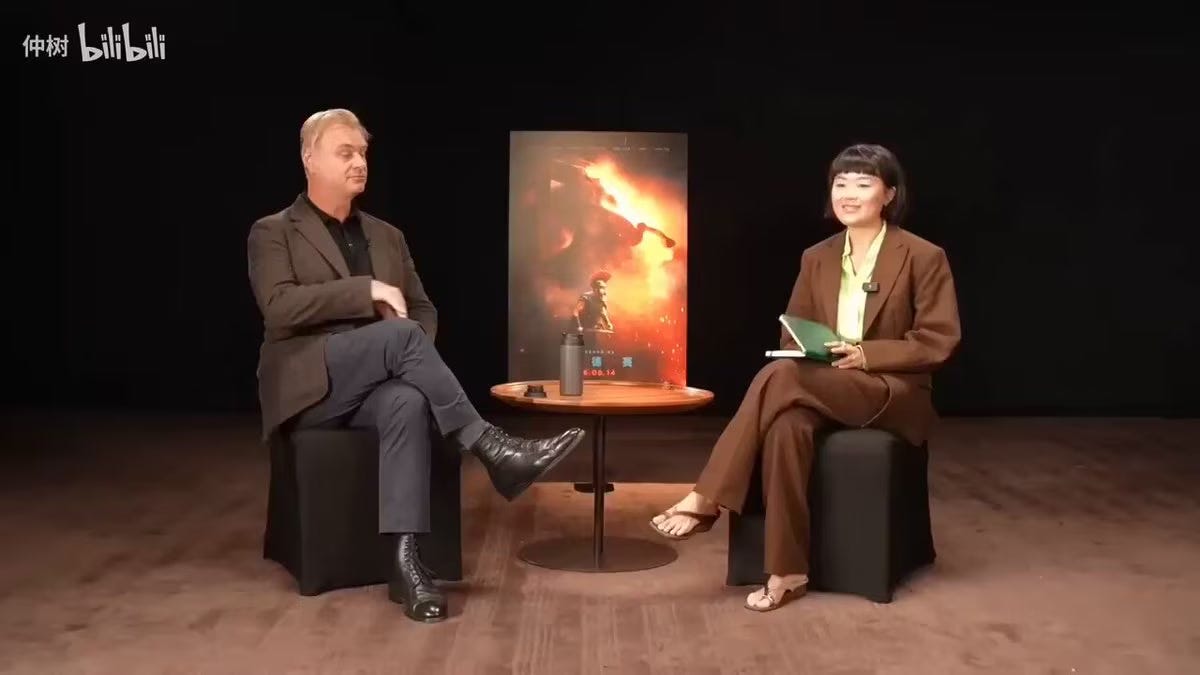
You may not yet have seen the most important cultural artifact of the whole conversation though: a seventeen-minute interview on Bilibili, the Chinese video platform, conducted by Yiyang Zhuge, who translates Hannah Arendt into Chinese, is finishing a political theory PhD, and showed up with a notebook and a set of questions so smartly aimed that online randos are impressed en masse.
She opens by calling filmmakers the bards of the modern age, walks him through the four-century gap between the Trojan War and the man who wrote it down, points out that Homer’s Greece was a civilization on the way up and that Nolan’s film is emphatically not, and asks him whether he is “a bard for a civilization at dusk.”

Geoff Keighley@geoffkeighley
Hats off to doctoral student and podcaster Zhong Shu in Beijing, China, who did this fascinating and smart interview with Christopher Nolan about THE ODYSSEY yesterday, originally posted to Bilibili. A great listen/watch.
3:58 AM · Aug 1, 2026 · 17M Views
395 Replies · 5.93K Reposts · 66.3K Likes
The clip got loose and made the rounds—reposted, reuploaded, clipped again, trending on Twitter/X. (The most widely seen tweet was from gaming legend / Hideo Kojima’s personal best friend Geoff Keighley for some reason!?) Under one of the reposts, someone wittily set the two press cycles side by side:
the Chinese interview asks whether he Christianized the Odyssey
the American one is ‘spin the snack wheel and read the thirst tweets, they called you zaddy.’
I have admittedly not seen the film yet (and am still uncertain whether IMAX screens exist in the Netherlands) but this is a conversation about the conversation around the movie. The reception is the more interesting object anyway. The argument in the West was about skin tone and armor. The only person to ask the director about guilt, atonement, hubris and the gods did it in Beijing, in her second language, and got an answer far more important than anything else about the film.
The accuracy fight was the loudest thing about this film and the least serious. Matthew Yglesias took it apart last week, and the useful part is not the culture war but the chronology: historical accuracy is itself a modern invention. The Tower of London’s Line of Kings put monarchs in whatever armor looked good for centuries. A fifteenth-century tapestry of the Trojan War dresses everyone as medieval Europeans. Sixteenth-century Germans painted Hector, Alexander and Caesar as sixteenth-century Germans, knowing perfectly well the three lived centuries apart. Faithfully reproducing the past simply was not the job.
Homer, more to the point, did not do it either. This is close to settled among people who study it: Moses Finley put the society of the poems centuries after the events they describe, Ian Morris moved it later still, and Anthony Snodgrass argued the whole homeric arrangement is an amalgam that never existed anywhere. Most damning: the poem is stuffed with references to iron a Bronze Age warrior would have never used: a smith tempering an axe, a proverb about iron drawing a man on, and Athena in disguise, claiming to be sailing to Temese with a cargo of iron to trade. That is a cover story that was hundreds of years out of place—but what do I know, for I am a simple unobtanium merchant.
Thanks for reading Endwise! This post is public so feel free to share it.
So the poems were fixed in the eighth century, in the middle of the Greek renaissance—the polis taking shape, colonies going out across the Mediterranean, the alphabet arriving. A politically fragmented people, dozens of independent and frequently hostile cities, acquired a shared past at precisely the moment they needed one. The epics travelled as Panhellenic property, performed at festivals drawing from cities who would otherwise be at each other’s throats, and the Catalogue of Ships in the second book of the Iliad is essentially a roll-call of who counts as Greek.
Homer was not preserving the Bronze Age. He was building a people their founding myth out of a tale already ancient when he reached it, furnished throughout with impossible narrative references and assumptions of his own day.
So the people demanding a historically accurate Odyssey are demanding a standard the Odyssey never met, in a genre that never had it, on behalf of a period whose actual texture nobody really wants.
Zhuge sets it up with a fact rather than an opinion. Atonement is not a Greek concept—absent from the culture, absent from the language, absent from Homer’s Odyssey. It is, she says, in his. Did you Christianize the Odyssey?
His answer begins: “I wasn’t too conscious in how I was approaching it philosophically…” (Full transcript here; every quotation below is from it and I would rather you read it first rather than take my word.) Don’t read that as thoughtlessness because you will misread the whole interview; he is manifestly a thoughtful man and the next fifteen minutes prove it. His answer is better than the question deserved but worse than he seems to know.
The idea of atonement, he says, is what we bring as viewers to the story. He does not know whether there really is atonement in the film, or whether we only feel it as emotional catharsis, watching the meeting between Odysseus and Penelope we have waited three hours for. We may, he says, be bringing our more modern sensibility to it. There is not a deliberate attempt to bring any sort of lesson, but perhaps just a natural interaction between an audience and story.
What he is actually disclaiming up-front is philosophical partisanship. He means he brought no position, took no side, came to the poem without a thesis to prove. He believes he approached it from no particular place.
Unfortunately for well-meaning liberal centrists, there is no no-particular-place. The rest of the conversation reveals his foundational beliefs verbatim, stated with real confidence by a man who has just said he wasn’t being philosophical.
When asked what he actually built the film around, Nolan says he honed in on xenia—the guest-host obligation, which the film renames Zeus’s Law “for simplicity.” He explains where the Greeks got it: you treat the stranger well because he might be a god in disguise.
And then, a minute later:
“once you ignore the theological underpinning of xenia, what you realize is that it is what we in modern terms call the Golden Rule. This idea of treat others as you would be treated has never really changed over time. The reasons that we try to hold people to that might have changed, but the idea itself hasn’t changed.”
Ignore the underpinning. Keep the rule. The reason is disposable; the obligation is permanent. And then he raises the stakes on the rule he has just cut loose: civilization, he says, “depends on this rule and possibly is even defined by it.”
I have argued before that this ethical move does not survive contact with arithmetic. Treating well those who can neither repay you nor hurt you has, as game theory, no payoff at all. Therefore it is irrational and rarely done.
But the Greek reason was not decoration. Ask why the strong should trouble themselves with a beggar who can do nothing for them and nothing to them, and he might be a god in disguise is the entire answer. It is what makes the obligation cost something. Take it away and the question comes back, unanswered. Nolan takes it away in the same breath he repeats it, and does not appear to notice that the answer left with it. He treats that premise as a Greek local detail, a piece of period furniture to be left behind on the way to the universal rule.
The command in the New Testament book of Hebrews is philoxenia, love of the stranger, built on the same xenos root the Greeks built xenia on, and the reason given is that some “have entertained angels unawares.” Again, the ancient importance of the ethic of being a good host. Matthew drops the hedge entirely: the stranger is not possibly a god, he is Christ—“as you did it to one of the least of these my brothers, you did it to me.” Writing in Greek, the New Testament authors reached for the same root and drew the same connection from generous hosting of strangers to Jesus’ Golden Rule teaching. The ethic was older than Athens on that side too—Abraham running out to meet three strangers at Mamre, and Leviticus commanding that the stranger who sojourns with you be loved as yourself, for you were strangers in the land of Egypt. And perhaps Nolan is even correct that this has some foundational stake to upholding civilization. The obvious question then: what’s the point of the maybe-god-rule if there is no god?
This is the same operation I traced through modern science last week, where the word ought outlived the law conception of ethics that gave it force and went on being spent as though it were funded. It’s using the value of an idea, blinded to its bankruptcy. I think of it as an unfunded universal: a norm, a concept, a zombie ethic, still drawing on the cache of an account that was closed a century ago.
Alasdair MacIntyre puts it better: What a culture like ours is left holding, he argued, are “the fragments of a conceptual scheme, parts which now lack those contexts from which their significance derived”—so that what survives are “simulacra of morality.”
The Golden Rule in Nolan’s hands is one of those fragments. He wants it to still be a universal order, potentially a loadbearing meta-structure for all civilization, particularly our American civilization.
The unfunded universal is not one director’s blind spot. It is the house style of educated Western opinion—French and Klein reached for it in the same newspaper inside a fortnight and both missed the zombie ethic surviving.
Zhuge presses on hubris—Thucydides blamed the fall of Athens on hubris, the film centers it in one man, so should Odysseus repent his pride? Or is pride appropriate for a great man?
Nolan’s reply is the tell:
“what difference would it make if he repented? … his repentance would be purely internal. It would purely be for his own spiritual self. It wouldn’t necessarily affect anything outside it because the damage is done.”
And then, explicitly:
“that’s where Christian theology looks at it in a different way, but in a practical sense doesn’t necessarily change what’s happened. And therefore, in storytelling terms, isn’t necessarily relevant.”
There is a whole ethics in that “therefore.” It holds that the moral weight of an act is identical to its downstream causal effect—that a change in a man which alters nothing outside him is, for practical purposes, nothing. That is a substantive philosophical assumption of consequentialist ethics, aka the ethics theory that promotes practical utility of ethics above either the goods of rule-following or becoming-virtuous. He adjudicates against Christian repentance, by name, via an ethics theory Christian theology rejects—and he does it while founding his film on guilt and atonement, having opened by saying he wasn’t being philosophical.
It is also refuted by his own film. By the end of the film (spoilers) this Odysseus has abdicated his throne and sailed into exile—a colossal external consequence, authored by Nolan, following directly from an interior change he has just told us could not affect anything outside the penitent.
The relationship with Penelope is dramatically changed. Odysseus originally built their marriage bed out of a living olive tree still rooted in the ground, immovable, and the secret of it is the one thing only the two of them know. Penelope uses this secret to test him. The emblem of their marriage is a thing that cannot be moved. Emily Wilson notices Nolan cut it, and delivers the loss as an aside: this Odysseus “does not build a marriage bed out of a tree growing in his house (it would be a waste of effort, since he so rarely seems to sleep or have sex).”
In Quillette, Charlotte Allen adds more in her review:
Homer’s epic ends with Odysseus, back in Ithaca and disguised as a beggar, nearly single-handedly slaying every last one of the 108 freeloading suitors. He then falls into bed with the thrilled Penelope…
Yet complicating the marital bliss, Wilson notes that Homer allowed Penelope a dream of geese in which she weeps for the suitors about to be slaughtered—realistic internal ambivalence about the return of a husband she has waited twenty years for.
…the ever-helpful Athena, goddess of wisdom, prolongs the night and signals rosy-fingered Dawn to take her time arriving so that Penelope and Odysseus can enjoy hours of love-making and he can regale her with the tales of his adventures.
No such Athena in Nolan’s adaptation and no such love-making at all. The test of marital fidelity is changed to a rather explicit scene of guilt, confession, and forgiveness for his violent soldiery.
Nolan’s film, by contrast, ends with Odysseus, also in beggar’s rags, pouring out a monologue of self-loathing to Penelope (Anne Hathaway), who has summoned him to her chambers. In this scene, the two are separated by a grille-like wooden screen, which will remind Catholic viewers of going to confession…After that confession, Odysseus [then] sails off into mysterious exile with a veiled Penelope at his side. I had to ask: “What did she do to deserve this fate?”
What replaces the rooted bed is a literal screen he confesses through. Both are furniture. One is shared and immovable and proves who he is. The other is a partition with a penitent on one side.
Watching the couple’s decidedly un-erotic exit in Nolan’s movie, I wondered if Odysseus would ever forgive himself long enough to realise that Penelope might be in the same room (or boat).
Penelope loses more than the bed and the marital unity. Nolan’s Penelope has no dreams, and a script that, in Wilson’s words, “gives her nothing to do except yearn for Matt Damon, for reasons unknown.” The presence of moral guilt and the urge for forgiveness is so concretely present that it in fact apparently dominates the characters’ entire relationship and narrative arcs. Hard to believe Nolan’s own words that repentance, “in storytelling terms, isn’t necessarily relevant.”
The last question is the best one. What are the gods—figments, or necessary noble lies?
To the characters, he says, they are simply real. In a pre-scientific world the evidence of divinity is everywhere; thunder is a god speaking, the sea is moved by gods, and there is no rival account on offer. So belief in them is not an article of faith at all. It is the obvious reading of the available data.
Then he turns it on us:
“just as we accept things from science as absolute fact—the Earth is round, we travel around the sun—we can’t know these things. We take them as faith because they’re presented to us as facts.”
Note the pronoun. That is not a remark about how the credulous public behaves. It is first person, and it is a claim about the reach of human knowing as such: we cannot know these things. Any belief is completely taken on faith.
Underneath it sits a familiar and unacknowledged inheritance—the notion that a scientific fact is one more presented authority, believed because presented, indistinguishable in kind from a thunderclap attributed to Zeus. He closes the loop a moment later: the gods “are real, but they are inside the people. They are being projected by the people.”
This is radical epistemic skepticism, a philosophy of knowledge that asserts a fundamental unreality, and it is offered as sophistication. It is not.
A claim you could in principle check, that carries an error bar, that comes with a public method by which it could be overturned and an institution that has overturned its predecessors, is not the same object as a claim for which no such procedure exists. “Facts” are not just what any scientist, or person of power, says is good. This is barbarism. There are, in fact, smarter ideas and dumber ideas. He has collapsed testimony into faith and called the wreckage humility.
But Nolan is certainly not unique in this. It is, I think, an accurate representation of most young people’s natural stance to be radically skeptical of all knowledge and testimony in general—and if true, it heralds a terrible consequence for societies already drowning in deepfake pornography, political disinformation campaigns, and psychological afflictions of every kind.
Apply Nolan’s epistemology honestly and the Golden Rule should dissolve first. It is the most obviously transmitted, most obviously authority-backed, most obviously culture-borne claim anywhere in the conversation—a rule he was taught, which he believes because it was presented to him as a fact. He pours the epistemic solvent on Zeus. He pours it on heliocentrism. He sets the bottle down before the ethics, and the ethics walk out of the interview untouched and universal and load-bearing for civilization itself.
Everything is projection except the thing he needs to remain standing in order to have something to mourn.
Which leaves him and the film in a rather awkward position. The Christian at least has an account of why any testimony can be trusted at all, of why the entire natural world is ordered and predictable at all. Nolan has universalized faith and removed every ground for it in the same breath, then built a three-hour film about a civilization destroyed by the breach of a law he cannot tell you how anyone can keep. That is more magical thinking, not less. It is a Weimar of facts and values with a $250 million budget.
To be clear, I do not want to prosecute Nolan here. He is more articulate about all of this than almost anyone who has reviewed him, which is rather exactly the problem. He is our most prestige-coded practitioner of the largest cultural export the West has, working at the top of his craft, and when a very competent interlocutor asks him what he believes about guilt and gods and the ends of a human life, he reports that he had not taken a position—and then takes four.
He says so, at length, and the sight of it is the reason the film has the tone it has. The dark color palette it has. The atavistic handwringing and guilt-ridden conscience it has. He cannot see that his account of knowledge and ethics is exactly the thing letting the chaotic waters in. Symptom and cause, in one chair, on camera, for seventeen minutes.
Within a day of the clip circulating, people were writing threads about Nolan’s Christianized xenia and his thin account of the gods—Alain Astruc’s is the sharpest, and it closes by thanking her. The material had been sitting there the whole time. It took the right questions, asked at the right levels, to make anyone able to see it.
Zhuge has since watched the same flattening happen to the interview itself. On her podcast afterward she described how, once it went viral, the specificity of both people in that room dissolved—they stopped being two individuals and became two symbols—and observed that there is nothing the internet does better than taking actual people and stuffing them back into a worldview the audience had already built. The one artifact that raised the level of the conversation was incestuously digested by the conversation inside of a day.
It took a young female doctoral student, working across political science and history and narrative and metaphysics at once, in a language not her own, to ask the question that made it visible.
That is the whole argument for the kind of reading this newsletter exists to do.
You cannot get a coherent account of a work of art out of any single discipline, because the thing that makes art coherent or incoherent sits underneath all of them. Good art comes from good metaphysics. So does good criticism. There is always something the viewer cannot see, and it is never in the frame.
Nolan spent a quarter of a billion dollars on a story about a man who breaks a sacred law and spends the rest of his life paying for it. Somebody should have asked him whose law it was.
No posts
Comments
Nothing yet. Say the first thing.
Sign in to join the conversation.