
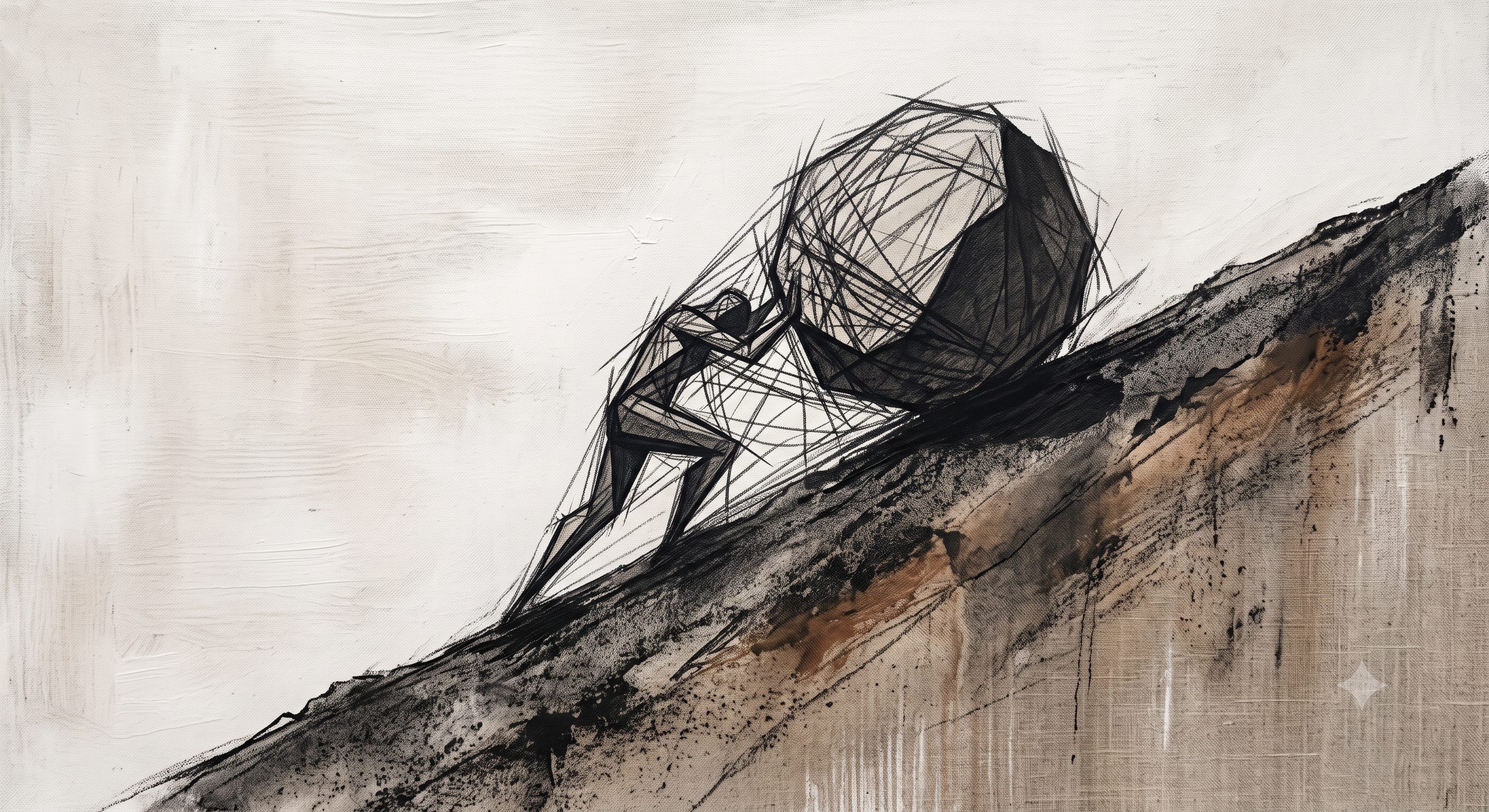
Even the dullest job, the kind of work Albert Camus might have described, where you wake up every day to hammer nails or carry something up and down the stairs, over and over, is not meaningless work. Even a job like that is profoundly meaningful. I’ll spend the rest of this post making the case.
A few months ago I wrote a post called “Who Are You Without a Job?” The point of it was to force people to imagine a scenario where they’d lost their job, whether to AI or to something else. I didn’t write it from a place of certainty. I wasn’t convinced AI would take all jobs, or hollow out knowledge work wholesale. I didn’t know then and I still don’t. I wrote it from a place of uncertainty, because with each passing month, as the models kept getting better, it seemed there was a non-trivial chance that at least some jobs would go.
Since then the shadow of AI has only gotten bigger. The more time I spend with these models, using them, building things, the more I get the feeling we’re in a strange twilight zone where the old certainties no longer hold and the new ones haven’t arrived. And in the gap between them, there’s just anxiety.
If I’m being honest, when I wrote that post, I hadn’t spent enough time thinking about the deeper layers of meaning that come from having a job. I skimmed the surface. I wrote that a job mediates the architecture of your life. It influences where you live, whether you buy a house, whether you marry and who you marry, whether you have kids, how you relate to your neighbourhood and community, your appetite for risk, on and on. All of it true.
It’s easy to describe the work you do. What’s harder is describing everything else that flows from having one, all the non-monetary things that come as a by-product. A job touches every part of your life, and most of what it touches is psychological. The non-pecuniary effects that flow out of a job are like a gooey substance that spreads itself all over your psyche. It fills the cracks and the pockmarks and the dents in your mind, the places where all the bad shit lives, and it evens things out. It holds you together and gives you coherence.
I ended the post there. But the more I thought about it, the more I realised how much I’d missed.
What a job actually gives you
Let’s start with the basics. A job is not just a way to make money. Sure, money is part of it. But it’s the least interesting part. There’s a whole set of fuzzy, hard-to-name things that flow out of a job and shape you, for better and worse.
The biggest one, maybe, is confidence. The plain, bodily confidence that you can wake up in the morning, walk out into the world, use your hands or your head, and come home having earned enough to put food on the table and take care of the people around you. It’s this confidence that lets you make the big choices. Whether to get married. Whether to start a family. How much risk you’re willing to run. Whether you’re steady enough to make commitments to other people and keep them. All of it is downstream of a simple loop: you do the work, you get rewarded for it, and you learn you can do it again tomorrow.
And a job here doesn’t have to mean a salaried job. It just has to be work that pays you something, a business of your own or a paycheck, it doesn’t matter which. The container is beside the point.
It might sound obvious, but we are all human. We walk around carrying crushing, debilitating amounts of fear, doubt, worry and anxiety, and a whole lot of questions about who we are and what we can and cannot do. Am I good enough? Can I take care of the people around me? Will I earn enough? Can I be relied on? These questions keep swirling around in the head. Some days they’re front and center, some days they sit at the back. At least mine do.
What a job, or any absorbing work, does is fill the space those questions would otherwise occupy. It shrinks the room left for what I can only call the darkness. That’s the trick. It isn’t just that work gives you things. It’s that work crowds out the bad stuff. Your mind stays busy, so there’s no room for the rest. And as long as you’ve got something to get up for in the morning, the demons a lot of us spend our whole lives outrunning never quite catch up.
Take away the job, and what happens? Suddenly you’re up against a whole set of psychological battles you never had to fight before. Battles a lot of us wouldn’t win.
There’s a social layer to a job too, and it’s one we don’t appreciate enough. For most people, the friendships they make in adult life are built at work. The workplace is an offline social network, the room where you meet people and slowly build a life alongside them. That’s not a small thing. Lose the job and you don’t just lose a task, you lose a whole web of relationships you didn’t realise you relied on.
A job also gives you the sense that you’re contributing something, that you’re a useful part of the whole. Yes, you can be stuck in a job that actively harms society. But that’s the exception, not the rule.
The research backs this up
None of this is just me theorising. The big meta-analysis here, Paul and Moser, pooled hundreds of studies and found that 34% of unemployed people showed psychological problems, against 16% of the employed. And it isn’t merely that unhappy people lose jobs. Finding work again reduces the distress. People out of work are more prone to depression, anxiety, substance abuse, alcoholism. When American counties got hit hardest by the China trade shock, they saw relative increases in fatal drug overdoses, and the spike tracked the deterioration in the local labour market.
The effects touch the next generation too. Children whose fathers were displaced from work go on to earn less as adults. But to be clear, this has more to do with poverty than with the point I’m making about meaning. The effect shows up almost entirely in families at the bottom of the income distribution. I’d suspect the non-monetary side plays a role here too, but that’s for the researchers to figure out.
Money isn’t the whole of it, though, and there’s good evidence for that. When economists went looking for why the unemployed are so unhappy, they found the non-monetary cost of losing work is larger than the monetary one. The damage holds up even after you control for income. And more generous unemployment benefits don’t really fix it. Replacing the money has only a minor effect on the misery. It was never only about the paycheck.
And when I call a job a bundle, I don’t mean a stack of separate things sitting side by side, independent of each other. The meaning a job gives you and all the psychological and social stuff that comes with it are interlinked. It’s a mesh of loops, some tight, some loose, all feeding back into each other. The work you do has a psychological effect, and that effect loops right back into the work, and on it goes. It’s this tangled, reinforcing quality that makes a job so hard to see clearly, and it’s why people tend to think about jobs and work in one-dimensional, limited ways.
And notice I keep saying “a job, or any purpose.” Because it isn’t really the job. It’s having something to do. A job is just the default container this society hands almost everyone. Anything that fills the space would do the job of the job. Hold that thought, because it matters later.
The bullshit job paradox
Now, a fair objection. In my last post I leaned hard on David Graeber’s idea of bullshit jobs, meaningless make-work that the person doing it half-knows is pointless. So how can a job be bullshit and a bundle of meaning at the same time?
It can. And the resolution is Sisyphus.
The task can be completely pointless. Having a task is not. Even if you spent your whole day carrying rocks up a hill and back down, your mind would be occupied, and all the uncertain stuff would stay out at the edges. That’s the nature of work. We find meaning in the meaningless. We’re all Sisyphus, the one Camus described so well, and he already told us the struggle toward the summit is enough. The meaning was never in the widget. It was in having a widget to nail. Some boulders just come with a job title and a salary.
A job is barely 250 years old
The idea of a job is barely 250 years old. You can more or less trace it to the Industrial Revolution. Before that there was no concept of a job. You just worked. You ran your little business, or you farmed, or you were a peasant who worked all your life and dropped dead. No retirement. No pension. None of it.
Retirement itself is a modern invention. Otto von Bismarck built the world’s first state pension in Germany in 1889, and the qualifying age he set was 70, in a country where average life expectancy was around 40. The world’s first retirement scheme was designed for a world where almost nobody lived long enough to collect it. Smart man.
It reminds me of an episode of The King of Queens. Doug tells his wife, Carrie, that she’s put on a little weight. She gets upset, starts dieting, and now Doug feels terrible about the whole thing. Then Arthur, Carrie’s father, shuffles into the kitchen, takes one look at the scene, and says that his generation never bothered with any of this. They ate whatever they wanted, worked themselves to the bone, dropped dead of a coronary at fifty-five, and they liked it.
It’s funny, but there’s a point buried in the joke. For most of human history, that was simply the deal. People worked their asses off, out in the fields, from sunrise, their whole lives, and then one day they just dropped dead. The entire shape of a modern life is very, very new: the job, the pension, the long retirement, the fussing over greens.
Now you might wonder why I’m being so alarmist about the loss of jobs if the job itself is only 250 years old. If we managed fine for 300,000 years without one, what exactly am I worried about?
It boils down to semantics. Before the invention of the modern salaried job, with its pension and its benefits and its nine to five, we still worked. We worked our asses off, morning till evening, with no clear line between work life and personal life, because there was no line to draw. Most of us did manual labour, toiling in the sun, our fates at the mercy of the elements. Yes, there were idle people. But there was no unemployment insurance either, so we never really stopped. We have always worked. We have always struggled. And for 99.9% of our history that striving was not to accumulate riches. It was just to survive.
If you made it into your forties or fifties without being carried off by a snakebite, diarrhoea, tuberculosis, a wild animal, the common cold, or any of the other varieties of death constantly lurking around you, you counted yourself among the privileged. It was practically a miracle.
Which is to say we all had our boulder to push, from day one. The job is the 250-year-old wrapper. Employer, salary, nine to five, pension, the whole apparatus. Work, in the sense of purposeful striving, is as old as the species. So those 300,000 pre-job years don’t undercut the worry one bit. The durable thing was never the job. It was the boulder. The hunter had one. The peasant had one. Neither of them had a job.
But what if this time is different?
Take a long enough sweep of history and you’ll see we’ve been steadily automating ourselves the whole way. Since we first stood upright and started making things. From rubbing stones together to make fire, to melting rock into metal, to sickles and hammers and ploughs and every machine since, right up through the Industrial Revolution, we’ve handed off more and more of our work. And yet, here we are.
That’s the version the skeptics reach for whenever AI and job losses come up. Automation has always been with us, they say, so this time is nothing new. It’s an easy generalisation to make, and I think it’s a mistake. Not because this time is definitely different. The correct answer isn’t that this time may be the same. It’s that we don’t know. Reaching for history is how we make sense of the present, but it should come with wide uncertainty bands.
And what makes AI different, at least to my mind, is that what it holds out, at least nominally, is a post-scarcity world.
Is it also automating cognitive labour rather than manual labour? Yes, and not just the deterministic kind. It isn’t taking over one narrow, sequential slice of a job the way a calculator or an Excel spreadsheet or a computer once did. AI is a shapeless technology. It wraps itself around the human brain and lets us, for now, do a huge range of things we’d otherwise have had to do ourselves.
The charitable way to describe this moment is that AI isn’t replacing whole jobs. It’s replacing tasks inside the bundle of activities we call a job.
So extrapolate a little. If progress keeps up, and AI goes on unbundling and automating more and more of those tasks, is there a day when we wake up in something like Keynes’s fabled fifteen-hour week? If there was ever a moment to take that possibility seriously, it’s now.
Set aside the hype, the boosterism, the doomerism, all the idiotic noise. Set aside the critics and detractors, most of whom, as far as I can tell, haven’t seriously used these things. What’s left is a revolutionary technology that is going to change the way we live.
And the thing we forget is how young it is. Count from the launch of ChatGPT in late 2022 and you get less than four years of this being in ordinary people’s hands. Four years. And in that time it has already forced us to sit around seriously discussing post-scarcity. Now imagine progress carries on at the same clip. It doesn’t even have to be exponential. Just steady. Forget AGI and ASI and the rest of the acronyms. Can you picture that world?
To state the obvious, we are bad at predicting the future, and worse at predicting the second-order effects of revolutionary technological shifts. It’s true that historically, every major technological shift has created more jobs than it destroyed. It’s true that we built a machine that took us to the moon and then went right back to striving. All of that, granted.
It’s still worth thinking about the question I’m posing. Even if AI never automates away all knowledge work, it seems clear enough to me that it will cause dislocations and disruptions in the labour market severe enough that the world as it’s currently set up, the politics, the economic system, all of it, is not designed to absorb them. Not the destruction of jobs. Just the disruption. We aren’t built for even that.
What Keynes was really asking
That, more or less, was Keynes’s question. In his famous essay “Economic Possibilities for our Grandchildren,” he made a prediction that’s since become a bit of a meme, that thanks to relentless technological progress, we’d soon reach a society of such abundance that we’d work maybe fifteen hours a week. It didn’t come true, and the sad part is that the failed forecast has become a caricature that’s taken on a life of its own, so people miss the deeper point he was making.
His point was this. We’ve been hardwired for struggle since the beginning, and Keynes argued that the compounding of technological progress, and the growth it throws off, would eventually solve what he called the economic problem, the problem of survival. Once our material needs could be met with barely any effort, fifteen hours a week, we’d reach a point where we no longer had to struggle to survive. And then what? He put the question better than I could:
Thus for the first time since his creation man will be faced with his real, his permanent problem—how to use his freedom from pressing economic cares, how to occupy the leisure, which science and compound interest will have won for him, to live wisely and agreeably and well.
In other words, in a society where work is no longer the main organising principle of people’s lives, would people fall into some deep existential crisis? Keynes pointed at the rich of his own day, people who had everything and no need to work, and noticed how many of them had sunk into depression, neurosis, aimlessness. He worried the same collective nervous breakdown was lying in wait for everyone once abundance arrived:
To use the language of to-day—must we not expect a general “nervous breakdown”? We already have a little experience of what I mean—a nervous breakdown of the sort which is already common enough in England and the United States amongst the wives of the well-to-do classes, unfortunate women, many of them, who have been deprived by their wealth of their traditional tasks and occupations—who cannot find it sufficiently amusing, when deprived of the spur of economic necessity, to cook and clean and mend, yet are quite unable to find anything more amusing.
And then:
Yet there is no country and no people, I think, who can look forward to the age of leisure and of abundance without a dread. For we have been trained too long to strive and not to enjoy.
So the fear was never really “AI takes my paycheck.” Roll out a universal basic income tomorrow and you solve the money problem entirely. The harder problem is still sitting there—the boulder is gone. And every doubt and worry the boulder used to crowd out comes flooding right back in.
Two branches
In the previous post I wrote that once the current crop of bullshit jobs goes, we’ll just go on and create a whole new category of them. I didn’t spend enough time articulating why. The reason is simple. We are beings designed to strive. It isn’t in our nature to sit quiet and do nothing. I’d presume this is hardwired into us somewhere, though that isn’t my area of expertise.
We just want something to do. Even if that something means going to an office and being paid to sit and tap the spacebar from nine to five. And as much as we might hate the job, we’d carry on doing it anyway, which tells you something.
Look at how many people are stuck in jobs they hate and stay. I’d guess that isn’t only about the money, or the commitments they’ve taken on. It’s that they wouldn’t know what to do with their time otherwise.
Pascal hit the nail on the head:
All of humanity’s problems stem from man’s inability to sit quietly in a room alone.
And we don’t like what Pascal said. So we’ll keep creating new rocks, and inventing new hills to roll them up. I don’t know if that’s hopeful. It’s just the nature of our species.
The more depressing question is the other one. Say AI does herald an age of abundance. Will we be able to handle it, fully or even partly? When the boulder we wake up to roll is yanked away, is society built to deal with that? Can it put a new boulder in people’s hands before the old one is gone?
There are a lot of hypotheticals in this post, but this one isn’t. We’ve watched it play out, and it was destructive.
People wave at the Industrial Revolution and say that despite the monumental technological shifts, everyone turned out alright. What these lazy descriptions obscure is what happened in between.
Economic historians have a term for it, Engels’ Pause. Roughly between 1790 and 1840, output per British worker rose sharply while wages stayed flat. And as with any historical economic fact, there are raging debates about whether it really happened, and whether other factors, the Napoleonic Wars, the Corn Laws, were what kept wages down. I’ll leave the economic historians to fight over that.
What is clear is that a lot of people living through that phase had to deal with the discontinuities, and had a miserable time of it before they readjusted. The handloom weavers and the Luddites, who have since become something of a caricature, and misunderstood ones at that, are just the most visible example. They struggled to readjust as their jobs were automated away.
This is the thing the boosters of technology gloss over. There are always severe dislocations and disruptions during technological shifts. And while that in itself may not necessarily be a bad thing, the bigger question is whether society, as it’s currently architected, is set up to deal with the fallout of dislocations on that scale. The answer, unequivocally, is no.
We saw it again with the China shock. Entire towns were decimated as manufacturing shifted wholesale to China. Not just people. Whole towns and communities were left behind. Economic theory said they’d simply move to other places where the jobs were. They didn’t. And the research links the China shock to rising political polarisation, to the opioid crisis, to a whole range of other social malaise.
When you have people with nothing to do and no help coming to get them readjusted, bad things happen. It’s as simple as that.
And what the debates about job creation and job losses keep missing is that a job mediates your entire worldview. It shapes how you see things. Usually for the better, but land in the wrong place, or the right place wired with the wrong incentives, and it bends you out of shape. Wall Street is the classic case, where a certain reckless, extractive, everything-is-just-a-number worldview is more or less the house style. Either way, you don’t keep it to yourself. You pass it down.
Zoom out from one person to the aggregate attitudes of a community that works against one that doesn’t, and the difference is night and day. The effects of work were never confined to the person doing it.
So there’s a real chance AI ends up forcing us to face the question Keynes was asking: what fills the void once the need to strive for survival is gone.
And maybe, in hindsight, we’ll all be proven wrong, and this whole question of mine becomes a meme too, the way Keynes’s fifteen-hour week did. Fair enough. But it still gets me that we’re even having this conversation. That a post-scarcity world, one with essentially no material want left, is now a mainstream talking point. Not long ago this stuff lived in a narrow sliver of futurists and sci-fi writers. Now, thanks to how fast AI keeps moving, ordinary people bring it up in ordinary conversation.
But the point I’m making with this essay is that not thinking about these hard questions is bad for us, especially when work eats up so much of our lives. Think about it. If you work at a company, you spend somewhere between eight and ten hours of every twenty-four working, another eight or so sleeping, and everything else gets crammed into the thin sliver that’s left. We spend the vast majority of our waking lives working. So how can we not think about what happens when that goes? When we no longer have to work, no longer have to struggle to survive, when all our material needs are met without our having to lift a finger?
Are we ready?
So now picture a whole society of the unemployed. Not a handful of people between jobs. A society. Are we anywhere close to ready for that?
Maybe the utopia arrives. Maybe we hit such an age of abundance that the machines toil around the clock and the surplus takes care of all of us, and we get to sit under a tree writing shitty poetry and painting shitty paintings that nobody looks at. Maybe. It’s a thought experiment worth having, and there’s a non-trivial chance some mild version of it actually turns up.
But the world as it’s currently wired is not built for a life of leisure and idleness. Which is the whole point. A job was never just a way to put food on the table. It’s a bundle of meanings, individual and social, and most of them stay invisible right up until they’re gone. If even a soft version of this future arrives before we’ve thought any of this through, the question stops being philosophical.
Who are you without a job?
I still don’t have a good answer. But it’s a standing system prompt I keep running in the background, and I think you should too.
Thanks for reading Ooh, that's interesting! Subscribe for free to receive new posts and support my work.
Comments
Nothing yet. Say the first thing.
Sign in to join the conversation.