
If AI reduces the benefit of developing writing and critical thinking skills, people will invest less in learning those skills
Whether this happens depends on if AI increases or reduces inequality in the labor market
Society would benefit from cultivating critical thinking, even if many tasks are done by AI
Recall staring blankly at a page, struggling to come up with an answer to an essay prompt. Formulating and articulating a thought might have taken hours, each sentence revised over and over. Working through writer’s block to craft a compelling argument was a painstaking rite of passage towards becoming an effective thinker and communicator.
Do students today have this experience? If AI can write our essays, what happens to human thought?
AI has been adopted rapidly by pupils for completing their coursework. This has led to concern that a generation of students will not learn to think for themselves.
How concerned should we be about this, what might be the consequences, and what should we do about it?
Start by surveying the state of AI in the classroom today. According to a recent survey from Common Sense Media, 7 in 10 teens aged 13 to 18 use generative AI tools. 40% of teens report using these tools for help with school assignments, with 46% of those using it without their teacher’s permission. 6 in 10 teens report that their school has either no rules for generative AI use or that they’re not sure if there are rules.
The survey also offers some foreboding statistics. Large majorities of both students and parents report that generative AI could be used to cheat in school, and that students might not learn critical skills because gen AI does the work for them.1
This echos concerns others have raised about the next generation’s critical thinking skills, such as in a recent piece by Paul Graham warning of a future world split between people who are “thinks and think-nots.”2 Recent academic studies also suggest that reliance on generative AI may reduce critical thinking, though there is a need for further high-quality causal studies.3
Given these widespread worries, how concerned should we be of AI creating a generation of non-thinkers?
To assess the impacts of AI on education, It’s useful to put the present changes in historical context. The past half century was a transformative period for education in the US and globally, offering rich insights for today.
From 1980 to 2020, the college wage gap in the US increased from 40% to 65%.4 Growing wage differences by education account for 70% of the growth in overall inequality in the US since the late 1980s, according to Hoffman et al. (2020).
What caused the divergence in wages? A broadly held belief among economists is that the college wage gap primarily increased because trends in technology favored more educated workers. More educated workers were better able to make use of advances in technology like computers, driving up their wages relative to less educated workers.
At the same time the college wage gap increased, the share of the US labor force with a college degree increased from 20% to over 40%. What caused this increase in college attainment? A key explanation is incentives. As the benefits of getting a college degree increased, more people chose to attend university. This means that more people went to college in large part because the college wage gap increased, incentivizing them to go.
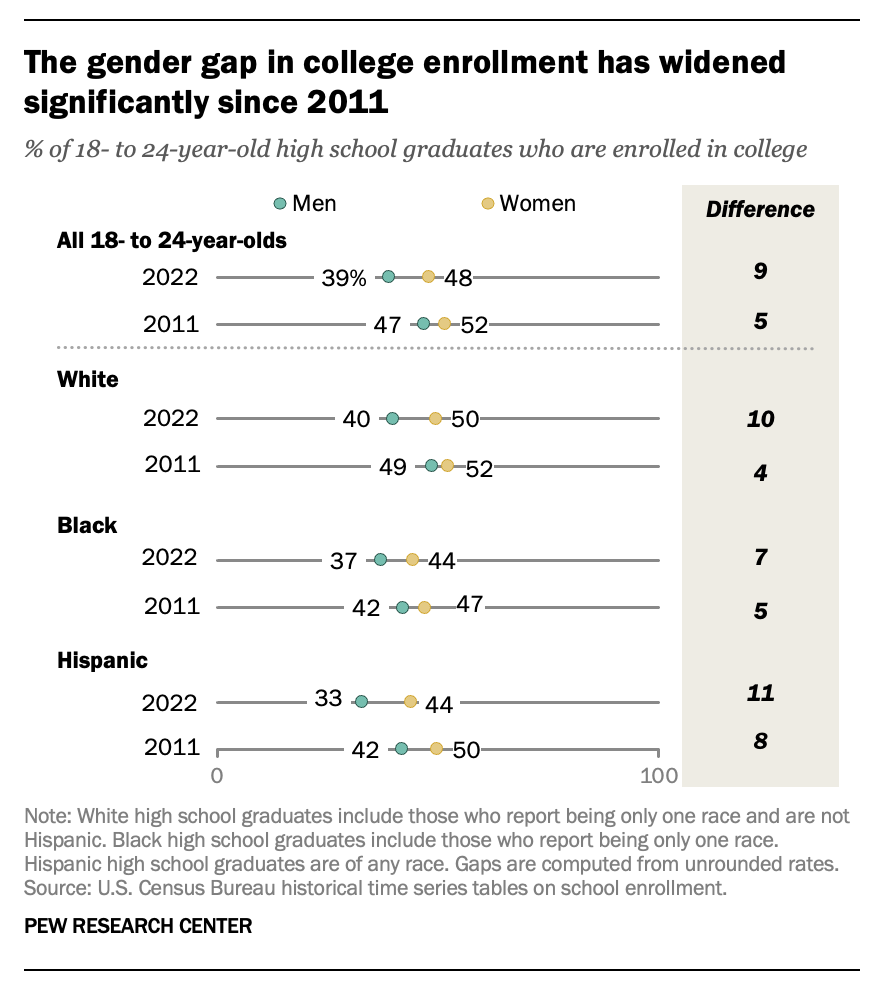
An interesting data point consistent with this explanation is the recent flattening in the college wage gap and college share. A puzzle for economists is that the college wage gap started growing more slowly around the turn of the century, despite continued adoption of computing and information technology. Soon after, the share of young people going to college started declining, especially among men.
My recent paper offers one explanation for these trends: lower returns to college for people on the margin between attending or not. I find that college graduates today are on average significantly less skilled than graduates 20 years ago. They make 16% less in wages than we would expect if they were as skilled as people in the past, adjusting for overall wage growth across the firms they work for. Declining skills coincide with the growing college share coming almost entirely from less-selective, non-selective, and for-profit institutions, which offer less benefit than more selective schools. Graduates today are also far more likely to come from difficult backgrounds that may hurt their preparation for higher education and the workforce.
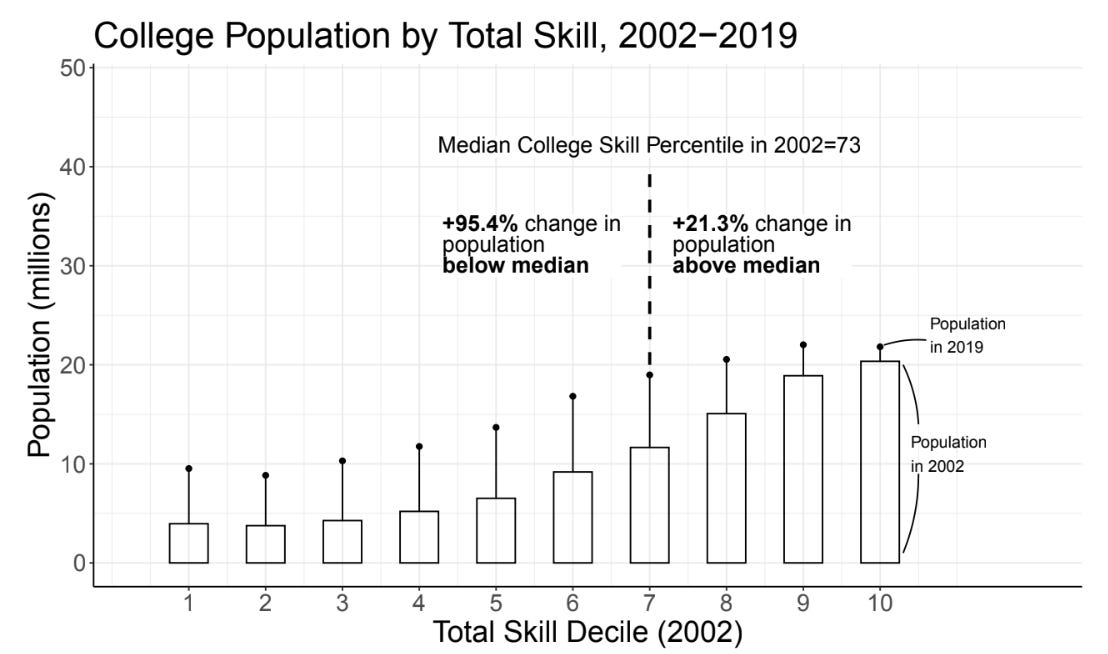
These trends imply that while on average college graduates earn 65% more money, for someone on the margin between going to a for-profit institution and working full-time right away the choice may not be so clear. Their incentive to go to college is lower, leading to a slowdown in the growth of college attendees.
The takeaway is that education choices, as with most other decisions, are shaped by incentives. This is consistent with a range of other studies using natural experiments or field experiments to study levers that shape education choices.5
What does this teach us about the consequences of AI on student learning? If being able to think critically and write continues to offer material or social rewards, then people will still have strong incentives to invest in developing those skills. On the other hand, if AI makes these skills less valuable, we should expect a decline in the share of people who bother putting in the effort to learn them.
Which of these paths is more likely? This is a complex question to answer with a lot of uncertainty, in part because of conflicting empirical evidence. Consider this recent article in the Economist summarizing how AI impacts the productivity of different workers.
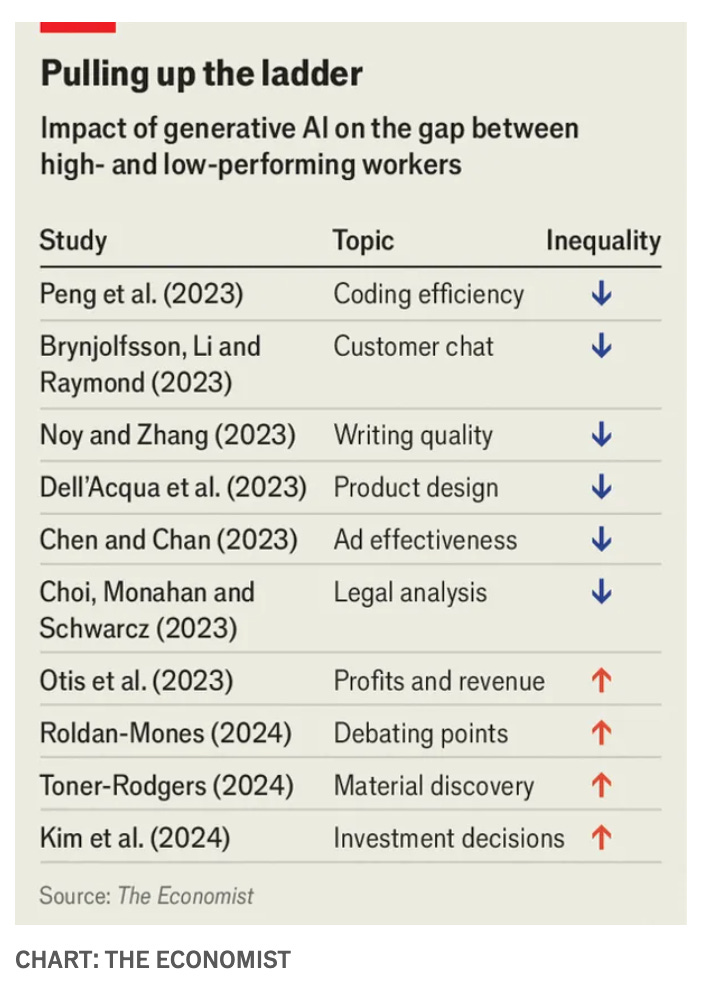
While early studies showed that AI reduced differences in productivity between the highest- and lowest- performers in settings like customer support, more recent work finds cases where the opposite holds. The highest performers were more effective at using the tools to increase their output in settings like entrepeneurial success and materials discovery.6
Whether AI turns out to complement skill or substitute for it will shape future generations’ incentives to become thinkers. If the returns to investing in critical thinking skills remain high, many people will continue to do it. Otherwise we could see a decline in proportion of students who bother putting in the effort unless driven by intrinsic motivation to learn.
If AI reduces the returns to critical thinking, we should expect students to invest in it less. If it increases the payoffs to critical thinkers, we should expect students to invest in it more.7 This presents a classic tradeoff between incentives and inequality: in precisely the cases where inequality falls we should expect lower investment in thinking skills.
If AI reduces incentives to invest in critical thinking, would this actually be a problem? It would likely coincide with some benefits to society, namely reduced inequality. What should we be concerned about?
One important worry concerns bad information or mistakes in decision-making. While students respond to incentives, they still make all sorts of mistakes in their education choices. Some of these are based on poor information, such as their competitiveness as candidates at strong colleges or the salaries across different majors. Others relate to shortsightedness or self-control issues. 8 year-olds, or for that matter their parents, don’t fully think through the long-term benefits of many education investments. If students have mistaken beliefs or shortsightedness about the value of writing an essay themselves versus having an AI do it for them, they may make choices they later regret.
The other concern is that even if the material returns to developing critical thinking skills truly are low, there could be benefits to society broadly if people still invest in learning. Thomas Jefferson was a proponent of this view, stating
Every government degenerates when trusted to the rulers of the people alone. The people themselves, therefore, are its only safe depositories. And to render even them safe, their minds must be improved to a certain degree.
Jefferson called for a constitutional amendment to provide public education. While this did not come to pass, by the early 20th century, every state had compulsory education laws. If citizens were going to have a say in their governance, then they needed to have the skills to make informed decisions to serve the public benefit.
As I wrote about previously, decisions depend not just on intelligence but also values, and values come through reflection and thought. Giving people better tools to do this kind of reflection is beneficial, both for personal enrichment and as a public good. No matter how intelligent an AI is, important social questions will still require input from human values.
It is still early to determine what, if anything, should be done to support critical thinking with the adoption of AI. This is in part because the space is moving so quickly, and in part because of a paucity of high quality experimental research studying the consequences of generative AI on education choices. Data to monitor include long-term trends in performance on standardized test scores, which for now remain in flux due to the aftermath of the pandemic. If the evidence becomes concerning, then we should develop systems to ensure that future generations have the tools they need to think critically.
On the other hand, a majority of students report that Gen AI tools could help brainstorm ideas for school projects, personalize learning, and give an a advantage in future jobs.
I recently attended a pitch by a Stanford start-up that aimed to create a homework evaluation tool that would prevent students from using AI to do their work.
These numbers come from CPS MORG data, following the methodology in Chandar (2025). I measure the college wage gap as the percent difference in average wages between adults in the workforce with and without a college degree.
A wide range of high-quality studies in economics show that education choices respond to incentives. For example, see the review articles from Dynarski et al. (2023) about effects of financial aid or articles cited in Burgess et al. (2021) about financial and non-financial incentives in education.
If the benefits to AI become really concentrated in the most able people, then we could see a reversal in incentives. The odds of becoming one of those few lucky people could be so low that people don’t bother trying for it. This is an important thing to consider if the empirical evidence points towards something like this happening.
No posts
Comments
Nothing yet. Say the first thing.
Sign in to join the conversation.