
Introduction
In this post, I will explain my own view of main concepts of a data lakehouse platform.
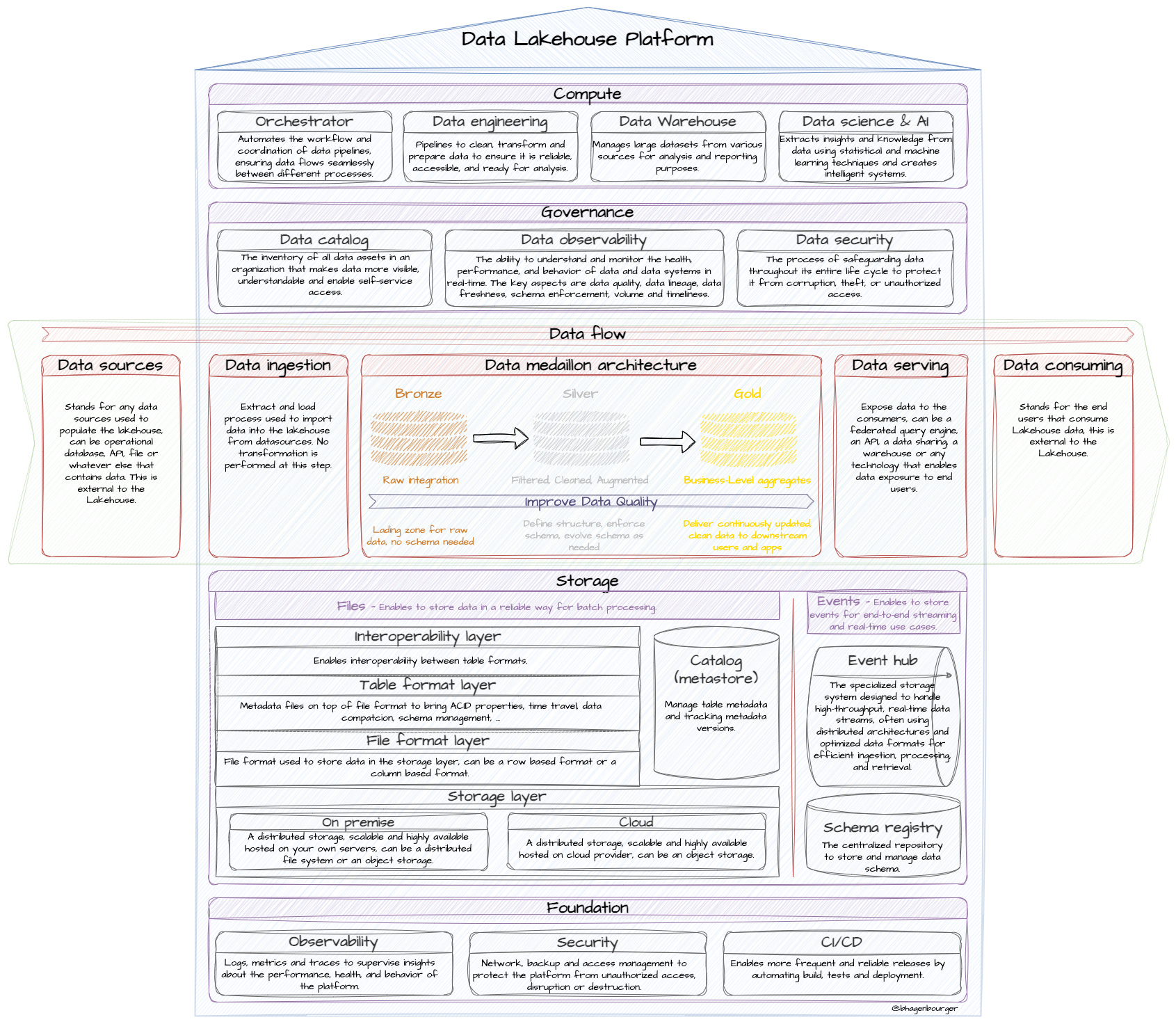
First let start with an overview schema with main components. Next, I will detail each component. Before to conclude, I will propose a full detailed schema of my view of the Data Lakehouse Platform.
Thanks for reading! Subscribe for free to receive new posts and support my work.
Overview schema
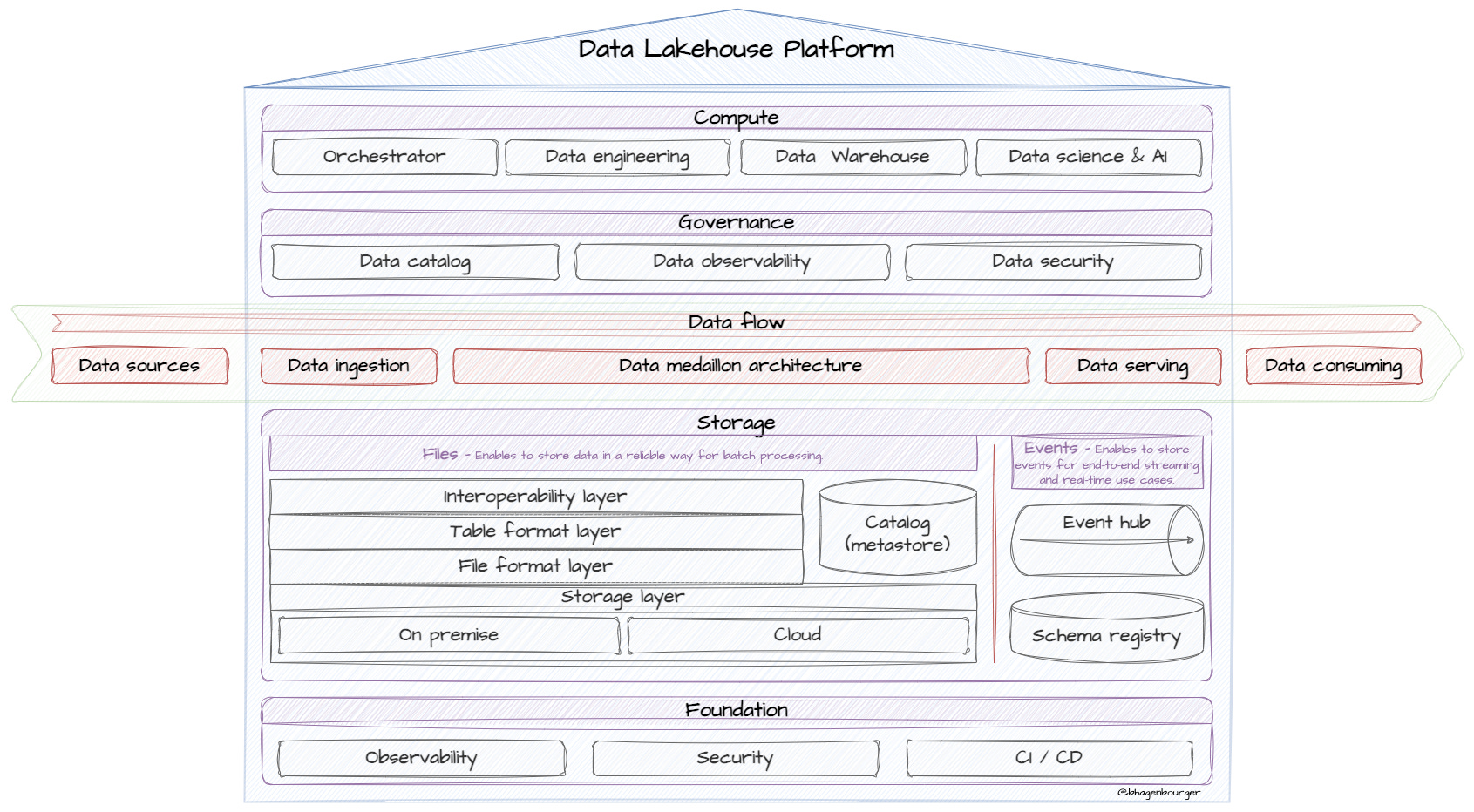
Explanation of each component
Foundation
Enables to secure, operate and monitor the platform.
Foundation - Observability
Logs, metrics and traces to supervise insights about the performance, health, and behavior of the platform.
Foundation - Security
Network, backup and access management to protect the platform from unauthorized access, disruption or destruction.
Foundation - CI/CD
Enables more frequent and reliable releases by automating build, tests and deployment.
Storage
Storage - Files
Enables to store data in a reliable way for batch processing.
Storage - Files - Storage layer - on premise
A distributed storage, scalable and highly available hosted on your own servers, can be a distributed file system or an object storage.
Storage - Files - Storage layer - cloud
A distributed storage, scalable and highly available hosted on cloud provider, can be an object storage.
Storage - Files - File format layer
File format used to store data in the storage layer, can be a row based format or a column based format.
Storage - Files - Table format layer
Metadata files on top of file format to bring ACID properties, time travel, data compaction, schema management, ...
Storage - Files - Interoperability layer
Enable interoperability between table formats.
Storage - Files - Catalog (metastore)
Manage table metadata and tracking metadata versions.
Storage - Events
Enables to store events for end-to-end streaming and real-time use cases.
Storage - Events - Event hub
The specialized storage system designed to handle high-throughput, real-time data streams, often using distributed architectures and optimized data formats for efficient ingestion, processing, and retrieval.
Storage - Events - Schema registry
The centralized repository to store and manage data schema.
Data flow
How the data go through the platform, from data sources to data consumers.
Data flow - Data sources
Stands for any data sources used to populate the Lakehouse, can be operational database, API, file or whatever else that contains data. This is external to the Lakehouse.
Data flow - Data ingestion
Extract and load process used to import data into the Lakehouse from datasources. No transformation is performed at this step.
Data flow - Medaillon architecture
Logical data organization from raw to data to business-level aggregated data.
Data flow - Medaillon architecture - Bronze
Raw flexible data without transformations or schema.
Data flow - Medaillon architecture - Silver
Validated, cleaned, enriched data with schema enforcement, prepped and aligned for analytical use.
Data flow - Medaillon architecture - Gold
Aggregated, anonymised data, optimized for read performance, trusted and suitable for end-users.
Data flow - Data serving
Expose data to the consumers, can be a federated query engine, an API, a data sharing, a warehouse or any technology that enables data exposure to end users.
Data flow - Data consuming
Stands for the end users that consume Lakehouse data, this is external to the Lakehouse.
Governance
Enables to manage, control and monitor data.
Governance - Data catalog
The centralized inventory of all data assets metadata that makes data more visible, understandable, auditable and leverage self-service access.
Governance - Data observability
The ability to understand and monitor the health, performance, and behavior of data and data systems in real-time. The key aspects are data quality, data lineage, data freshness, schema enforcement, volume and timeliness.
Governance - Data Observability - Data lineage
The process of tracking, tracing and visualizing of data's origin, transformation, and usage throughout its lifecycle from data sources to consumption.
Governance - Data Observability - Data quality
Measures how well a dataset meets criteria for accuracy, completeness, validity, consistency, reliability and fitness for intended purposes.
Governance - Data security
The process of safeguarding data throughout its lifecycle to protect it from corruption, theft, integrity or unauthorized access.
Compute
Enables to process data at scale.
Compute - Orchestrator
Automates the workflow and coordination of data pipelines, ensuring data flows seamlessly between different processes.
Compute - Data engineering
Pipelines to clean, transform and prepare data to ensure it is reliable, accessible, and ready for analysis.
Compute - Data Warehouse
Manages large datasets from various sources for analysis and reporting purposes.
Compute - Data science & AI
Extracts insights and knowledge from data using statistical and machine learning techniques and creates intelligent systems.
Full detailed schema
Conclusion
A Data Lakehouse Platform is a complex platform that involves many concepts and components. Master it can take a while but it’s useful to have an overview in mind.
I hope you enjoy this post about my view of the Data Lakehouse Platform. Don’t hesitate to ask questions or share your own view.
Thanks for reading! This post is public so feel free to share it.
Thanks for reading! Subscribe for free to receive new posts and support my work.
Comments
Nothing yet. Say the first thing.
Sign in to join the conversation.