
A single thought can change the shape of a whole day.
A thought becomes a feeling.
A feeling becomes a desire.
A desire becomes an attachment.
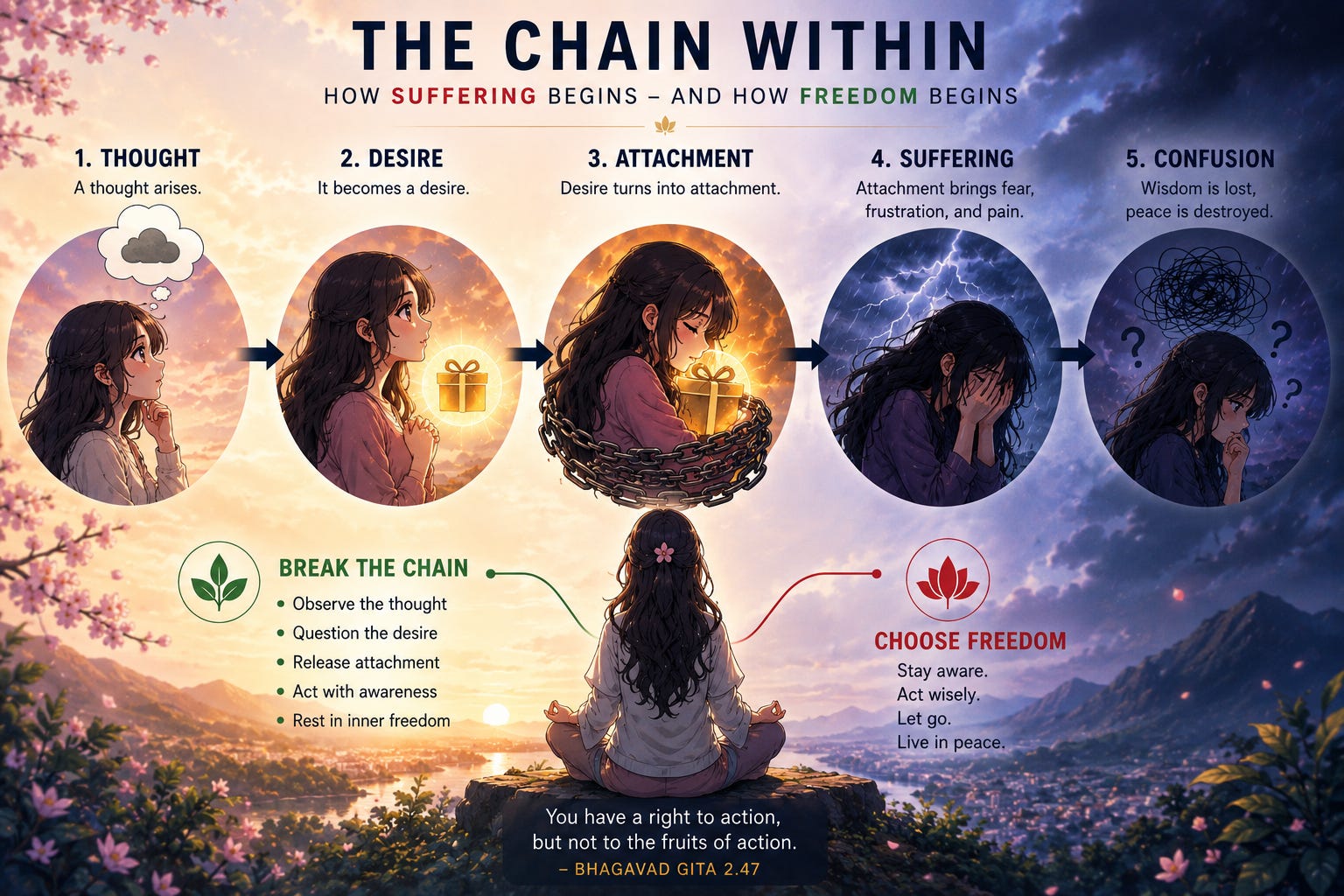
And attachment, if left unchecked, becomes suffering.
This is one of the most practical psychological insights in the Bhagavad Gita. It is also one of the most ignored.
We usually blame our pain on events. But the Gita looks deeper. It says the real chain begins inside the mind, long before the suffering becomes visible.
That is why this teaching matters so much. It explains not only why we suffer, but how suffering is manufactured, step by step, in ordinary life.

Suffering rarely arrives with a dramatic announcement. It begins quietly.
A passing thought appears:
I want this.
I need this.
I should have that.
Why don’t I have what they have?
At first, it seems harmless. Just a thought. But the mind has a habit of feeding what it repeatedly touches.
The Gita describes this process in a famous verse:
“When a person dwells on the objects of the senses, attachment to them arises.”
— Bhagavad Gita 2.62
This is the first turning point. Thought, when entertained again and again, starts to harden into attachment.
What begins as awareness becomes fascination.
What begins as fascination becomes dependence.
The mind is not passive. It is a meaning-making machine.
A thought is never just a thought for long. It begins to color the imagination. It creates stories. It builds expectation. It trains the body to lean toward what it wants.
That is why the Gita does not treat the mind lightly. It understands that thought has consequences.
A small thought such as “I will be happy when this happens” can become a deep inner program. Once the mind accepts that program, it keeps returning to it.
And every return strengthens the chain.
Thought becomes desire when the mind starts leaning toward an object, outcome, or person.
Desire says:
I want this to happen.
I need this to be mine.
I will not feel complete until this is fulfilled.
Desire is powerful because it narrows attention. It makes one thing seem larger than everything else. The rest of life fades into the background.
The Gita warns that this is not a neutral process. In Chapter 2, verse 62, it continues the sequence:
“From attachment arises desire…”
— Bhagavad Gita 2.62
Desire is not wrong in itself. Human life requires direction, effort, and aspiration. But when desire begins to dominate the inner world, it stops being a guide and becomes a master.
Then the mind no longer asks, “What is right?”
It asks, “How do I get what I want?”
That is a dangerous shift.
Attachment is what happens when desire stops being flexible.
At this stage, the mind is no longer simply interested. It has invested its peace in a result. The object is no longer just desired; it is emotionally necessary.
This is where inner freedom starts to shrink.
Attachment says:
This must happen.
This must stay.
This must not be lost.
Now the mind has handed over its stability to something outside itself. And anything outside itself can change.
That is why attachment is so fragile. It ties inner peace to outer conditions.
The Gita’s psychology is sharp here: attachment does not only bind us to pleasure. It also binds us to fear. Once we cling, we begin to worry about loss.
One of the strange things about attachment is that it creates suffering in advance.
Before we lose something, we are already afraid of losing it.
Before we are rejected, we are already anxious.
Before the outcome turns bad, the mind has already rehearsed the pain.
So the suffering is not only in the event. It is in the anticipation.
That is why attachment can feel exhausting. The mind keeps guarding what it cannot control.
The Gita points to this chain because it wants us to see the hidden cost of clinging.
The fourth step is suffering.
When desire is attached to an outcome and that outcome is denied, the mind reacts with frustration, anger, disappointment, grief, or fear.
This is not random. It is the natural consequence of inner dependence.
The Gita describes the downward movement clearly:
“From desire, anger arises.”
— Bhagavad Gita 2.62
And later:
“From anger arises delusion; from delusion, loss of memory; from loss of memory, the destruction of wisdom; from the destruction of wisdom, one perishes.”
— Bhagavad Gita 2.63
This is one of the darkest but most useful teachings in the text.
The Gita is showing that suffering is not a single event. It is a chain reaction. If the chain is not interrupted, one inner disturbance leads to another.
First the thought.
Then the desire.
Then the attachment.
Then the pain.
Then the anger.
Then the confusion.
And once confusion enters, the mind becomes harder to guide.
The good news is that this chain can be broken.
The Gita is not fatalistic. It does not say suffering is inevitable. It says suffering is understood, and therefore transformable.
The chain begins with thought, which means awareness can begin there too.
If you can notice a thought before it becomes obsession, you have already created space.
If you can notice desire before it becomes attachment, you have already weakened the chain.
If you can notice attachment before it becomes panic, you have already recovered freedom.
This is where spiritual practice becomes practical psychology.
The Gita does not offer a complicated formula. It offers steady inner discipline.
First, observe the thought without immediately obeying it.
Second, ask whether the desire is useful or merely compulsive.
Third, notice whether peace has become tied to a specific outcome.
Fourth, return attention to action, duty, and presence.
This is the essence of karma yoga: act fully, but do not let your peace depend entirely on results.
The Gita says:
“You have a right to action, but not to the fruits of action.”
— Bhagavad Gita 2.47
This does not mean indifference. It means clarity.
Work sincerely. Love deeply. Choose wisely. But do not hand over your inner stability to outcomes that are always partly outside your control.
A large part of attachment comes from the mind’s hunger for certainty.
We want guarantees.
We want control.
We want to know things will go our way.
But life does not work like that.
The more we demand certainty from life, the more anxious we become. The more anxious we become, the more we cling. The more we cling, the more we suffer.
The Gita teaches a different path: steadiness without control, action without obsession, love without possession.
That is not easy. But it is free.
Try this today.
When a strong thought arises, do not immediately follow it. Pause for a moment and ask:
What am I actually wanting right now?
Is this desire helping me, or tightening me?
Have I tied my peace to this outcome?
What would remain if I simply did my part and released the rest?
These questions create distance. And distance creates freedom.
The chain of thought → desire → attachment → suffering is one of the clearest psychological maps in the Bhagavad Gita.
It tells us something sobering: much of our pain is not created by life alone, but by the way the mind holds life.
And it tells us something hopeful too: if the chain is made by the mind, it can also be undone by the mind.
That is where practice begins. That is where peace begins.
If this article resonated with you, subscribe and continue the journey into the timeless wisdom of the Bhagavad Gita
Comments
Nothing yet. Say the first thing.
Sign in to join the conversation.