
Welcome back to Changemakers, the newsletter for founders, storytellers and leaders shaping the future of climate, nature and impact-led innovation.
In this edition: a free coupon to build the story that fixes the silence, plus a way to get the next part of the course on me. And because the offer is only as good as the thing behind it, we go deep on the origin story itself: why it is the first story every founder needs, why most people build it backwards, and why the right one makes investors lean in instead of drift away. So let’s get to it!
Today’s Topics:
→ Free This Week: Build Your Origin Story Video Course (Coupon Inside)
→ Leave a Review, Get the Next Part Complimentary
→ Why Nobody Believes Your Pitch Yet
→ The Story Everyone Starts With
→ The Shape of a Strong Origin Story
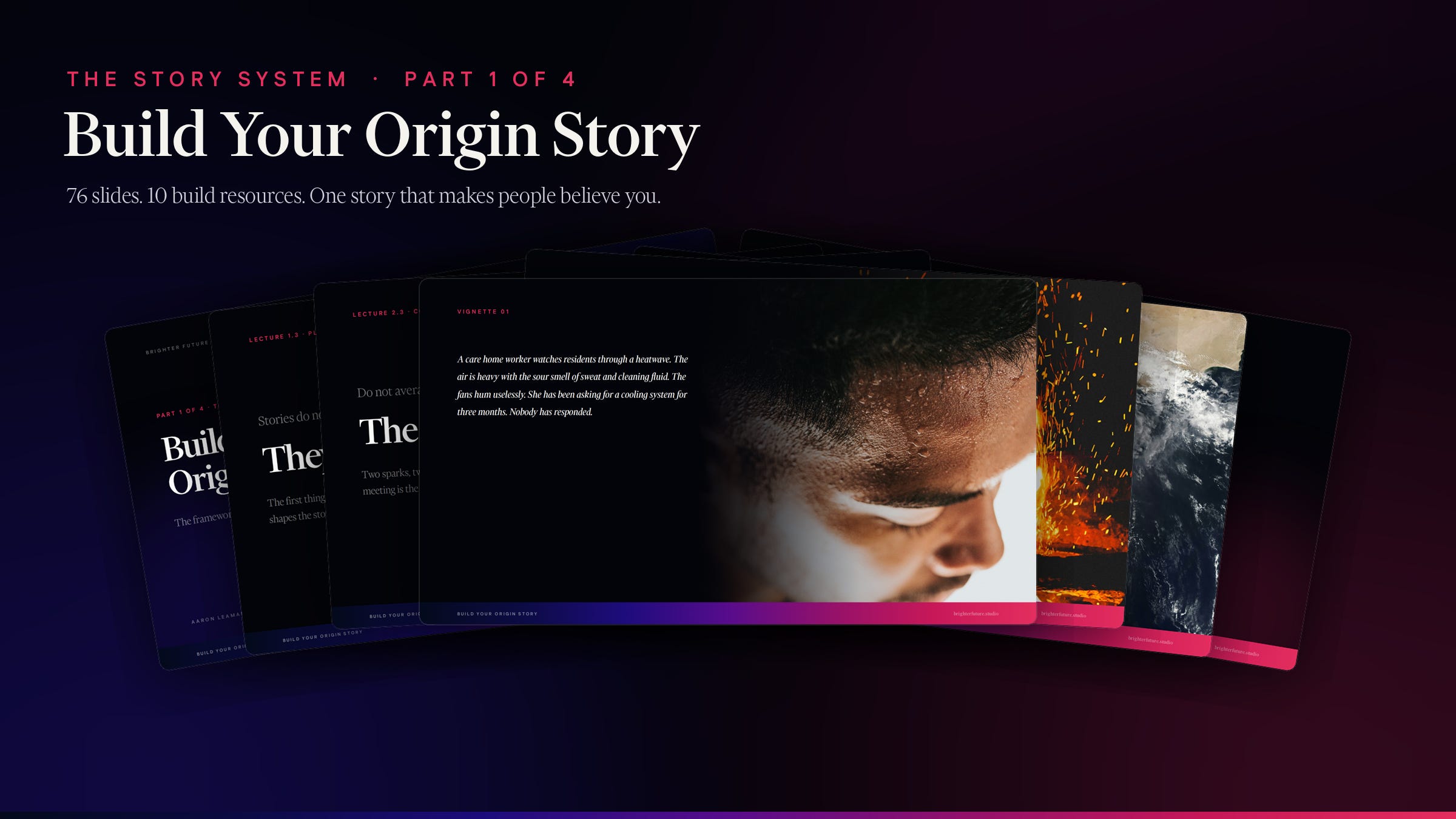
Before we get into why it matters, here is the thing itself, because you should not have to read to the bottom to claim it.
Part 1: Build Your Origin Story is live on Udemy, and this week it is free for Changemakers readers. Around two hours, and you walk out with a finished origin story ready to deploy.
Two more things worth knowing before the deep dive:
The series is rolling out part by part. Parts 1 to 3 are out now (Origin, then Purpose and Vision, then Customer and Product), with Part 4 on Impact coming next.
Build your story and leave an honest review, then reply to this email with a screenshot, and I will send you the next part free.
Now, the reason any of this is worth your two hours.
You can explain what you do. You can list the credentials, walk through the product, run the deck end to end. And still the room stays polite. Investors nod and go quiet. Clients say “interesting” and never reply. Your own team agrees with you without quite feeling it.
The problem is not what you are saying. It is the foundation underneath it.
People do not buy into work they admire. They buy into people they believe. And belief does not start with your product or your traction. It starts with you, with why you of all people are the one standing here doing this. That is the origin story. And it is the one most founders skip, because it feels softer and less serious than the numbers. It is the opposite. It is the thing that makes the numbers land.
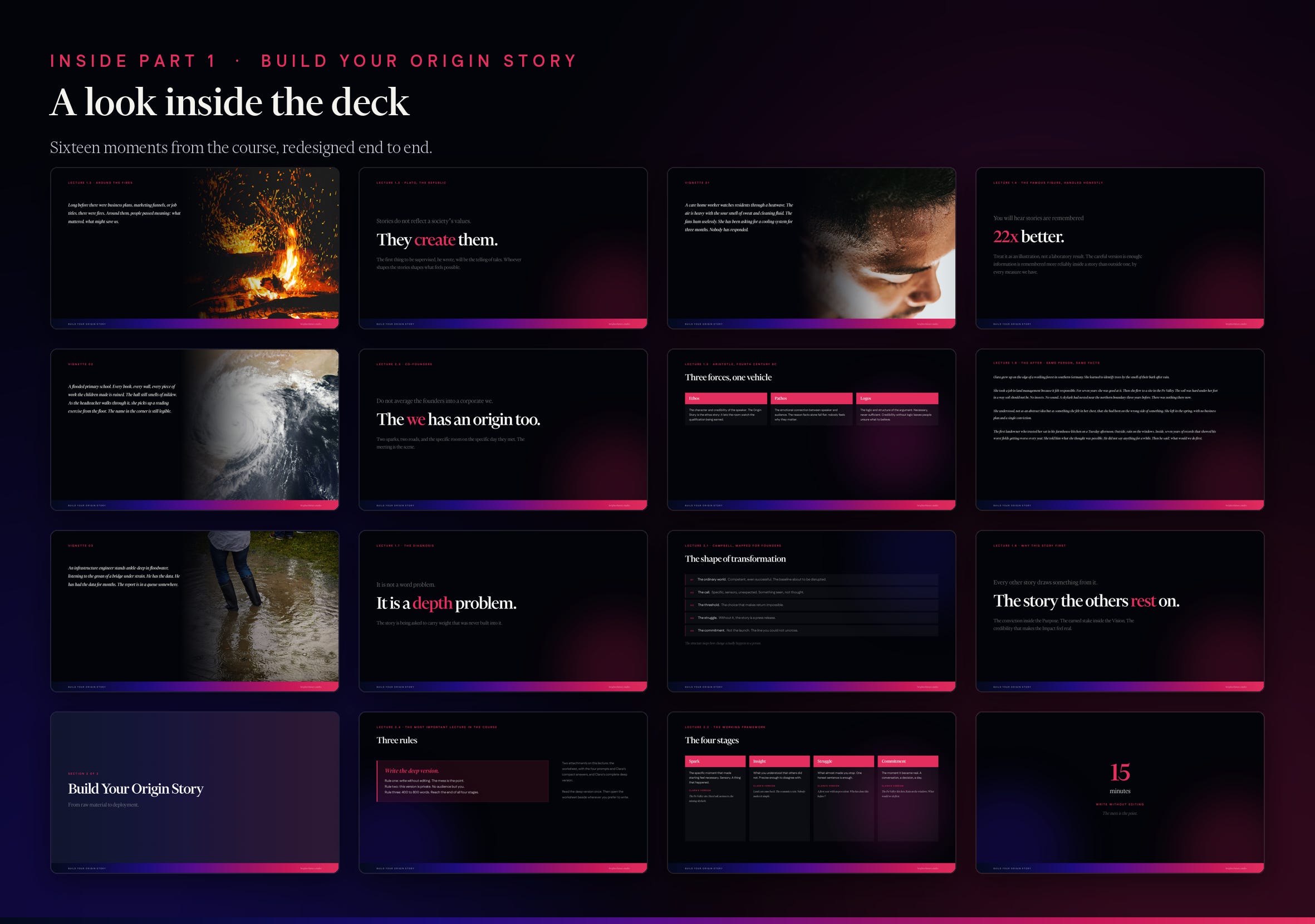
There are six stories every business needs: Origin, Purpose, Vision, Customer, Product and Impact. They do different jobs and they get told in different rooms. But they all sit on top of one.
Everyone starts with the same story. The origin story. Because before anyone believes in your work, they have to believe in you. Get that one right and every other story has somewhere to stand. Skip it, and the rest float.
And it works in two directions at once. Outward, it is what makes investors, clients and partners believe in you before there is any proof to go on. Inward, it is what your team builds around. It is the reason a strong hire chooses you over a better-funded competitor, the thing people repeat to each other on a hard week, the emotional foundation a culture grows from. A company with no clear origin story is harder to join and harder to stay loyal to, because there is nothing underneath the work to belong to.
If you read that and thought your origin story is weak, here is the reframe we use in the course: a low score is not a weak story, it is an unbuilt one. And every unbuilt story has already happened to you. The raw material is sitting in your own history right now. You have just never been shown how to cut it into shape.
Take Patagonia. The origin is real and specific: in 1957 a young climber called Yvon Chouinard taught himself blacksmithing, bought a second-hand forge, and started making climbing pitons in his parents’ backyard in Burbank, selling them by hand for a dollar fifty each. Spark and struggle in plain sight. The moment people remember came later, in 1972, when those pitons were the company’s best-selling product and Chouinard chose to walk away from them, because the gear was scarring the rock he loved, replacing them with chocks that left no mark. It helped launch what climbers still call clean climbing, and the bet paid off commercially too.
Notice the handoff. The origin sets up who he is and why you trust him. The decision to give up his best-selling product is where origin hardens into purpose. Origin earns the belief. Purpose and vision decide what you do with it, and they carry every bit as much weight. The six stories are not a ranking, they are a system, each doing a job the others cannot, which is exactly why Part 2 builds your purpose and vision stories next.
A strong origin story is not a timeline of your career. It is four moments, in order: the Spark, the Insight, the Struggle and the Commitment.
The Spark is where it truly began, not the idea but the experience, a moment with a place and a sensory detail that puts the listener inside it with you. Our worked example, founder Clara Voss, opens hers on degraded land in the Po Valley: soil hard underfoot, no insects, no birdsong, the skylark that should be there and is not. Four sentences, and you are standing in the field with her.
The other three are where most founders go wrong. The Insight is the angle only you can see, and it has to be sharp enough that someone could disagree with it. The Struggle is the part everyone wants to hide and shouldn’t, because a story without resistance is a press release and a story with real struggle is a human being. The Commitment is the moment it became real in your gut, not the incorporation date and not the first customer.
Each stage has a build, and a way it commonly fails. That is what Part 1 takes you through, one stage at a time, on your own story rather than on Clara’s. There is also a track for early-stage founders with no history to narrate yet, where Struggle becomes the risk you are taking and Commitment becomes the belief you are betting on. I built Brighter Future Studio that way myself, on a conviction long before there was a track record to point at.
Here is the one idea that changes everything, and the reason most origin stories come out thin.
Almost everyone writes the polished public version first. The bio, the thirty-second intro. And it falls flat, because they are trying to cut a sculpture before they have the block of stone.
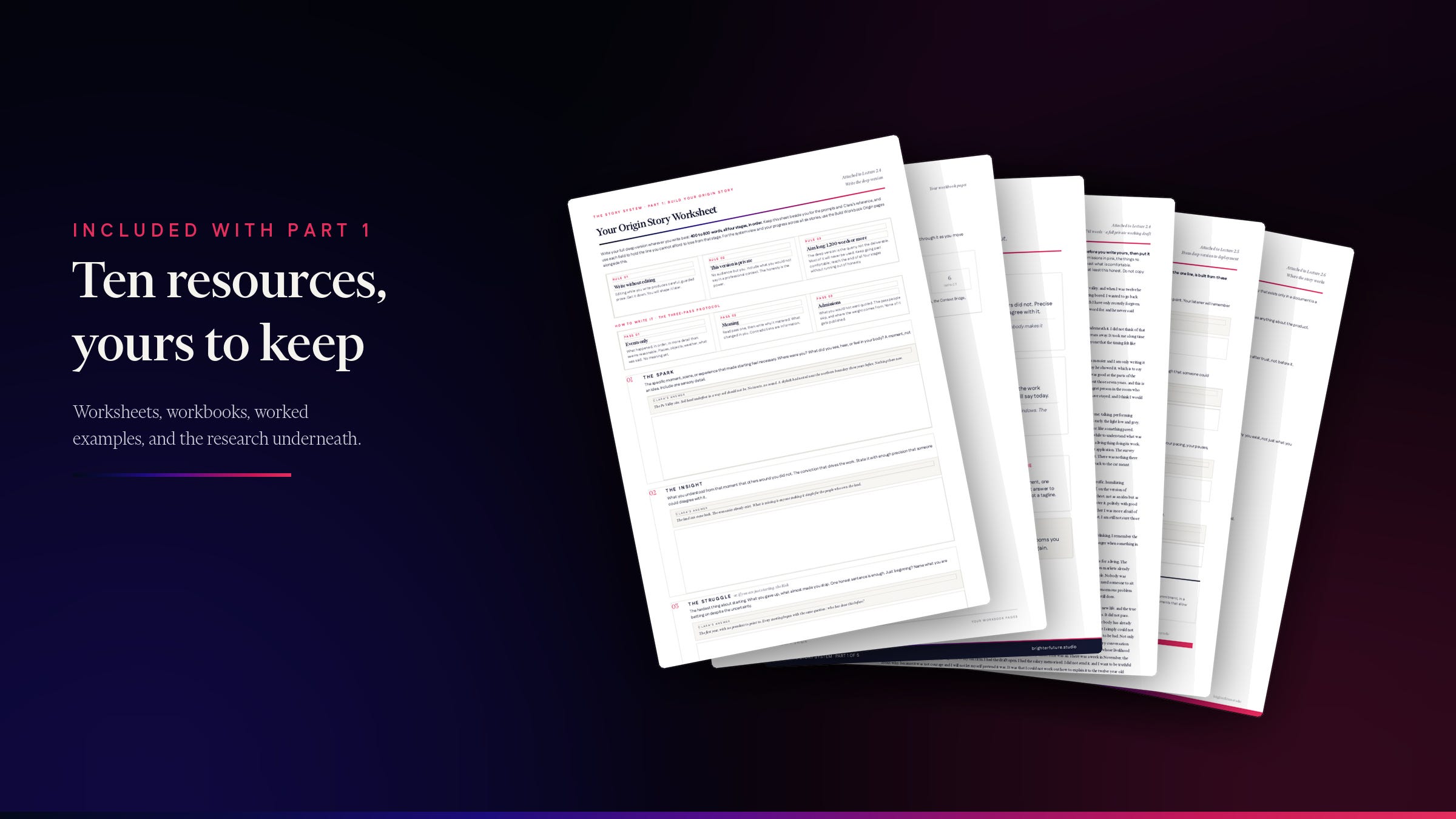
You build it backwards. You write a long, private, unpublished version first, the one nobody will ever read, and you cut every public version out of that. Stories built from the inside out survive any question, because everything you say in the room is backed by ten things you wrote alone. Stories built from the outside in fall apart the moment someone asks you something real.
The full method, how the private version works and the deployable forms you pull from it, is the spine of Part 1.
You do not need a course to begin an origin story. But if you want the full framework, the worked examples, the worksheets and the deep-version process walked through step by step, that is what Part 1 is built to do, and this week it is free.
Build your story, leave an 5* review, and reply with a screenshot. I will send you the next part free. Build the story, tell me what landed and what did not, and keep going on me.
Your work is almost certainly better than your story currently makes it sound. That gap is quiet, and it is expensive. The origin story is where you close it. Build the deep version once and you will never again walk into a room unsure of how to begin.
Know Someone Who Needs Brand or Communications Support?
Refer a founder to Brighter Future Studio and earn a 10% commission on their first project. Let’s help more purpose-led teams win with story. If this resonated, or if you’re preparing for a high-stakes moment of your own, we’d love to help.
Thanks for reading.
If you’ve made it this far, feel free to share this with a founder, partner, or investor who needs to be believed, not just understood. Or reach out directly to talk.
Best,
Founder, Brighter Future
Comments
Nothing yet. Say the first thing.
Sign in to join the conversation.